Adventures in Science Fiction Cover Art: The Vaguely Defined Looming Man Shape

stewart01

(John Richards’ cover for the 1961 edition of Earth Abides (1949), George R. Stewart)

Note: if anyone can identify the artist for the first three downright spectacular covers I’d be very very happy.  I’m positive that they match stylistically (the vague human shape, the cityscape, the brush strokes, the textures).  Two of the three covers were made for Signet press and all three are from the early 1960s.  I suspect if I perused the covers from the Signet catalogue from that era I’d find even more….  Perhaps it’s the work of Sanford Kossin?  He was producing covers for Signet around the same time.  Solved: The cover artist is John Richard.

And now The Vaguely Defined Looming Man Shape Continue reading

Updates: Recent Science Fiction Acquisitions No. LXXIV (Malzberg + Geston + Anthony + Barjavel)

Part 5 of 5 acquisitions posts covering my haul from Dawn Treader Books in Ann Arbor, Michigan.  I’ve saved some good ones for the end — namely, Mark S. Geston’s Out of the Mouth of the Dragon (1969).  I’ve previously reviewed his first novel — Lords of the Starship (1967) — which was a relentlessly dark vision that showed great promise.  Besides the work of Stanislaw Lem, I know very little about non-English language SF so I snatched up a copy of Rene Barjavel’s Future Times Three (1944).  According to some critics, his treatment of time travel proved profoundly influential.

The other two novels are somewhat bigger risks.  Brian N. Malzberg’s The Empty People (1969), written under his pseudonym K. M. O’Donnell, is one of his first SF novels and supposedly quite average.  And, Piers Anthony’s Macroscope (1969) strikes me as a rather bloated, pseudo-spiritual, New Wave extravaganza (but not in a good way) — we’ll just have to see.

Thoughts?

1. Out of the Mouth of the Dragon, Mark S. Geston (1969)

(John Schoenherr’s cover for the 1969 edition) Continue reading

Book Review: The View from the Stars, Walter M. Miller, Jr. (1965)

(Richard Powers’ cover for the 1965 edition)

3.75/5 (Collated rating: Good)

Almost all SF fans have read Walter M. Miller, Jr.’s masterpiece A Canticle for Leibowitz (1959) but few indulge in his shorter works.  By 1957 Miller had virtually quit publishing new SF (A Canticle is comprised of novellas published between 1955-1957).  His only work published later was Saint Leibowitz and the Wild Horse Woman (1997) completed by Terry Bisson and released posthumously.

The View From the Stars (1965) — containing five short stories, two novelettes, and one novella — is a cross section of his most productive decade.  Although I found that none of the works included should be considered masterpieces, “I, Dreamer” (1953), “Dumb Waiter” (1952),  “Big Joe and the Nth Generation” (1952), and “The Big Hunger” (1952) were wonderful.  All the others are readable Continue reading

Updates: Recent Science Fiction Acquisitions No. LXXI (Malzberg, Bishop, Mano, Runyon)

Part 2 of 5 acquisition posts covering my massive haul from Dawn Treader Books in Ann Arbor Michigan….  I suspect that if I lived nearby I’d slowly migrate their entire SF collection to my shelves.  Two books below are by unknown authors (or at least to me) — Charles Runyon and D. Keith Mano.  Runyon is supposedly average to bad (one of my risk buys) while Mano polarizes readers — he tends to be rather right wing in his views so it’ll be intriguing to see what he does with the dystopic future in The Bridge (1973).  But, as with Runyon my expectations are low.

On the other hand, Malzberg’s The Men Inside (1971) seems to be one of his stranger works — I look forward to it.  And despite how well-known Michael Bishop is I’ve yet to read any of his works so I’ll be reading Beneath the Shattered Moons (1976) soon.

Thoughts?

1. The Men Inside, Barry N. Malzberg (1971)

(Ron Walotsky’s cover for the 1971 edition) Continue reading

Updates: Recent Science Fiction Acquisitions No. LXX (Lafferty, Sheckley, Lightner, Ball)

There is no better book store for used SF in the US (that I have been to) than Dawn Treader Books in Ann Arbor, Michigan….  Thankfully, I made the pilgrimage for an altogether different purpose — I delivered a paper at a conference at the University of Michigan — but couldn’t help but spend a while amongst the heavenly stacks (well for a SF fanatic).  This is part 1 of 5 acquisition posts which will showcase the bounty I procured.  And there were probably close to 80 other books I wanted.  Alas.

So, what have we here?  One of Lafferty’s most famous novels — nebula nominated Fourth Mansions (1969).  I’ve only read his shorter work so I’ll be devouring this one soon. More Sheckley for one can never have enough of his biting, wonderful, and hilariously satirical short stories.  A straight-forward space opera by Brian N. Ball (yes, I know, not normally my cup of tea) on recommendation from Mike at Potpourri of Science Fiction Literature… And a somewhat more risky purchase, A. M. Lightner’s The Day of the Drones (1969) — this work of social SF is supposedly her most mature work (she tended to write for the young adult audience) but it was still edited for publication to be suitable for younger readers.  Despite the socially relevant theme, I suspect it will come off as rather corny/undeveloped.

1. Fourth Mansions, R. A. Lafferty (1969)

(Diane and Leo Dillon’s cover for the 1969 edition) Continue reading

Book Review: The Deep, John Crowley (1975)

(Richard Powers’ cover for the 1976 edition)

4.5/5 (Very Good)

The Deep (1975) was John Crowley’s first published novel and his first of three SF works from the 70s (The Deep, Beasts, Engine Summer).  He is best known for Engine Summer (1979) and his complex/literary fantasy — Little, Big (1981) and the Ægypt sequence (1987-2007).  In the two novels of his I’ve read (the other is Beasts), Crowley’s prose is characterized by an almost icy detachment, an adept construction of unusual images, and dialogue that says only what is needed.

The Deep deploys, in minimalistic fashion, the standard tropes of the fantasy genre mixed with distinctly SF elements: namely, an android visitor whose blood “was alive — it flowed  Continue reading

Updates: Recent Science Fiction Acquisitions No. LXVIII (Varley + Cherryh + Cummings + et. al)

Some fun finds!  Perhaps surprisingly, I still haven’t read Clarke’s “The Sentinel” (1951) so I was happy to find it in a collection collated by Kingsley Amis and Robert Conquest — Spectrum 3 (1963).  Even more appealing are the famous Poul Anderson, J. G. Ballard, and Murray Leinster tales in the same volume…  The entire Spectrum collection (I-V) brings together some fantastic works.

John Varley is one of the important 70s writers that I still haven’t read. Thus, despite the egregious cover, I snatched his collection of 70s stories, The Persistence of Vision (1978)…  I look forward to diving into this one.

Also, C. J. Cherryh was one of my favorite authors as a teen so it’s always nice to come across one of her works I hadn’t devoured yet — in this case, her second novel Brothers of Earth (1976).

1. The Persistence of Vision, John Varley (1978)

(Jim Burns’ cover for Continue reading

Book Review: Approaching Oblivion, Harlan Ellison (1974)

(Leo and Diane Dillon’s cover for the 1974 edition)

4.25/5 (collated rating: Good)

Ellison’s stories punch where it hurts.  Approaching Oblivion (1974) is filled with transfixing tales about violent future racism (“Knox”), humanity’s last moments (“Kiss of Fire”), the desperate desire to change one’s own past (“One Life, Furnished in Early Poverty”), a last rebel against the militarizing system (“Silent in Gehanna”), and familial rivalry within a vast arcology (“Catman”), etc…

They are terrifying and vicious, immersive and gut-wrenching, and span from baroque far future speculations to near future warnings.  Above all, they are well-written and intelligent.  Many are infused with (pseudo) autobiographical content and lament the societal ills Continue reading

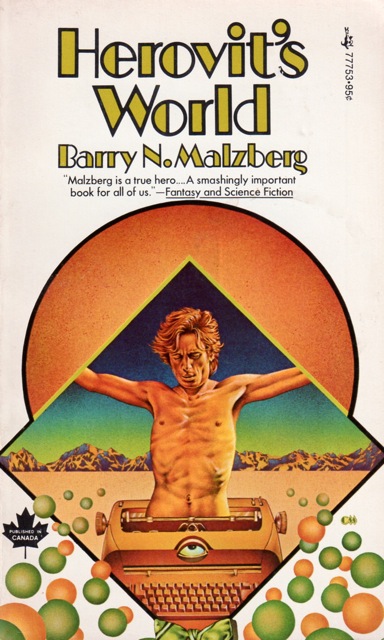
Book Review: Herovit’s World, Barry N. Malzberg (1973)

(Charles Moll’s cover for the 1974 edition)

3.5/5 (Good)

Note: Today is Barry N. Malzberg’s birthday!

Upon reading In the Enclosure (1973) I was immediately seduced by Barry N. Malzberg’s metafictional brand of science fiction — best illustrated by his masterpieces Beyond Apollo (1972) and Revelations (1972).  Although Herovit’s World (1973) contains many of the same metafictional trademarks of Malzberg’s best work, it should be noted that the novel is not science fiction and more a work about writing (pulp) science fiction.  In this case, the mental collapse of a pulp writer whose life may or may not contain “true” autobiographical kernels from Malzberg’s own experience Continue reading