Adventures in Science Fiction Cover Art: Domed Cities (and Outposts) of the Future, Part IV

Screen shot 2013-01-25 at 9.47.21 PM

(Ley Kenyon’s cover for the 1953 edition of Adventures in Tomorrow (1951), ed. Kendell F. Crossen)

Since the release of the TV series Under the Dome (2013-), based on Stephen King’s 2009 novel by the same name, there has been a resurgence of interest in domed cities.  And for good reason — the trope is one of the most popular of science fiction artists and authors since the 30s (and probably earlier).  Not only do the societal implications and visual allure of the trope of a domed outpost on a harsh planet or a domed city amidst the ruins of Earth arouse the creative authorial juices but also generate some fantastically Continue reading

Adventures in Science Fiction Cover Art: The Hand of God?

194-1

(William Timmins’ cover for the January 1947 issue of Astounding Science Fiction)

A hand from a body off canvas enters the fray….  An alien’s hands wrap around the Earth, amused or disturbed by its creations?  A hand rises from a variety of desolate landscapes…  Is it the remnant of a robotic construct or a relics from some age old creator?

This particular theme — a powerful force depicted via an often disembodied hand — has yielded some fantastic covers.  Brian Lewis’ cover for the 1958 issue of Science Fantasy is one of my favorites.  I find the scene — a group of people discovering a robotic hand reaching from the f Continue reading

Updates: Recent Science Fiction Acquisitions No. LXVI (Anderson + Simak + Ballard)

Gifts!  From my fiancé!

Four more wonderful books…  I can’t wait to read J. G. Ballard’s The Burning World (1964) and Poul Anderson’s short story collection Time and Stars (1964)…  Ballard is a genius and Anderson is a solid writer who always produced fun plot-driven works (I suspect his Hugo nominated There Will Be Time (1973) will be similar).  Also, despite my general frustration with Clifford D. Simak’s ouvre, I’m intrigued by Why Call Them Back From Heaven? (1967)….

Enjoy the two Powers covers!

1. The Burning World, J. G. Ballard (1964)

THBRNNGWR1964

(Richard Powers’ cover for the 1964 first edition) Continue reading

Updates: Recent Acquisitions No. LXV (Spinrad + Coney + Cummings + an anthology containing short stories by Pohl, Knight, Aldiss, et al.)

My first book from the 80s in many a year!  But, I’m on a Norman Spinrad kick so when I saw it for one dollar at the store I had to snatch it up his post-apocalyptical vision Songs from the Stars (180)….  The premise is rather hokey but perhaps a quality writer like Spinrad can imbue it with some vigor.

I’m most excited about The Ninth Galaxy Reader, ed. Frederik Pohl (1966) (twelve short stories from the Galaxy Magazine) due the top-quality author line-up — Brian W. Aldiss, John Brunner, Richard Wilson, Damon Knight, Philip Kose farmer, Harry Harrison, Frederik Pohl, Lester Del Rey, Roger Zelazny, C. C. MacApp, Larry Niven, and R. A. Lafferty….

1.  Songs from the Stars, Norman Spinrad (1980)

SNGSFRMTHS1982

(Uncredited cover for the 1982 Continue reading

Updates: My 7 Favorite Metafictional Science Fiction Novels

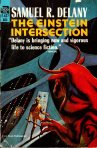
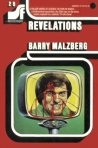
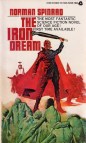
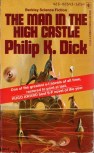
Here are my seven favorite metafictional science fiction novels. By metafiction I’m referring to devices such as breaking the fourth wall (characters addressing the audience), the author addressing the reader, a story about a writer writing a story, a story containing another work of fiction within it, a work where the narrator reveals himself or herself as the author of the story, narrative footnotes, etc….

I’d love to hear your favorites (they don’t have to be novels)!

Obviously, these types of experimental works only appeal to some readers (especially fans of the sci-fi New Wave movement of the late 60s and early 70s) but I personally love seeing experimentation in an often — dare I say — stylistically stale genre.  Often, the metafictional aspects do not prevent authors from deploying traditional narratives.

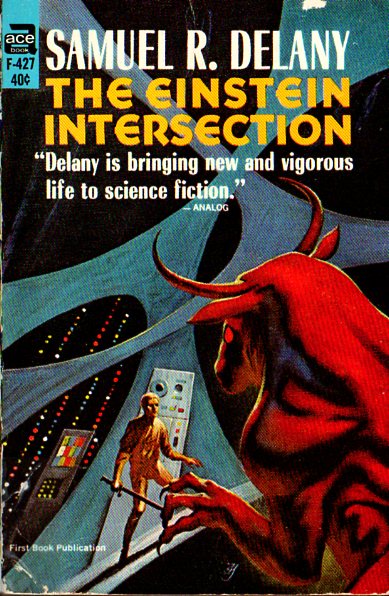
 71nOA-QfpuL NSTNINT1967 RVLTNSXKSK1977

 THIRNDRM1972 MNINTHCST1974

My top seven (and an honorable mention):

1. Beyond Apollo, Brian N. Malzberg (1972) (REVIEW) — what you read is most likely the novel written by the main character. However, he’s most likely insane so attempting to get AT the true nature of his voyage to Venus is purposefully layered… Complicating the matter is how unreliable of a narrator he is and the fact that he’s tells many versions of the same story. Malzberg pokes fun at pulp science fiction throughout — which he clearly enjoyed as a child.

2. Stand on Zanzibar, John Brunner (1968) — the metafictional aspects are rather hidden in this New Wave masterpiece (my single favorite sci-fi novel).  Brunner’s vast (in scope and depth) mosaic of invented book fragments, advertising jingles, and narrative portions are interspersed with news articles taken from his own day — including the school shooting at the University of Texas in 1966.  Of course, as readers we’re geared to imagining that everything Continue reading

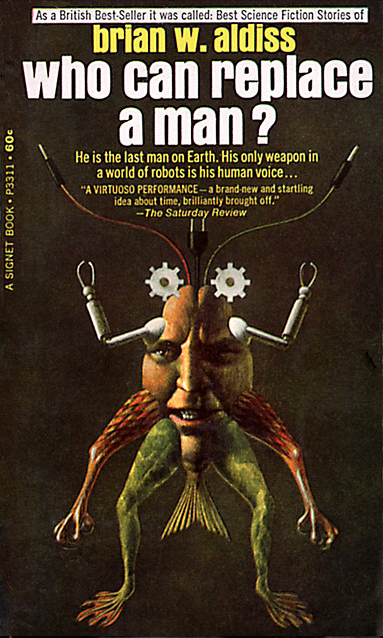
Book Review: Who Can Replace a Man? (variant title: Best Science Fiction Stories of Brian W. Aldiss), Brian W. Aldiss (1965)

Screen shot 2013-02-10 at 11.42.53 AM

(Don Puchatz’s cover for the 1967 edition)

4/5 (collated rating: Good)

Seven of the 1950s short stories in Brian W. Aldiss’ best of collection Who Can Replace a Man? (1965) I’ve reviewed before in No Time Like Tomorrow (1959) and Galaxies Like Grains of Sand (1960).  However, the collection contains seven additional 50s and 60s novellas/short stories that make up the majority of pages.  I’ve indicated the old material in the review with an asterisk Continue reading

Updates: Recent Science Fiction Acquisitions No. LVI (Herbert + Pohl + Kornbluth + Harrison + Wouk)

More Christmas gifts and winter break purchases….

Another Herbert non-Dune novel with a great vat baby fetus cover by the indomitable Lehr…

Another Pohl + Kornbluth 50s satire about worlds sunk into savage degeneration….

A lesser known illustrated utopian space fable by the Pulitzer Prize winning Herman Wouk…  I really have no idea what to expect from this one.

And an alternate history sci-fi adventure by Harry Harrison.

1.  Tunnel Through the Deeps (variant title: A Transatlantic Tunnel, Hurrah!), Harry Harrison (1972)

(Richard Powers’ cover for the 1974 edition) Continue reading

SF Article: Barry N. Malzberg (b.1939): Metafiction and the Demystification of the Cult of the Astronaut

This was my recent guest post on Little Red Reviewer.

For those who didn’t see it I decided to post it here….

——-

 Barry N. Malzberg (b. 1939): Metafiction and the Demystification of the Cult of the Astronaut

Screen shot 2013-01-14 at 1.55.20 PM

In the World Book Encyclopedia Science Service publication The United States Astronauts and their Families: A Pictorial Presentation (1965), each astronaut is allotted a two-page spread replete with staged photos of their family life and hobbies.  Otis L. Wiese, the editor of the volume, proclaims grandiosely “Man’s reach for the world of space is born of his insatiable curiosity about the unknown… his indomitable drive for accomplishment… his instinctive response to a challenge. Astronauts-Husbands-Fathers: these men are the men featured here but it’s essentially as family men that we portray them” (i).

The photographs are fascinating.  Roger B. Chaffee’s wife Martha teaches him lunar geography (22), L. Gordon Cooper, Jr. sits at the helm of his speedboat Bluebonnet which is capable of reaching 80 knots (28), in another photo him and his family spend time with their German shepherd (29), Donn F. Eisele teaches his daughter “the finer points of marksmanship” (35), while Alan B. Shepard, Jr. plays piano tunes for his daughters (61) and in the facing image shakes hands with John F. Kennedy (61).

Their families illustrate the epitome of the American family: the ultra-masculine man with his cars and boats, the supportive wife facilitating Continue reading

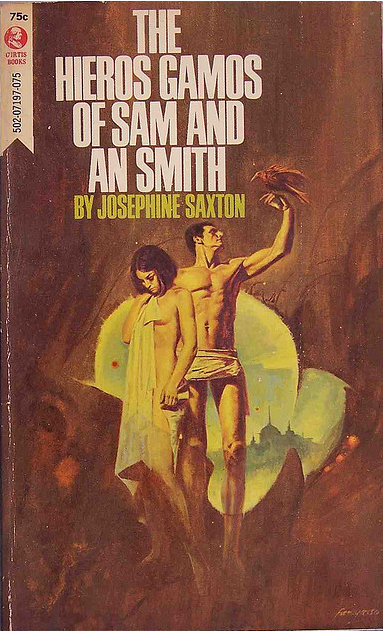
Book Review: The Hieros Gamos of Sam and An Smith, Josephine Saxton (1969)

(Jack Faragasso’s cover for the 1970 edition)

4.5/5 (Very Good)

The Hieros Gamos of Sam and An Smith (1969) is an experimental (but approachable) science fiction fable set in a world which, at least on the surface, is very much like our own.  The buildings remain, food dispensers still dispense food, and undisturbed store shelves are fully stocked.  However, the majority of the animals have disappeared and people are almost all gone. Cannibalism is hinted at.  A few other individuals flit on the outskirts of the narrative, phantom-like, unsubstantial in their physicality.  Are they hallucinations, or external viewers of the spectacle who intrude when needed before vanishing with no evidence of their arrival?

Josephine Saxton deftly utilizes the coming of age narrative, Continue reading