Updates: Recent Science Fiction Acquisitions N. XXXIX (Priest + Brunner + Crowley + Wallace + Duncan)

Ah, what a delightful group! A few from my father, a few from Marx books which I hadn’t posted yet….  Priest and Crowley’s novels involve fascinating worldscapes — a world winched across the horizon, a world at the top of a pillar…  Both are considered among the better stylists in science fiction and fantasy.

And, my 22nd (?) Brunner novel!  The Stone That Never Came Down (1973) — from his glory period of the late 60s-early 70s (this period produced Stand on Zanzibar, The Sheep Look Up, Shockwave Rider, The Jagged Orbit).

And two more impulsive finds — Ian Wallace’s Croyd (1967) — a reader claimed it was one of the best sci-fi novels of the 60s, and thus due to my intense curiosity, I had to find a copy.  And Dark Dominion (1954), I know little about David Duncan — he wrote only three sci-fi novels in the 50s.  His work is described by SF encyclopedia as “quietly eloquent, inherently memorable, worth remarking upon.”

And the covers!

1. The Inverted World, Christopher Priest (1974)

(Jack Fargasso’s cover for the 1975 edition) Continue reading

Book Review: Farewell, Earth’s Bliss, D. G. Compton (1966)

(Karel Thole’s cover for the 1971 edition)

4.5/5 (Very Good)

(*some spoilers due to the limited nature of the plot*)

Another D. G. Compton novel, another wonderful (and terrifying) experience…  The only one of his novels so far that has failed to hold my interest was The Missionaries (1971), a lackluster satire on religion.  The Continuous Katherine Mortenhoe (variant title: The Unsleeping Eye) (1973) is a masterpiece and Farewell, Earth’s Bliss (1966) and Synthajoy (1968) are close behind.

Farewell, Earth’s Bliss is best described as a character study of a group of convicts sent to Mars and their attempts to integrate into an incredibly repressive and conservative society (derived in part to to the extreme dangers of the Martian environment) — in short, a piece of race and religion themed social science fiction.  Be warned, there  is little to no action.  As with most of Compton’s works, near future environments are the perfect vehicle for societal ruminations Continue reading

Book Review: Revelations, Barry N. Malzberg (1972)

(Michael Presley’s cover for the 1977 edition)

5/5 (Masterpiece)

Revelations (1972) is the second in a thematically linked group of Malzberg’s novels — published in-between its siblings, The Falling Astronauts (1971) and Beyond Apollo (1972) (from now on BA).  Each deals with insane astronauts, and in Malzberg’s own words, “sexual dysfunction as representing the necessary loss of energy of the machine age,” and each contains a character desperately attempting to speak out.  But, as with most of Malzberg’s novels, it is unclear whether there is truth in these cries.

Revelations is less rigorously structured than BA, which was characterized by 67 short tellings/retellings/scenes/dream moments all from the perspective of a single insane character.  As with BA, our anti-hero is an unreliable narrator, but due to the variety of diaristic, epistolary, and interrogatory fragments that comprise  Continue reading

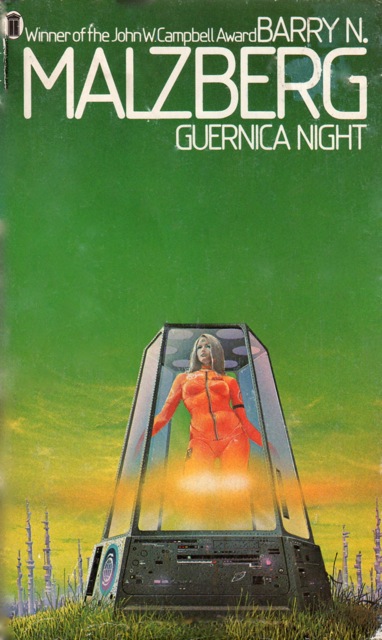
Book Review: Guernica Night, Barry N. Malzberg (1975)

(Tim White’s cover for the 1979 edition)

4.25/5 (Good)

Nominated for the 1976 Nebula Award for Best Novel

“Here we are in Disney Land/Disney World; clutching the strange hands of those with whom we came, we move slowly through the ropes under the chanting of the attendants, swatting insects of habitation, toward the exhibit of the martyred President.  The martyred President has become a manikin activated by machinery, tubes and wiring; he delivers selected portions of his famous addresses, stumbling back and forth […] (1)”

Guernica Night (1975) is the third of Barry N. Malzberg’s books I’ve read after Conversations (1975) and In the Enclosure (1973).  Although lacking the Continue reading

Adventures in Science Fiction Cover Art: My Top 15 Science Fiction Covers

1. Harold Bruder’s cover for the 1967 edition of Pyschogeist (1966), L. P. Davies.

Because everyone loves lists…

…I’ve selected from my collection of cover art, placed in no particular order, my fifteen favorite science fiction covers of all time.  Of course, lists being lists, and the fact that I’ve only seen a portion of all the covers ever made, it is incomplete and maleable.  Although many of the most famous sci-fi artists (Powers, Lehr, and pulp masters such as Wesso) feature, some of my favorites are by lesser known artists whose visual contributions to the field should not be forgotten (Bruder, Podwil, Foster, Schongut, etc).

A few points to consider: 1) The artist rarely had control over the font.  If the graphic designer responsible for putting together the final cover wasn’t up to snuff, the text often doesn’t Continue reading

Updates: Recent Science Fiction Acquisitions No. XXXI (Dick + Zelazny + Tucker + Smith)

Another wonderful assortment (some from Central Texas bookstores, some from my father as presents, some semi-forgotten works from a few months ago that I forgot to post about)…  Regardless, I’m almost finished Zelazny’s Jack of Shadows (1971) and am quite impressed (I loved This Immortal and Lord of Light).  Another PKD, Dr. Bloodmoney or How We Got Along After the Bomb (1965),  swells my already extensive collection of his novels and short story collections — again, the premise is vintage PKD surrealism (girl with twin brother growing inside of her in a post-apocalyptical wasteland).  I bought the Wilson Tucker novel, Tomorrow Plus X (1956), because of the gorgeous Richard Powers cover…  A few of his works are supposedly readable, but this one is probably justly forgotten.  The Cordwainer Smith collection, Space Lords (1965), will be my first exposure to his work — very excited!  Now that I think about it, I do have a copy of Norstrilia (1975) languishing somewhere.

Enjoy!

1. Jack of Shadows, Roger Zelazny (1971)

(Robert Pepper’s cover for the 1972 Continue reading

Updates: Recent Acquisitions No. XXIX (Dick + White + Harrison + et al.)

A return to old familial haunts yields a heart warming stash of gems and a few radiating a more dubious aura…

And more Richard Powers’ covers for my growing collection….

Most importantly, I picked up my fourteenth or fifteenth Philip K. Dick novel! I will acquire ALL of them eventually.

And another Ace double — little did I know (but I should have guessed considering the egregious art and interior images) that is was sci-fi of the more comic variety.  But, I wanted at least one of Lafferty’s novels after reading a few of his impressive short stories.

Enjoy!

1. Star Surgeon, James White (1963)

(Richard Powers’ cover for the 1963 edition) Continue reading

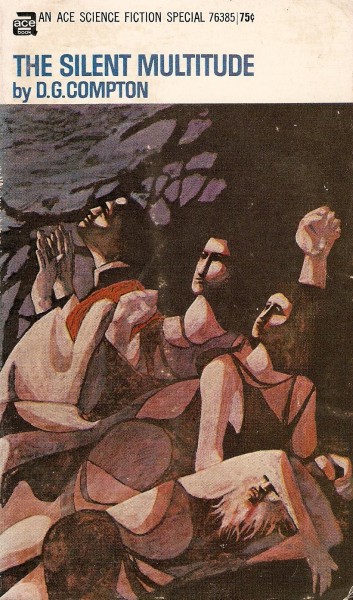
Book Review: The Silent Multitude, D. G. Compton (1966)

(Leo and Diane Dillon’s cover for the 1969 edition)

4.25/5 (Very Good)

“He was out now looking for signs.  He knew how to stay alive.  He was a strangely violent man, to him the fall of the city was some sort of unholy celebration (89).”

The decaying/empty city as allegory: its few post-evacuation occupants (a tramp and his cat, the cathedral’s dean, a young suburban woman, a troubled architect’s son — all well-drawn characters) wander the deserted streets of Gloucester consumed with their own obsessions.  The cement consuming fungus — a vague agent of destruction that severs us from our loci of civilization, our functionalist cityscapes, Continue reading

Updates: Recent Science Fiction Acquisitions No. XXVI (Malzberg + Wells + Gunn +Pohl)

A nice (varied) selection of finds….

I’ve continued to be on the lookout for Malzberg’s novels and, due to the proliferation of comments by my readers about what is his best, I’ve acquiesced and picked up a copy of his acknowledged masterpiece, Beyond Apollo (1972).  I suspect it will be as good as In The Enclosure (1973).

If there is any area (besides sci-fi from the 21st century) that I haven’t read a good portion of the classics, it’s works from around the turn of the century.  I have read a large swathe of Verne’s works and from beginning of the 20th century  all of Edgar Rice Burroughs’ John Carter series — but, only a few of H. G. Wells’ oeuvre (The War of the Worlds and The Time Machine).  So, when I came across a 60s edition of The First Men in the Moon (1901) with a nostalgic looking cover I snatched it up!

The two short story collections are unknown commodities: Frederick Pohl’s In The Problem Pit (1976) and James Gunn’s Station in Space (1958).  I’ve never heard of Gunn and sort of dislike what I’ve read of Pohl so far.  Regardless, both works have intriguing covers!

Enjoy!

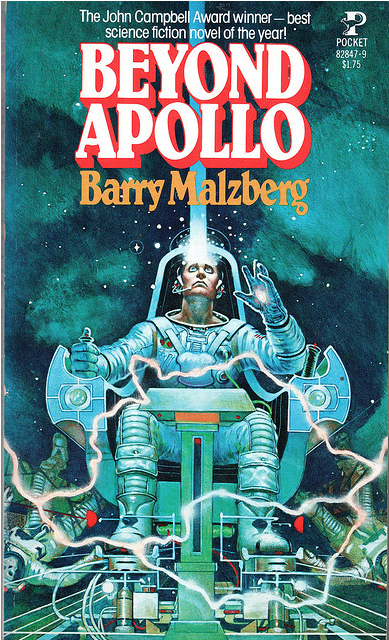
1. Beyond Apollo, Barry Malzberg (1972)

(Don Maitz’ cover for Continue reading