What pre-1985 science fiction are you reading? + Update No. XXV

What pre-1985 science fiction are you reading or planning to read next month? Here’s the July installment of this column.

One of my favorite forms of SF scholarship is careful identification of a intellectual genealogy–tracing what an author read and engaged in dialogue with. Authors are readers. They also can’t escape references and textual traces of what they’ve consumed (or, of course, engagement with the world in which they lived).

I’ve read two interesting examples recently. The first, Carol McGuirk’s “J. G. Ballard and American Science Fiction” in Science Fiction Studies, vol. 49 (2022), is the perfect example of this type of scholarship. She traces Ballard’s engagement with SF, his earliest stories, and the various parallels an interactions between his work and American SF that he read (Galaxy Magazine, Theodore Sturgeon, Fritz Leiber, Robert Heinlein, Frederik Pohl, C. M. Kornbluth, Ray Bradbury, Judith Merril, Federic Brown, Henry Kuttner, C. L. Moore, etc.). She argues that Ballard engaged in “retelling with a twist” (476). She writes that “early Ballard stories rework prior sf in moods ranging from measured homage to barbed repose to parodic photo-bomb” (483).

Continue reading

What pre-1985 science fiction are you reading? + Update No. XXIV

What pre-1985 science fiction are you reading or planning to read next month? Here’s the June installment of this column.

I adore teaching American History for college credit. Every summer I ponder what to change and improve. And this year, I want to integrate a few science fiction stories!

My 1950s unit in the spring semester could be modified with a few science fiction short stories. Considering my ongoing fascination with media landscapes of the future, I want to integrate one story on fears over television and one on nuclear horror (which would fit nicely with a group of assignments I have using song lyrics about atomic panic). Feel free to suggest a story that you would include or wish was included in your own US college course (or advanced high school course). No novels unfortunately. I have access to a range of syllabi and a TON of ideas but I always love to hear your selections.

Before we get to the photograph above and the curated birthdays, let me know what pre-1985 SF you’re currently reading or planning to read! 

Continue reading

Exploration Log 11: Interview with Chukwunonso Ezeiyoke, author of Nigerian Speculative Fiction: The Evolution (2025)

Over the last few years, I have highlighted a smattering of the vast range of spectacular scholarship on science fiction in my reviews and Exploration Log series that intrigue me.1 Today I have an interview with Chukwunonso Ezeiyoke about his brand new book Nigerian Speculative Fiction: The Evolution (2025), the first ever monograph on Nigerian speculative fiction (science fiction, fantasy, and horror) (SF). Due to the focus of my site and research interests, I focused my questions primarily on the historical portions of his book.

You can buy a copy directly from Routledge here or on Amazon. As academic works aren’t the cheapest, can also request your library procure a copy.

Let’s get to the interview and the fascinating world of Nigerian SF!

Continue reading

What pre-1985 science fiction are you reading? + Update No. XXIII

What pre-1985 science fiction are you reading or planning to read next month? Here’s the May installment of this column.

In my interview with Jaroslav Olša, Jr. about his book Dreaming of Autonomous Vehicles: Miles (Miroslav) J. Breuer: Czech-American Writer and the Birth of Science Fiction (2025), an interesting methodological question jumped out to me: what is the role of more ephemeral publications outside of Hugo Gernsback in the early history of genre? A bit of context: Miles J. Breuer also wrote in Czech. He published stories in Czech-language publications aimed at the immigrant community far earlier than their re-written versions appeared in Gernsback’s Amazing. In addition, he published in various medical journals (that occasionally ran SF) and university publications. As Olša points out in the interview, it obviously depends on the questions asked by the historian — and these publications had small audiences that make it hard to ascertain “influence” or “inspiration” for later authors. Food for thought.

Before we get to the photograph above and the curated birthdays, let me know what pre-1985 SF you’re currently reading or planning to read! 

Continue reading

Magazine Review: Galaxy Science Fiction, ed. H. L. Gold (October 1950) (Simak, Sturgeon, MacLean, Matheson, Leiber, Brown, Asimov)

Preliminary Note: I plan on reading all 116 issues of the influential, and iconic, SF magazine Galaxy under H. L. Gold’s editorship (October 1950-October 1961) in chronological order. How long this project will take or how seriously/systematically I will take it are complete unknowns. I am a reader of whim. I will choose whether to reread certain stories that I’ve previously covered. Serialized novels will only be reviewed after I complete the entire work and posted as separate reviews. Why Galaxy, you might ask?

First, I can’t escape the pull of 1950s science fiction focused on social commentary and soft science. Second, I am obsessed with 50s American politics during a time of affluence, the rise of TV and mass culture, and the looming terror of the Cold War. Third, there are a legion of well-known 50s authors I’ve yet to address in any substantial manner on the site who appeared behinds its illustrious covers. Fourth, H. L. Gold was interested in all different types of stories.

As SF Encyclopedia explains, Galaxy was an “immediate success” in part because “Astounding was at this time following John W Campbell Jr’s new-found obsession with Dianetics and was otherwise more oriented towards technology.” Gold’s interests, on the other hand, “were comparatively free-ranging: he was interested in psychology, sociology and satire and other humor, and the magazine reflected this.”

I hope you enjoy this series! Feel free to join.

Up Next: the November 1950 issue.


You can read the entire issue here.

Clifford D. Simak’s Time Quarry (variant title: Time and Again) (1950). Serialized over three issues. I will post an individual review after I complete the serialization.

Continue reading

What pre-1985 science fiction are you reading? + Update No. XX

What pre-1985 science fiction are you reading or planning to read this month? Here’s the January installment of this column (sorry I missed a month).

Before John W. Campbell, Jr. (1910-1971) attempted to raise the “standards and thinking in magazine SF,” David Lasser (1902-1996) attempted his own brief (1929-1933) program to improve science fiction as managing editor of Hugo Gernsback’s Science Wonder Stories, Wonder Stories, and Wonder Stories Quarterly. According to Mike Ashley’s The Time Machine: The Story of the Science-Fiction Pulp Magazine from the Beginning to 1950 (2000), Lasser is a “much neglected revolutionary in science fiction” and through his efforts the genre “started to mature” (66).

Ashley highlights Lasser’s letter of instruction mailed to his regular contributors on the 11th of May, 1931, in which he “exhorted them to bring some realism to their fiction” (72). He also outlawed common tropes like the giant insect story and space opera (73). He emphasized the need to focus on characters that “should really be human” — not everything needs to be a “world-sweeping epic” (73). Stories in this vein, according to Ashley, include Clifford D. Simak’s religiously themed “The Voice in the Void” (1932), P. Schuyler Miller and Walter Dennis’ “The Red Spot on Jupiter” (1931) and “The Duel on the Asteroid” (1974), which featured a grim realism and character development (74).

Continue reading

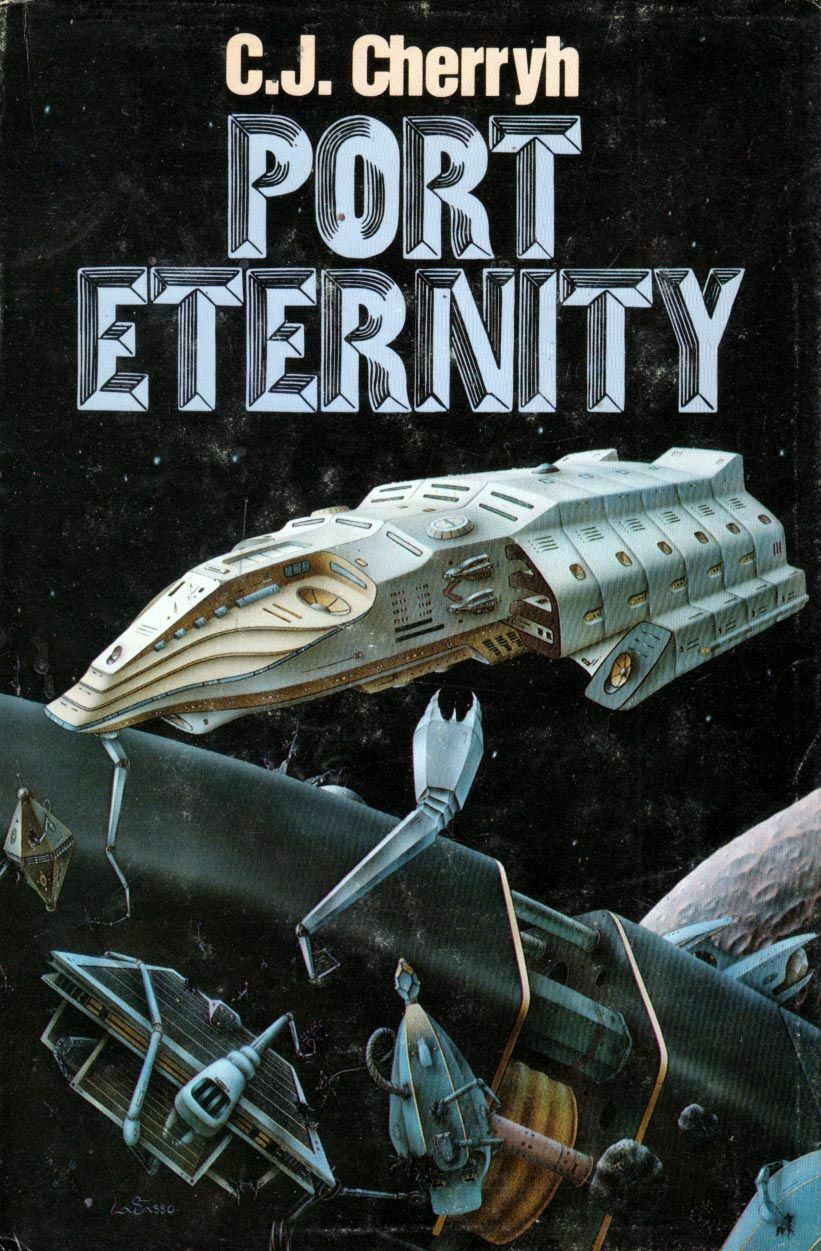
Book Review: Port Eternity, C. J. Cherryh (1982)

(Gary LaSasso’s cover for the 1983 edition)

4/5 (Good)

In my late teens I encountered the space opera of C. J. Cherryh  through the Hugo and Nebula Award-winning Downbelow Station (1981).* I was hooked. Her paranoia-drenched spacescapes, interstellar freighters, the awe-inspiring cumulative world-building effect of innumerable novel sequences from distinct perspectives, and narration that dwells on psychological impact of events were my bread and butter. See below for the list of the ten (I think?) novels I’ve previously read (although many details blend together). For whatever reason I hadn’t returned to her SF in more than a decade. I am glad I did!

C. J. Cherryh’s Port Eternity (1982), part of the Age of Exploration sequence within the larger Alliance-Union world, can be read alone.  It is a claustrophobic rumination on identity Continue reading

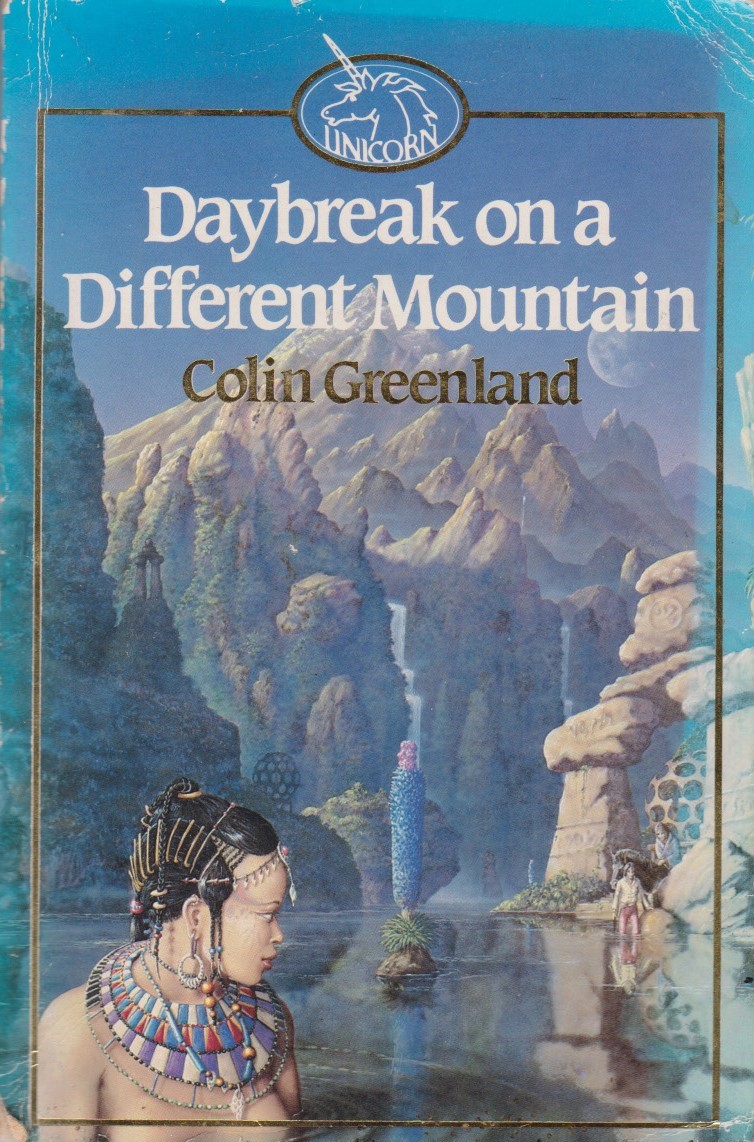
Book Review: Daybreak on a Different Mountain, Colin Greenland (1984)

(Steve Weston’s cover for the 1st edition)

4/5 (Good)

Fantasy and science fiction that deploys geographical and urban allegory—Italo Calvino-esque cities balanced over chasms, the skeletons of urban human interactions measured out in string, etc.*—relentlessly intrigues. In John Crowley’s The Deep (1975), the world as chessboard is perched on top of a pillar with endlessness on all sides. In Garry Kilworth’s Cloudrock (1988), two tribes eek out their existence on a levitating rock surrounded by poisonous gasses. Terry Carr’s Cirque (1977) posits a city next to an abyss out of which crawls a tentacled beast…. Sculpted urban and geographic artifice can, in the hands of an adept author, create meaning-rich texts as characters inscribe new patterns on the landscapes they traverse. Continue reading

Updates: Recent Science Fiction Acquisitions No. CC “Foreign Vintage SF Edition” (Dutch SF Anthology + World SF Anthology + Non-English Language European SF Anthology + and a Czech Collection)

(Gianni Benvenuti’s back cover art detail for the 1978 edition of View from Another Shore (1973), ed. Franz Rottensteiner)

A Vintage Foreign SF Acquisitions Post!

Over the last few weeks, I’ve acquired three anthologies that gather vintage SF in translation from Japan to Denmark. I’ve also included in this post a single author collection of Czech 50s/60s science fiction. In addition to my initial thoughts, I’ve noted the non-English language countries covered in each volume. This is an incredibly exciting group of books as I know little to nothing about the individual authors and their works and can’t wait to explore….

1. Fantastic ruined city cover with exploring spaceman…. At first glance, this collection contains a substantial number of fantasy stories–I wish I knew which ones were SF!

Countries: Denmark and Belgium (specifically, the Dutch-speaking regions).

2. Maxim Jakubowski’s anthology deliberately gathers stories from a range of countries (many are English-speaking) including a few famous English-speaking authors (Brian W. Aldiss, Michael Moorcock, Cherry Wilder, John Sladek, etc.). In a humorous touch, he includes one of his own stories under the name Adam Barnett-Foster from the country of San Serriffe. As I knew immediately that this wasn’t a real country, a quick Wikipedia search reveals it was a fictional island nation created by Britain’s Guardian for April Fools’ Day 1977!

(Real) Countries: Romania, West Germany, France, USSR, The Netherlands, Japan, Spain, Sweden, Poland.

3. Entirely non-English language European SF in translation… I enjoyed the humorous cover.

Countries: Poland, France, Denmark, West Germany, Czechoslovakia, Romania, Italy, USSR.

4. One of the few non-Soviet single-language vintage SF collections I’ve encountered–Josef Nesvadba, Czechoslovakia (modern day Czech Republic). Of the four included in the collection, Nesvadba’s collection beckons most seductively.

All scans are of my personal copies (click to enlarge). Continue reading