Short Fiction Reviews: Leigh Kennedy’s “Salamander” (1977), “Whale Song” (1978), “Detailed Silence” (1980), and “Speaking10 to Others2; Speaking3 to Others20” (1981)

In the past few years, I’ve put together a series on the first three published short fictions by female authors who are completely new to me or whose most famous SF novels fall mostly outside the post-WWII to mid-1980s focus of my reading adventures.

Today I’ve selected the first four stories by an author I’ve only recently started to read–Leigh Kennedy (1951-). I’d previously reviewed “Helen, Whose Face Launched Twenty-Eight Conestoga Hovercraft” (1982) and placed her on the list for this series. According to SF Encyclopedia, Kennedy’s “writing is succinct, polished, lucent, and her stories are emotionally penetrating; it is unfortunate that she has fallen from the world of novel publishing, though continuing to work as a professional indexer.” And I can’t agree more! Her first four stories show great promise and moments of refined vision. I can’t help but think the backlash to her Nebula-nominated (and best-known work) “Her Furry Face” (1983) might have had some effect on her trajectory.

So far I’ve featured Alice Eleanor Jones (1916-1981), Phyllis Gotlieb (1926-2009), Sydney J. Van Scyoc (1939-2023), Josephine Saxton (1935-), Carol Emshwiller (1921-2019), Wilmar H. Shiras (1908-1990), Nancy Kress (1948-), Melisa Michaels (1946-2019), Lee Killough (1942-), Betsy Curtis (1917-2002), and Eleanor Arnason (1942-). To be clear, I do not expect transformative or brilliant things from first stories. Rather, it’s a way to get a sense of subject matter and concerns that first motivated authors to put pen to paper.

Let’s get to the stories!


Continue reading

Updates: Recent Science Fiction Purchases No. CCCXXXIX (Frank Herbert, Alan E. Nourse, Ann Maxwell, Craig Harrison)

Which books/covers/authors in the post intrigue you? Which have you read? Disliked? Enjoyed?

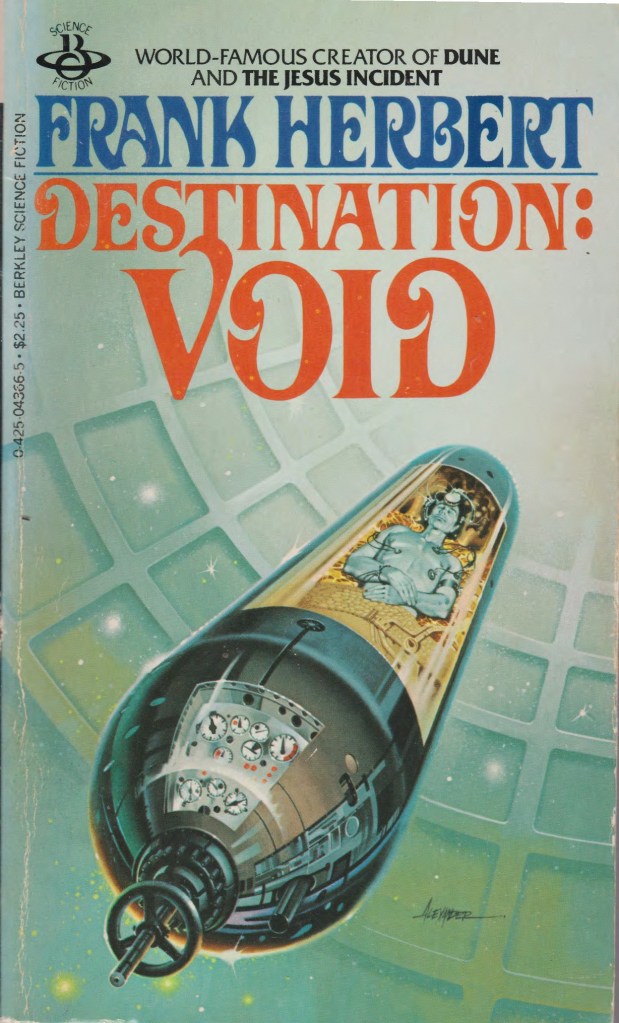
1. Frank Herbert’s Destination: Void (1966, rev. 1978)

From the back cover: “DESTINATION: VOID

THE COMPLETELY REVISED AUTHOR’S EDITION OF THE CLASSIC DEEP-SPACE ADVENTURE!

‘When the publishers announced that they were going to bring out a new edition of DESTINATION: VOID, they offered me the opportunity to make any changes I felt were necessary. Because of the tightly interwoven scientific premises behind this story and rapid development in the fields related to these premises, it would be extraordinary if discoveries across thirteen years did not dictate certain revisions.

Continue reading

Updates: Recent Science Fiction Purchases No. CCCXXXVIII (Gregory Benford, Dean McLaughlin, Warren Norwood, and Aileen La Tourette)

Which books/covers/authors in the post intrigue you? Which have you read? Disliked? Enjoyed?

1. In Alien Flesh, Gregory Benford (1986)

From the back cover: “A journey into the depts of space and time by Gregory Benford, winner of the Nebula Award.”

Contents: “In Alien Flesh” (1978), “Time Shards” (1979), “Redeemer” (1979), “Snatching the Bot” (1977), “Relativistic Effects” (1982), “Nooncoming” (1978), “To the Storming Gulf” (1985), “White Creatures” (1975), “Me/Days” (1984), “Of Space/Time and the River” (1985), “Exposures” (1981), “Time’s Rub” (1984), “Doing Lennon” (1975).

Continue reading

Short Story Reviews: Ted White’s “Growing Up Fast in the City” (1971), “Junk Patrol” (1971), and “Things Are Tough All Over” (1971)

Ted White (1938-) took over as editor of Amazing Science Fiction and Fantastic from Barry N. Malzberg in October, 1968. As the magazines were bi-monthly and Malzberg had already acquired stories for multiple later issues, White’s first issues appeared in 1969. He’d accepted the position on the condition that he phase out the reprints (not acquired by White) slowly over multiple years.1 Apparently while White was not a fan of the New Wave movement, he “was all for more daring fiction exploring adult themes and saw no reason why these stories could not co-exist alongside more traditional stories.”2 Thus, his two magazines attempted to appeal to a wide-range of readers.

By the early 1970s, White demonstrated growing interest in even “greater liberalization of science fiction, in line with what was happening to youth nationwide.” He saw SF as “a vehicle to push back on the barriers of the ‘establishment’, with no suppression of soft drugs, ‘healthy sex,’ or free expression.”3 His magazines included stories emphasizing future sex in all its forms” far more frequently than its competitors.4 As the pay rates of both magazines were low–White could only pay 1 cent a word vs. 3 cents for the bigger magazines of the day–he attempted to appeal to writers who did not mesh well with the “establishment.”5

White did not earn a living wage as the editor despite the magazines consuming much of his time. In order to cobble together a meager living he also served as art director (which included cutting and pasting each issue) and wrote stories to publish in his own magazines!6 White’s first professional stories appeared in 1962 after a decade of fan writing.

This post includes three of White’s own violent and bleak visions of future society that appeared in Amazing and Fantastic. While he might not have been a fan of the experimental tendencies of the movement, his obsession with violating taboos, scenes of urban decay, and general miasmic gloom are certainly on display.

I am increasingly fascinated by the more radical, bleak, and grimy stories within White’s magazines–both from his pen and others–and plan on exploring more. See my earlier reviews of Lisa Tuttle’s “Stone Circle” (1976) and Grania Davis’ “New-Way-Groovers Stew” (1976).

Let’s get to the stories!

3.75/5 (Good)

Continue reading

Book Review: Herovit’s World, Barry N. Malzberg (1973)

(Charles Moll’s cover for the 1974 edition)

3.5/5 (Good)

Note: Today is Barry N. Malzberg’s birthday!

Upon reading In the Enclosure (1973) I was immediately seduced by Barry N. Malzberg’s metafictional brand of science fiction — best illustrated by his masterpieces Beyond Apollo (1972) and Revelations (1972).  Although Herovit’s World (1973) contains many of the same metafictional trademarks of Malzberg’s best work, it should be noted that the novel is not science fiction and more a work about writing (pulp) science fiction.  In this case, the mental collapse of a pulp writer whose life may or may not contain “true” autobiographical kernels from Malzberg’s own experience Continue reading

Update: Science Fiction Books to be Reviewed/Read this summer

I’ve read hundreds and hundreds of science fiction books  from the classics to the not so classic.  I’ve decided to use this blog as motivation to read new books.  Hence, reviews of Dune (Herbert), Hyperion (Simmons), Stand on Zanzibar (Brunner) and other major works probably will not reviewed in the near future since I’ve read them already and until I run out of things to read I’m not inclined to read them Continue reading