For a large portion of the year, I’ve been collecting evidence on unions in post-WWII to very early 60s American science fiction.1 To be clear, I am not on the hunt for the best by these authors. This project is about stories that reference unions. I will read all the stories I can by American SF authors on the topic during this timeframe for this project in order to understand how authors responded to the historical moment in which they lived. Exciting!
A Bit of Historical Context
During the Great Depression, there was broad consensus among leftist thinkers that the labor movement would lead to radical change. The Second World War and the economic recovery shattered that consensus.2 The unions themselves underwent substantial transformation in this period. American corporate powers and their conservative congressional allies unleashed a “propaganda campaign” against the labor movement.3 This culminated in the contentious passage of the Taft-Hartley Act (1947), which weakened the ability of unions to strike. Over the course of the 1950s, automobile manufacturers and their unions pioneered a new relationship—adopted by other industries—in which companies agreed to grant wage increases, health care, and retirement plans in return for union support of long-term contracts. Increasingly, the political and social transformation of capitalism became secondary to preserving their organizations and maintaining a harmonious relationship with industry.4
Before World World II, anti-capitalist intellectuals imagined the labor movement as the American Proletariat which would, at any moment, transform the capitalist system. After WWII, they struggled to grapple with an economic system they had expected to collapse and the lack of interest in socialism within American unions.5 C. Wright Mills (1916-1962) argued labor had been co-opted by state power.6 Those that continued to support elements of the labor movement, such as Sidney Lens (1912-1986), struggled to rationalize labor’s part in the militarization of Cold War America.7 The one-time Trotskyist, Seymour Martin Lipset (1922-2006), argued that while the labor-movement fell short of representing the “class-based aims of a unified working class” it continued to play a roll in “prohibiting antidemocratic mass movements” by offering workers a role in a “mediating institution.”8 Most involved in the 60s New Left abandoned labor completely as a force for change and grouped unions as part of the liberal establishment, irrelevant in the construction of a new radicalism.9 As in, trade unions “focused on material gains, not fundamental social change.”10
Science fiction written in the post-WWII world likewise reflected outright criticism, deep ambivalence, and confusion over the role of the labor movement. Philip K. Dick’s “Stand-By” (1963) satirizes unions and the media in a post-scarcity world but tentatively suggests conflict between both might lead to the overthrow of a ruling computer and the eventual reemergence of democracy. Milton Lesser’s “Do It Yourself” (1957), one of only a handful unabashedly positive accounts on unions in the 50s, imagines a post-apocalyptic future in which the American individualist ethos reigns supreme. While banned and publicly ridiculed, a union secretly sends out agents to facilitate the rebuilding project. And in H. Beam Piper and John J. McGuire’s “Hunter Patrol” (1959), a ragtag group of disaffected, including a union man (an object of jest), attempt to recruit a soldier from earlier in time to overthrow a dictator. More than a few 50s authors, like Robert Silverberg (whom I’ll feature in a later post) and Clifford D. Simak, read and engaged with contemporary writers on the labor movement.11
Let’s get to the stories!
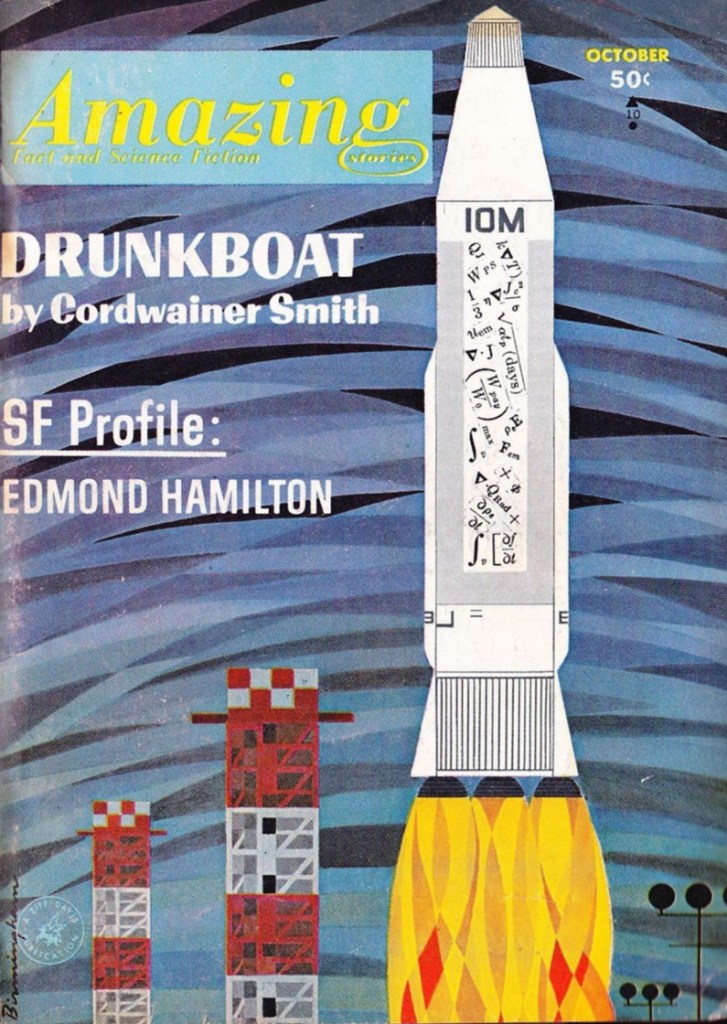
Lloyd Birmingham’s cover art for Amazing, ed. Cele Goldsmith (October 1963)
2.75/5 (Bad)
Philip K. Dick’s “Stand-By” first appeared in Amazing Stories, ed. Cele Goldsmith (October 1963). You can read it online here.
Continue reading
 Science Fiction and Other Suspect Ruminations