What pre-1985 science fiction are you reading? + Update No. XIX

What pre-1985 science fiction are you reading or planning to read this month? Here’s the December installment of this column.

Lost texts, and the act of reconstructing the fragments, fascinates. The questions pile up. Would the contents reveal a pattern in an author’s work? Intriguing personal details? A startling modus operandi? At the 11th World Science Fiction Convention (Philcon 2), Philadelphia (September 1953), Philip José Farmer gave a speech titled “SF and the Kinsey Report.” Considering Farmer’s recent publication of “The Lovers” (1952), this is not surprising. Alfred Kinsey, the famous sexologist and founder of the Kinsey Institute for Research in Sex, Gender, and Reproduction on Indiana University’s campus, published his controversial Sexual Behavior in the Human Male in 1948. Sexual Behavior in the Human Female appeared in 1953. Like many of Farmer’s earliest speeches, he did not keep copies.

Deeply intrigued by what the speech might have contained, Sanstone and I (on Bluesky) managed to piece together a few general responses from fanzines and magazine con reports.

Continue reading
What pre-1985 science fiction are you reading? + Update No. XVIII

What pre-1985 science fiction are you reading or planning to read this month? Here’s the November installment of this column.

Last week I wrote a post about Clifford D. Simak’s delightfully inclusive 1971 speech at the height of the New Wave in which he celebrated science fiction as a “forum of ideas” open to all voices. While reviewing the various snarky comments leveled at the movement by “classic authors” like Asimov, a faint memory of James Blish’s own anti-New Wave sentiments tickled my memory. I randomly opened up a book on my desk to figure out a fascinating SF tidbit to start this post, and voilà, the James Blish story.

Jacqueline Foertsch’s Reckoning Day: Race, Place, and the Atom Bomb in Postwar America (2013) contains a sustained analysis of Samuel R. Delany’s various post-apocalyptic novels. She includes a discussion of the response to Delany’s Nebula-winning The Einstein Intersection (1967). At the 1968 Nebula Awards Banquet, moments after Delany received his prize for Einstein (and where moments later he’d collected another award for “Aye, and Gomorrah”), Blish lambasted the New Wave. Blish complained about the “loosening of the genre’s parameters” and the “re-christening of the genre” as “speculative fiction” (98). I find all of this hilarious as Blish himself wrote fantasy novels like Black Easter (1968) (that would also nab a 1969 Nebula nomination) and far earlier oblique proto-New Wave speculative fictions like “Testament of Andros” (1953). I wonder if Blish aimed such vitriol at a figure like Simak, who took the loosening of the genre’s parameters to extremes during the New Wave–i.e. novels like The Goblin Reservation (1968), Destiny Doll (1971), and Out of Their Minds (1970). Unfortunately, I don’t think it’s surprising that Blish took especial issue with one of the few black SFF authors of the day.

And let me know what pre-1985 science fiction you’ve been reading!

Continue reading

What pre-1985 science fiction are you reading? + Update No. XI

What pre-1985 science fiction are you reading or planning to read this month. Here’s March’s installment of this column.

Before we get to books and birthdays and writing plans…

Continue reading

What pre-1985 science fiction are you reading? + Update No. X

What pre-1985 science fiction are you reading or planning to read this month? Here’s February’s installment of this column.

Before we get to books and birthdays and writing plans…

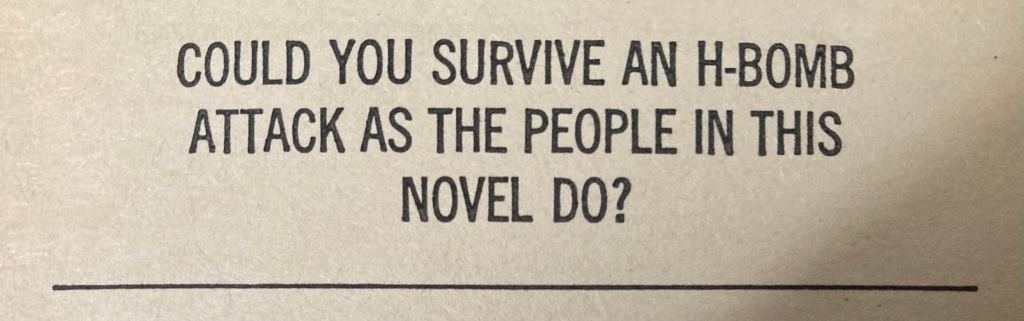
Do you have the inner strength to survive the panic of a nuclear attack? Take a test in the August 21st 1953 issue of Collier’s and find out! Sample question: “HOW DO YOU FEEL WHEN: […] You are alone in an automatic elevator when it stalls between floors?” Possible answers: “I’m not bothered,” “I become tense,” “It jars me badly,” and “I blow up.”

Continue reading

Updates: Recent Science Fiction Purchases No. CCXCI (James White, Joan D. Vinge, D. G. Compton, Somtow Sucharitkul)

Which books/covers/authors intrigue you? Which have you read? Disliked? Enjoyed?

1. The Escape Orbit (variant title: Open Prison), James White (1964)

From the back cover: “STRANDED ON A PLANET OF MONSTERS. When the survivors of the his starship were taken prisoner by the insec-creatures against whom Earth had fought a bitter war for nearly a century, Sector Marshal Warren expected to be impounded in a prison camp like those the Earthmen maintained. But the “Bugs” had a simpler method of dealing with prisoners–they dumped them on an uninhabited planet, without weapons or tools, and left them to fend for themselves against the planet’s environment and strange monsters. A “Bug” spaceship orbited above, guarding them.

Continue reading

Updates: Recent Science Fiction Purchases No. CCLXXVII (Octavia E. Butler, Harlan Ellison, James White, Poul Anderson)

As always, which books/covers/authors intrigue you? Which have you read? Disliked? Enjoyed?

1. Dawn, Octavia E. Butler (1987)

From the back cover: “XENOGENESIS: The birth of something new—and foreign.

Lilith Iyapo awoke from a centuries-long sleep—and found herself aboard the vast living spaceship of the Oankali. Alien creatures covered in writhing tentacles, the Oankali had saved every surviving human from a dying, ruined Earth. They healed the planet, cured cancer, increased human strength and disease resistance, and were now ready to help Lilith lead her people back to Earth.

Continue reading

Updates: Recent Science Fiction Purchases No. CCLII (James White, Patricia A. McKillip, John Maddox Roberts, and an Original Anthology)

As always which books/covers intrigue you? Which have you read? Disliked? Enjoyed?

1. Fool’s Run, Patricia A. McKillip (1987)

Michael Whelan’s cover for the 1988 edition

From the back cover: “Terra Viridian is a young woman who obeyed a vision, took a laser assault rifle, and turned fifteen hundred innocents into light. She was captured, convicted, and sentences to the orbital prison called the Underworld. Forever.

Seven years later: a bar-band pianists Continue reading

Updates: 2016 in Review (best novels + best short stories + best anthologies + notable posts)

Dear readers, thank you all profusely for your comments, words of thanks, and emails over the year. It is my overarching goal to inspire you all to read more SF from the 50s-70s, dust off the boxes of your parents’ books in some forgotten closet, browse the shelves at your local used book store (or favorite online store), reflect on the often fascinating cover art…

2016 was not the most productive reading/reviewing year as my PhD dissertation defense date rapidly approaches. For the purposes of maintaining my sanity, reading and writing about SF remains my primary relaxation hobby—surprising perhaps as I read a lot of depressing SF that wouldn’t be “relaxing” for most people. According to Megan at From Couch to Moon I like my fiction “moody, broody, meta, and twisted.”

And other than a few satires here and there, my favorite SF reads of 2016 fit firmly within Megan’s descriptors.

Thanks again!

thdrmmllnn1974 czuqgixw0aiddub-1 crrehycuiaassn4

Best novels

  1. The Affirmation, Christopher Priest (1981)
  2. The Infernal Desire Machines of Doctor Hoffman (variant title: The War of Dreams), Angela Carter (1972). Review forthcoming 
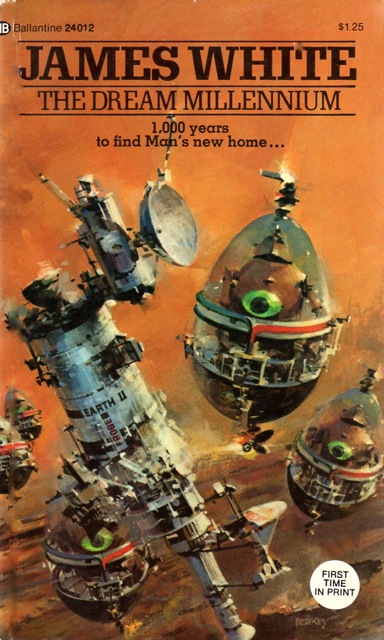
  3. The Dream Millennium, James White (serialized 1973, novel 1974)
  4. The Committed Men, M. John Harrison (1971)

Continue reading

Book Review: The Dream Millennium, James White (serialized 1973, novel 1974)

THDRMMLLNN1974

( John Berkey’s cover for the 1974 edition)

4.75/5 (Very Good)

“The thought of the vast, utterly silent ship stretching away on all sides of his cubicle, guarded and guided by silent computers, was paralyzing his own ability to make sounds […]” (3)

The crew of a seed ship sent to find a new habitable planet dream the same dreams, dreams of unnatural clarity plagued by pain and death.  As a young woman lies dying in her cold cubicle, her final meal at her lips and unaware of her predicament, she whispers to our reluctant hero (Devlin), “All I seem to dream about is being a lady dinosaur” (32).  Devlin’s dreams follow some pseudo-evolutionary schema, first he dreams he’s a trilobite in some Silurian sea crushed by the tentacles of a cephalopod, “he went on feeding while the hot, constant flame of hunger was punctuated by explosions of pain as his appendages were twisted and crushed and torn away […]” (10).  Then he dreams he’s a brontosaurus, and then an early primate…

Periodically, the automated machines that tend the colonists in cold storage awake their charges, “BASIC INSTRUCTIONS. SPEAK. EXERCISE. REMEMBER” (2).  The Continue reading