What pre-1985 science fiction are you reading or planning to read next month? Here’s the October installment of this column.
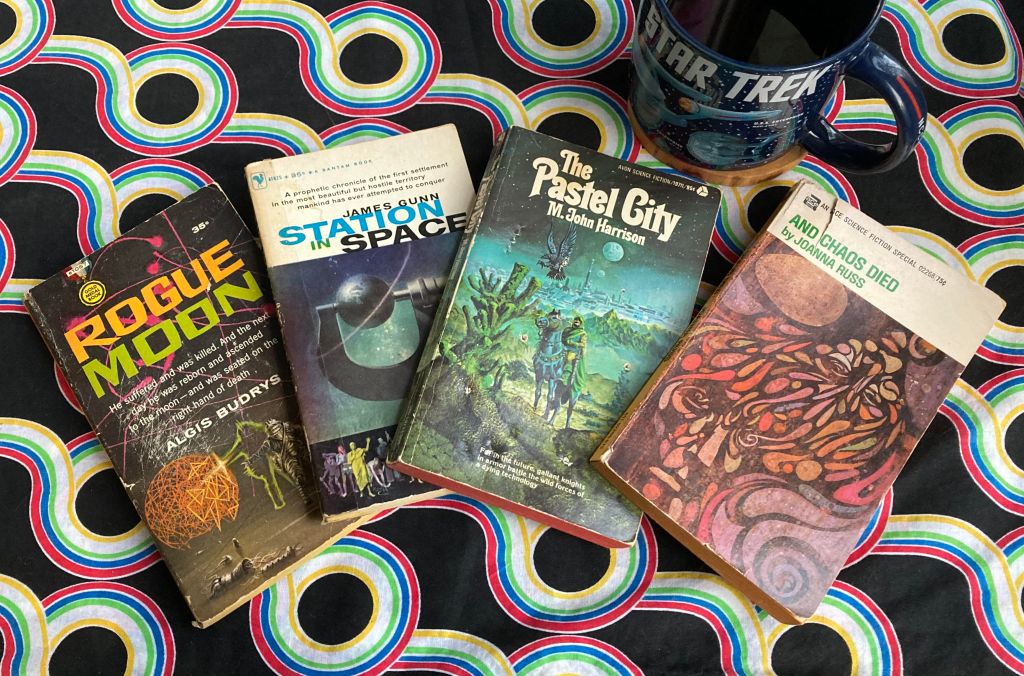
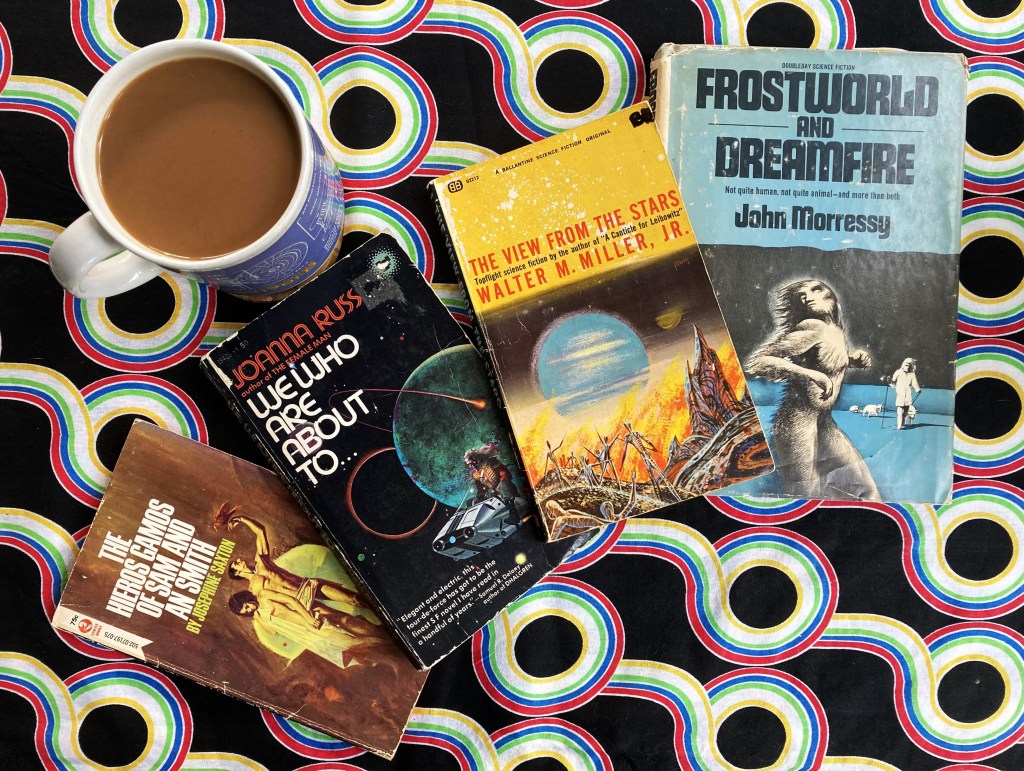
A selection of read volumes from my shelves
If I’m feeling a bit unmotivated to write about science fiction, I always end up on Fanacor another online repository of fanzines/newspapers exploring all the old historical fannish debates. I especially enjoy their reports on various conventions and the community (from accepting to reactionary) that emerges. For example, the details I uncovered about a lost Philip José Farmer speech titled “SF and the Kinsey Report at the 11th World Science Fiction Convention (Philcon 2) in Philadelphia (September 1953) and Pat M. Kuras and Rob Schmieder’s article “When It Changed: Lesbians, Gay Men, and Science Fiction Fandom” (1980) on the first Worldcon panel with an openly LGBTQ topic: “The Closed Open Mind: Homophobia in Science Fiction Fantasy Stories” moderated by Jerry Jacks, one of the “early openly gay fans.” I recently edited a friend’s article for academic publication on the role of conventions in forming feminist and political activism. Conventions sound like fascinating places, at least from my historically-minded vantage point and lens.
What pre-1985 science fiction are you reading or planning to read this month? Here’s the August installment of this column.
I often think back to how I got hooked on science fiction. As I have mentioned many times before, I primarily read fantasy–in particular every bloated Tolkein ripoff I could get my hands on–before I moved to science fiction in my late teens. Tad Williams’ fantasy trilogy Memory, Sorrow & Thorn (1988-1998) holds special significance. While looking for other fantasy titles by Williams at the local used book store, I stumbled across his equally bloated four-volume SF sequence Otherland (1996-2001). And so the slow shift began… I had read other science fiction but nothing hooked me quite like Otherland. It’s one of those works that I plan on never rereading—the spell would break.
What pre-1985 science fiction are you reading this week?
I’ve thoroughly enjoyed the conversations and connections you all have made in the comments over the last two months of this column. Make sure to check out the previous installment if you haven’t already. As before, I’ve included a bit about the books in the photograph, birthdays from the last two weeks, and brief ruminations on what I’ve been reading and writing.
What pre-1985 science fiction are you reading this weekend?
Thank you all for making this fanzine column a success! I’ve thoroughly enjoyed the conversations and connections you all have made in the comments. Make sure to check out the previous installment if you haven’t already. As before, I’ve included a bit about the books in the photograph, birthdays from the last two weeks, and brief ruminations on what I’ve been reading and writing.
Today I have the second post in my new Exploration Log series. Some posts will be a brief survey of the various SF-related non-fiction I’ve read. Other posts, I hope, will be a jumping off point for my own research. In this instance, I’ll share the elements of an article that resonated with me.
Check out my previous post on publishing Ursula K. Le Guin behind the Iron Curtain here.
Al Thomas’ “Sex In Space: a Brief Survey: A Brief Survey of Gay Themes in Science Fiction” first appeared in Gay Peoples UnionNews, Vol. 5, N. 12 (September 1976). You can read it online here.
In 1971, inspired in part by the Stonewall Riots of 1969 that brought national attention to the gay liberation movement and Wisconsin’s earlier and lesser known LGBTQ riots, the Gay Peoples Union (GPU) was founded in Milwaukee, Wisconsin as “a social service agency dedicated to the needs of the gay community” and “concurrently dedicated to educating the community at large about gays and lesbians” (source). An offshoot of the Gay Liberation Organization at the University of Wisconsin Milwaukee, the GPU was the “‘first’ at many things” including community center, gay health clinic, and published a monthly periodical called GPU News (source). The publication soon gained national recognition for its broad coverage of topics to the gay and lesbian community. GPU News produced the “first regularly scheduled, scripted gay and lesbian [radio] program in the nation” between 1971-1972 and collaborated on multiple programs with the mainstream Milwaukee news sources. For recordings and other pieces of ephemera check out the University of Wisconsin-Madison digital collection. For a brief oral history of attending a GPU meeting, check out this fascinating interview with Don Schwamb and other early members.
The article I’ll cover today–Al Thomas’ “Sex In Space: A Brief Survey of Gay Themes in Science Fiction” (September 1976)–appeared in the publication’s heyday in the 70s before it folded due in the early 80s due to lack of volunteers (source).
Al Thomas, about whom I’ve been able to find nothing about, surveys the state of science fiction on gay (and occasionally lesbian) themes up to 1975. While the article itself is riddled with errors that impact the conclusions he reaches, “Sex In Space” is a fascinating look at how science fiction was viewed by the gay liberation movement of the day. I’ve provided each work with gay and lesbian themes covered in the article below.
Which books/covers/authors intrigue you? Which have you read? Disliked? Enjoyed?
1. Japan Sinks!, Sakyo Komatsu (1973; trans. by Michael Gallagher, 1976)
David McAllister’s cover for the 1978 edition
From the back cover: “WORST DISASTER IN THE HISTORY OF THE WORLD!
A FISSURE in a wall–a land survey mysteriously out of true–a small island disappearing overnight–and one of the worst disaster in the history of the world is born. Only one man suspects the truth, but his theory is so unprecedented, his predications so horrifying that even his fellow scientists ignore him.
Earthquakes
Then a series of devastating earthquakes strikes, and suddenly the authorities are prepared to listen. But time is short and as they frantically try to ward off the disaster the crust of the earth begins to shift…”
As always, which books/covers/authors intrigue you? Which have you read? Disliked? Enjoyed?
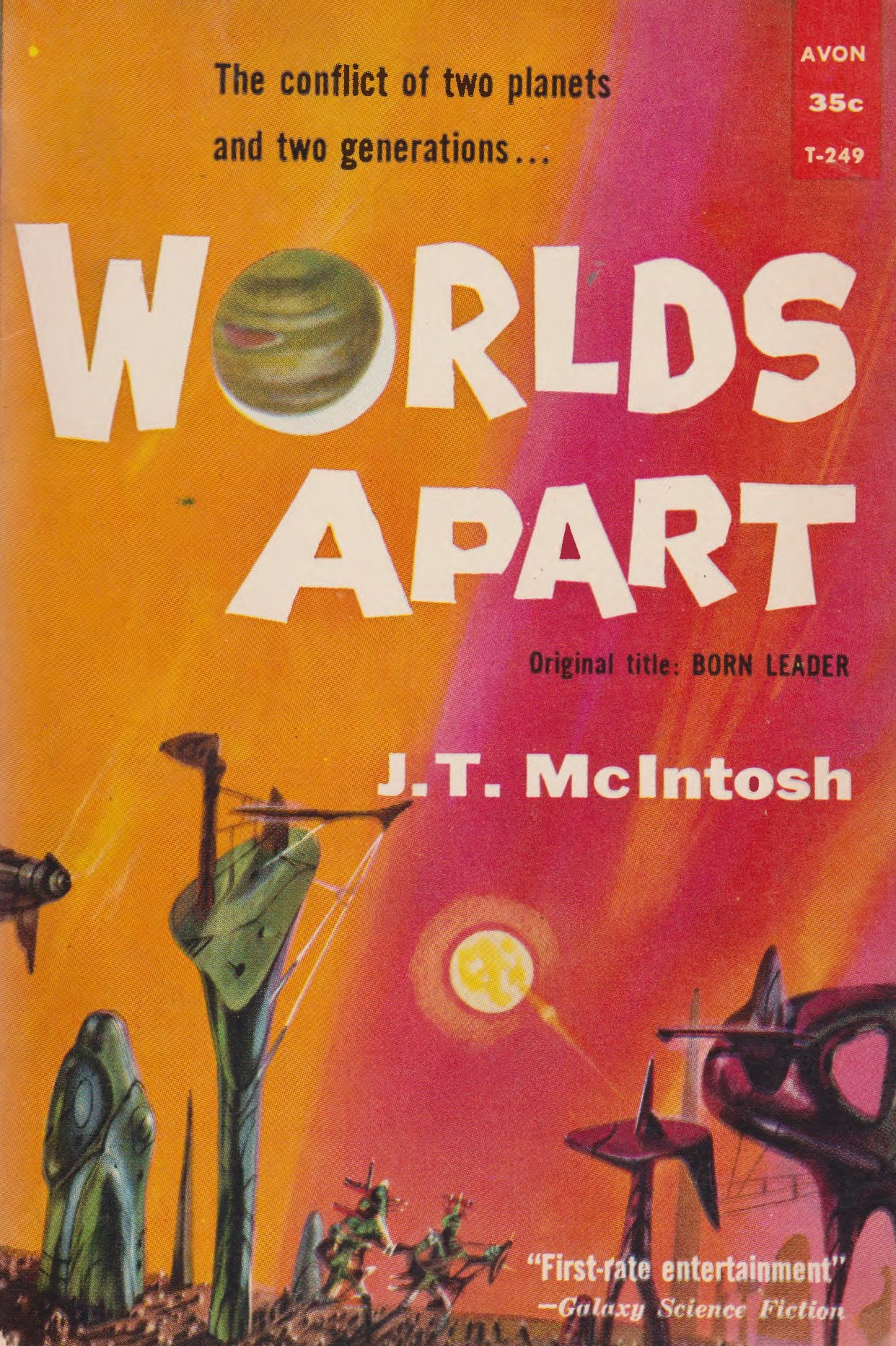
1. Worlds Apart (variant title: Born Leader), J. T. McIntosh (1954)
Richard Powers’ cover for the 1958 edition
From the back cover: “ROG FOLEY had never seen Earth—and he never would. For all that was left of Earth was an atomic funeral pyre in the sky.
ROG FOLEY was a leader of the new generation of humans who were born and raised on Mundis, the distant planet circling Brinsen’s Star and to which the last survivors of Earth had escaped in a 17-year journey through space.
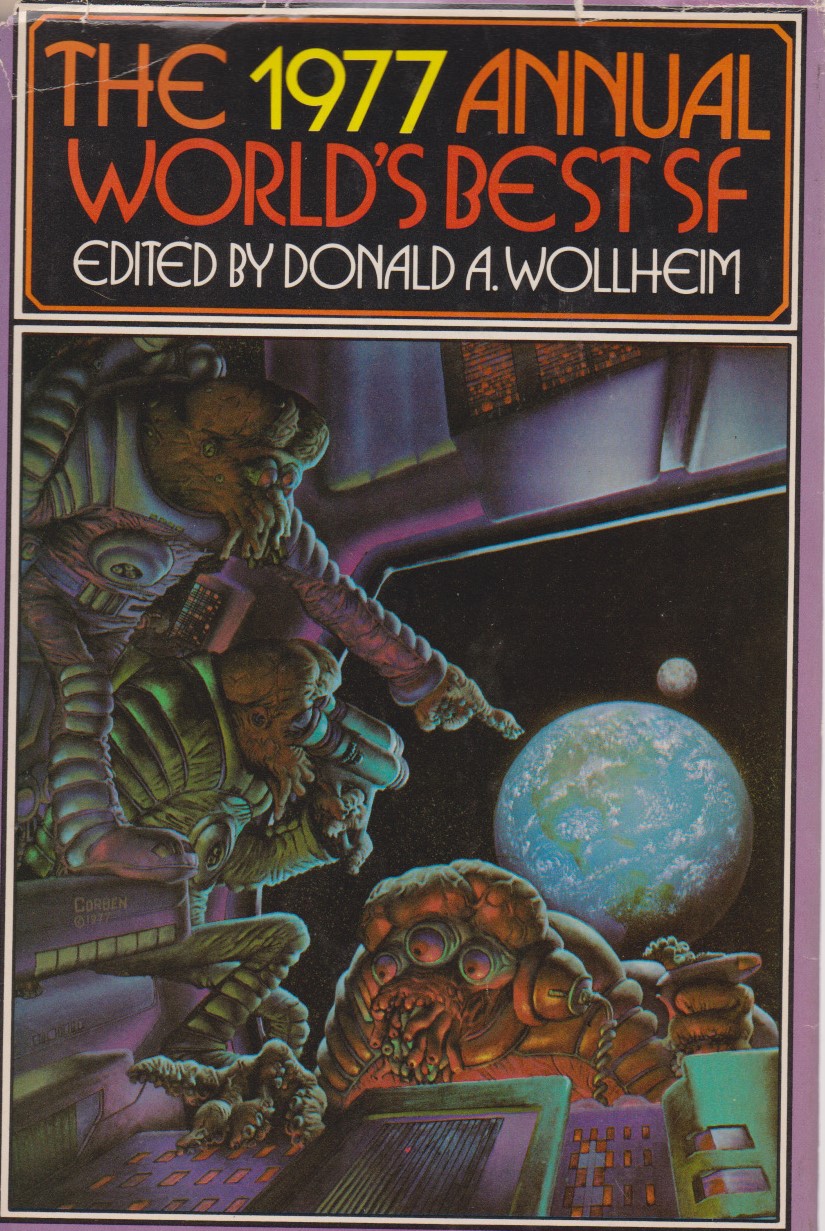
The 1977 Annual World’s Best SF, ed. Donald A. Wolheim and Arthur S. Saha (1977) is a glorious anthology of SF published from the year before containing rousing works by the established masters (Isaac Asimov and Brian W. Aldiss), philosophical gems from New Wave icons (Barrington J. Bayley), and gritty and disturbing commentaries on masculinity by the newer voices (James Tiptree, Jr.). While Richard Cowper and Lester del Rey misfire, the overall quality is high for a large Continue reading →




 Science Fiction and Other Suspect Ruminations