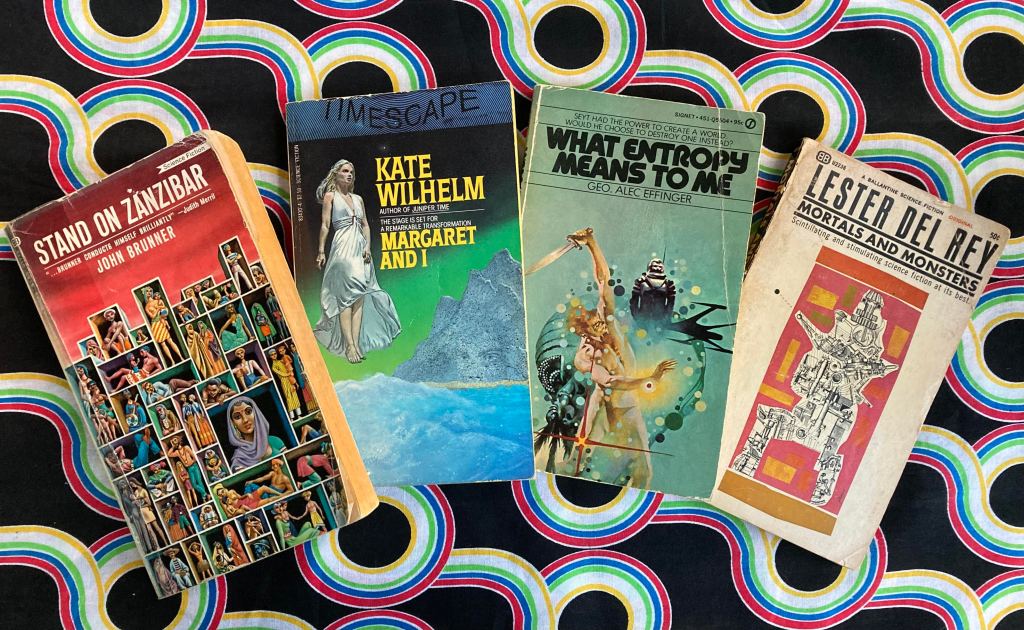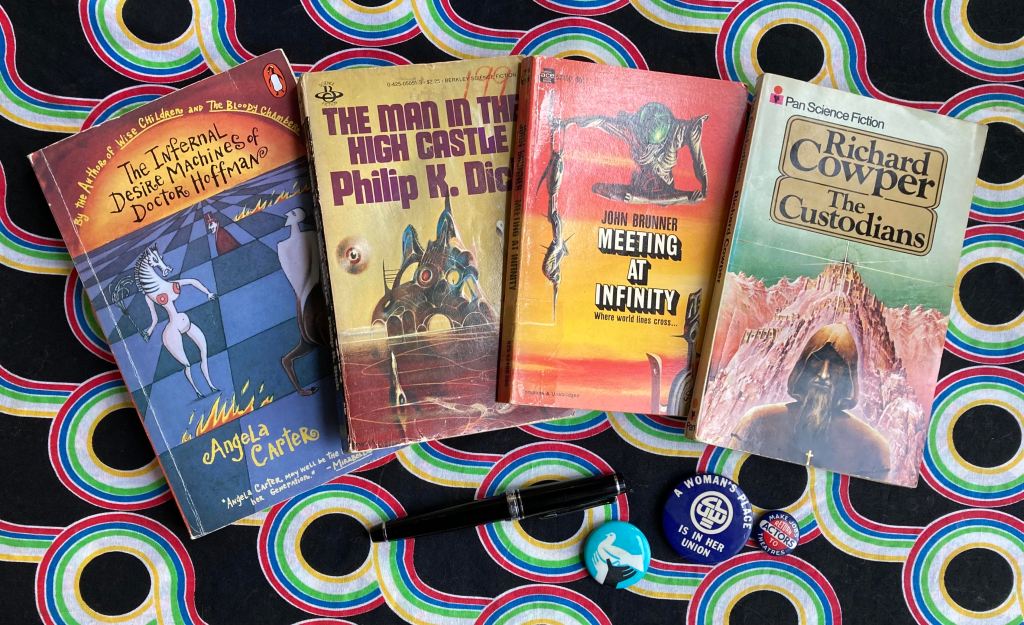
What pre-1985 science fiction are you reading? + Update No. XXIII

What pre-1985 science fiction are you reading or planning to read next month? Here’s the May installment of this column.

In my interview with Jaroslav Olša, Jr. about his book Dreaming of Autonomous Vehicles: Miles (Miroslav) J. Breuer: Czech-American Writer and the Birth of Science Fiction (2025), an interesting methodological question jumped out to me: what is the role of more ephemeral publications outside of Hugo Gernsback in the early history of genre? A bit of context: Miles J. Breuer also wrote in Czech. He published stories in Czech-language publications aimed at the immigrant community far earlier than their re-written versions appeared in Gernsback’s Amazing. In addition, he published in various medical journals (that occasionally ran SF) and university publications. As Olša points out in the interview, it obviously depends on the questions asked by the historian — and these publications had small audiences that make it hard to ascertain “influence” or “inspiration” for later authors. Food for thought.

Before we get to the photograph above and the curated birthdays, let me know what pre-1985 SF you’re currently reading or planning to read! 

Continue reading
My 2024 in Review (Best Science Fiction Novels and Short Fiction, Articles/Podcasts, Reading Initiatives, and Bonus Categories)

Here’s to a happy reading in 2025! I hope you had a successful reading year. Whether you are a lurker, occasional visitor, a regular commenter, a follower on Bluesky or Mastodon, thank you for your continued support. It’s hard to express how important (and encouraging) the discussions that occur in the comments, social media, and via email are to me. This was the third year running of record-breaking numbers of viewers and views in the 13-year history of my site. What were your favorite vintage SF reads–published pre-1985–of 2024? Let me know in the comments.

Clifford D. Simak defined my 2024. Starting with a February review of his collection Worlds Without End (1964), I embarked on a fiction and non-fiction reading extravaganza that culminated in my article for Journey Planet, which I spent most of the summer writing, titled “‘We Must Start Over Again and Find Some Other Way of Life’”’: The Role of Organized Labor in the 1940s and ’50s Science Fiction of Clifford D. Simak.” Despite his Grand Master status, there’s little scholarship on Simak’s work and so much more to be done. As expected, there was little response to the article outside of my website. I also wrote two Exploration Logs on six of his interviews and his 1971 Worldcon speech and contributed to a podcast on “The Huddling Place” (1944) (the second City story). Sometimes you find a little niche that you never expected to inhabit which you feel there’s so much more to explore and say. I hope my Simak focus continues into 2025.

Continue reading

Book Review: The Squares of the City, John Brunner (1965)

4/5 (Good)

Nominated for the 1966 Hugo Award for Best Novel

John Brunner’s The Squares of the City (1965) transposes the moves of a 1892 chess game between Wilhelm Steinitz (1836-1900) and Mikhail Chigorin (1850-1905) onto a near future landscape of political intrigue. Inspired by Brazil’s planned capital Brasília (founded in 1960), the action takes place in Ciudad de Vados, the capital city of the imaginary Latin American nation of Aguazul.1 Conjured out of a “barren, rocky stretch of land,” Ciudad de Vados contains all the homogenized trappings of an ultra-modern metropolis (170). It’s sterile. Planned. Mechanized. Quickly the monumental urban regularity fades into the background and the intricate game across its squares takes over.

Continue reading

What pre-1985 science fiction are you reading? + Bimonthly Update No. II

What pre-1985 science fiction are you reading this weekend?

After the success of the previous installment, I’ve decided to make this a bimonthly post (“column”) for my site (“fanzine”). As before, I’ve included a bit about the books in the photograph, birthdays from the last two weeks, and brief ruminations on what I’ve been reading and writing.

Continue reading

Updates: Recent Science Fiction Purchases No. CCCXXII (John Brunner, Leigh Kennedy, Poul Anderson, Salman Rushdie)

I’ve returned from my expedition abroad. It’s time to get back to writing about science fiction! But first, there are always new books that have accumulated at my doorstep…

Which books/covers/authors intrigue you? Which have you read? Disliked? Enjoyed?

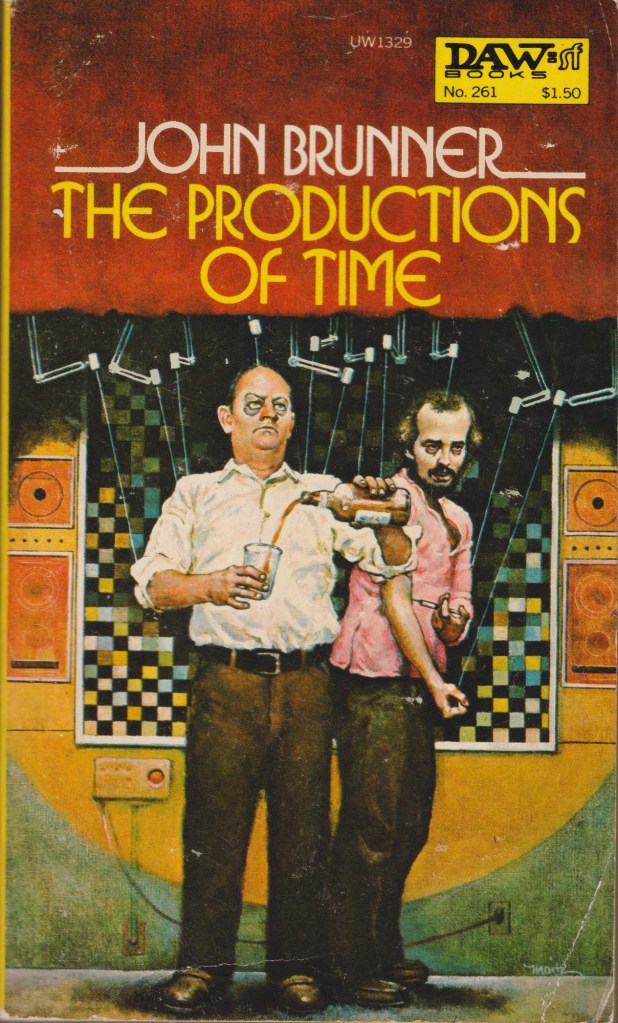
1. The Productions of Time, John Brunner (serialized 1966)

From the back cover: “Murray Douglas had been a theatrical star until he’d hit the bottle once too often. But now he had broken the habit, and, handsome and fit, was ready for a comeback. The most challenging opening available was an avant-garde play where the actors themselves would make up the drama as they went along.

But out at an isolated country estate where the rehearsals were going on, Murray found himself trapped on a real-life day-and-night stage in which nothing was as it seemed, in which inexplicable devices monitored everything and eerie lures attracted each actor’s psychological weakness.

Who then was the real sponsor of this terrifying play–and to what alien audience was it to be presented?

By the Hugo-winning author of STAND ON ZANZIBAR, this is the first unabridged American edition of this John Brunner classic.”

Continue reading

Updates: Recent Science Fiction Purchases No. CCCXV (John Brunner, Connie Willis, Cynthia Felice, Philip Wylie, and a themed anthology)

Which books/covers/authors intrigue you? Which have you read? Disliked? Enjoyed?

1. The Shockwave Rider, John Brunner (1975)

From the back cover: “Future shock!

In the obsessively technological, paranoidally secretive and brutally competitive society depicted by John Brunner, even personal identities are under threat. But one man has made it his mission to liberate the mental prisoners, to restore their freedom in a world run mad.

Nickie Haflinger, the only person to escape from Tarnover–where they raise hyper-intelligent children to maintain the political dominance of the USA in the 21st century–is on the run, dodging from loophole to crevise to crack in the computerised datanet that binds the continent like chains. After years of flight and constant changes of identity, at the strange small town called Precipice he discovers he is not alone in his quest. But can his new allies save him when he falls again into the sinister grasp of Tarnover…?”

Initial Thoughts: I read John Brunner’s The Shockwave Rider (1972) before I started my site–along with his other masterpieces Stand on Zanzibar (1968), The Sheep Look Up (1972), The Jagged Orbit (1969), The Whole Man (196), etc. Of his best known novels, I remember the least about The Shockwave Rider. However, I cannot find my copy for a rare reread! For all I know I gave it to a friend or lost it in a move. I sought out this UK edition due to the intriguing urban arcology background of the cover.

Continue reading

Updates: My 2022 in Review (Best SF Novels, Best SF Short Fiction, and Bonus Categories)

2022 was the single best year in the history of my site for visits and unique viewers!

As I mention year after year, I find reading and writing for the site—and participating in all the SF discussions generated over the year—a necessary and greatly appreciated salve. Whether you are a lurker, occasional visitor, or a regular commenter, thank you for your continued support.

Continuing a trend from 2021, I read only a handful of novels this year. Instead, I devoted my obsessive attention to various science short story review initiatives (listed below), anthologies, and histories of the science fiction genre. Without further ado, here are my favorite novels and short stories I read in 2022 with bonus categories. Descriptions are derived from my linked reviews.

Check out last year’s rundown if you haven’t already for more spectacular reads. I have archived all my annual rundowns on my article index page if you wanted to peruse earlier years.


My Top 5 Science Fiction Novels of 2022 [TITLES LINK TO FULL REVIEWS]

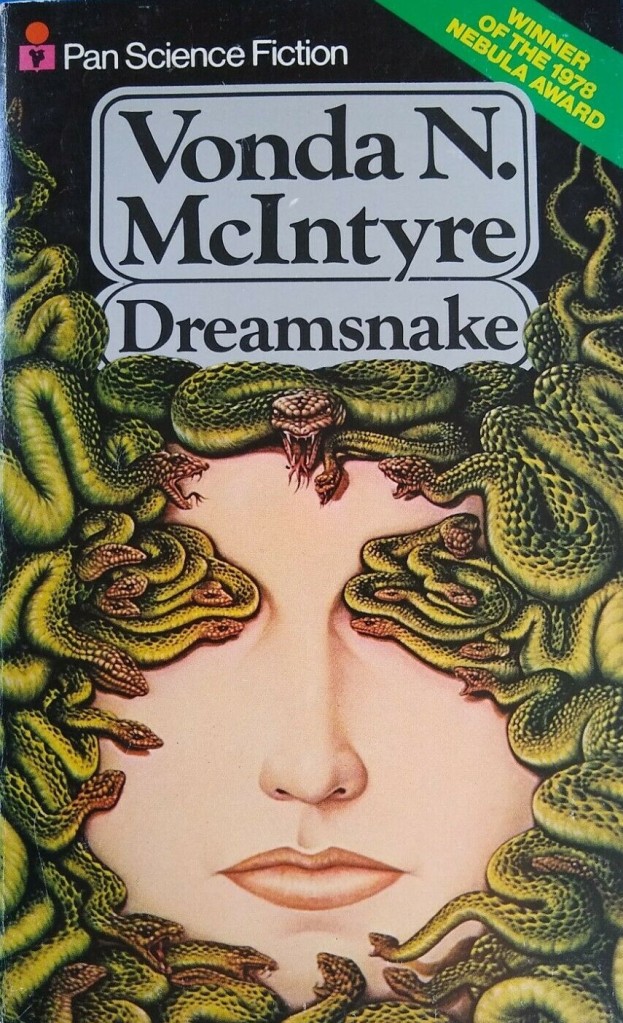
1. Vonda N. McIntyre’s Dreamsnake (1978), 4.75/5 (Near Masterpiece): Won the 1979 Hugo, Locus, and Nebula Award for Best Novel. Snake journeys across the post-apocalyptic wastes of a future Earth with three serpents healing the sick and caring for the dying. She is a member of the healers, who adopt orphans and rescue the oppressed and train them how to use the serpents. Mist and Sand are genetically modified vipers of terrestrial origin. But Grass comes from another alien world. Snake uses Mist and Sand’s venom to create vaccines, treat diseases, and cure tumors. Grass, the rare dreamsnake, with its alien DNA is the most important of them all–it provides therapeutic pleasure and dreams that facilitate conquering one’s fear and healing in the ill. In Snake’s voyages, she encounters prejudice and violence. A joyous sense of sexual freedom permeates the proceedings. A powerful and different take on a post-apocalyptic worldscape in every possible way.

Continue reading

Updates: Recent Science Fiction Purchases No. CCCVI (John Brunner, Phillip Mann, Shepherd Mead, and a Frederik Pohl anthology)

Which books/covers/authors intrigue you? Which have you read? Disliked? Enjoyed?

I planned to have a review up today. Unfortunately, August is always my least productive month writing as it marks the return to work after a much needed summer break. It’s been a rough few weeks! Stay tuned.

1. The Squares of the City, John Brunner (1965)

From the back cover: CHECHMATE IN PARADISE. Ciudad de Vados was a Latin-American showplace, a paradise…a flourishing supercity designed and run nearly to perfection.

But not quite. They had a traffic problem.

Continue reading

Future Media Short Story Review: John Brunner’s “Fair” (1956)

Today I’ve reviewed the seventeenth story in my series on the science fictional media landscape of the future. John Brunner explores how total immersion media, one organ in a vast futuristic fair designed to satiate the masses, can transform fear within the broken.

Previously: John D. MacDonald’s “Spectator Sport” (February 1950).

Up Next: C. M. Kornbluth’s “The Advent on Channel Twelve” (1958) and Alice Eleanor Jones’ “The Happy Clown” (December 1955).

4.5/5 (Very Good)

John Brunner’s “Fair” first appeared in New Worlds Science Fiction, ed. John Carnell (March 1956) under the pseudonym Keith Woodcott. You can read it online here. It also appeared in his first collection No Future In It (1962).

I recently devoured Jad Smith’s short monograph John Brunner (2012) in the Modern Masters of Science Fiction series for Illinois University Press. Not only did the book rekindle my desire to tackle more of Brunner’s short fiction but I also bought copies of The Squares of the City (1965) and Quicksand (1967). I might even reread The Shockwave Rider (1975) in the near future. If you are at all interested in John Brunner’s science fiction I recommend acquiring a copy.

Smith identifies “Fair” (1956) as Brunner’s “finest achievement during this [early] period” (Smith 28). I’d rank it right under his spectacular generation ship short story “Lungfish” (1957). As with many of Brunner’s best works, “Fair” had a contested publication history–in this instance John Carnell only accepted it under the pseudonym “Keith Woodcott” to “fill out an issue” (Smith 29). The identity of the consummate wordsmith didn’t last long as Carnell accidentally revealed his identity in next issue when the story came in second in the reader’s poll!

Continue reading