Updates: 2016 in Review (best novels + best short stories + best anthologies + notable posts)

Dear readers, thank you all profusely for your comments, words of thanks, and emails over the year. It is my overarching goal to inspire you all to read more SF from the 50s-70s, dust off the boxes of your parents’ books in some forgotten closet, browse the shelves at your local used book store (or favorite online store), reflect on the often fascinating cover art…

2016 was not the most productive reading/reviewing year as my PhD dissertation defense date rapidly approaches. For the purposes of maintaining my sanity, reading and writing about SF remains my primary relaxation hobby—surprising perhaps as I read a lot of depressing SF that wouldn’t be “relaxing” for most people. According to Megan at From Couch to Moon I like my fiction “moody, broody, meta, and twisted.”

And other than a few satires here and there, my favorite SF reads of 2016 fit firmly within Megan’s descriptors.

Thanks again!
thdrmmllnn1974 czuqgixw0aiddub-1 crrehycuiaassn4

Best novels

  1. The Affirmation, Christopher Priest (1981)
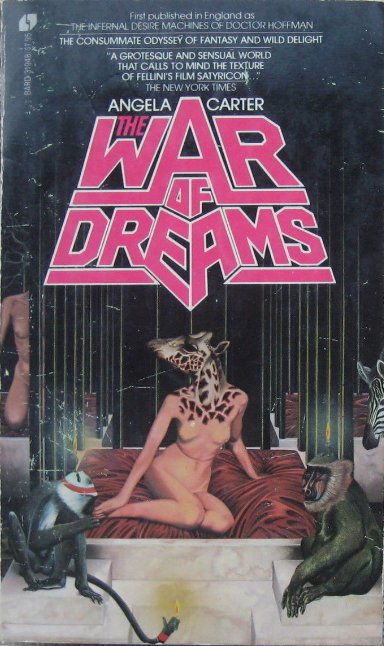
  2. The Infernal Desire Machines of Doctor Hoffman (variant title: The War of Dreams), Angela Carter (1972). Review forthcoming 
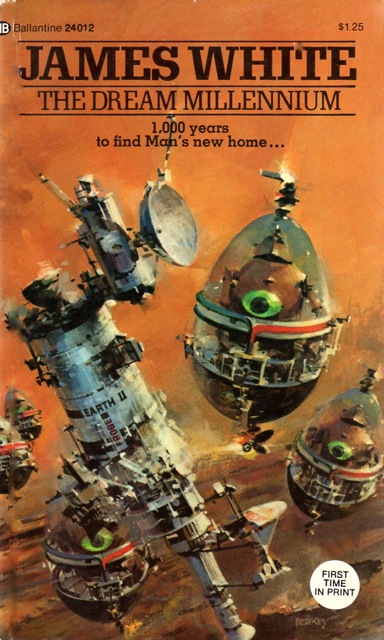
  3. The Dream Millennium, James White (serialized 1973, novel 1974)
  4. The Committed Men, M. John Harrison (1971)
Continue reading

Updates: Recent Science Fiction Acquisitions No. CLXVI (Saxton + Harrison + Whiteley + New Worlds Anthology)

Procuring SF paperbacks never gets old! I have started scanning in the covers (two of the four below) in order to provide higher quality images (click to zoom)— especially if they are hard to find images online and/or I find them aesthetically pleasing (Powers + Lehr in this post).

Let me know if the change is worth it!

Book rundown:

Josephine Saxton: Despite reading The Hieros Gamos of Sam and An Smith (1969) years ago, my mind still traces the imprint of its strange ritualistic beauty . Her short fiction was published in a range of SF magazines and collections from 1965 to 1992.  I have tracked down a copy of her first collection. Despite its 1985 publication date, eight of the fourteen stories were published in the 60s/70s.

Harry Harrison: A “classic” author whose work I need to explore more: I’ve read Deathworld (1960), attempted to read Make Room! Make Room! (1966) and A Transatlantic Tunnel, Hurrah (1972) at least three times, and Lifeship (1976), which he co-wrote with Gordon R. Dickson. I’ve encountered his short fiction here and there and found “By The Falls” (1970) a satisfying New Wave endeavor. Time for more short fiction!

New Worlds Anthology: I want all of them, end of story.

And finally, the selection bound to surprise and confuse my regular readers…. Aliya Whiteley: Despite my various protestations, I have not stopped reading new SF entirely.  And I couldn’t resist finding a copy of Whiteley’s well-received  fungal nightmare…. If you’re curious see Jesse’s review over at Speculiction.

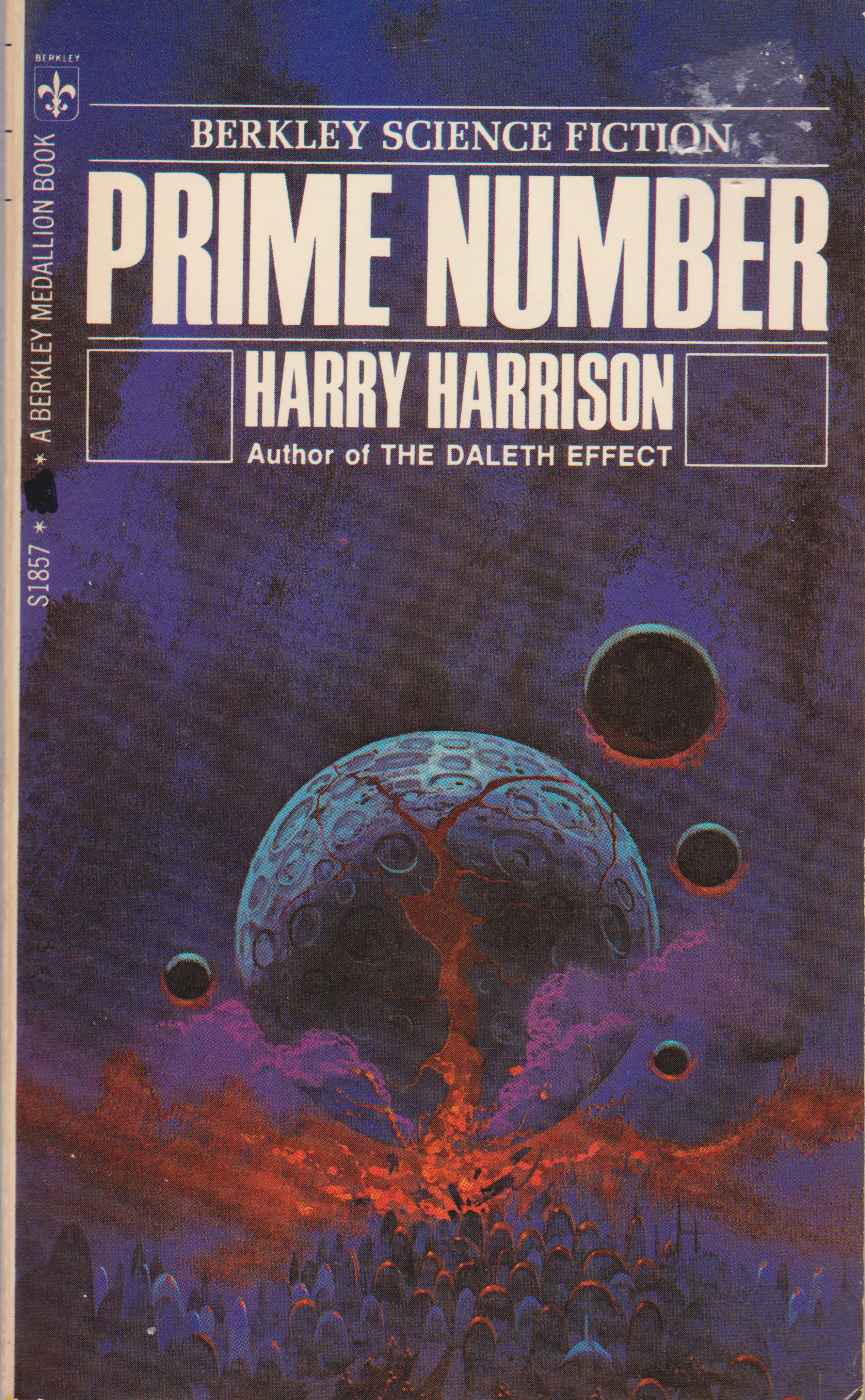
1. Prime Number, Harry Harrison (1970)

lehr-prime-numbers-harrison

(Paul Lehr’s cover for the 1970 edition) Continue reading

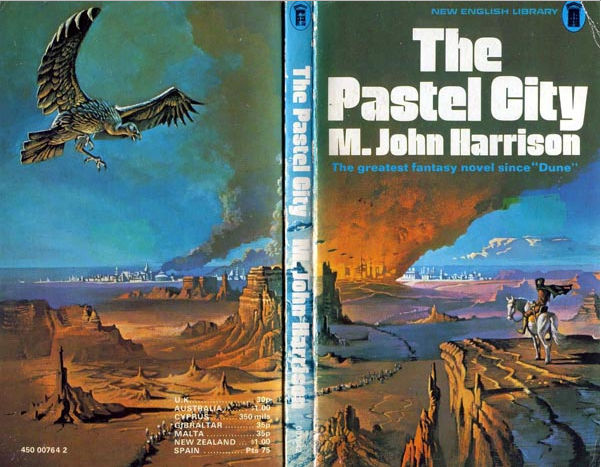
Book Review: The Pastel City, M. John Harrison (1971)

screen-shot-2016-11-04-at-10-30-36-am

(Bruce Pennington’s cover for the 1971 edition)

4.25/5 (Very Good)

One of the previous owners of my copy of M. John Harrison’s The Pastel City (1971) must have harbored a pernicious grudge against corroded landscapes and nebulous morals.  So much in fact that they propped up the first volume of the Viriconium sequence against a tree and used it for BB gun target practice. I am still trying to identify the cause of the book’s other wounds… [pictorial evidence below].

As one can expect from Harrison, decadence and decay seeps from the quires of The Pastel City as characters try to create meaning, or grasp hold of half-formed Continue reading

Book Review: The Committed Men, M. John Harrison (1971)
THCMMTTDMB1971-1

(Chris Yates’ cover for the 1971 edition)

4.5/5 (Very Good)

Entropic visions of decay and despair inhabit M. John Harrison’s first novel The Committed Men (1971).  Possessed by destructive melancholy, the inhabitants of a post-apocalyptical UK–where political powers have sunk into oblivion–attempt to recreate a semblance of normalcy.  Clement St John Wendover, teeth long since rotted, still administers to the skin diseases and ailments of his one-time patients although he cannot cure them.  Halloway Pauce, decked out in his “gold lamé suit”, fastidiously coats his cancered face with a “layer of pancake make-up” (48).  Grocott Personnel and his hierarchically oriented fellows recreate the bureaucratic veneer Continue reading

Updates: Recent Science Fiction Acquisitions No. CXLIII (Two themed anthologies: Election Day 2084 and TV: 2000 + Harrison + Gary)

Two themed anthologies—one in “honor” of the election [*cough* I mean, well, I won’t go all political] year cycle…  Another on one of my favorite SF themes, television of the future!

That said, both Asimov edited collections (from the 80s but with stories from only earlier decades) have a serious fault: out of the combined 35 stories there is not a single story by a woman author.  I’ve read a vast number of 60s/70s collections which do not fall into this trap…. Orbit 1 (1966) almost manages gender parity!  I can think of numerous stories by women authors that fit both themes.  For example, Kit Reed’s wonderful “At Central” (1967) fits the TV anthology!

A hard to find for cheap early M. John Harrison novel…. Unfortunately I only found a much uglier edition that the one I show below as the rest were out of my price range….

And, a complete shot in the dark—a SF novel by the mainstream French/Lithuanian novelist/screenwriter Romain Gary, the author of White Dog (1970)..

As always, I’d love to hear your thoughts + comments.

1. The Committed Men, M. John Harrison (1971)

THCMMTTDMB1971-1

(Chris Yates’ cover for the 1971 edition) Continue reading

Short SF Book Reviews: Michaelmas, Algis Budrys (1976), The Machine in Shaft Ten, M. John Harrison (1975), and Catacomb Years, Michael Bishop (1979)

[The second of four review catch up posts.  The first — > here]

1. Catacomb Years, Michael Bishop (1979)

(Ron Walotsky’s cover for the 1979 edition)

5/5 (collated rating: Masterpiece)

Michael Bishop’s Catacomb Years (1979) takes the form of a complex and multi-layered future history of a single city, the Urban Nucleus of Atlanta, Georgia—entombed/reborn under a vast dome where even the sky is obscured.  Over the course of seven short SF works linked by recurring characters (and character references), theme, and chronology Bishop weaves one of the more spectacular future history canvases.  This is a future history of a profoundly human scope focusing on transformative junctures in the life of the city from the point of view of a range of the inhabitants—from the old to the young, from technicians to recluses obsessed with bonsai, from teachers to human caregivers of the alien visitors…  And most intriguing is Bishop’s willingness to Continue reading

Updates: Recent Acquisitions No. CXXV (M. John Harrison + Coney 3x + Anthology + Cooper)

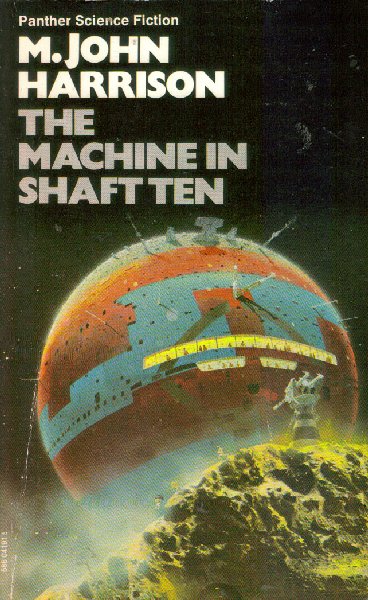
M. John Harrison’s collection The Machine in Shaft Tent (1975) contains one of the more humorous inside flap advertisements I have encountered:

P1050232

Don’t worry, I certainly intend to “see tomorrow today!”  I’ll be disappointed if I can’t!

The others are a strange blend…  From Edmund Cooper’s apparently anti-Free Love/60s culture Kronk (1970) to a delightful collection of another one of my favorite years of SF.

Also, I seldom accept advanced reader copies due to my limited time/limited interest in newer SF/and incredible mental block when it comes to, how shall I say it, outside forces guiding my central hobby which tends to take me in a variety of directions solely on whim.  But, Gollancz was nice enough to send me their new omnibus collection of 1970s Michael G. Coney novels (amazon link: US, UK).  Not only did I enjoy Hello Summer, Goodbye (1975) but I recently reviewed and loved Coney’s bizarre and original Friends Come in Boxes (1973).  With two out of two successes it’s hardly like I wouldn’t buy his work on sight anyway (another one of my requirements when accepting AVCs)….  I will review two or three of the novels in the omnibus one at a time over the next few months.

Thoughts?

1. The Machine in Shaft Ten, M. John Harrison (1975)

THMCSTRS071975

(Chris Foss’ cover for the 1975 edition) Continue reading

Updates: 2014 in Review (Top 10 SF novels + Top 10 Short SF works + Other Categories)

I like lists!  I like reading lists!  Here’s my rundown of the best and worst of what I read in 2014.

This year I have tried something new—my first guest post series. My ten post Michael Bishop review series—reviews written by SF bloggers interested in classic SF and frequent readers of my site—hopefully introduced a lot of my frequent readers to one of my favorite (and criminally underrated) authors.  My second post series did not transpire solely on my site but stretched to others—what Gollancz Masterworks should include…  Thanks for all the wonderful contributions!

Feel free to list your best reads of the year.  Maybe I’ll add a few of them to my to read/to acquire list.

…and, if you tend to agree with at least some of my views on SF, read these!


Best SF novel

1. Ice, Anna Kavan (1967):  Easily the best novel I have read this year, Kavan weaves a Kafka-esque landscape will touches of J. G. Ballard.  Ice, caused by some manmade disaster, is slowly creeping over the world.  The unnamed narrator is torn between two forces: returning to his earlier research on jungle dwelling singing lemurs in the southern regions vs. tracking down a young woman about whom he has Continue reading

Book Review: The Centauri Device, M. John Harrison (1974)

(Paul Lehr’s cover for the 1980 edition)

4/5 (Good)

I can only imagine the shock that readers received and still receive (according to amazon reviews) after diving into M. John Harrison’s The Centauri Device (1974) expecting a standard space opera.  This is a subgenre where the anti-hero still has not found a firm place to roost…  You know the rubric: Empathizing with the hero.  Positivism.  Saving the world.  The good guys win.

I suspect the shock to the system that Stephen R. Donaldson’s leprous and bitter (and reluctant) savior Thomas Covenant in Lord Foul’s Bane (1977) and subsequent novels had on high fantasy was something akin to impact The Centauri Device‘s drug-addled, inarticulate, and passive spacer Continue reading