Short Book Reviews: Margot Bennett’s The Long Way Back (1954) and Mack Reynolds’ The Earth War (1964)

Note: My read but “waiting to be reviewed pile” is growing. Short rumination/tangents/impressions are a way to get through the stack before my memory and will fades. My website partially serves as a record of what I have read and a memory apparatus for future projects. Stay tuned for more detailed and analytical reviews.

1. Margo Bennett’s The Long Way Back (1954)

3.25/5 (Above Average)

I’m always on the lookout for lesser-known SF works by female authors. And Margot Bennett’s The Long Way Back (1954) certainly fits the bill. Bennett (1912-1980), a Scottish-born screenwriter and author of primarily crime and thriller novels, lead a fascinating life before her writing career. During the Spanish Civil War, she volunteered for Spanish Medical Aid, and was shot in both legs. Afterwards, she continued to participate in various left-wing political causes such as the Campaign for Nuclear Disarmament.

The Long Way Back manifests, with satirical strokes, her critical stance on nuclear war and British colonialism. In a future collectivized Africa ruled by a calculating machine that grades the population, Grame, a “mechanical-repetitive worker” (7), dreams of a career in physics. Instead, the machine shuffles him off on an ill-fated expedition to the ruined remains of Britain post “Big Bang” (nuclear blast). On the way he falls in love with the leader of the expedition, Valya, who serves as a virginal Bride of the State (24). After their sea plane lands, they are beset by a bizarre range of mutations–ferocious dogs, micro-horses, etc. Eventually they discover a tribe of hairless white survivors holed up in primitive caves. Grame teaches the brightest arithmetic. Valya sets about measuring and applying pseudo-scientific theories to understand white society, religion, and conception of the world i.e. parroting all the pseudo-science and racist theories posed by British explorers of Africa. As they attempt to find a lost city, Hep, the third surviving member of the expedition, imagines the potential exploitation and colonization Africa might implement—“Yellow America” is on the rise and resources will be needed. History threatens to re-cycle through the horrors of the past in more ways than one.

Continue reading

Updates: Recent Science Fiction Purchases No. CCCXXXIII (Keith Laumer, Vernor Vinge, Mack Reynolds, Daphne du Maurier)

Which books/covers/authors in the post intrigue you? Which have you read? Disliked? Enjoyed?

1. It’s A Mad, Mad, Mad Galaxy, Keith Laumer (1968)

Back cover: “This frenetic collection of science fiction stories–often disturbing, always entertaining–comes from outstanding and unpredictable SF author Keith Laumer.

Tingle your imagination: In ‘The Planet Wreckers,’ Jack Waverly goes to bed an ordinary mortal and wakes up a movie star. But the trouble is, his life is the price.

Tired of being a 97-pound weakling? “The Body Builders” has the answer for you: Just buy yourself the Body Beautiful.

Exorcise your hostility! A Certain Powers plans to obliterate “the greatest menace in the world today”–coast-to-coast television, better known as ‘The Big Show.'” [I think the last description is not for a story in the collection. Laumer always had a story title “The Big Show” that appeared in 1968. Maybe they were planning on including it in this collection but substitute something else at the last minute?]

Continue reading

Updates: Recent Science Fiction Purchases No. CCCVI (John Brunner, Phillip Mann, Shepherd Mead, and a Frederik Pohl anthology)

Which books/covers/authors intrigue you? Which have you read? Disliked? Enjoyed?

I planned to have a review up today. Unfortunately, August is always my least productive month writing as it marks the return to work after a much needed summer break. It’s been a rough few weeks! Stay tuned.

1. The Squares of the City, John Brunner (1965)

From the back cover: CHECHMATE IN PARADISE. Ciudad de Vados was a Latin-American showplace, a paradise…a flourishing supercity designed and run nearly to perfection.

But not quite. They had a traffic problem.

Continue reading

Updates: Recent Science Fiction and Fantasy Purchases No. CCCII (C. L. Moore, Marc Laidlaw, Fredric Brown, Mack Reynolds)

Which books/covers/authors intrigue you? Which have you read? Disliked? Enjoyed?

1. Dad’s Nuke, Marc Laidlaw (1986)

From the back cover: “BARBECUE THE NEIGHBOURS. In post-collapse suburban America, keeping up with the Joneses has got a little out of hand. Fallout shelters used to be the ultimate status symbol–until Mr. Johnson had his baby daughter’s digestive system adapted to consume radioactive waste.

Now Jock Smith has the edge on his neighbours–he has installed his very own tactical nuclear missile in the back yard.

After all, these are dangerous times..”

Continue reading

Updates: Recent Science Fiction Acquisitions No. CXCIII (Wolf + Simak + Reynolds + Anthology edited by Silverberg)

1. I recently proclaimed my fascination with sports-related SF (despite my general lack of interest in sports) in my review of William Harrison’s “Roller Ball Murder” (1973)… A few of my blog friends have favorably reviewed Gary K. Wolf’s Killerbowl (1975) — couldn’t resist buying a copy online.

I reviewed Wolf’s The Resurrectionist (1979) last year.

2. An anthology edited by Robert Silverberg filled with a veritable horde of great authors–Ursula Le Guin, Terry Carr, R. A. Lafferty, James Triptree, Jr…..

3. A family friend sent me a large box of science fiction paperbacks, which arrived on my doorstep while I was hiking in the Adirondacks—I’ll be posting them slowly. Some I’d purchase if I’d encountered them in a used book stores, others I’d avoid… All greatly appreciated!

And goodness me does this Simak novel have a stunning Richard Powers cover!

4. Part of the gift–Mack Reynolds. Hmm. I am always weirdly excited about opening his books only to discover shoddy plots, half-baked political philosophy, and a few fun ideas hidden in forgotten corners…. At first glance, this fix-up novel reminds me of Rick Raphael’s slice of life novel Code Three (1967).

As always. thoughts and comments are welcome.

Note: Images are hi-res scans of my personal copies.

_

1. Killerbowl, Gary K. Wolf (1975)

(Steve Marcesi’s cover for the 1975 edition) Continue reading

Updates: Recent Science Fiction Acquisitions No. CLXXVII (Piercy + Gotschalk + Bax + anthology edited by Haldeman)

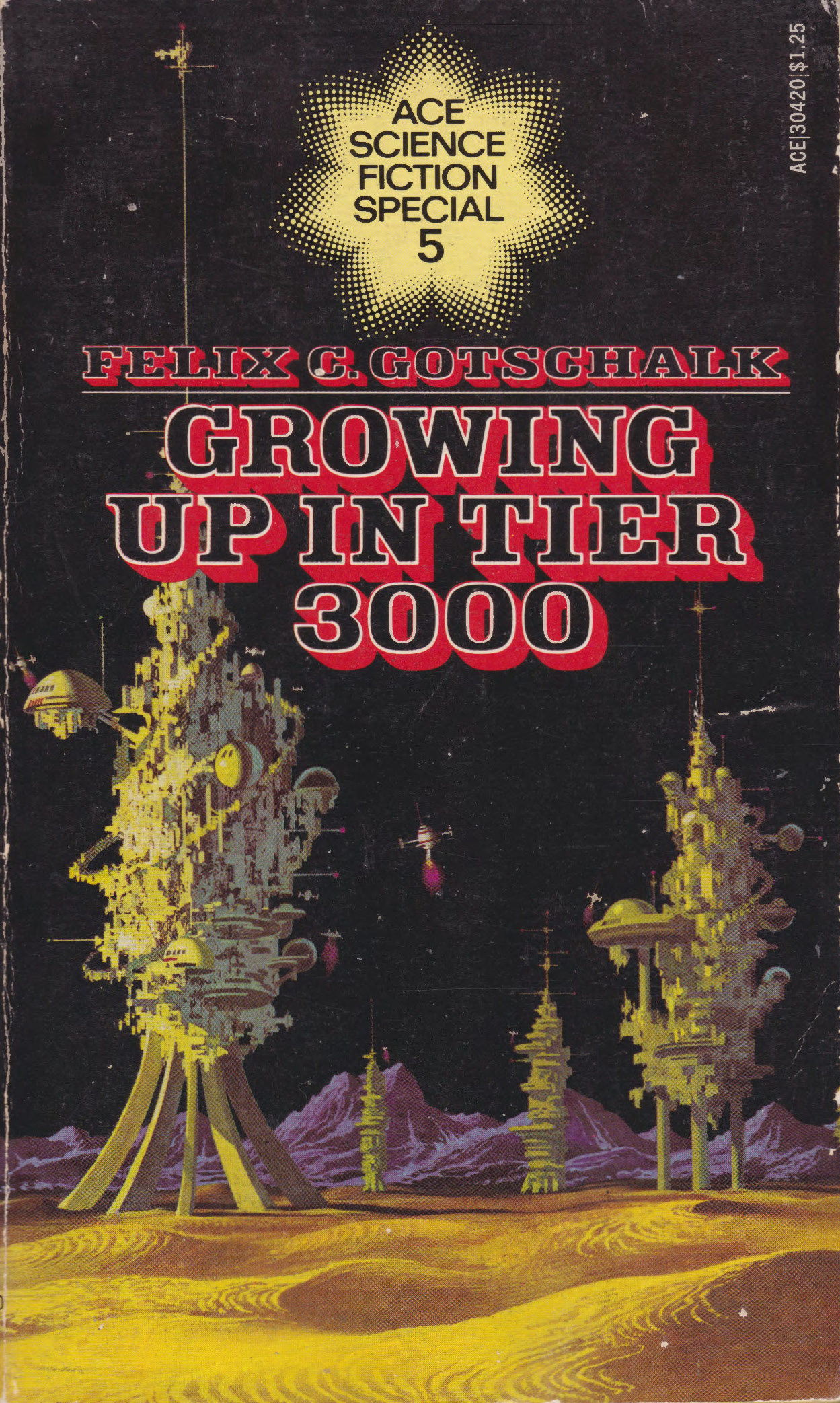
1) Futuristic city? Yes! Is more needed? Okay, okay, I concede, more is needed. I hope Gotschalk’s novel with its fantastic Dean Ellis cover delivers. Among the least known of the Ace Science Fiction Special series…

Check out my older reviews of J. G. Ballard’s “Billennium” (1961)Future City, ed. Roger Elwood (1973), and The World Inside, Robert Silverberg (1971) for more SF on this theme of futuristic cities. If you delve through the archives you’ll find many more examples.

2) Ballard blurbs Martin Bax’s novel as “…the most exciting, stimulating and brilliantly conceived book I have read since Burroughs’ novels.” Hyperbole aside, the two reviews (here and here) I’ve read of Bax’s sole novel puts this at the top of my “to read” pile.

I have cheated a bit by including the cover for the first New Directions edition rather than the later Picador edition I own due to the cover quality.

3) Three acquisitions posts ago (here) I mentioned that the premise of Marge Piercy’s Dance the Eagle to Sleep (1970) did not inspire me to read it anytime soon. Thankfully I found a copy of what many consider her masterpiece Woman at the Edge of Time (1976) cheap at the local used book store.

4) I am not sure why I picked this collection up—I’ve heard good things about Joe Haldeman’s introduction which draws on his experience in the Vietnam War. As Isaac Asimov, Mack Reynolds, etc are not normally authors who intrigue me, I might do something I rarely do and read and review Effinger’s story only (and maybe Poul Anderson’s as he’s better in short form)…

As always thoughts and comments are welcome.

~

1. Growing up in Tier 3000, Felix C. Gotschalk (1976)

(Dean Ellis’ gorgeous cover for the 1976 edition) Continue reading