Short Story Reviews: Ted White’s “Growing Up Fast in the City” (1971), “Junk Patrol” (1971), and “Things Are Tough All Over” (1971)

Ted White (1938-) took over as editor of Amazing Science Fiction and Fantastic from Barry N. Malzberg in October, 1968. As the magazines were bi-monthly and Malzberg had already acquired stories for multiple later issues, White’s first issues appeared in 1969. He’d accepted the position on the condition that he phase out the reprints (not acquired by White) slowly over multiple years.1 Apparently while White was not a fan of the New Wave movement, he “was all for more daring fiction exploring adult themes and saw no reason why these stories could not co-exist alongside more traditional stories.”2 Thus, his two magazines attempted to appeal to a wide-range of readers.

By the early 1970s, White demonstrated growing interest in even “greater liberalization of science fiction, in line with what was happening to youth nationwide.” He saw SF as “a vehicle to push back on the barriers of the ‘establishment’, with no suppression of soft drugs, ‘healthy sex,’ or free expression.”3 His magazines included stories emphasizing future sex in all its forms” far more frequently than its competitors.4 As the pay rates of both magazines were low–White could only pay 1 cent a word vs. 3 cents for the bigger magazines of the day–he attempted to appeal to writers who did not mesh well with the “establishment.”5

White did not earn a living wage as the editor despite the magazines consuming much of his time. In order to cobble together a meager living he also served as art director (which included cutting and pasting each issue) and wrote stories to publish in his own magazines!6 White’s first professional stories appeared in 1962 after a decade of fan writing.

This post includes three of White’s own violent and bleak visions of future society that appeared in Amazing and Fantastic. While he might not have been a fan of the experimental tendencies of the movement, his obsession with violating taboos, scenes of urban decay, and general miasmic gloom are certainly on display.

I am increasingly fascinated by the more radical, bleak, and grimy stories within White’s magazines–both from his pen and others–and plan on exploring more. See my earlier reviews of Lisa Tuttle’s “Stone Circle” (1976) and Grania Davis’ “New-Way-Groovers Stew” (1976).

Let’s get to the stories!

3.75/5 (Good)

Continue reading

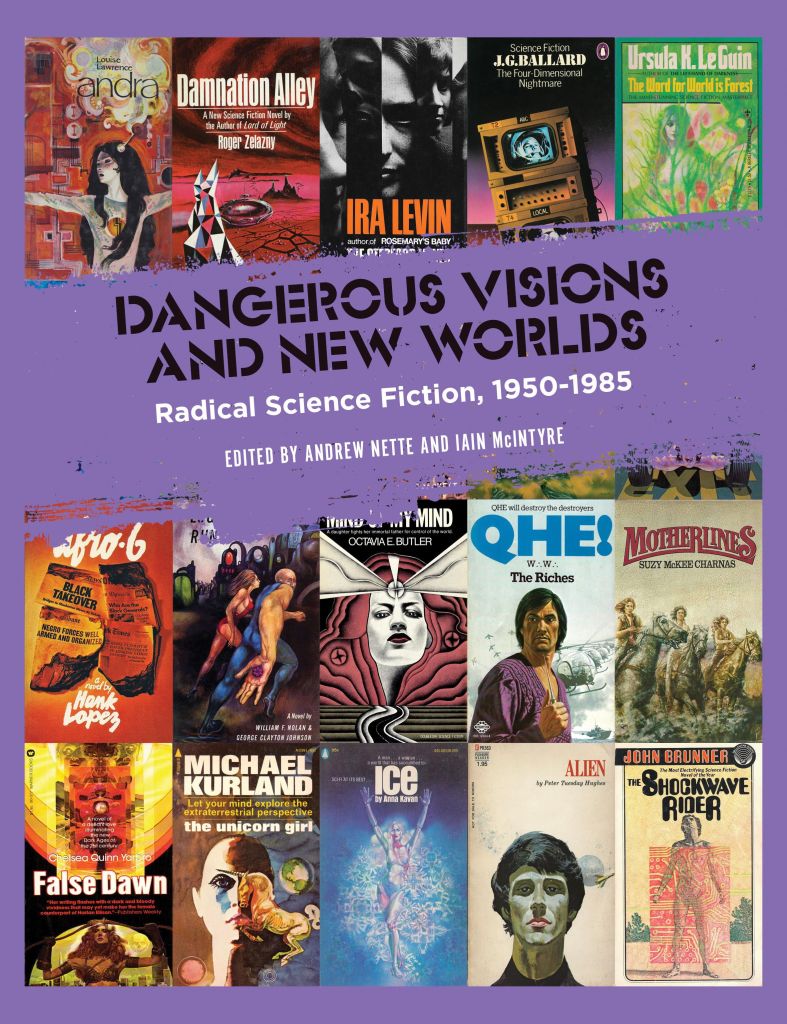
The Introduction to Dangerous Visions and New Worlds: Radical Science Fiction, 1950-1985, ed. Andrew Nette and Iain McIntyre (2021)

I’ve recently conducted a binge read of my ARC of Dangerous Visions and New Worlds: Radical Science Fiction, 1950-1985, ed. Andrew Nette and Iain McIntyre (2021). It is a must buy for any SF fan of the era interested in exploring the larger world behind the texts. Considering the focus of my website and most of my reading adventures over the last decade, I can unabashedly proclaim myself a fan of the New Wave SF movement–and this edited volume is the perfect compliment to my collection and interests.

The editors and PM Press have graciously provided me with the introduction to the volume. Perhaps it’ll convince you to purchase your own copy!

Relevant links: Amazon USA, Amazon UK, and the publisher website.


Dangerous Visions and New Worlds

An Introduction

The “long sixties,” an era which began in the late 1950s and extended into the 1970s, has become shorthand for a period of trenchant social change, most explicitly demonstrated through a host of liberatory and resistance movements focused on class, racial, gender, sexual, and other inequalities. These were as much about cultural expression and social recognition as economic redistribution and formal politics. While the degree to which often youthful insurgents achieved their goals varied greatly, the global challenge they presented was a major shock to the status quo.

Continue reading

Updates: My 7 Favorite Metafictional Science Fiction Novels

Here are my seven favorite metafictional science fiction novels. By metafiction I’m referring to devices such as breaking the fourth wall (characters addressing the audience), the author addressing the reader, a story about a writer writing a story, a story containing another work of fiction within it, a work where the narrator reveals himself or herself as the author of the story, narrative footnotes, etc….

I’d love to hear your favorites (they don’t have to be novels)!

Obviously, these types of experimental works only appeal to some readers (especially fans of the sci-fi New Wave movement of the late 60s and early 70s) but I personally love seeing experimentation in an often — dare I say — stylistically stale genre.  Often, the metafictional aspects do not prevent authors from deploying traditional narratives.

 71nOA-QfpuL NSTNINT1967 RVLTNSXKSK1977

 THIRNDRM1972 MNINTHCST1974

My top seven (and an honorable mention):

1. Beyond Apollo, Brian N. Malzberg (1972) (REVIEW) — what you read is most likely the novel written by the main character. However, he’s most likely insane so attempting to get AT the true nature of his voyage to Venus is purposefully layered… Complicating the matter is how unreliable of a narrator he is and the fact that he’s tells many versions of the same story. Malzberg pokes fun at pulp science fiction throughout — which he clearly enjoyed as a child.

2. Stand on Zanzibar, John Brunner (1968) — the metafictional aspects are rather hidden in this New Wave masterpiece (my single favorite sci-fi novel).  Brunner’s vast (in scope and depth) mosaic of invented book fragments, advertising jingles, and narrative portions are interspersed with news articles taken from his own day — including the school shooting at the University of Texas in 1966.  Of course, as readers we’re geared to imagining that everything Continue reading