What pre-1985 science fiction are you reading this weekend?
After the success of the previous installment, I’ve decided to make this a bimonthly post (“column”) for my site (“fanzine”). As before, I’ve included a bit about the books in the photograph, birthdays from the last two weeks, and brief ruminations on what I’ve been reading and writing.
What pre-1985 science fiction are you reading this weekend?
Every Saturday for more than a year, I’ve asked this question on Twitter (and since February on Mastodon) with a photo of books I’ve read and reviewed on my website from my shelves. Due to the painful implosion of Twitter and the confused and frustrating “what platform do we go to next” panic, I’ve decided to move my weekly question and photo to my site. This community is always first and foremost in my mind. Thank you commenters and lurkers!
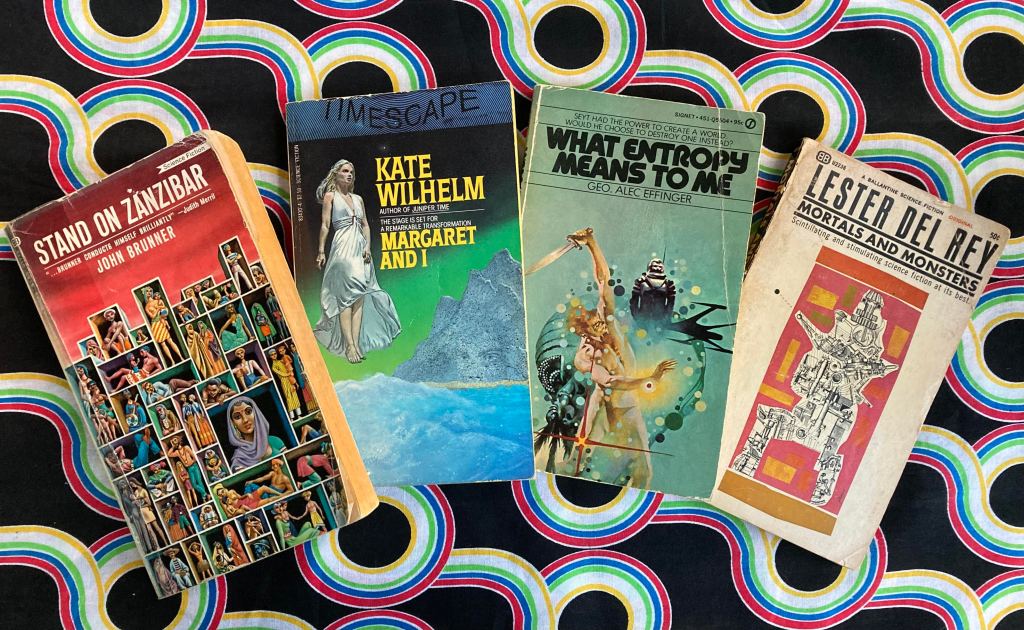
I’ve returned from my expedition abroad. It’s time to get back to writing about science fiction! But first, there are always new books that have accumulated at my doorstep…
Which books/covers/authors intrigue you? Which have you read? Disliked? Enjoyed?
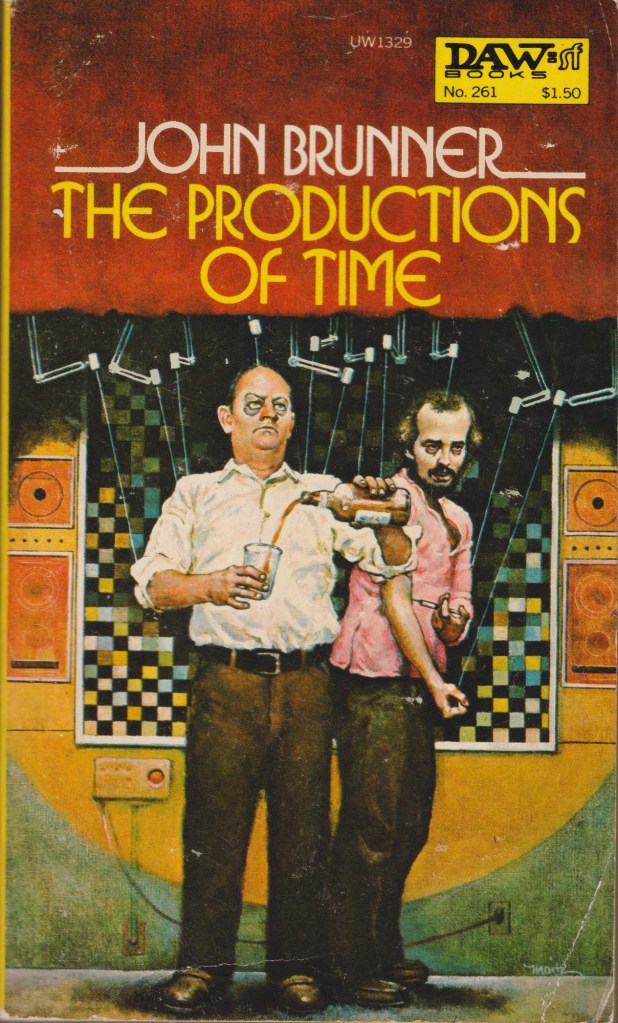
1. The Productions of Time, John Brunner (serialized 1966)
Don Maitz’s cover for the 1977 edition
From the back cover: “Murray Douglas had been a theatrical star until he’d hit the bottle once too often. But now he had broken the habit, and, handsome and fit, was ready for a comeback. The most challenging opening available was an avant-garde play where the actors themselves would make up the drama as they went along.
But out at an isolated country estate where the rehearsals were going on, Murray found himself trapped on a real-life day-and-night stage in which nothing was as it seemed, in which inexplicable devices monitored everything and eerie lures attracted each actor’s psychological weakness.
Who then was the real sponsor of this terrifying play–and to what alien audience was it to be presented?
By the Hugo-winning author of STAND ON ZANZIBAR, this is the first unabridged American edition of this John Brunner classic.”
Which books/covers/authors intrigue you? Which have you read? Disliked? Enjoyed?
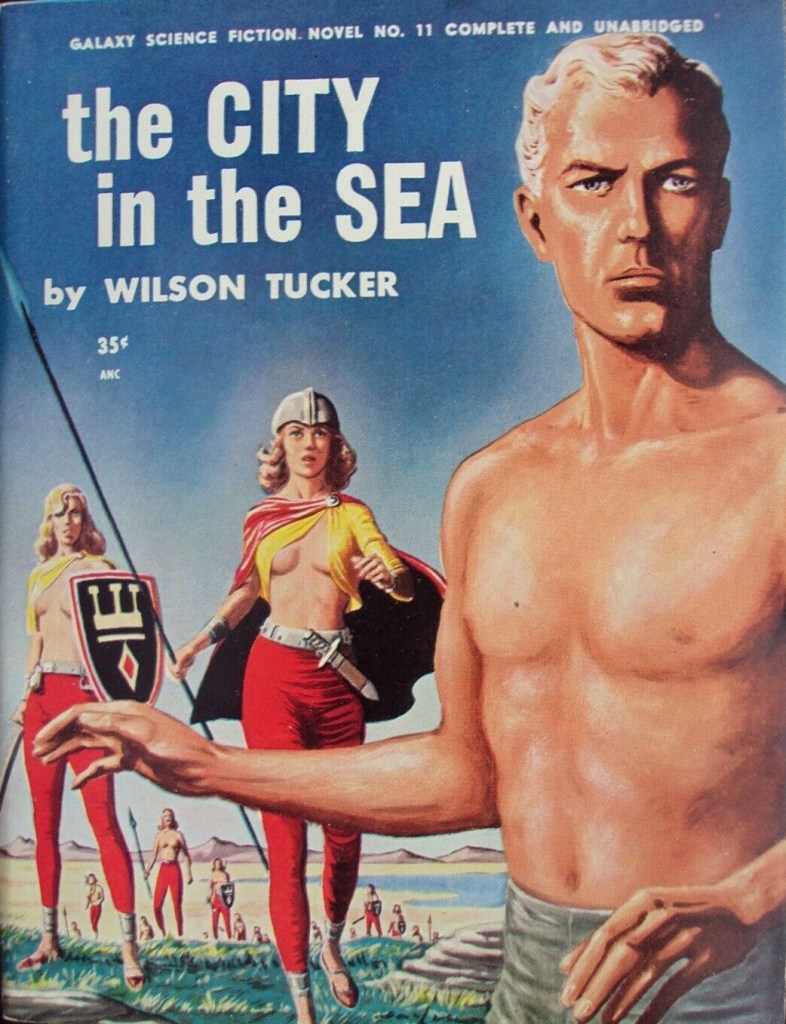
1. The City in the Sea, Wilson Tucker (1951)
Ed Emshwiller’s cover for the 1952 edition
From the inside flap: “Who knows whether the strange events of this story might not one day occur?
This is the story of an expedition—a strange and exciting expedition of one man and an army of women.
He had come into the land of the women suddenly—and without warning. Tall, bronzed, muscular, he stood out among their pale skins and meek spirits. And when they learned of the land from which he had come–the land they hadn’t even known existed—they had to follow him to it.
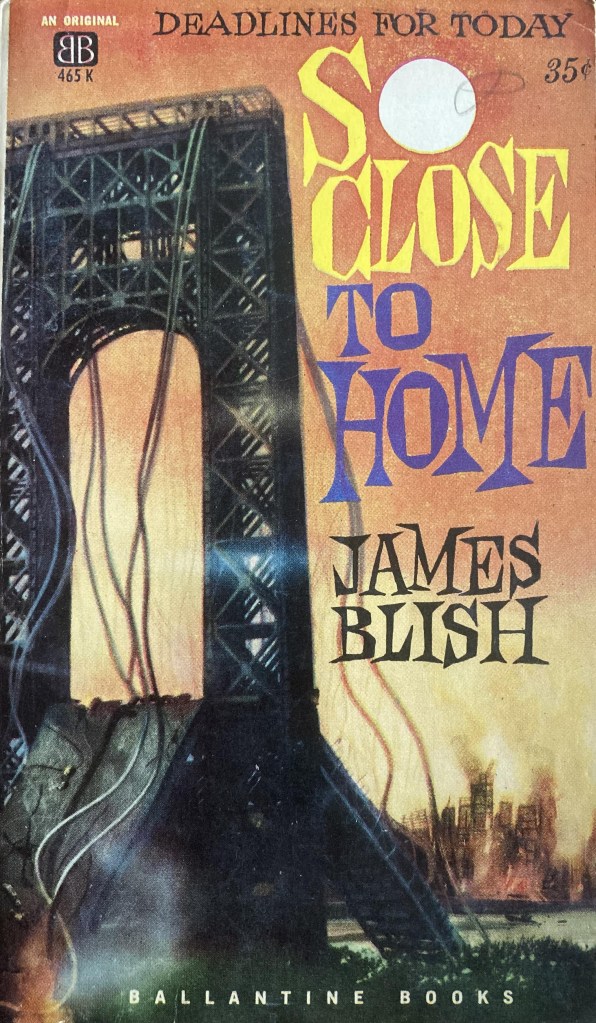
It’s been more than a decade since I’ve read James Blish. I’ve long been a fan of his Hugo-winning novel A Case of Conscience (1958) and individual stories in collections like The Seedling Stars(1957) and Galactic Cluster (1959). Unfortunately, So Close to Home (1961) is an uneven collection with more duds than hits. The three worthwhile stories–“The Oath” (1960), “Testament of Andros” (1953), and “The Masks” (1959)–can be found online at the links below. Almost all the stories in the collection are set in the near future and chart humanity’s fear of the end and how one might navigate the strange new worlds that emerge.
Which books/covers/authors intrigue you? Which have you read? Disliked? Enjoyed?
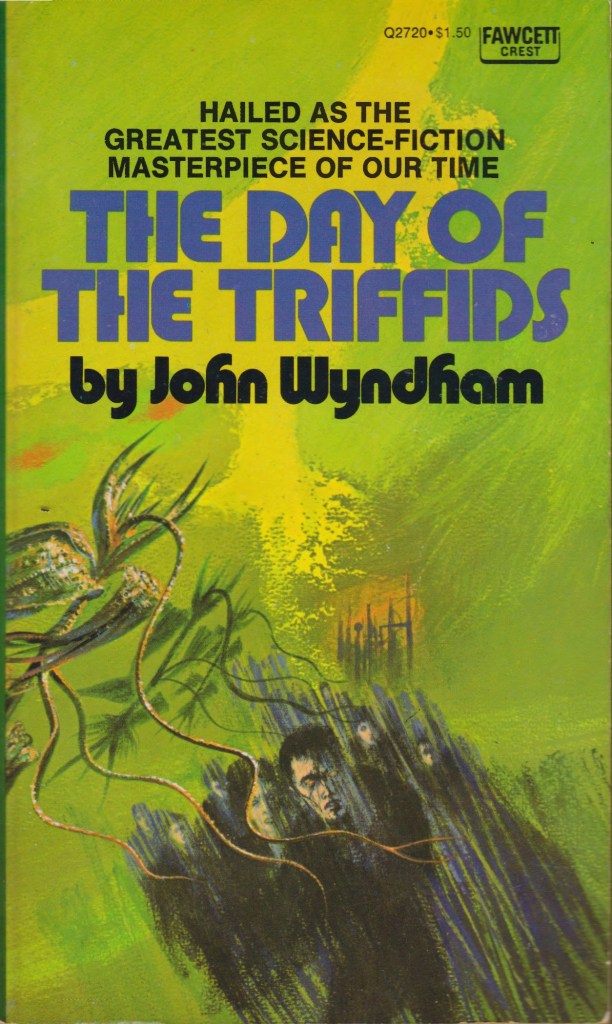
1. The Day of the Triffids, John Wyndham (1951)
Richard Powers’ cover for the 1964 edition
From the back cover: “WHAT WERE THEY–
THESE HIDEOUS TRIFFIDS ROAMING THE RUINS OF THE EARTH?
Until a few short hours ago–before the sky exploded into a shower of flaming green hell–triffids had been regarded as merely a curious and profitable form of plant life. Now these shadowy vegetable creatures became crawling, killing nightmare of pain and horror.
Madness hung in the air, fear lurked in every side street, death hovered in every doorway. Stripped of civilized veneer by terror and desperation, the handful of surviving humans began to turn on each other.
The following review is the 20th installment of my series searching for “SF short stories that are critical in some capacity of space agencies, astronauts, and the culture which produced them.” Some stories I’ll review in this series might not fit. Many are far from the best. And that is okay. I relish the act of literary archaeology.
I turn now to an author, Harlan Ellison (1934-2018), whom I’ve only marginally explored considering his prodigious output. I am completely ignorant of his 50s visions. I’d previously read and reviewed his collection Approaching Oblivion (1974) and a handful of other stories including “A Boy and His Dog” (1969). The first story in this post–“Psycho at Mid-Point” (1956)–exemplifies the theme at its most brutal and nihilistic. As a bonus, I’ve paired it with one of Ellison’s better known 50s tales of mutants and prison ships–“The Discarded” (variant title: “The Abnormals”) (1959). If you know of any other Ellison stories that might fit the theme, let me know.
As always, feel free to join the conversation and read along with me on the search for the depressed astronaut.
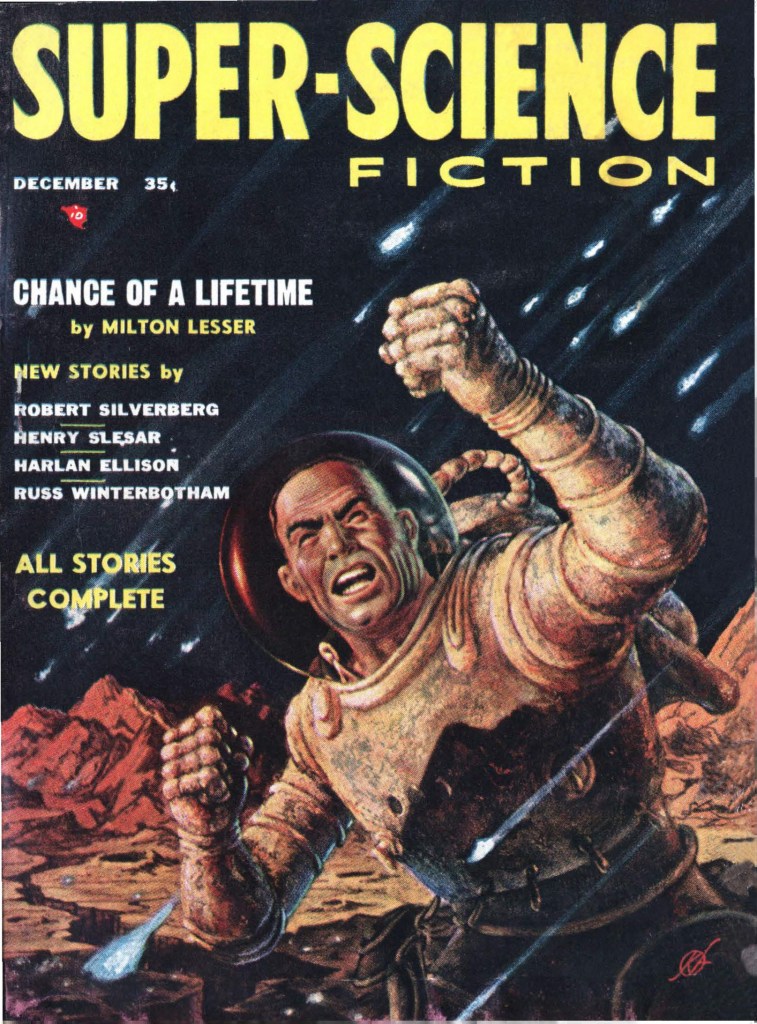
Frank Kelly Freas’ cover for Super-Science Fiction, ed. W. W. Scott (December 1956)
3.25/5 (Above Average)
Harlan Ellison’s “Psycho at Mid-Point” first appeared in Super-Science Fiction, ed. W. W. Scott (December 1956). You can read it online here. It was not collected or anthologized.
Mike Ashley in Transformations: The Story of the Science Fiction Magazines from 1950 to 1970(2005) does not have kind words for the three-year run of the magazine Super-Science Fiction (1956-1959). He describes the editor W. W. Scott as utterly out of his depth with a misguided reliance on “instant impact” without substance or cohesion or knowledge of the field. That said, Scott accidentally published a few solid short stories before the magazine’s demise in the market collapse in the late 50s even if the overall issues tended to be poor (168-169) and pandered to whatever craze filled the air (187). I’d classify Harlan Ellison’s “Psycho at Mid-Point” as a solid early work that fits the theme of this series perfectly!
Which books/covers/authors intrigue you? Which have you read? Disliked? Enjoyed?
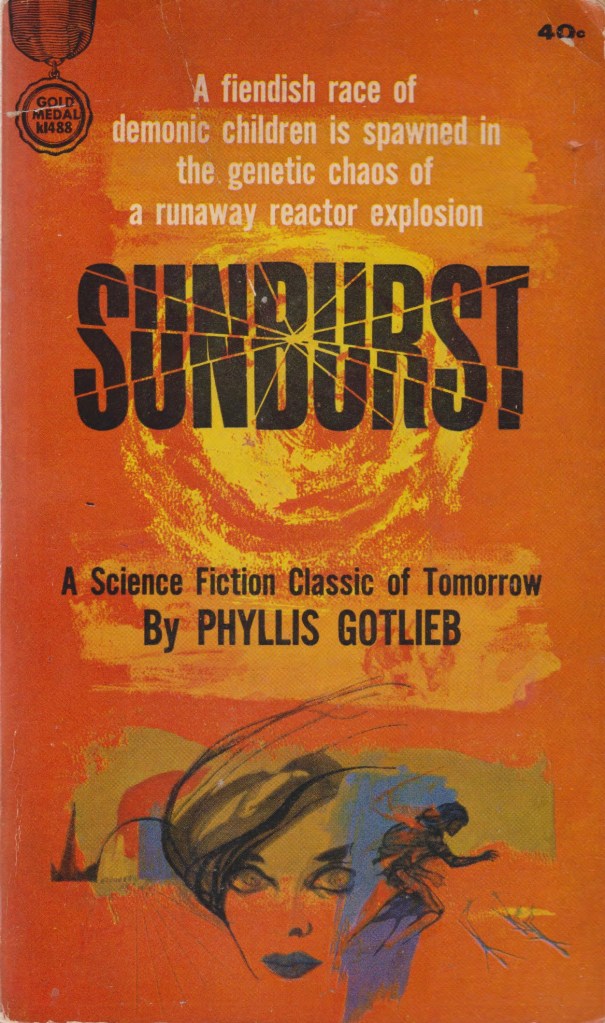
1. Sunburst, Phyllis Gotlieb (1964)
Richard Powers’ cover for the 1st edition
From the back cover: “In the hideous aftermath of the atomic sunburst. The people of Sorrel Park had been written off. Now they were nothing but a kind of human garbage, festering and hopeless.
In the center of town lived the worst of the human garbage–and by far the most dangerous. They were a breed of terrible children, possessed by terrifying supernormal powers. They were a new race of monster bred out of the sunburst, and if they ever broke loose they would destroy the world…”

 Science Fiction and Other Suspect Ruminations