Which books/covers/authors intrigue you? Which have you read? Disliked? Enjoyed?
1. Deus Irae, Philip K. Dick and Roger Zelazny (1976)
Richard Corben’s cover for the 1980 edition
From the back cover: “One their own, they have written landmarks works that have added whole new dimensions of wonder to the field of science fiction. Now, in Deus Irae, they have created what ALA Booklist calls “the most successful collaboration in years!”–set in in bizarre world where you will encounter…
A bunch of backwoods farmers who happen to be lizards…
What pre-1985 science fiction are you reading or planning to read this month? Here’s the January installment of this column (sorry I missed a month).
Before John W. Campbell, Jr. (1910-1971) attempted to raise the “standards and thinking in magazine SF,” David Lasser (1902-1996) attempted his own brief (1929-1933) program to improve science fiction as managing editor of Hugo Gernsback’s Science Wonder Stories, Wonder Stories, and Wonder Stories Quarterly. According to Mike Ashley’s The Time Machine: The Story of the Science-Fiction Pulp Magazine from the Beginning to 1950 (2000), Lasser is a “much neglected revolutionary in science fiction” and through his efforts the genre “started to mature” (66).
Ashley highlights Lasser’s letter of instruction mailed to his regular contributors on the 11th of May, 1931, in which he “exhorted them to bring some realism to their fiction” (72). He also outlawed common tropes like the giant insect story and space opera (73). He emphasized the need to focus on characters that “should really be human” — not everything needs to be a “world-sweeping epic” (73). Stories in this vein, according to Ashley, include Clifford D. Simak’s religiously themed “The Voice in the Void” (1932), P. Schuyler Miller and Walter Dennis’ “The Red Spot on Jupiter” (1931) and “The Duel on the Asteroid” (1974), which featured a grim realism and character development (74).
What pre-1985 science fiction are you reading or planning to read this month? Here’s the December installment of this column.
Lost texts, and the act of reconstructing the fragments, fascinates. The questions pile up. Would the contents reveal a pattern in an author’s work? Intriguing personal details? A startling modus operandi? At the 11th World Science Fiction Convention (Philcon 2), Philadelphia (September 1953), Philip José Farmer gave a speech titled “SF and the Kinsey Report.” Considering Farmer’s recent publication of “The Lovers” (1952), this is not surprising. Alfred Kinsey, the famous sexologist and founder of the Kinsey Institute for Research in Sex, Gender, and Reproduction on Indiana University’s campus, published his controversial Sexual Behavior in the Human Male in 1948. Sexual Behavior in the Human Female appeared in 1953. Like many of Farmer’s earliest speeches, he did not keep copies.
Deeply intrigued by what the speech might have contained, Sanstone and I (on Bluesky) managed to piece together a few general responses from fanzines and magazine con reports.
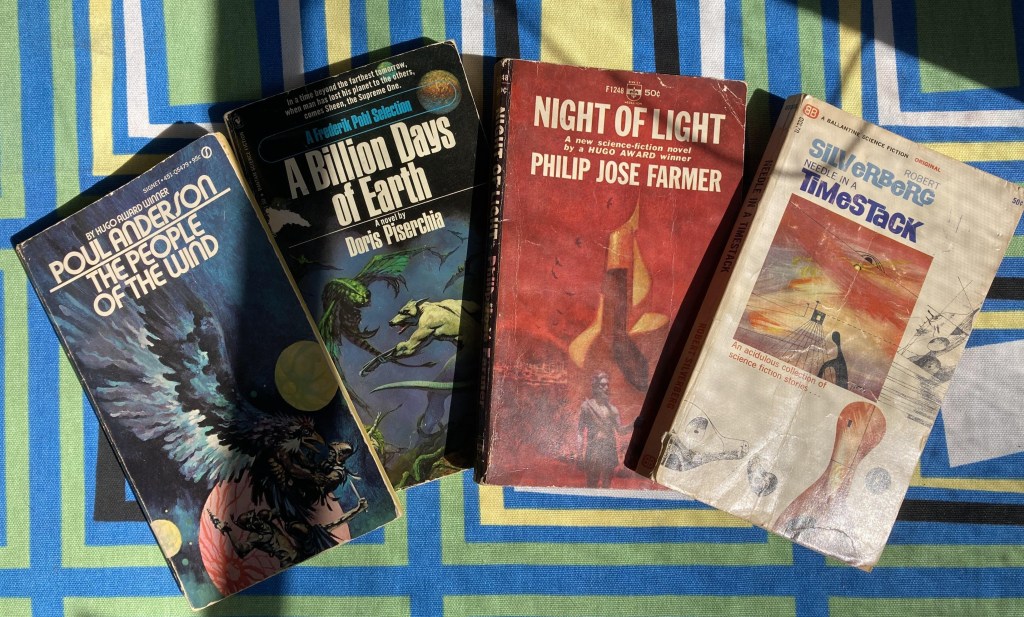
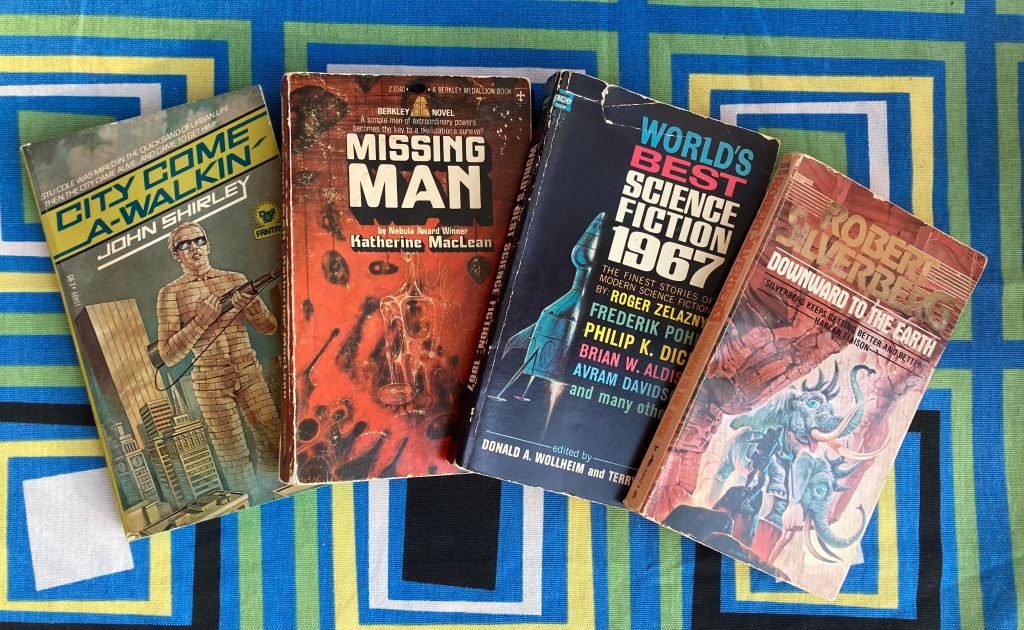
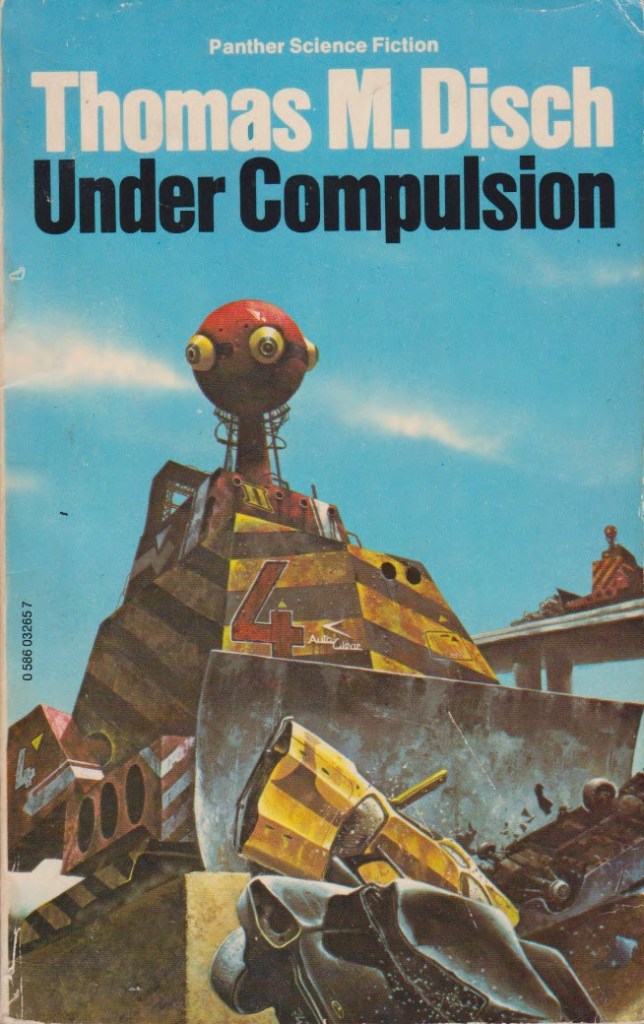
A selection of SF volumes acquired over winter break!
Which books/covers/authors intrigue you? Which have you read? Disliked? Enjoyed?
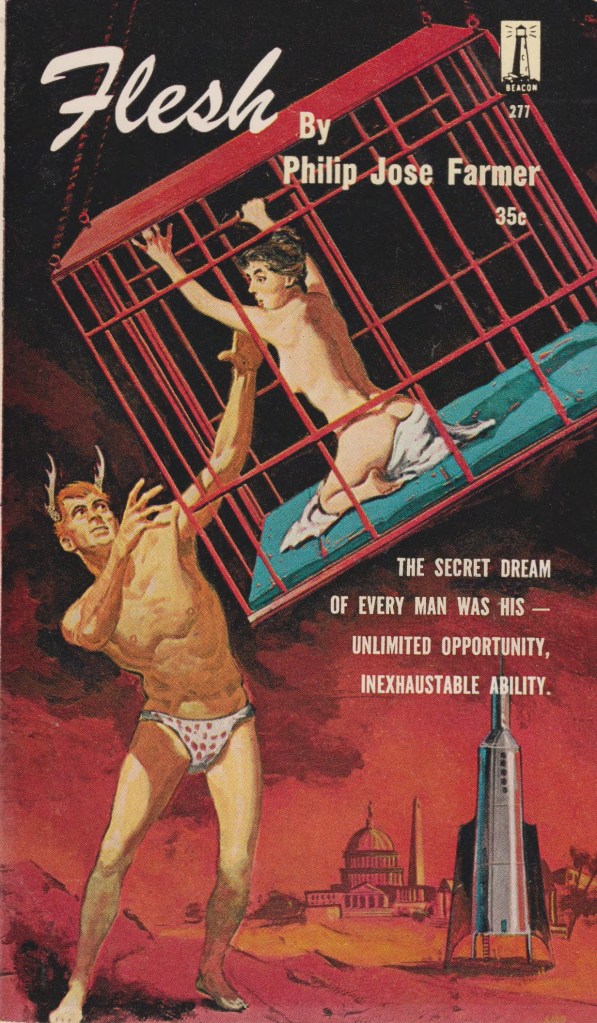
1. Flesh, Philip José Farmer (1960)
Gerald McConnell’s cover for the 1st edition
From the back cover: “Spaceman by DAY… MONSTER by night!
Peter Stagg was caught in the vilest trap ever devised–his own lust-driven body! For FLESH is the pulse-stirring story of a space explorer’s return from the strangest voyage man had ever made–to the strangest world the universe had ever seen–his own Earth!
Which books/covers/authors intrigue you? Which have you read? Disliked? Enjoyed?
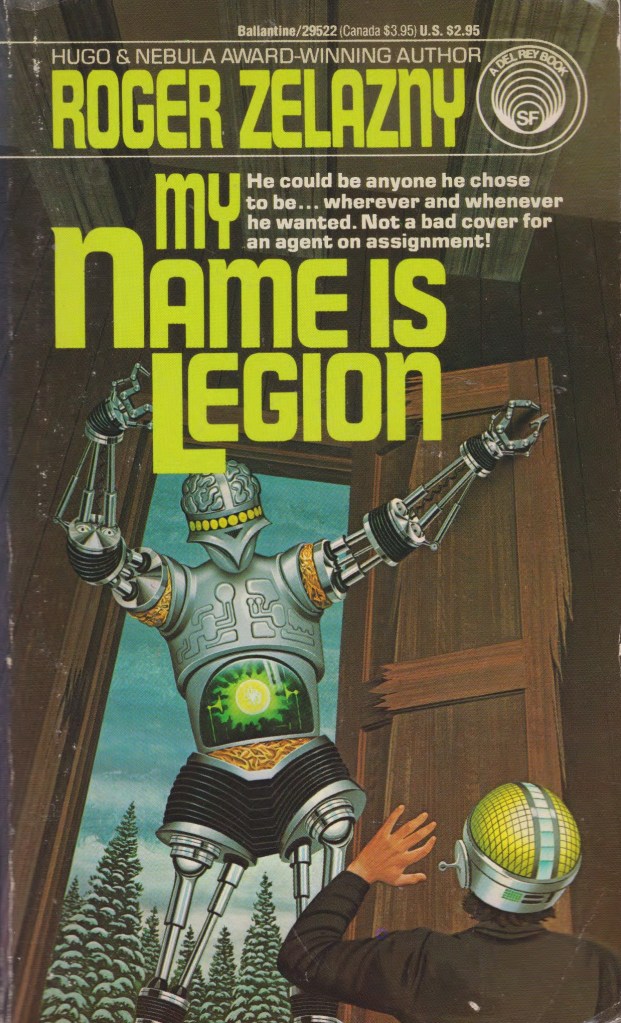
1. My Name is Legion, Roger Zelazny (1976)
Ralph Brillhart’s cover for the 1981 edition
From the back cover: “HE DID NOT EXIST… OR DID HE? He had destroyed his punch cards and changed his face. There was no credit card, birth record, or passport for him in the International Data Bank.
His names were many… any he chose.
His occupation was taking megarisks in the service of a vast global detective agency.
His interworld assignments were highly lucrative, incalculably vital, and terrifyingly deadly.
And more often than not, his life was a living hell!”
Contents: “The Eve of RUMOKO” (1969),” “‘Kjwalll’kje’k’koothaïlll’kje’k” (1973), “Home Is the Hangman” (1975)
Initial Thoughts: In the early days of my site read I reviewed the first in the Nemo sequence–“The Eve of RUMOKO” (1969). At the time I did not care for it. However, I recently read F. Brett Cox’s monography Roger Zelazny (2021) and retrospectively I’m not sure that I understood the character or what Zelazny was trying to accomplish with the story sequence. Often after I read a monograph, I end up making a few impulsive purchases and this is one of them! I hope, at the very least, it gives me a deeper understanding of Zelazny’s SF project. And “Home Is the Hangman” (1975) is a Hugo and Nebula-winning novella that I have not read.
2022 was the single best year in the history of my site for visits and unique viewers!
As I mention year after year, I find reading and writing for the site—and participating in all the SF discussions generated over the year—a necessary and greatly appreciated salve. Whether you are a lurker, occasional visitor, or a regular commenter, thank you for your continued support.
Continuing a trend from 2021, I read only a handful of novels this year. Instead, I devoted my obsessive attention to various science short story review initiatives (listed below), anthologies, and histories of the science fiction genre. Without further ado, here are my favorite novels and short stories I read in 2022 with bonus categories. Descriptions are derived from my linked reviews.
Check out last year’s rundown if you haven’t already for more spectacular reads. I have archived all my annual rundowns on my article index page if you wanted to peruse earlier years.
My Top 5 Science Fiction Novels of 2022 [TITLES LINK TO FULL REVIEWS]
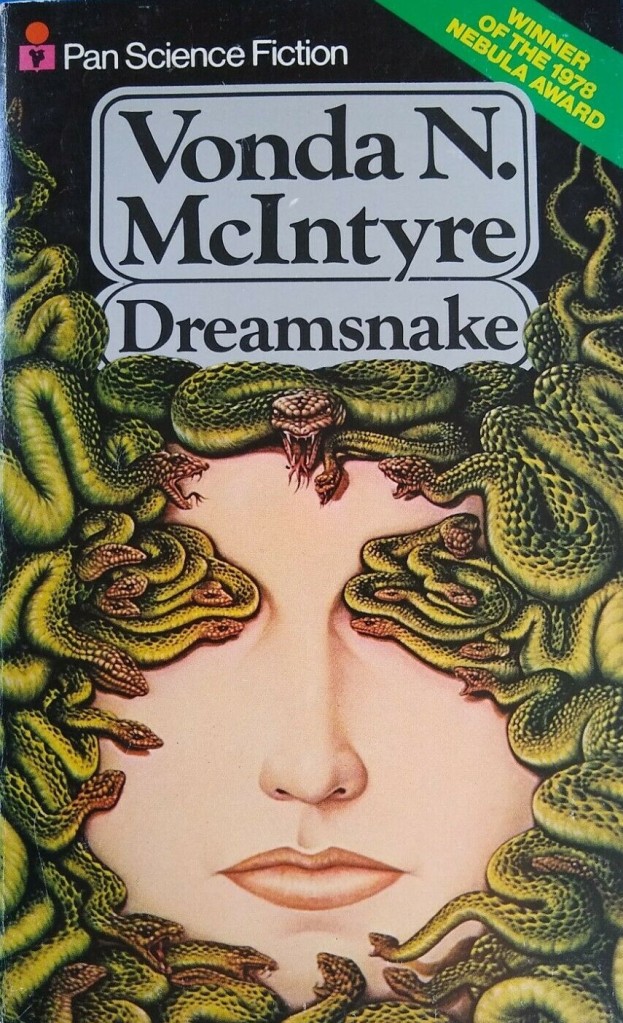
George Underwood’s cover for the 1979 edition
1. Vonda N. McIntyre’s Dreamsnake(1978), 4.75/5 (Near Masterpiece): Won the 1979 Hugo, Locus, and Nebula Award for Best Novel. Snake journeys across the post-apocalyptic wastes of a future Earth with three serpents healing the sick and caring for the dying. She is a member of the healers, who adopt orphans and rescue the oppressed and train them how to use the serpents. Mist and Sand are genetically modified vipers of terrestrial origin. But Grass comes from another alien world. Snake uses Mist and Sand’s venom to create vaccines, treat diseases, and cure tumors. Grass, the rare dreamsnake, with its alien DNA is the most important of them all–it provides therapeutic pleasure and dreams that facilitate conquering one’s fear and healing in the ill. In Snake’s voyages, she encounters prejudice and violence. A joyous sense of sexual freedom permeates the proceedings. A powerful and different take on a post-apocalyptic worldscape in every possible way.
Earle Bergey’s cover for Startling Stories, ed. Samuel Mines (August 1952)
3.5/5 (Good)
Preliminary note: This is a review of the original 1952 novella. You can read it online here. Philip José Farmer published a novelization in 1961. While the novel was frequently republished, the original novella was not anthologized until 2003 (bibliography). I am in half a mind to read the 1961 version and analyze the changes!
This is a review that I wish I didn’t have to provide a rating as my lukewarm response to the story might obfuscate my fascination with its thematic contents and larger historical context. Philip José Farmer’s novella “The Lovers” (1952) is, without doubt, historically important for the development of the SF genre as it introduced a transgressive mix of sex (mostly implied), unusual xenobiology, and colonial critique. It shocked and fascinated readers at the time. In a letter published in the September issue of Startling Stories, Farmer himself predicted the “Reverberations from THE LOVERS should be really bouncing” later in the year (136). And he was right!
Which books/covers/authors intrigue you? Which have you read? Disliked? Enjoyed?
1. The Lovers, Philip José Farmer (1961)
Mati Klarwein’s cover for the 1972 edition
From the back cover: “In 1952, Philip José Farmer excited instant acclaim in the science fiction field with the publication of a short story, THE LOVERS.
In 1961, he wrote and published the full-length novel based on that short story.
And in 1972, Ballantine Books is proud to bring this classic work back into print.
Mr. Farmer, who is known for his explorations into the psychological byways of odd relationships, here postulates a love affair which might well have surprised even Haverlock Ellis. but words such as ‘normal’ or ‘abnormal’ simply have no application in the original concepts to which Mr. Farmer’s imagination gives rise. The book remains unique and fascinating.”




 Science Fiction and Other Suspect Ruminations