Book Review: The Joy Makers, James Gunn (1961, magazine publication 1955)

(William Hofmann’s cover for the 1961 edition)

4.25/5 (collated rating: Good)

The three parts of James Gunn’s fix-up novel The Joy Makers (1961) were originally published in magazine form in 1955 as ‘Name Your Pleasure,’ ‘The Naked Sky’, and ‘The Unhappy Man.’  I have not read the originals so I’m unsure of how much was added or subtracted or completely re-conceptualized.  Largely a satire — Gunn pushes his point to the logical, and terrifying extreme — each part is a further chronological progression of a society whose chief aim is to make people happy.  It is hard not to read Part I as a satirical take on some aspects of Scientology,  a movement that was gaining force in the early 1950s.

Because each part is only linked thematically to the others

Continue reading

Updates: Recent Science Fiction Acquisitions N. XXXVIII (Spinrad + Harrison + Kavan + Effinger)

Ah, when I have access to a massive inexpensive catalogue (Marx Books) the quality of my finds goes up and up…..  Finally a copy of Norman Spinrad’s metafictional The Iron Dream (1972) (if Hitler lived in America and wrote a sci-fi novel AND a commentary on said piece of science fiction).  Unfortunately, I own a later edition (with a hideous cover) than the one below.  Geo. Alec Effinger’s bizarre What Entropy Means to Me (1972) — again, about writing, and interpreting writing, and inventing interpretation…  Anna Kavan’s drug inspired underrated and underread sci-fi parable Ice (1976).  AND, a futuristic fantasy of the highest caliber, M. John Harrison’s The Pastel City (1971) — yes, I could have purchased the multi-novel sequence (and related short stories) in one volume but I like having the original paperbacks.

1. The Iron Dream, Norman Spinrad (1972)

(Uncredited cover for the 1972 edition) Continue reading

Adventures in Science Fiction Cover Art: Nuclear Explosions + Mushroom Clouds

(Ed Valigursky’s cover for the 1957 edition of Doomsday Eve (1957). Robert Moore Williams)

The nuclear scare produced some of the best dystopic visions ever put to paper — the devastation would be utter, complete, and the radiation, oh what fun science fiction authors and filmakers had with the effects of radiation.  A red spectrum! Mutations! Hybrid bug people!  Godzilla!  Women with two heads!  An endless assortments of monsters…  I’ve selected a wide range of covers depicting the actual nuclear explosion — not the after effects.  Families gaze from caves in dispair, watching the bomb incinerate their world.  People run helter-skelter away from the explosion.  Or, artists take a more stylized approach to the explosion — figures are cast upward amongst the wreckage of buildings. Continue reading

Updates: Recent Science Fiction Acquisitions No. XXXII (Cowper + Vance + Williamson + MacTyre)

As always Half Price Bookstore in Northern Austin, TX yielded a wonderful collection of sci-fi paperbacks…  I bought Doomsday, 1999 (1962) solely on the cover art — cool looking city exploding…  Richard Cowper’s Profundis (1979) on recommendation of my friend 2theD at Potpourri of Science Fiction Literature who waxed prophetic (hopefully)/intellectually about to joys of this seldom read author (well, his fantasy at least).  I personally, do not have high hopes considering the questionable nature of the back flap blurb.  My previous Williamson experiment, Trial of Terra (1962), had promise so I picked up one of his supposedly best works, Bright New Universe (1967).  And well, Vance is Vance and thus almost always worth reading….

1. Doomsday, 1999 (variant title: Midge),  Paul MacTyre (1962)

(Uncredited cover for the 1963 Continue reading

Book Review: The Penultimate Truth, Philip K. Dick (1964)

(Uncredited cover for the 1964 edition)

4/5 (Good)

Although I’ve read a great majority of Philip K. Dick’s novels and short stories, I’ve only reviewed one of Philip K. Dick’s novels in the lifetime of this blog, The Man Who Japed (1956).  Despite not reaching the near perfection which characterizes his best works, The Penultimate Truth (1964) is worth the read.  The work’s premise is pure PKD.  As with his best, an uncanny sci-fi infused surrealism seeps from the pages….  However, the work is plagued by ramshackle editing, the unfortunate tendency to use words like “homeostatic” and “tropism” ever few pages, and an ungainly plethora of named characters who have little to no import in the novel creates unnecessary confusion.

Brief Plot Summary (limited spoilers)

Most of the inhabitants of Earth, due to worries about an approaching nuclear war with the Soviets, retreated to massive underground facilities (Tom Mix Continue reading

Updates: Recent Science Fiction Acquisitions No. XXXI (Dick + Zelazny + Tucker + Smith)

Another wonderful assortment (some from Central Texas bookstores, some from my father as presents, some semi-forgotten works from a few months ago that I forgot to post about)…  Regardless, I’m almost finished Zelazny’s Jack of Shadows (1971) and am quite impressed (I loved This Immortal and Lord of Light).  Another PKD, Dr. Bloodmoney or How We Got Along After the Bomb (1965),  swells my already extensive collection of his novels and short story collections — again, the premise is vintage PKD surrealism (girl with twin brother growing inside of her in a post-apocalyptical wasteland).  I bought the Wilson Tucker novel, Tomorrow Plus X (1956), because of the gorgeous Richard Powers cover…  A few of his works are supposedly readable, but this one is probably justly forgotten.  The Cordwainer Smith collection, Space Lords (1965), will be my first exposure to his work — very excited!  Now that I think about it, I do have a copy of Norstrilia (1975) languishing somewhere.

Enjoy!

1. Jack of Shadows, Roger Zelazny (1971)

(Robert Pepper’s cover for the 1972 Continue reading

Adventures in Science Fiction Cover Art: Ice-Covered Cities

(Uncredited cover for the 1959 edition of We Who Survived (1959), Sterling Noel)

One of many ways science fiction authors speculate about the end (or beginning of the end/or an apocalyptic hurdle) of the human race is the coming of an Ice Age.  Such an occurrence (induced by us or the arrival of a natural cycle) would cover our cities with layers of ice — conjure the disturbing images from Gilliam’s film 12 Monkeys (1985) or Roland Emmerich’s egregious The Day After Tomorrow (2004) — forcing us to evacuate to the more inhabitable zones.  Those left behind might eek out an existence, revert to a primitive state, or die out completely…

I have a review for John Christopher’s The Long Winter (1962) in the works — Continue reading

Book Review: The Dark Side of the Earth, Alfred Bester (1964)

(Uncredited cover for the 1964 edition)

3/5 (Average)

Despite enjoying Alfred Bester’s famous novels The Demolished Man (1952) and The Stars My Destination (1956), I found his short stories in The Dark Side of the Earth (1964) on the whole nowhere near as masterful.  Yes, they are witty, comedic, playful, silly, pseudo-intellectual (references to film directors such as De Sica, etc), and on occasion refreshingly experimental in structure (‘The Pi Man’).  Of those adjectives, ‘silly’ is the most constant.

Bester is at his best when he blends his satirical/comedic side with a fascinating concept — for example, an inventive theory of time travel in ‘The Man Who Continue reading

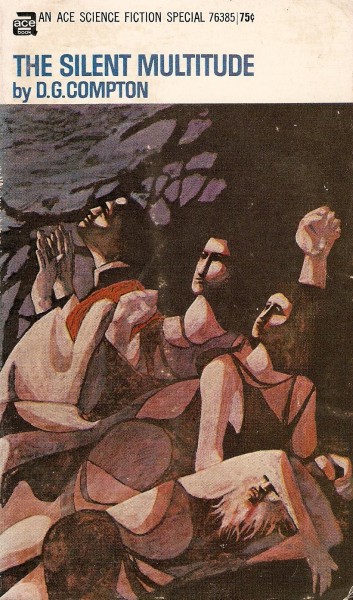
Book Review: The Silent Multitude, D. G. Compton (1966)

(Leo and Diane Dillon’s cover for the 1969 edition)

4.25/5 (Very Good)

“He was out now looking for signs.  He knew how to stay alive.  He was a strangely violent man, to him the fall of the city was some sort of unholy celebration (89).”

The decaying/empty city as allegory: its few post-evacuation occupants (a tramp and his cat, the cathedral’s dean, a young suburban woman, a troubled architect’s son — all well-drawn characters) wander the deserted streets of Gloucester consumed with their own obsessions.  The cement consuming fungus — a vague agent of destruction that severs us from our loci of civilization, our functionalist cityscapes, Continue reading