What pre-1985 science fiction are you reading? + Update No. XXVII

What pre-1985 science fiction are you reading or planning to read next month? Here’s the October installment of this column.

If I’m feeling a bit unmotivated to write about science fiction, I always end up on Fanac or another online repository of fanzines/newspapers exploring all the old historical fannish debates. I especially enjoy their reports on various conventions and the community (from accepting to reactionary) that emerges. For example, the details I uncovered about a lost Philip José Farmer speech titled “SF and the Kinsey Report at the 11th World Science Fiction Convention (Philcon 2) in Philadelphia (September 1953) and Pat M. Kuras and Rob Schmieder’s article “When It Changed: Lesbians, Gay Men, and Science Fiction Fandom” (1980) on the first Worldcon panel with an openly LGBTQ topic: “The Closed Open Mind: Homophobia in Science Fiction Fantasy Stories” moderated by Jerry Jacks, one of the “early openly gay fans.” I recently edited a friend’s article for academic publication on the role of conventions in forming feminist and political activism. Conventions sound like fascinating places, at least from my historically-minded vantage point and lens.

Continue reading
Adventures in Science Fiction Art: Rodger B. MacGowan’s Approachable New Wave Art, Part I

Rodger B. MacGowan (1948-2025), best known for his wargame art and design, passed away yesterday.1 Most of the memorial posts I’ve seen on social media focus on his later career paths in the board-gaming world. Thus, I thought it would be worthwhile to narrow in on his contribution to science fiction art. After graduating UCLA, where he studied art, motion pictures, and graphic design, MacGowan found work at an advertising agency and an opportunity to create art for one of their accounts, the short-lived Vertex science fiction magazine.2

Continue reading

Updates: Recent Science Fiction Purchases No. CCCXXXIX (Frank Herbert, Alan E. Nourse, Ann Maxwell, Craig Harrison)

Which books/covers/authors in the post intrigue you? Which have you read? Disliked? Enjoyed?

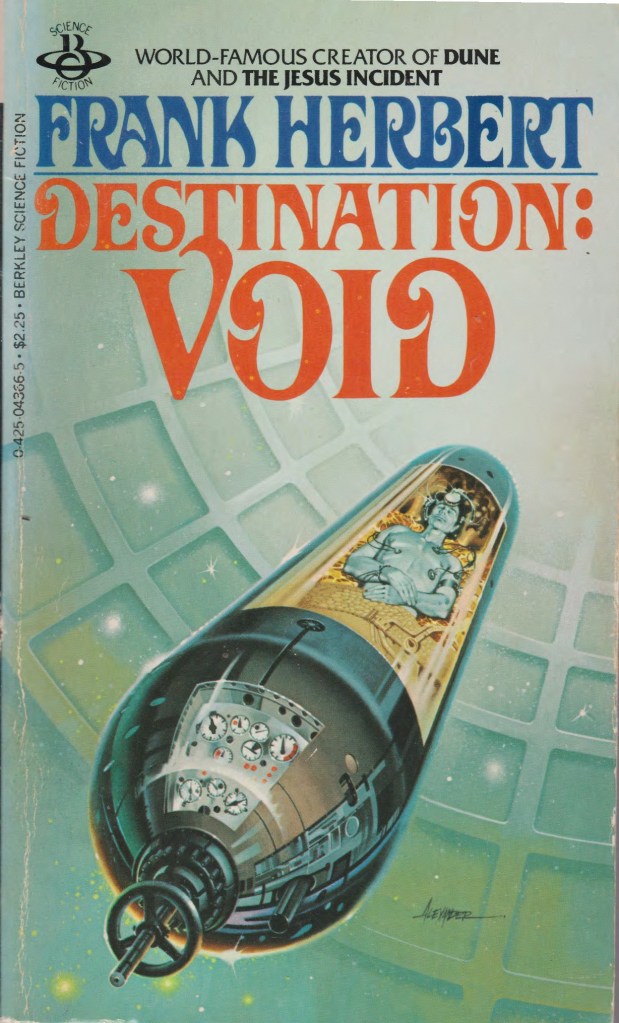
1. Frank Herbert’s Destination: Void (1966, rev. 1978)

From the back cover: “DESTINATION: VOID

THE COMPLETELY REVISED AUTHOR’S EDITION OF THE CLASSIC DEEP-SPACE ADVENTURE!

‘When the publishers announced that they were going to bring out a new edition of DESTINATION: VOID, they offered me the opportunity to make any changes I felt were necessary. Because of the tightly interwoven scientific premises behind this story and rapid development in the fields related to these premises, it would be extraordinary if discoveries across thirteen years did not dictate certain revisions.

Continue reading

Short Story Reviews: Ted White’s “Growing Up Fast in the City” (1971), “Junk Patrol” (1971), and “Things Are Tough All Over” (1971)

Ted White (1938-) took over as editor of Amazing Science Fiction and Fantastic from Barry N. Malzberg in October, 1968. As the magazines were bi-monthly and Malzberg had already acquired stories for multiple later issues, White’s first issues appeared in 1969. He’d accepted the position on the condition that he phase out the reprints (not acquired by White) slowly over multiple years.1 Apparently while White was not a fan of the New Wave movement, he “was all for more daring fiction exploring adult themes and saw no reason why these stories could not co-exist alongside more traditional stories.”2 Thus, his two magazines attempted to appeal to a wide-range of readers.

By the early 1970s, White demonstrated growing interest in even “greater liberalization of science fiction, in line with what was happening to youth nationwide.” He saw SF as “a vehicle to push back on the barriers of the ‘establishment’, with no suppression of soft drugs, ‘healthy sex,’ or free expression.”3 His magazines included stories emphasizing future sex in all its forms” far more frequently than its competitors.4 As the pay rates of both magazines were low–White could only pay 1 cent a word vs. 3 cents for the bigger magazines of the day–he attempted to appeal to writers who did not mesh well with the “establishment.”5

White did not earn a living wage as the editor despite the magazines consuming much of his time. In order to cobble together a meager living he also served as art director (which included cutting and pasting each issue) and wrote stories to publish in his own magazines!6 White’s first professional stories appeared in 1962 after a decade of fan writing.

This post includes three of White’s own violent and bleak visions of future society that appeared in Amazing and Fantastic. While he might not have been a fan of the experimental tendencies of the movement, his obsession with violating taboos, scenes of urban decay, and general miasmic gloom are certainly on display.

I am increasingly fascinated by the more radical, bleak, and grimy stories within White’s magazines–both from his pen and others–and plan on exploring more. See my earlier reviews of Lisa Tuttle’s “Stone Circle” (1976) and Grania Davis’ “New-Way-Groovers Stew” (1976).

Let’s get to the stories!

3.75/5 (Good)

Continue reading