Which books/covers/authors intrigue you? Which have you read? Disliked? Enjoyed?
1. Deus Irae, Philip K. Dick and Roger Zelazny (1976)
Richard Corben’s cover for the 1980 edition
From the back cover: “One their own, they have written landmarks works that have added whole new dimensions of wonder to the field of science fiction. Now, in Deus Irae, they have created what ALA Booklist calls “the most successful collaboration in years!”–set in in bizarre world where you will encounter…
A bunch of backwoods farmers who happen to be lizards…
What pre-1985 science fiction are you reading or planning to read this month? Here’s the December installment of this column.
Lost texts, and the act of reconstructing the fragments, fascinates. The questions pile up. Would the contents reveal a pattern in an author’s work? Intriguing personal details? A startling modus operandi? At the 11th World Science Fiction Convention (Philcon 2), Philadelphia (September 1953), Philip José Farmer gave a speech titled “SF and the Kinsey Report.” Considering Farmer’s recent publication of “The Lovers” (1952), this is not surprising. Alfred Kinsey, the famous sexologist and founder of the Kinsey Institute for Research in Sex, Gender, and Reproduction on Indiana University’s campus, published his controversial Sexual Behavior in the Human Male in 1948. Sexual Behavior in the Human Female appeared in 1953. Like many of Farmer’s earliest speeches, he did not keep copies.
Deeply intrigued by what the speech might have contained, Sanstone and I (on Bluesky) managed to piece together a few general responses from fanzines and magazine con reports.
What pre-1985 science fiction are you reading or planning to read this month? Here’s February’s installment of this column.
Before we get to books and birthdays and writing plans…
Do you have the inner strength to survive the panic of a nuclear attack? Take a test in the August 21st 1953 issue of Collier’s and find out! Sample question: “HOW DO YOU FEEL WHEN: […] You are alone in an automatic elevator when it stalls between floors?” Possible answers: “I’m not bothered,” “I become tense,” “It jars me badly,” and “I blow up.”
Which books/covers/authors intrigue you? Which have you read? Disliked? Enjoyed?
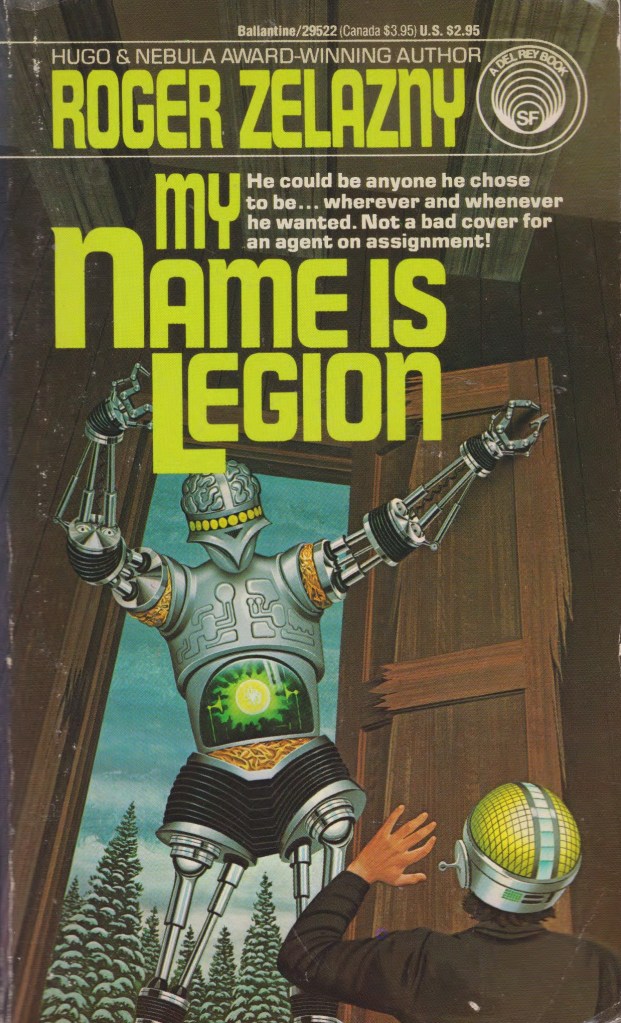
1. My Name is Legion, Roger Zelazny (1976)
Ralph Brillhart’s cover for the 1981 edition
From the back cover: “HE DID NOT EXIST… OR DID HE? He had destroyed his punch cards and changed his face. There was no credit card, birth record, or passport for him in the International Data Bank.
His names were many… any he chose.
His occupation was taking megarisks in the service of a vast global detective agency.
His interworld assignments were highly lucrative, incalculably vital, and terrifyingly deadly.
And more often than not, his life was a living hell!”
Contents: “The Eve of RUMOKO” (1969),” “‘Kjwalll’kje’k’koothaïlll’kje’k” (1973), “Home Is the Hangman” (1975)
Initial Thoughts: In the early days of my site read I reviewed the first in the Nemo sequence–“The Eve of RUMOKO” (1969). At the time I did not care for it. However, I recently read F. Brett Cox’s monography Roger Zelazny (2021) and retrospectively I’m not sure that I understood the character or what Zelazny was trying to accomplish with the story sequence. Often after I read a monograph, I end up making a few impulsive purchases and this is one of them! I hope, at the very least, it gives me a deeper understanding of Zelazny’s SF project. And “Home Is the Hangman” (1975) is a Hugo and Nebula-winning novella that I have not read.
Which books/covers/authors intrigue you? Which have you read? Disliked? Enjoyed?
1. The Impossible Manand Other Stories, J. G. Ballard (1966)
Richard Powers’ cover for the 1st edition
From the back cover: “THE IMPOSSIBLE MAN is the eighth book by J. G. Ballard to be published in the United States. Since the publication of his famous first two novels in 1962, The Wind from Nowhere and The Drowned World, no writer in modern science fiction has received higher acclaim from the critics:
“…the freshest new talent in science fiction since Brian Aldiss.” — DAMON KNIGHT
“Ballard is one of the brightest new stars in post-war fiction… he may turn out to be one of the most imaginative of Wells’s successors.” — KINGSLEY AMIS
THE IMPOSSIBLE MAN gathers together nine of Ballard’s most recent stories. A few samples:
In “The Drowned Giant” an enigmatic visitor is subjected to the various kindnesses of man…”
Cover art detail by Allison (aka Mariella Anderlini) for the 1979 Italian edition of Roger Zelazny’s The Guns of Avalon (1972)
On twitter, I recently learned from Jay O’Connell (cover artist and author) that all of Roger Zelazny’s work will be back in print. What exactly “everything back in print” means in reality I’m not entirely sure–will it include only the best known novels? All the short stories? Are works Zelazny wanted to “kill off” like To Die in Italbar (1973) really going to get reprints? Regardless, I was inspired to look back at the non-English language covers his work has received over the years. Naturally, as I moved to the fantastic Italian presses, I re-encountered and fell in love (again) with Allison’s evocative take on Zelazny’s Chronicles of Amber (Corwin) five-novel sequence.
Which books/covers/authors intrigue you? Which have you read? Disliked? Enjoyed?
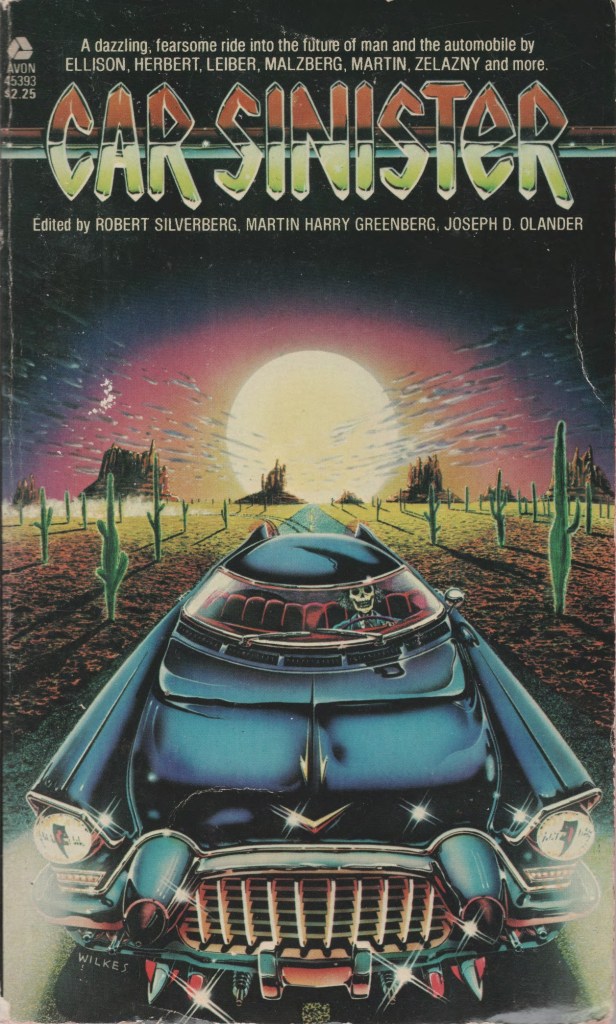
1. Car Sinister, ed. Robert Silverberg, Martin Harry Greenberg, and Joseph D. Olander (1979)
Mike Wilkes’ cover for the 1st edition
From the back cover: “MAN AND HIS MACHINE. The car is man’s most personalized machine; for teenagers it is a rite of passage and a statement of freedom; for adults it is a reflection of success, taste, and hopes; and for an entire culture it is a great and industrious mode of transportation–driving, perhaps, on the road of destruction. And the automobile–thrilling, honking, speeding, nerve-shattering–haunts us with the dark possibility that when our age of motoring innocence is over, we may no longer be the masters… CAR SINISTER–a splendid, imaginative vision of what lies down the road for all of us.”
Roger Zelazny described To Die in Italbar (1973) as the one novel he would “kill off” if he could! Here’s a bit of context for his condemnatory statement. In early 1969, Zelazny quit his U.S. Social Security Administration job to become a full-time writer. Yes, he wrote Lord of Light (1967) and This Immortal (1966) among many others after work! He quickly wrote To Die in Italbar in May 1969 to complete a contract but the novel was rejected by the press. Years later Zelazny added new material and finally published the novel in 1973 (citation). Haste and filler characterize the final product. That said, if action-packed SF adventure with bizarre ideas is something you are looking for and you already enjoy Zelazny, pick this one up.
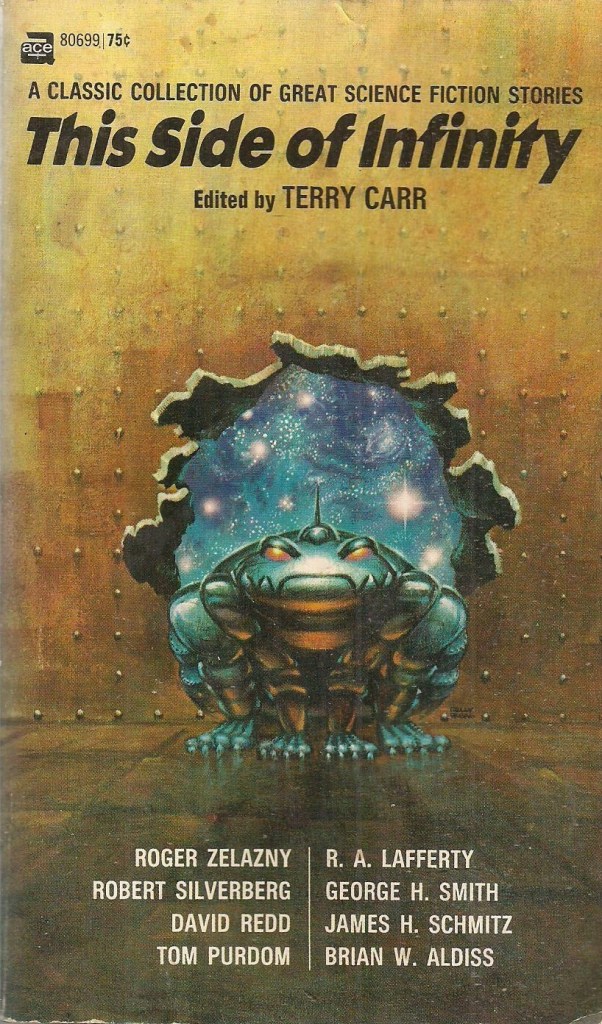
Soldiers in mech armor plagued by existential crisis. Asexual insectoid aliens pretending to be human. Children wielding pet apes as weapons. This Side of Infinity, ed. Terry Carr (1972) gathers eight kaleidoscopic visions from stalwarts (Roger Zelazny and Robert Silverberg) to lesser known authors (David Redd and George H. Smith). As a collated whole, this is a solid collection without a defining standout masterpiece but worth acquiring for the sheer variety and hallucinatory power of it all.





 Science Fiction and Other Suspect Ruminations