Short Book Reviews: Octavia E. Butler’s Mind of My Mind (1977) and Susan Cooper’s Mandrake (1964)

Note: My read but “waiting to be reviewed pile” is growing. Short rumination/tangents are a way to get through the stack before my memory and will fades. My website partially serves as a record of what I have read and a memory apparatus for future projects. Stay tuned for more detailed and analytical reviews.


1. Mind of My Mind, Octavia E. Butler (1977)
4/5 (Good)

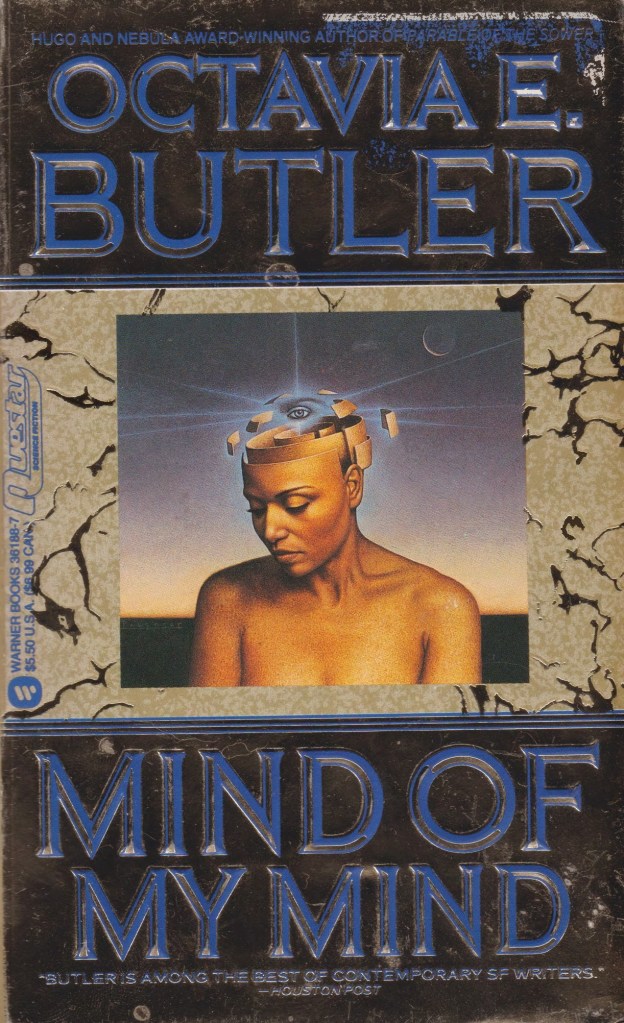
Octavia E. Butler’s Mind of My Mind (1977) is the second-published and second chronological installment of her Patternist series of novels (1976-1984), that chart the dystopic and hyper-violent development (and destruction) of a telepathic society. The series also contains her disowned (and hard-to-afford without selling a child) novel Survivor (1978). I wish I had read Wild Seed (1980) first!

The immortal Doro, able to hone into those with telepathic talent and shift his essence into new human bodies at will, oversees a generations-old telepathic breeding project. The harrowing story follows one his many daughters, Mary, a rare active telepath (vs. latent), as she comes of age and begins to understand the role that she is designed to play. Doro preys on the downtrodden and abandons the majority of latent telepaths to live miserable lives, unable to filter out the emotions they sponge up. Doro pairs Mary with another active telepath named Karl in order to guide her through her transition. But something new appears in her mind, she seems to have created a pattern that compulsively draws in actives from across the country. And Doro begins to feel threatened by his own creation.

Continue reading
Short Story Reviews: Sydney J. Van Scyoc’s “Shatter the Wall” (1962), “Bimmie Says” (1962), and “Pollony Undiverted” (1963)

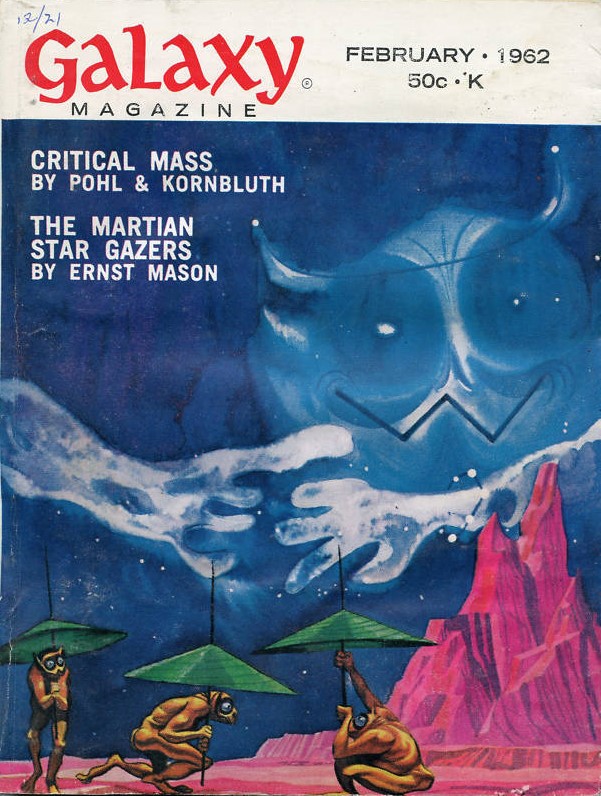
Today I’ve reviewed the 29th story in my series on the science fictional media landscape of the future. In Sydney J. Van Scyoc’s debut “Shatter the Wall” (1962), a bedraggled wife attempts to prevent her daughter and husband from taking on the personas of a television family.

Previously: Henry Kuttner’s “Year Day” (1953)

Up Next: Edmond Hamilton’s “Requiem” (1962) and John Anthony West’s “George” (1961)

As I’d only previously read one of Van Scyoc’s novels more than a decade ago, I added her next two published short fictions to fit the parameters of my series on the first three published short fictions by female authors who are new(ish) to me. So far I’ve featured Phyllis Gotlieb (1926-2009), Josephine Saxton (1935-), Carol Emshwiller (1921-2019), Wilmar H. Shiras (1908-1990), Nancy Kress (1948-), Melisa Michaels (1946-2019), Lee Killough (1942-), Betsy Curtis (1917-2002), and Eleanor Arnason (1942-).

Sydney J. Van Scyoc (1939-2023) published eleven novels and around thirty short stories across her writing career (primarily 1962-1991). Her visions were rarely republished or anthologized. “A Visit to Cleveland General” (1968) might be her best-known short story as it appeared in Carr and Wollheim’s best of 1969 anthology. I have a positive impression of her work so far.

Have you read any of her work? If so, what were your thoughts?


3/5 (Average)

“Shatter the Wall” first appeared in Galaxy, ed. Frederik Pohl (February 1962). You can read it online here.

According to Gary R. Edgerton in The Columbia History of American Television (2007), a debate emerged in the late 1950s about American materialism and its glorification on television. John Kenneth Galbraith’s The Affluent Society (1958) suggested that advertising created synthetic needs and damaging desires in American citizens. “Shatter the Wall” is all about synthetic needs and damaging desires.

Continue reading

What pre-1985 science fiction are you reading? + Bimonthly Update No. V

What pre-1985 science fiction are you reading this week?

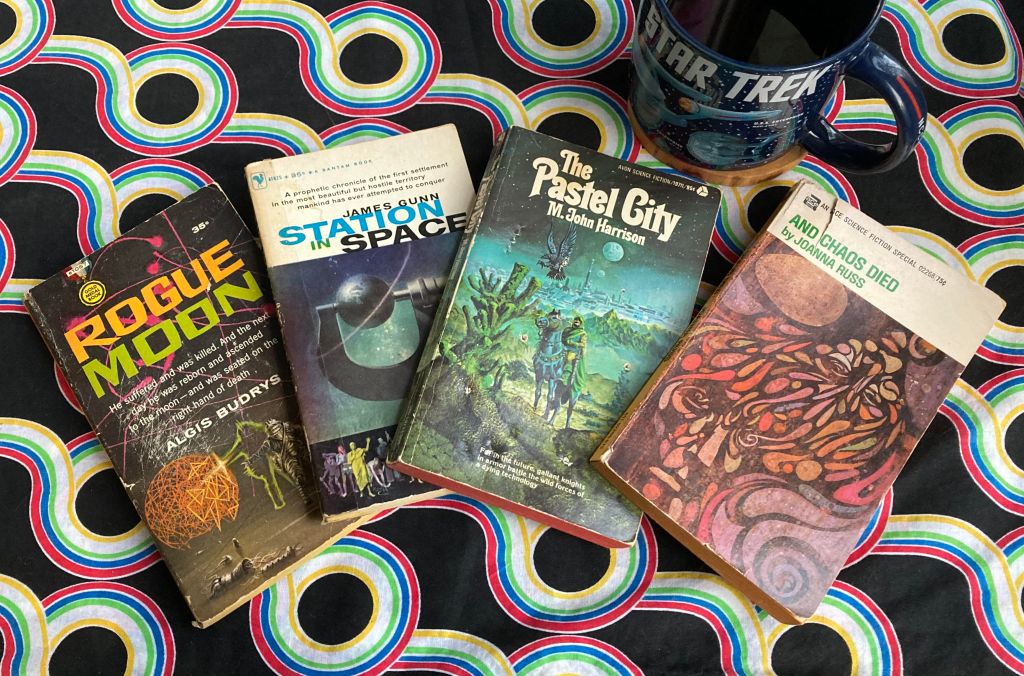
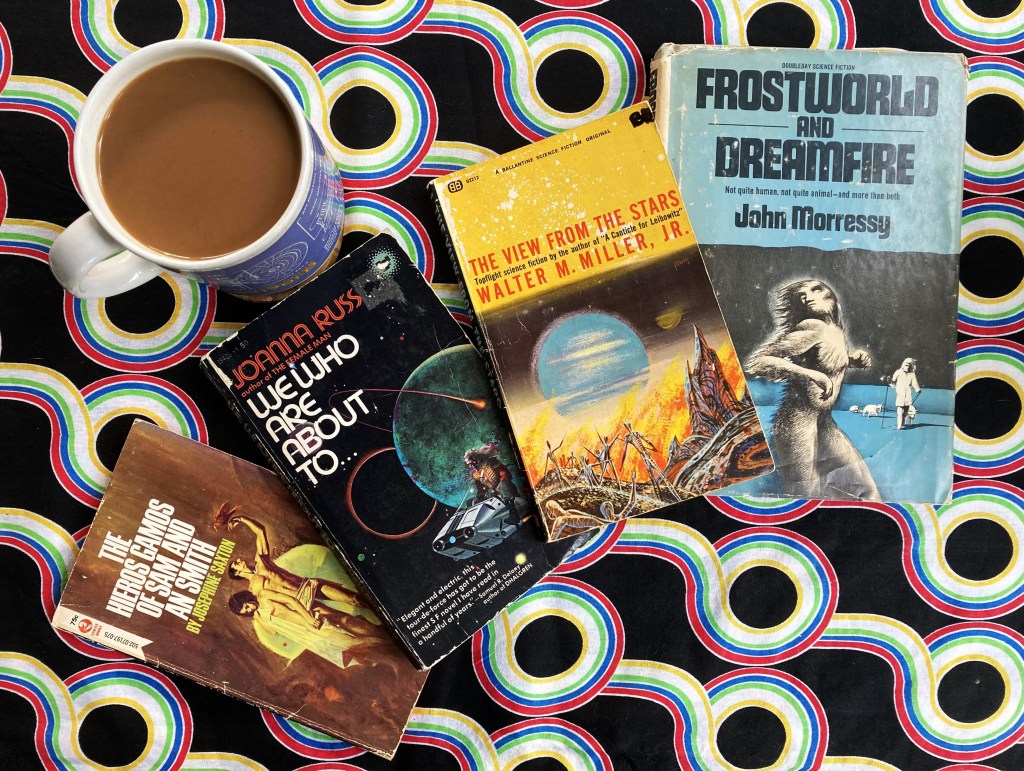
Thanks again for all the great conversation. Make sure to check out the previous installment if you haven’t already. As before, I’ve included a bit about the books in the photograph, birthdays from the last two weeks, and brief ruminations on what I’ve been reading and writing.

Let me know what pre-1985 SF you’ve been reading!

Continue reading

Book Review: The Gold at the Starbow’s End, Frederik Pohl (1972)

3.75/5 (Collated rating: Good)

After Frederik Pohl (1919-2013) left his editorial position at Galaxy and If in 1969, he set his pen towards a productive vein of form in the 70s that would culminate in his Hugo and Nebula-winning Gateway (1977). The Gold at the Starbow’s End contains five short stories–including the first of his Heechee sequence–from this period. Two of the best stories, the titular “The Gold at the Starbow’s End” (1972) and “The Merchant of Venus” (1972), demonstrate Pohl’s characteristic blend of hyperbolic satire and delirious energy. There are no duds in this collection.

Continue reading

What pre-1985 science fiction are you reading? + Bimonthly Update No. IV

What pre-1985 science fiction are you reading this week?

I’ve thoroughly enjoyed the conversations and connections you all have made in the comments over the last two months of this column. Make sure to check out the previous installment if you haven’t already. As before, I’ve included a bit about the books in the photograph, birthdays from the last two weeks, and brief ruminations on what I’ve been reading and writing.

Let me know what pre-1985 SF you’ve been reading!

Continue reading

Short Story Review: Kate Wilhelm’s “Planet Story” (1975) and Clark Ashton Smith’s “Master of the Asteroid” (1932)

The following review is the 27th and 28th installment of my series searching for “SF short stories that are critical in some capacity of space agencies, astronauts, and the culture which produced them.” Some stories I’ll review in this series might not fit. And that is okay. I relish the act of literary archaeology.

Kate Wilhelm’s “Planet Story” (1975) charts a planetary mystery that seems just out of reach of the cold, factual truth of scientific instruments. And Clark Ashton Smith’s “Master of the Asteroid” (1932) imagines the fragile minds of human explorers unable to grapple with the interplanetary gulf.

As always, feel free to join the conversation.

Previously: Philip K. Dick’s “The Precious Artifact” (1964) and Henry Slesar’s “Mr. Loneliness” (1957)

Up Next: Clifford D. Simak’s “Conditions of Employment” (1960).

4/5 (Good)

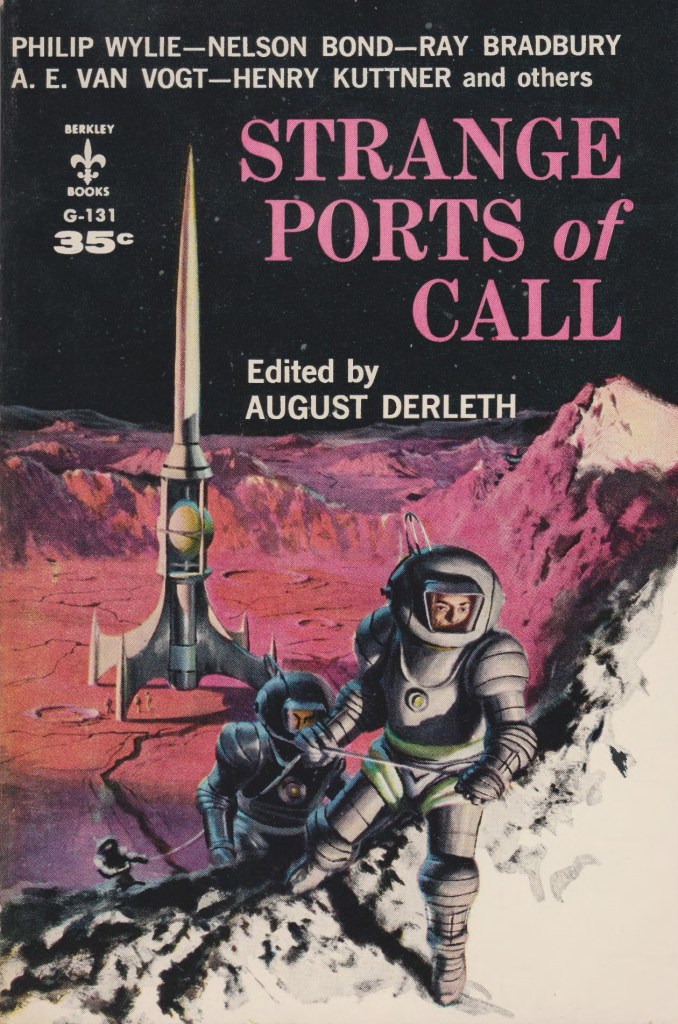
Clark Ashton Smith’s “Master of the Asteroid” first appeared in Wonder Stories, ed. Hugo Gernsback (October 1932). You can read it online here. I read it in the 1958 edition of Strange Ports of Call, ed. August Derleth (1948).

Cark Ashton Smith (1893-1961) is characterized as “one of the big three of Weird Tales, with Robert E. Howard and H. P. Lovecraft.” His fiction was deeply influenced by his psychological afflictions, “including intense agoraphobia,” and nightmares. Due to the Great Depression and the declining health of his parents, Smith wrote more than a hundred short stories between 1929-1934. “Master of the Asteroid” (1932), produced in this productive moment, reads like an unnerving catalog of manias.

Continue reading

Exploration Log 3: Interview with Adam Rowe, author of Worlds Beyond Time: Sci-Fi Art of the 1970s (2023)

Today I have the third post in my Exploration Log series.

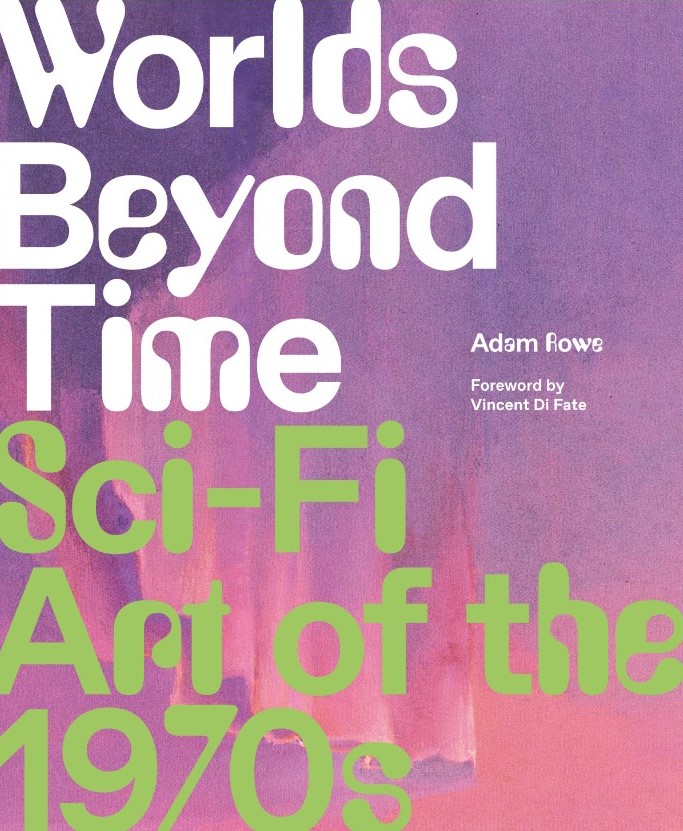
I would like to welcome Adam Rowe to Science Fiction and Other Suspect Ruminations. He is the author of a brand new book–Worlds Beyond Time: Sci-Fi Art of the 1970s (2023)–on 70s science fiction cover art with a foreword by artist Vincent Di Fate. You can follow Adam’s art account on Twitter and Tumblr. I also recommend subscribing to his free 70s SF art newsletter. You can buy Worlds Beyond Time on Amazon and Barnes and Noble

Adam Rowe is a writer who has been collecting retro science fiction art online since 2013. He covers technology at Tech.co and has been a Forbes contributor on publishing and the business of storytelling. He has also written for iO9, Popular Mechanics, Tor.com, and the Barnes & Noble Sci-Fi & Fantasy Blog. Worlds Beyond Time: Sci-Fi Art of the 1970s (2023) is his first book.

Continue reading

What pre-1985 science fiction are you reading? + Bimonthly Update No. III

What pre-1985 science fiction are you reading this weekend?

Thank you all for making this fanzine column a success! I’ve thoroughly enjoyed the conversations and connections you all have made in the comments. Make sure to check out the previous installment if you haven’t already. As before, I’ve included a bit about the books in the photograph, birthdays from the last two weeks, and brief ruminations on what I’ve been reading and writing.

Continue reading

Book Review: Davy, Edgar Pangborn (1964)

5/5 (Masterpiece)

Nominated for the 1965 Hugo Award for Best Novel [1]

Edgar Pangborn’s Davy (1964) takes place in a future devastated by a partially abortive nuclear war and the depravations of subsequent plagues (50). A powerful theocracy and perpetually warring microstates in the American Northeast emerged from the Years of Confusion. The novel takes the form of an autobiography. We follow a young orphan in love with life and desperate to escape his unfortunate circumstances.

Continue reading