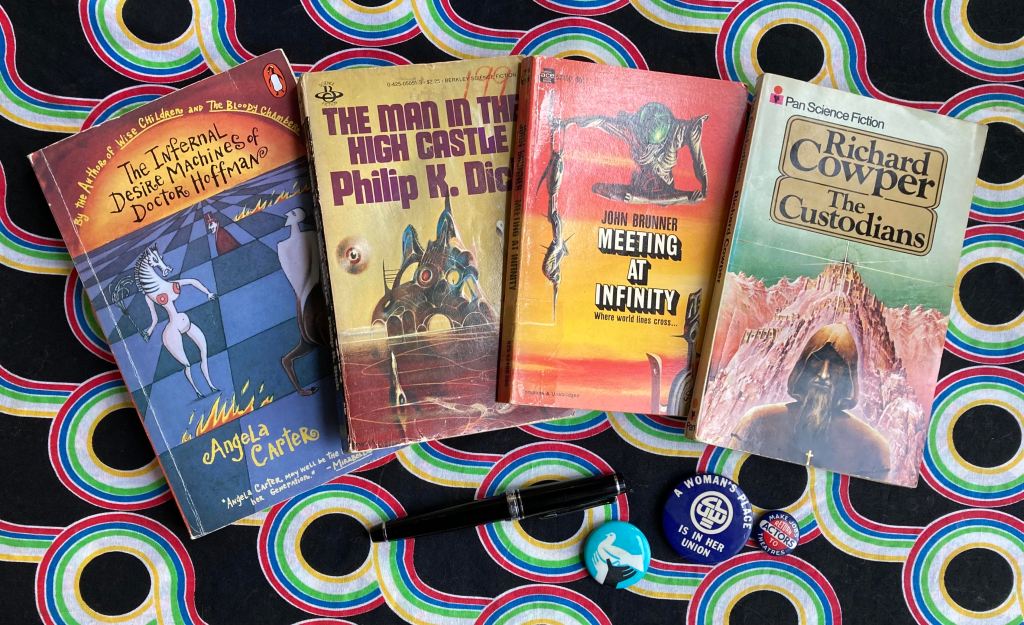
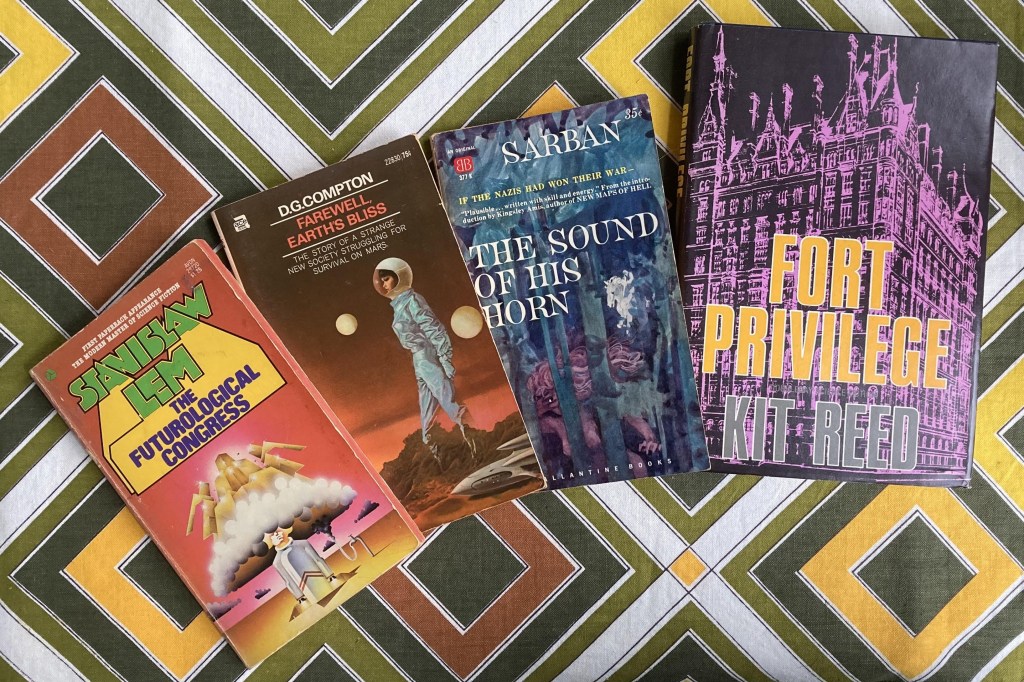
What pre-1985 science fiction are you reading or planning to read this month? Here’s the March installment of this column.
Recently I came across John Boston and Damien Broderick’s three-volume series examining each and every story and non-fiction article in the pre-Michael Moorcock New Worlds and Science Fantasy/SF Impulse magazines in the UK. John Boston is a valued member of my site’s community — frequently stopping by in the comment sections. I thought for this mini-editorial I’d list a handful of active community members with websites, books, and worthwhile SF-related fanzine articles. I, of course, could be missing a few. Community matters more than you might think. I enjoy the discussion. I enjoy reading reviews that others write — even if it’s on science fiction that might not be within my more narrow focus (the historian in me). I always want to learn and share what’s worth reading and/or historically interesting. Thank you one and all.
The following reviews are the 33rd, 34th, and 35th installments of my series searching for “SF short stories that are critical in some capacity of space agencies, astronauts, and the culture which produced them.” Some stories I’ll review in this series might not fit. And that is okay. I relish the act of literary archaeology.
For this post I’ve selected three short stories about the horrific conditions on a colonized Mars by E. C. Tubb (1919-2010) that appeared in the British SF magazine New Worlds. Along with three additional tales, they were fixed-up as the novel Alien Dust (1955).1 I “blame” the “Friend of the Site” John Boston for my renewed interest in Tubb’s bleak stories. I recently acquired Boston’s three-volume commentary on pre-Moorcock New Worlds and Science Fantasy.2 Boston correctly describes Tubb’s earlier stories as preoccupied with the “domestic lives of spacefarers” in often overwritten and maudlin strokes.3 Regardless, I found the topics he explored worth my time. I’d only previously read his later short story “The Seekers” (1965) and The Space-Born (variant title: Star Ship) (1955). Considering his hard-boiled sensibilities, I imagine a substantial slice of his fiction would fit this series.4
Gerard Quinn’s cover for New Worlds, # 13, ed. John Carnell (January 1952)
3.5/5 (Good)
“Without Bugles” first appeared in New Worlds, # 13, ed. John Carnell (January 1952): You can read it online here.
As with most E. C. Tubb stories, “Without Bugles” starts with a punch: “The man writhed on the narrow cot, and fought for his life” (52). The man in question is one of many colonists on Mars afflicted with a futuristic black lung–“an industrial disease. Silicosis they called it once”–caused by radioactive dust (54). The origin of the radioactivity isn’t clear. Dust cannot be avoided on Mars. It seeps through all seals. It gathers in corners. It bypasses masks. Into the colony of the dead and dying and those that tend them, Anders, the Secretary for Extra-Planetary Affairs, and Pat Easton, a vivacious and idealistic reporter for Trans-World Communications arrive on an infrequent rocket. The purpose of the commission? Anders gets straight to the point: “Congress has poured billions of dollars into this project. When are you going to start paying it back?” (56). Pat proposes the fate of the colony can be swayed by a positive depiction of the heroic colonists.
Sherwood Anderson (1876-1941) confides in the introduction to his travel memoir Puzzled America (1935) that the Great Depression was inescapable: “I was a writer of tales. It might be that I should have remained just that, but there is difficulty. There are, everywhere in America, these people now out of work. There are women and children hungry and others without enough clothes.”1 Edgar Albion Lyons, in the author’s note to his science fiction novel The Chosen Race: A Novel Based on the Depression and Machine Age (1936), echoes this sentiment: “The following chapters were written during the months of 1932 when the words ‘Depression’ and ‘Unemployment’ were on everyone’s lips.”2 Magazine science fiction, with its eye towards the marvelous technological future, likewise could not escape contemporary economic, political, and societal convulsions.3 Science, “in the form of a hypothesized device or theory,” enabled exciting adventures but also the exploration of “diverse and dire social implications.”4
On May 9th, 1934, a massive two-day dust storm caused by severe drought and human-made factors, removed massive amounts of Great Plains topsoil. The Dust Bowl unleashed its fury. The dust clouds reached Chicago and cities in the east, blotted out the Statue of Liberty and the United States Capitol. Red snow fell in New England.5 In the September 1934 issue of Astounding, a twenty-year-old Frank K. Kelly published “Famine on Mars” (1934) about a desperate attempt to assist Martians dying of thirst and starvation after a drought. In Kelly’s vision, The Combine, Earth’s government, deliberately caused the genocide and refuses to provide assistance.6
M. Marchioni’s interior art for “Famine on Mars” (1934)
Which books/covers/authors intrigue you? Which have you read? Disliked? Enjoyed?
1. Tom O’Bedlam, Robert Silverberg (1985)
Jim Burns’ cover for the 1986 edition
From the back cover: “MESSIAH OR MADMAN? It is 2103 and Tom O’Bedlam, madman, prophet, and visionary, wanders through California, dwelling place of the last humans on a continent decimated by radioactive dust. Tom, caught up in a living vision of distant worlds ruled by godlike beings, is the herald of a new age, a herald no one wants to hear until others too begin to dream of salvation beyond the stars. Yet while many dream, only tom has the power to make the wondrous visions real, to give people the ultimate escape they desire. Across the universe they must go… if Tom is humanity’s last hope–and not its final destroyer.”
What pre-1985 science fiction are you reading or planning to read this month? Here’s the January installment of this column (sorry I missed a month).
Before John W. Campbell, Jr. (1910-1971) attempted to raise the “standards and thinking in magazine SF,” David Lasser (1902-1996) attempted his own brief (1929-1933) program to improve science fiction as managing editor of Hugo Gernsback’s Science Wonder Stories, Wonder Stories, and Wonder Stories Quarterly. According to Mike Ashley’s The Time Machine: The Story of the Science-Fiction Pulp Magazine from the Beginning to 1950 (2000), Lasser is a “much neglected revolutionary in science fiction” and through his efforts the genre “started to mature” (66).
Ashley highlights Lasser’s letter of instruction mailed to his regular contributors on the 11th of May, 1931, in which he “exhorted them to bring some realism to their fiction” (72). He also outlawed common tropes like the giant insect story and space opera (73). He emphasized the need to focus on characters that “should really be human” — not everything needs to be a “world-sweeping epic” (73). Stories in this vein, according to Ashley, include Clifford D. Simak’s religiously themed “The Voice in the Void” (1932), P. Schuyler Miller and Walter Dennis’ “The Red Spot on Jupiter” (1931) and “The Duel on the Asteroid” (1974), which featured a grim realism and character development (74).
Ballantine Books’ illustrious science fictional program started with a bang–Star Science Fiction Stories. According to Mike Ashley’s Transformations: The Story of Science-Fiction Magazines from 1950 to 1970 Frederik Pohl’s anthology series of original (mostly) stories was “intended as both a showcase of Ballantine’s authors and a lure to new writers.” Paying better rates than magazines, the Star series foreshadowed the explosion of original anthologies that would provide a sustained challenge to the eminence held in the 50s by the magazine.
I’ve selected the third volume of the six-volume series.1 It contains an illustrative cross-section of 50s science fiction. Philip K. Dick’s “Foster, You’re Dead” (1955), Richard Matheson’s “Dance of the Dead” (1955), and Jack Williamson’s “Guinevere for Everybody” (1955) are not to be missed.
Which books/covers/authors intrigue you? Which have you read? Disliked? Enjoyed?
1. Subi: The Volcano, Burt Cole (1957)
Peter Rudland’s cover for the 1958 edition
From the inside flap: “This is a forceful war story with a different. There is the Far Eastern background, the convincing solders’ talk, the military politics, the sex, disablement, disease, death, violence, stoicism, sadism, and so on, which combine to stress once again war’s futility and stupidity and man’s inhumanity to man: but there are also deeper implications which make this novel so strikingly unusual.
Judson, a persistent deserter from an army camp, has made a rough shelter for his native girl in the nearby ramshackle, bombed city, when he hears of a guerrilla attack on the camp. He goes to the base of the volcano (where the mob has gathered) to persuade them that if they kill Americans they will only die of disease for want of medical treatment. For his pains he is set upon and torn to pieces.
MacGowan’s illustrations for Neil Shapiro’s “Starman of Faraway Station” in Vertex (July 1975)
Rodger B. MacGowan (1948-2025), best known for his wargame art and design, passed away yesterday.1 Most of the memorial posts I’ve seen on social media focus on his later career paths in the board-gaming world. Thus, I thought it would be worthwhile to narrow in on his contribution to science fiction art. After graduating UCLA, where he studied art, motion pictures, and graphic design, MacGowan found work at an advertising agency and an opportunity to create art for one of their accounts, the short-lived Vertex science fiction magazine.2
“We also encountered many gay people, feminists and progressives of every stripe. These people were at the convention because present day science fiction has much to offer them. Science fiction is the fiction of ideas, and the ideas coming from the minds of the new writers more and more concern progressive analyses of social issues.”
— Pat M. Kuras and Rob Schmieder (1980)
At the 38th World Science Fiction Convention (29th August–1st September, 1980) held in Boston, MA, organizers scheduled the first Worldcon panel with an openly LGBTQ topic: “The Closed Open Mind: Homophobia in Science Fiction Fantasy Stories” moderated by Jerry Jacks, one of the “early openly gay fans.”1 Around 200 fans attended to hear Elizabeth A. Lynn (SFF author), Samuel R. Delany (SFF author), Frank M. Robinson (SF author and activist), and Norman Spinrad (SFWA President and SF author) (“the token straight”) discuss issues of representation.
Pat M. Kuras and Rob Schmieder’s “When It Changed: Lesbians, Gay Men and Science Fiction Fandom” in the September 27th, 1980 issue of Gay Community News