Book Review: Jack Dann’s Timetipping (1980)

3.75/5 (collated rating: Good)

Alien sex dolls. Carpet stain entities constructing love-nests. Underground retirement community entertainment. Jack Dann’s stories obsessively chart the new rituals of survival in a blasted, irradiated, and decayed future. His characters attempt to identify their place in the world, or, at the very least, stay alive as the world shifts. If you do not care for anti-heroes, a good dose of dystopian perversity, and moments of metaphysical descent, Timetripping (1980) might not be for you. Four of the fourteen stories in the collection were nominated for the Nebula Award.

If you are a fan of the New Wave (and Barry N. Malzberg and Robert Silverberg in particular), and haven’t yet explored Dann’s nightmares, don’t wait as long as I did. Also, go ahead and snag a copy of his later masterpiece The Man Who Melted (1984). I’ve acquired copies of two early fix-up novels Junction (1981) and Starhiker (1976).

My 20 best short story reads of 2025 will undoubtedly include a handful of stories from Timetripping (1980). I found his best works—“The Dybbuk Dolls” (1975), “A Quiet Revolution for Death” (1978), “I’m with You in Rockland” (1972), and “Camps” (1979)—remain cohesive despite moments of metaphysical rumination and deluge of surreal image. Even at his least effective moments of narrative wander, Dann adeptly conjures image and turn of phrase.

Continue reading
What pre-1985 science fiction are you reading? + Update No. IX

What pre-1985 science fiction are you reading or planning to read this month? Here’s January’s installment of this column.

When I’m not reading science fiction, I’m more often than not devouring history that touches on my decades of focus: 1945-1985. Recently that’s meant lots and lots of monographs on Cold War culture: from fallout shelters, suburbia, to analysis of the drama of morality and terror that characterized nuclear deterrence. And in Guy Oakes’ transfixing The Imaginary War: Civil Defense and American Cold War Culture (1994), I came across a fascinating collision of science fictional thought and public policy.

A few months into Dwight D. Eisenhower’s presidency, the Public Affairs Office of the Federal Civil Defense Administration released a short pamphlet that analyzed the “relation between national will and nuclear terror” under the ridiculous title “Civil Defense Implications of the Psychological Impact and Morale Effect of Attacks on the People of the United States” (April 1953). In this pamphlet, the authors imagine the effects of nuclear war. They suggest that some survivors would “isolate themselves from the terrifying consequences of nuclear war by effecting a pseudo-escape into an interior psychological reality.” I thought immediately of Richard Matheson’s brilliant “Pattern for Survival” (1955), in which a SF author reenacts the process of writing and publishing a story to escape the reality in which he lives. The pamphleteers further imagine a political reality dominated by “mystical sects and cults, enthralled by the vision of an immeasurably happier future in an inner fantasy life of an extramundane kingdom of bliss that transcended the brutal empirical reality of nuclear destruction” (41). Early Cold War policy makers and consultants as science fiction authors!

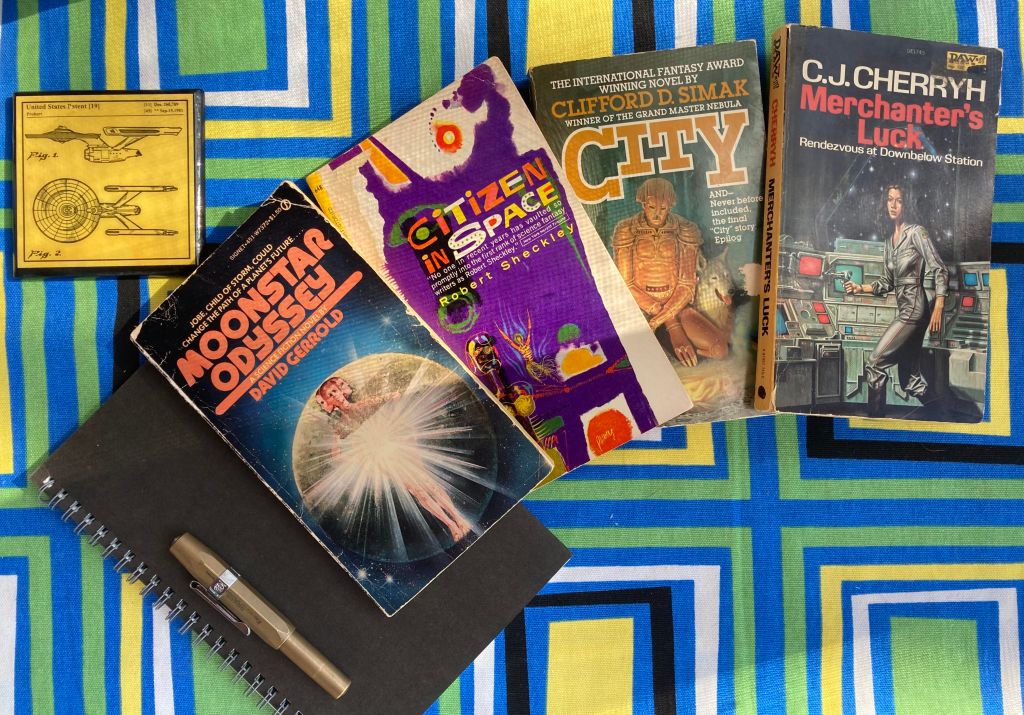
50s paranoid future visions aside, let’s turn to the books in the photo and what I’ve been reading and writing about.

Continue reading