Updates: Recent Science Fiction Acquisitions No. XCVII (Asimov + Malzberg + Randall + Schmidt)

Some goodies (finally reaching the bottom of my large pile of unreported SF—holiday leftovers, one or two Half Price/Thrift store visits, birthday gifts).

My second collection (need more!) of Malzberg short stories eagerly wants to be read!

An Asimov collection, Buy Jupiter and Other Short Stories (1975), that was inexpensive and also low on my list of books to read.  As readers know, one of my first SF novels I ever read was The Currents of Space (1952)… That said, Asimov has nostalgic allure but none of the many subsequent novels of his I have read have proved, in my opinion, his supposed “genius talent” and cult of “hero worship.”

Both the Malzberg and Asimov collections have brief intro essays to each story and random autobiographical fragments—smacks of filler.  But, perhaps there will be some intriguing observations (although, I rather not know that Malzberg wrote a particular short story in only an hour, or that Asimov took a bet from a pretty female editor, blah, blah, blah).

Marta Randall’s Islands (1976) was a solid read so it was only a matter of time before I acquired her superior (according to Ian Sales) A City in the North (1976).  You have to feel for her, her books received some of the most horrid Vincent Di Fate covers possible….

 I suspect that The Sins of the Fathers (1973) by Stanley Schmidt is a forgettable 70s space opera but I am willing to give it a try.

Thoughts?

1.  The Man Who Loved the Midnight Lady, Barry N. Malzberg (1980)

(Michael Flanagan’s cover for the 1980 edition) Continue reading

Book Review: Ancient, My Enemy, Gordon R. Dickson (1974)

(Peter Rauch’s cover for the 1974 edition)

2.75/5 (collated rating: Vaguely Average)

Between 1974 and 1990 Gordon R. Dickson’s collection Ancient, My Enemy (1974) was reprinted eleven times.  The reason for this “popularity” is beyond me considering I found that a grand total of three of the nine stories were solid while the rest were poorly written cliché-ridden magazine filler…  Dickson had the ability to write some great short SF—for example, Mike at Potpourri of SF Literature adores his collection In the Bone (1987).  But Ancient, My Enemy gives little indication of his talent and generally lacks the insight that his novels such as The Alien Way (1965) possess.

Recommended only for Gordon R. Dickson completists.  I suggest acquiring later more discerning collections of his 50s/60s SF such as Continue reading

Updates: Recent Science Fiction Acquisitions No. XCVI (Varley + Wilhelm + Blish + Effinger)

With the sole novel of his I’ve read, What Entropy Means to Me (1972), George Alec Effinger has entered the pantheon of my favorite authors—the novel is that brilliant.  So, with a birthday gift card from my sister I procured a copy of Irrational Numbers (1975), a collection of short fiction.  Will read soon….

I know very little about John Varley’s work.  I have a copy of his collection The Persistence of Vision (1978)  but had no idea that his first novel, The Ophiuchi Hotline (1977) was as well known as the Goodreads ratings make it out to be (1,476 votes!).  I am positive that Boris Vallejo’s horrid cover prevented me from even considering the novel in the past.

More Wilhelm! (Juniper Time)

More Blish! (Midsummer Century)

All first edition hardbacks for a mere $1-2 each.

Thoughts?

1. The Ophiuchi Hotline, John Varley (1977)

(Boris Vallejo’s cover for the 1977 edition) Continue reading

Book Review: Billenium, J. G. Ballard (1962)

(Richard Powers’ cover for the 1962 edition)

4.25/5 (collated rating: Very Good)

Billenium (1962), J. G. Ballard’s first collection of short stories, contains three masterpieces of the 50s/60s: “Billenium” (1961), “Build-Up” (variant title: The Concentration City) (1957), and “Chronopolis” (1960).  The first is a deadpan satire on overpopulation, the second a fantastic Borgesian depiction of an endless city that stretches (literally) in all directions, and the third a vision of a city that had enough and revolted against time.  I preferred these three ruminations, that unfolded in evocative and decaying urban spaces, to the three decadent and baroque stories—“Studio 5, The Stars” (1961), “Mobile” (variant title: “Venus Smiles”) (1957), and “Prima Belladonna” (1956)—from his famous Vermillion Sands sequence.  The remaining four are all readable.

As with J. G. Ballard’s first novel masterpiece, The Drowned World (1962), the sense of decay and malaise that permeate majority of the stories in Billenium is gorgeously Continue reading

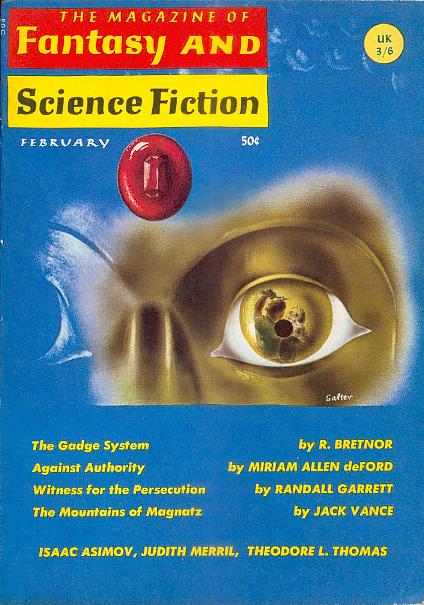
Updates: New Type of Post (grouped reviews of uncollected short stories published in magazines)


I do not own many SF magazines from the 40s-70s.  The reasons are as follows: 1) Novels tended to be serialized which means I have to track down multiple magazines to read an entire novel.  2) The novels were often radically altered for their first book form publication (think, Herbert’s “Dune World” (1963) that later became Dune (1965).  Thus, I rather own the later novel form that wasn’t as constrained by the strictures of magazine form. 3) I love short story collections and would rather own the entire collection than read a singleton story.

Continue reading

Updates: Recent Science Fiction Acquisitions No. XCV (Ballard + Butler + Brunner + Schmidt)

I must confess, I’ve never read an Octavia Butler novel…  I now own one and will read it soon.  More Ballard!  More Brunner (a review of his 1969 masterpiece The Jagged Orbit is coming soon)! And a complete mystery, I mean, who besides Tarbandu over at The PorPor Books Blog has read Newton and the Quasi-Apple (1975) by Stanley Schmidt?

Thoughts?

1. The Voices of Time, J. G. Ballard (1962) (MY REVIEW)

(Richard Powers’ cover for the 1962 edition) Continue reading

Adventures in Science Fiction Art: Visualizing Time, Part II (time travel + sundials + the decay of eternity + time portals)

11_1953_07_fantasticsty_walterpopp

(Walter Popp’s cover for the 1953 issue of Fantastic Story Magazine, ed. Samuel Mines)

It has been along time since I cobbled together a cover art post…

…but it’s a good one!

This is Part II of my Visualizing Time sequence—if you haven’t seen it already check out Part I.  And in Part II we have a standoff across time with your primitive ancestors, decay and the hourglass, rewriting America’s racist past, the sundial as an arena for an epic showdown with an alien, jumping through cave paintings (a metaphor Continue reading

Updates: Recent Science Fiction Acquisitions No. XCIV (Simak + Farmer + Harness + Van Scyoc)

More Simak! More Philip José Farmer Farmer! And two unknown qualities, Harness’ collection The Rose (1955) and Sydney van Scyoc’s Saltflower (1971)…

And three of the the covers for this collection are top-notch—two Powers’ gems and a wonderful Lehr “cityscape.”

Thoughts?

1. Saltflower, Sydney Van Scyoc (1971)

(Paul Lehr’s cover for the 1971 edition) Continue reading

Book Review: Citizen in Space, Robert Sheckley (1955)

(Richard Powers’ cover for the 1955 edition

4/5 (collated rating: Good)

Robert Sheckley’s easily one of the best SF satirists in the short story form.  The collection Citizen in Space (1955), although not as uniformly brilliant as the collection Store of Infinity (1960), is chock full of gems including “The Luckiest Man in the World” (1955), “Something for Nothing” (1954), “Ask a Foolish Question” (1953), and “Skulking Permit” (1954).  Sheckley exposes in all their glory the vast variety of humankind’s follies and utopic delusions.

Later in the 50s and in the span of 6os his visions would become increasingly searing and metafictional.  This early collection Continue reading