What pre-1985 science fiction are you reading? + Update No. XXVI

What pre-1985 science fiction are you reading or planning to read next month? Here’s the August installment of this column.

The Power of the List. I adore lists. I’ve compiled lists of science fiction stories on my site about generation ship stories, immortality (abandoned), overpopulation (abandoned), and sports and games (abandoned). I religiously update my SF Novel and Short Story Review index and the Best SF Novels I’ve reviewed index. In your exploration of genre, I imagine you’ve encountered a “Best Of” list that horrified you — they tend to generate controversy, argument, and all sorts of impulsive takes. Lists can be dangerous. Lists can suggest canon. Lists exclude. Lists can be incomplete. Lists can motivate. Ian Sales, a long-time critic, author, and visitor to my site, created the SF Mistressworks (unfortunately, also abandoned) website in response to an egregious list that demonstrate utter ignorance about the wonderful SF written by women.

Continue reading

Updates: Recent Science Fiction and Fantasy Purchases No. CCCXLV (Ursula K. Le Guin, Alan Garner, Burt Cole, and a Cyberpunk Anthology)

Which books/covers/authors intrigue you? Which have you read? Disliked? Enjoyed?

I apologize for the photos of my copies instead of my normal hi-res scans. My scanner died suddenly. Goodbye Dutiful and Dedicated Recorder of the SF Volumes.

1. Always Coming Home, Ursula K. Le Guin (1985)

From the back cover: “Ursula K. Le Guin’s Always Coming Home is a major work of the imagination from one of America’s most respected writers of science fiction. More than five years in creation, it is a novel unlike any ever written. A rich and complex interweaving of story and fable, poem, artwork and music, it totally immerses the reader in the culture of the Kes, a peaceful people of the far future who inhabit a place called the Valley on the Northern Pacific coast.”

Continue reading

What pre-1985 science fiction are you reading? + Update No. XXV

What pre-1985 science fiction are you reading or planning to read next month? Here’s the July installment of this column.

One of my favorite forms of SF scholarship is careful identification of a intellectual genealogy–tracing what an author read and engaged in dialogue with. Authors are readers. They also can’t escape references and textual traces of what they’ve consumed (or, of course, engagement with the world in which they lived).

I’ve read two interesting examples recently. The first, Carol McGuirk’s “J. G. Ballard and American Science Fiction” in Science Fiction Studies, vol. 49 (2022), is the perfect example of this type of scholarship. She traces Ballard’s engagement with SF, his earliest stories, and the various parallels an interactions between his work and American SF that he read (Galaxy Magazine, Theodore Sturgeon, Fritz Leiber, Robert Heinlein, Frederik Pohl, C. M. Kornbluth, Ray Bradbury, Judith Merril, Federic Brown, Henry Kuttner, C. L. Moore, etc.). She argues that Ballard engaged in “retelling with a twist” (476). She writes that “early Ballard stories rework prior sf in moods ranging from measured homage to barbed repose to parodic photo-bomb” (483).

Continue reading

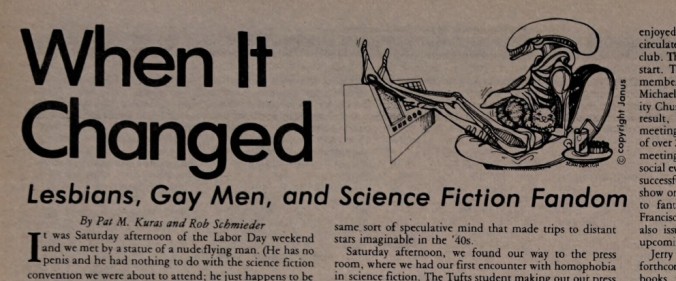
Exploration Log 8: Pat M. Kuras and Rob Schmieder’s “When It Changed: Lesbians, Gay Men, and Science Fiction Fandom” (1980)

“We also encountered many gay people, feminists and progressives of every stripe. These people were at the convention because present day science fiction has much to offer them. Science fiction is the fiction of ideas, and the ideas coming from the minds of the new writers more and more concern progressive analyses of social issues.”

— Pat M. Kuras and Rob Schmieder (1980)

At the 38th World Science Fiction Convention (29th August–1st September, 1980) held in Boston, MA, organizers scheduled the first Worldcon panel with an openly LGBTQ topic: “The Closed Open Mind: Homophobia in Science Fiction Fantasy Stories” moderated by Jerry Jacks, one of the “early openly gay fans.”1 Around 200 fans attended to hear Elizabeth A. Lynn (SFF author), Samuel R. Delany (SFF author), Frank M. Robinson (SF author and activist), and Norman Spinrad (SFWA President and SF author) (“the token straight”) discuss issues of representation.

Continue reading

Updates: Recent Science Fiction Purchases No. CCCXL (Philip José Farmer, L. Sprague de Camp, George Alec Effinger, and an Anthology of SF by Women)

A selection of SF volumes acquired over winter break!

Which books/covers/authors intrigue you? Which have you read? Disliked? Enjoyed?

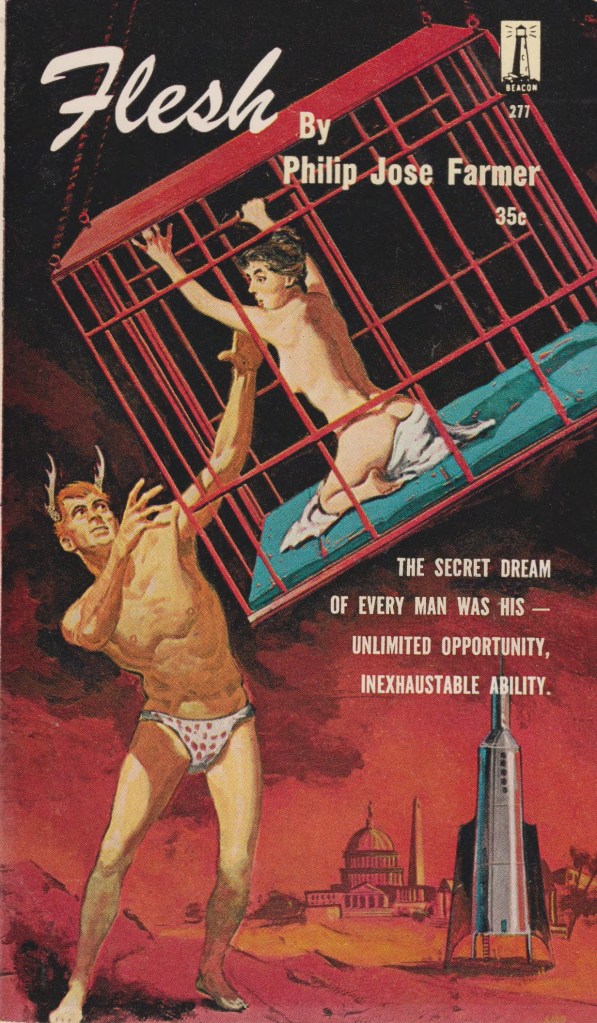
1. Flesh, Philip José Farmer (1960)

From the back cover: “Spaceman by DAY… MONSTER by night!

Peter Stagg was caught in the vilest trap ever devised–his own lust-driven body! For FLESH is the pulse-stirring story of a space explorer’s return from the strangest voyage man had ever made–to the strangest world the universe had ever seen–his own Earth!

Continue reading

What pre-1985 science fiction are you reading? + Update No. X

What pre-1985 science fiction are you reading or planning to read this month? Here’s February’s installment of this column.

Before we get to books and birthdays and writing plans…

Do you have the inner strength to survive the panic of a nuclear attack? Take a test in the August 21st 1953 issue of Collier’s and find out! Sample question: “HOW DO YOU FEEL WHEN: […] You are alone in an automatic elevator when it stalls between floors?” Possible answers: “I’m not bothered,” “I become tense,” “It jars me badly,” and “I blow up.”

Continue reading

Updates: New Books! No. CCCXXIV (Octavia E. Butler, Edgar Pangborn, Piers Anthony, Themed Anthology)

Which books/covers/authors intrigue you? Which have you read? Disliked? Enjoyed?

1. The Company of Glory, Edgar Pangborn (serialized 1974, novel 1975)

From the back cover: “BEHOLD DEMETRIOS! With the same rich imagination and dazzling insights that won him the International Fantasy award, Edgar Pangborn weaves a magical tapestry set far in man’s future.

It is a time when man, struggling to rise above the ashes of nuclear holocaust, has returned to the simpler values and lifestyles of medieval times. And in this society, Demetrios the storyteller is revered among men for his captivating tales of the Old Time, with its miraculous Telephones, and Jet Planes, and TV, and Automobiles. But Demetrios is also feared–for one storyteller with a head full of ancient truth can be dangerous.

So Demetrios is forced to flee, with six compatriots, and together they embark on a journey full of unexpected sorrows, and unimagined delights, a journey through realms of fantasy, philosophy, and rich human possibility, which the reader will be delighted and privileged to share.”

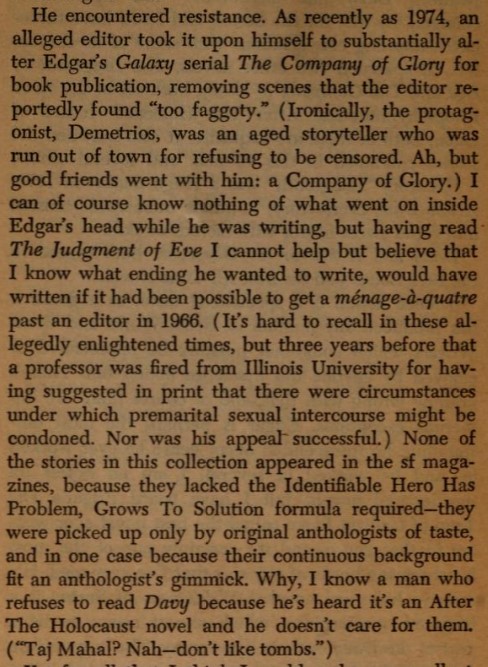
Initial Thoughts: After reveling in Pangborn’s masterpiece Davy (1964), I decided to acquire everything in the Tales of a Darkening World sequence I didn’t own already. According to Spider Robinson, the editor at Pyramid Books cut portions of the novel that was serialized in Galaxy… Inset image is from Robinson’s intro to Still I Persist in Wondering (1978).

Continue reading

Updates: Recent Science Fiction Purchases No. CCCXVII (Roger Zelazny, Philip José Farmer, Steve Wilson, and an anthology with Ursula K. Le Guin)

Which books/covers/authors intrigue you? Which have you read? Disliked? Enjoyed?

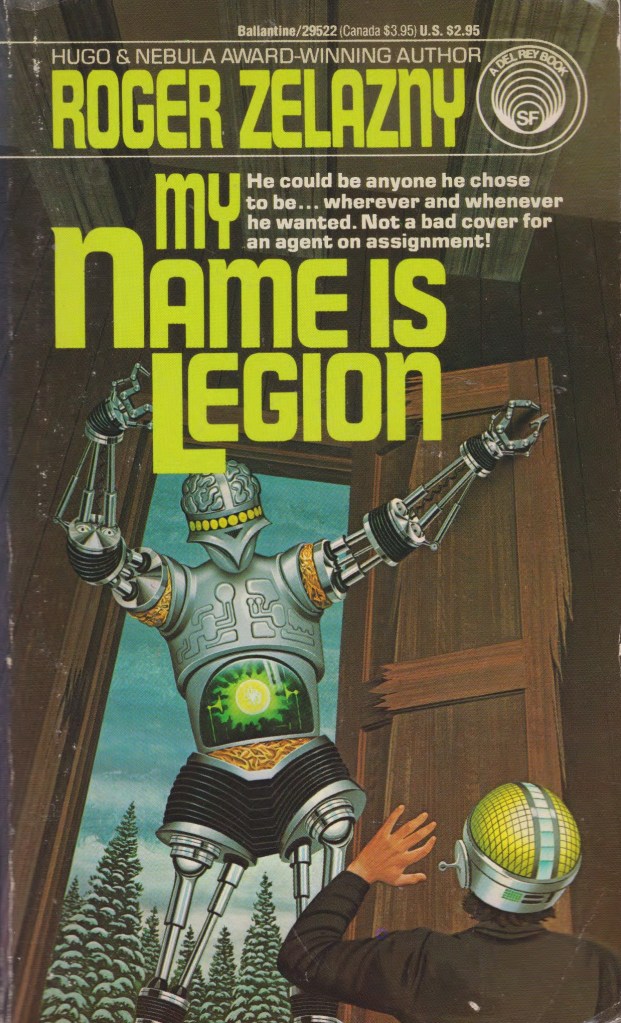
1. My Name is Legion, Roger Zelazny (1976)

From the back cover: “HE DID NOT EXIST… OR DID HE? He had destroyed his punch cards and changed his face. There was no credit card, birth record, or passport for him in the International Data Bank.

His names were many… any he chose.

His occupation was taking megarisks in the service of a vast global detective agency.

His interworld assignments were highly lucrative, incalculably vital, and terrifyingly deadly.

And more often than not, his life was a living hell!”

Contents: “The Eve of RUMOKO” (1969),” “‘Kjwalll’kje’k’koothaïlll’kje’k” (1973), “Home Is the Hangman” (1975)

Initial Thoughts: In the early days of my site read I reviewed the first in the Nemo sequence–“The Eve of RUMOKO” (1969). At the time I did not care for it. However, I recently read F. Brett Cox’s monography Roger Zelazny (2021) and retrospectively I’m not sure that I understood the character or what Zelazny was trying to accomplish with the story sequence. Often after I read a monograph, I end up making a few impulsive purchases and this is one of them! I hope, at the very least, it gives me a deeper understanding of Zelazny’s SF project. And “Home Is the Hangman” (1975) is a Hugo and Nebula-winning novella that I have not read.

Continue reading

Exploration Log 1: Sonja Fritzsche’s “Publishing Ursula K. Le Guin in East Germany” (2006)

I devour a massive quantity of scholarship on science fiction (authors, culture, fandom, etc.) and history topics that intersect with my SF interests. Some weeks I spend more time reading historical fanzine debates and magazine articles than fiction. I thought that I would share some of what I’ve found most transfixing with you all! In the past I’ve tweeted the most intriguing bits I’ve come across (Michael Moorcock burning John Brunner novels for example) but with the impending implosion of the platform I thought it best to post more on my site which is on track for a banner year.

Thus, I inaugurate the first in what I hope are many future Exploration Logs! Some posts will be a brief survey of the various SF-related non-fiction I’ve read. Other posts, I hope, will be a jumping off point for my own research. In this instance, I’ll share the elements of an article that resonated with me.

Today I’ll cover an absolutely transfixing piece by Sonja Fritzsche on how two Ursula K. Le Guin novels went through an “elaborate approval process” before appearing print in Communist East Germany (GDR). Read more to learn more about the Stanislaw Lem Club’s stash of illegal western SF and how The Dispossessed‘s Shevek was incorporated in the East German national myth!


Sonja Fritzsche’s article “Publishing Ursula K. Le Guin in East Germany” appeared in Extrapolation, vol. 47, Iss. 3 (Winter 2006). As I could not find a copy online, I requested it through my university’s Interlibrary Loan system. If you’re desperate to get your hands on a copy, reach out!

“Publishing Ursula K. Le Guin in East Germany” reveals three fascinating intersecting threads–1) the mechanisms of the censorship program according to the “official literary policy of Socialist Realism,” 2) status of genre within the GDR and 3) how Le Guin’s complex takes were interpreted and rationalized in order to see print for the growing number of East German SF fans in the 70s and 80s.

Continue reading