
9.5/10 (Masterpiece)
Winner Palm d’Or Cannes 1995
Seldom, if ever, have I been so enamored with a movie. Emir Kusturica weaves a poignant, comic, vicious, madcap, sprawling, and physics defying cinematic experience deftly intertwined
with the history of Yugoslavia and its successor states.
Brief Plot Summary
Two friends build a massive underground weapons making complex to protect their town from the German invasion in WWII while they join the communist guerilla fighters. Both fall for the same woman — an actress who helps the Germans and also has a bungling/comical German lover. Eventually, one friend is injured and remains underground while the other rises up through the ranks of the Tito regime (and adapts an elaborate system to convince those still hidden underground that WWII is still being waged). I best not spoil the rest!
Most criticism of the film I’ve read revolves around Kusturica’s interpretation historical events. Although I’m not Serbian or Bosnian but I do have some basic knowledge concerning the break-up of the Yugoslavia, WWII, and the Serbian atrocities inflicted on various other ethnic groups in the region.
Emir Kusturica was so badgered by attacks concerning his glossing over of the real issues of the succession (ethnic cleansing etc…) that he was forced into voluntary film retirement (thankfully that did not last long) because of the hostile reaction he received at home even though he won the prestigious Palm de’Or at Cannes in 1995.
I do not have a clear rebuttal, but I can say that this exclusion should not condemn him. The monumental task of embodying the history of a country, the feelings of a people, into an extended family over 60 years cannot and should not include everything. A WWII movie about the invasion of Normandy most likely will not address the Holocaust — neither will a movie about German U-boat captains address the Nazi invasion of Russia in any depth. The material which he covers for a Hollywood director would be material for tons of movies. His concentration on a single family (and the history that eddies around them) excludes discussion of atrocities for to quote Kusturica, “they were not all bad.”
This statement is depressing in the context of the movie itself for it is hard for the audience to sympathize with anyone. Those that are truly innocent are either mentally handicapped or hidden underground and brainwashed with Tito propaganda.
That is the chilling part of the film and I feel it is the crux of his message. Many people in Yugoslavia were misguided, but in the context of the extreme isolation of Tito’s regime and WWII these actions are definitely not to be forgiven but perhaps, understood in context to a greater degree.
The acting is impeccable. Miki Manojlovic is my personal favorite portraying the alcoholic womanizing and eventually fiercely loyal husband. The chemistry between him and his best friend (Lazar Ristovski) is exceptional as is the love triangle with Mirjana Jokovic (an amazing actress). Slavko Stimac plays the mentally slow Ivan and his journey through the tunnels in search of his chimpanzee friend is harrowing and frightening.
![[kusturica+-+underground1.jpg]](https://sciencefictionruminations.com/wp-content/uploads/2010/06/kusturica2b-2bunderground1.jpg?w=300)
My favorite element of Emir Kusturica’s films is his use of magical realism. This element is normally used by South American writers, and Italo Calvino and Borges in Europe but rarely is it used in Cinema. If used poorly it can seem corny and contrived. Emir is the master of using the technique, for example, the glorious Underground wedding scene with the bride connected to the wheeled wooden arm. Only in the beginning is this moving contraption seen, in all other shots the bride is actually flying around the room, over the tables. The effect is stunning. Many stories thrive off of unexplained, unscientific, elements that the characters themselves are oblivious too. The grenade exploding in the suitcase, the detaching island, the underwater scenes, etc…
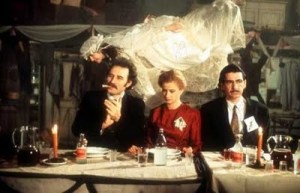
The movie is LONG. The scenes are madcap. The cinematography is spectacular. The music is exceptional, infectious and crawls farther and farther into your skull edging you on to some conclusion — simply put, either you love it or hate it. The movie is also heart wrenching (perhaps the symbolism is occasionally heavy handed) while being astoundingly funny — a dichotomy paramount for his message. It explores the joys of family, of love, and the terror of events and feelings (war, lust) that might seem out of an individual’s control. A cinematic masterpiece.
 Science Fiction and Other Suspect Ruminations
Another well-written review… Although i have not heard of the controversy concerning the historical accuracy of the film, I understand your dedication of a sizable piece of your review to this issue. Alas! a film is not a mirror that reflects a true portrait of the past. Or perhaps it is precisely because of this fact – the distortion of the film/mirror – which enables films such as this one to transcend their particular time and place and allow viewers to grasp something ineffable, or perhaps more universal, beyond. (Borges is Argentine).
–mark
A 14-year-old review. Very well-written. Underground is a lot to process but is ultimately rewarding. Note: One of the writers who hounded Kusturica in 1995 is a French intellectual named Alan Finkelraut. He just came out in support of Marine LePen. The irony.
Thanks for stopping by. Despite the age of the review, I still remember it fondly. What did he hound Kusturica about?
He’s a Zionist and a neoconservative and he hounded Kusturica about Serb nationalism. The reason the establishment found Kusturica so threatening in the 90s is the fact that he’s both a Muslim and a Serbian nationalist. Serbia was outside of the Western consensus and Serbs were being portrayed as baby eating monsters. Now ironically Finkelraut supports LePen and French fascism because he’s afraid that Melancthon will be too anti-Zionist. He needn’t have worried. Macron simply refused to seat a leftist government.
Thank you for the explanation. I must confess, when I watched the film in my late teens (a sophomore in college with access to a great audiovisual library), I found the nationalist ending a bit unusual. It comes off as an evocation of nostalgia untethered to the disturbing reality that transpired.
I’m not from the Balkans so I wouldn’t presume to explain the intricacies of nationality in the former Yugoslavia. But ethnicity in the Balkans depends on religion, not skin color. To be a Serb you have to be an Orthodox Christian and your family has to have a “Slava” (a kind of household saint). Kusturica has come out and said “my ancestors became Muslims to survive the Turks.” That would be a bit like a Canadian saying “I’m only a Canadian because my ancestors didn’t have the guts to defy the British so they crossed the border when the American Revolution started.”
In any event, in the 1990s Bosnian Muslims were the darlings of the liberal West. NATO wanted an excuse to move into the Balkans so they portrayed a civil war as a Manichean struggle between good and evil with Muslims as the victims and Orthodox Christians as baby eating monsters. So Kusturica got ostracized from the cool crown in Paris, Hollywood, and Cannes. Since 9/11 of course it’s been the opposite. It’s Muslims who have been portrayed as baby eating monsters. What’s happening in Gaza has thrown yet another wrinkle into the whole issue. Boomers side with Israel, Millennials with the Palestinians. In the Balkans it’s even more convoluted. There’s an anti-imperialist side left over from the former Yugoslavia that sides with the Palestinians. Conservative Serb nationalists tend to side with the Zionists.
I certainly know most of this now, but not pre-History PhD ~2007 when I was but 20 years old and saw the film and wrote the review. Reflecting on the chronology, I wrote the review back when I posted reviews on Amazon. And when I started my site in graduate school in 2010, I transferred some of the older reviews. I have long since deleted most of what I wrote about film for my site but kept this one for whatever reason.
I would recommend Kusturica’s second movie When Father was Away on Business. It was made in the 1980s. Ethnicity means nothing. The important conflict was Tito vs. Stalin, independent Yugoslavian communism vs. the Soviet bloc.
I have seen most of his available films! Black Cat, White Cat (1988), Arizona Dream (1993), Time of the Gypsies (1988), When Father Was Away on Business (1985), Promise Me This (2007), Life is a Miracle (2004)… Did not care for the last two. Huge fan of Arizona Dream for the Iggy Pop/Goran Bregovic soundtrack and as a rare example of Magical Realism.
I would also recommend an American movie called Four Friends. The screenplay was written by Steve Teisch, a Serbian immigrant (the same man who wrote the classic cycling movie Breaking Away). My theory is that Kusturica used it as the template for Underground.
While I have not seen Four Friends, I certainly know Breaking Away! I still live close to Bloomington, IN (the location of the film i.e. Indiana University, where I went to grad school).
Four Friends is on YouTube in full. Check out the opening where they’re playing Dvorak’s New World Symphony while running down the street. It reminded me of the opening of Underground. Kusturica also uses New World Symphony in his scenes of the liberation of Belgrade. I’ve always liked Breaking Away.
Only thing that threw me off a bit was the way they portrayed Indian University as a snob school, more like USC than a Big Ten school. I suspect it had something to do with Teisch’s anxiety about being a “real American.” Kind of funny the way Dave gets rejected by the Italians, a WASP American who wanted to fit into another country and can’t
Yeah, definitely just a standard massive state school designed to serve students from the state — and not an expensive private establishment.
I can’t promise I’ll get to the film anytime soon. My movie watching days have long since passed — I can convince myself to watch a few a year. I have other interests and hobbies.
Interestingly Larry Bird spent two weeks at Indiana University and thought it was so unbearably snobbish he dropped out to become a garbage man. Then he transferred to Indiana State in Terre Haute.
IU now lets in 82% of its applicants (like all the huge state schools in small states who don’t have a ton of high school students to select from to fill enrollment). If people think it’s snobbish now (again, maybe it was different in the past), I guess they are unaware of who attends, i.e. anyone who passed most of their high school classes. Again, I was a graduate student who applied due to its specialties in the history department. I taught undergrads of course but was quite separate from them. It is the best state school in the state so, maybe that’s the reason. But Notre Dame or Butler are definitely the places you go if you have money to burn…
I went to Rutgers, a very similar school. It’s basically the University of New Jersey afraid to change it’s name because, well, New Jersey. Yeah, there’s a gulf between Rutgers and Princeton. My sister in law went to Notre Dame. That is definitely an elite place. Purdue on the east coast interestingly enough is considered a quasi-Ivy. If you have a computer science degree from Purdue and you apply for a job here it’s pretty much like having a degree from Stanford.
Purdue might be considered a quasi-Ivy when it comes to engineering or computer science — but certainly not the liberal arts.
I went to The University of Texas, Austin. And as Texas has FAR MORE high school students to choose from, it lets in around 32% of its applicants. While not close to the Ivy League acceptance rates, it’s far closer to them than IU.