Updates: Recent Science Fiction Acquisitions No. XXXII (Cowper + Vance + Williamson + MacTyre)

As always Half Price Bookstore in Northern Austin, TX yielded a wonderful collection of sci-fi paperbacks…  I bought Doomsday, 1999 (1962) solely on the cover art — cool looking city exploding…  Richard Cowper’s Profundis (1979) on recommendation of my friend 2theD at Potpourri of Science Fiction Literature who waxed prophetic (hopefully)/intellectually about to joys of this seldom read author (well, his fantasy at least).  I personally, do not have high hopes considering the questionable nature of the back flap blurb.  My previous Williamson experiment, Trial of Terra (1962), had promise so I picked up one of his supposedly best works, Bright New Universe (1967).  And well, Vance is Vance and thus almost always worth reading….

1. Doomsday, 1999 (variant title: Midge),  Paul MacTyre (1962)

(Uncredited cover for the 1963 Continue reading

Book Review: The Penultimate Truth, Philip K. Dick (1964)

(Uncredited cover for the 1964 edition)

4/5 (Good)

Although I’ve read a great majority of Philip K. Dick’s novels and short stories, I’ve only reviewed one of Philip K. Dick’s novels in the lifetime of this blog, The Man Who Japed (1956).  Despite not reaching the near perfection which characterizes his best works, The Penultimate Truth (1964) is worth the read.  The work’s premise is pure PKD.  As with his best, an uncanny sci-fi infused surrealism seeps from the pages….  However, the work is plagued by ramshackle editing, the unfortunate tendency to use words like “homeostatic” and “tropism” ever few pages, and an ungainly plethora of named characters who have little to no import in the novel creates unnecessary confusion.

Brief Plot Summary (limited spoilers)

Most of the inhabitants of Earth, due to worries about an approaching nuclear war with the Soviets, retreated to massive underground facilities (Tom Mix Continue reading

Adventures in Science Fiction Cover Art: Spaceships Under Construction

(James B. Settles’ cover for the October 1948 issue of Amazing Stories)

A spaceship rearing from the plain, scaffolding surrounds its lithe form…  A classic image (the new Star Trek movie for example)!  Often utilizing a very traditional science fiction trope which I’ve dubbed Rocket Field Figure, cover art concerning spaceship construction is often more stylized than realistic.  My favorite is Carlo Jacono’s cover for the Italian edition of The Stars are Ours (1954).  I’m not sure that he is actually the artist due to the fact that MANY foreign editions use the work of American or British artists  modified slightly (this is not a hard fast rule, the work Continue reading

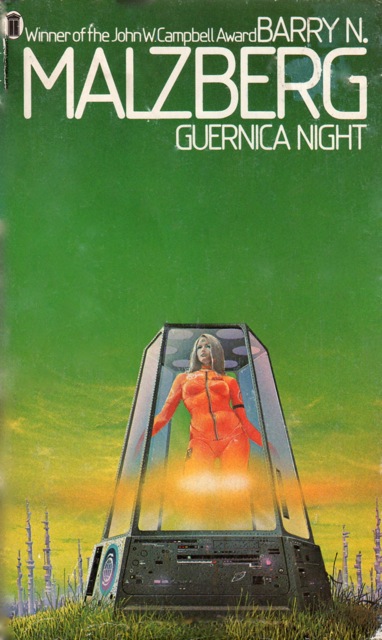
Book Review: Guernica Night, Barry N. Malzberg (1975)

(Tim White’s cover for the 1979 edition)

4.25/5 (Good)

Nominated for the 1976 Nebula Award for Best Novel

“Here we are in Disney Land/Disney World; clutching the strange hands of those with whom we came, we move slowly through the ropes under the chanting of the attendants, swatting insects of habitation, toward the exhibit of the martyred President.  The martyred President has become a manikin activated by machinery, tubes and wiring; he delivers selected portions of his famous addresses, stumbling back and forth […] (1)”

Guernica Night (1975) is the third of Barry N. Malzberg’s books I’ve read after Conversations (1975) and In the Enclosure (1973).  Although lacking the Continue reading

Adventures in Science Fiction Cover Art: My Top 15 Science Fiction Covers

1. Harold Bruder’s cover for the 1967 edition of Pyschogeist (1966), L. P. Davies.

Because everyone loves lists…

…I’ve selected from my collection of cover art, placed in no particular order, my fifteen favorite science fiction covers of all time.  Of course, lists being lists, and the fact that I’ve only seen a portion of all the covers ever made, it is incomplete and maleable.  Although many of the most famous sci-fi artists (Powers, Lehr, and pulp masters such as Wesso) feature, some of my favorites are by lesser known artists whose visual contributions to the field should not be forgotten (Bruder, Podwil, Foster, Schongut, etc).

A few points to consider: 1) The artist rarely had control over the font.  If the graphic designer responsible for putting together the final cover wasn’t up to snuff, the text often doesn’t Continue reading

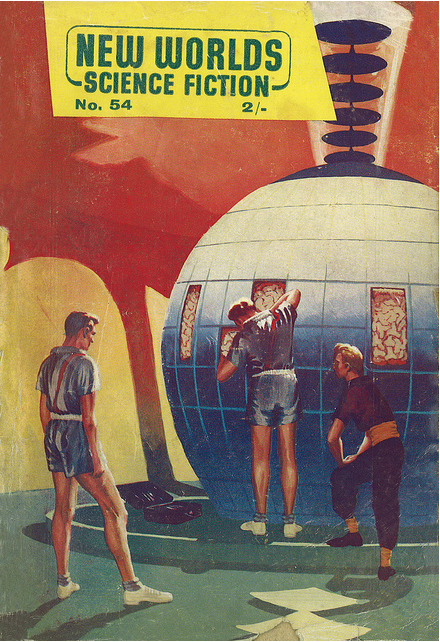
Adventures in Science Fiction Cover Art: Disembodied Brains, Part I

(Gerard Quinn’s cover for the December 1956 issue of New Worlds)

Disembodied brains — in large metal womb-like containers, floating in space or levitating in the air (you know, implying PSYCHIC POWER), pulsating in glass chambers, planets with brain-like undulations, pasted in the sky (GOD!, surprise) above the Garden of Eden replete with mechanical contrivances among the flowers and butterflies and naked people… The possibilities are endless, and more often than not, taken in rather absurd directions.

I’ve cobbled together a large variety of images from pulp magazines to covers from the late 70s.  My favorites include Valigrusky’s Continue reading

Updates: Recent Science Fiction Acquisitions No. XXXI (Dick + Zelazny + Tucker + Smith)

Another wonderful assortment (some from Central Texas bookstores, some from my father as presents, some semi-forgotten works from a few months ago that I forgot to post about)…  Regardless, I’m almost finished Zelazny’s Jack of Shadows (1971) and am quite impressed (I loved This Immortal and Lord of Light).  Another PKD, Dr. Bloodmoney or How We Got Along After the Bomb (1965),  swells my already extensive collection of his novels and short story collections — again, the premise is vintage PKD surrealism (girl with twin brother growing inside of her in a post-apocalyptical wasteland).  I bought the Wilson Tucker novel, Tomorrow Plus X (1956), because of the gorgeous Richard Powers cover…  A few of his works are supposedly readable, but this one is probably justly forgotten.  The Cordwainer Smith collection, Space Lords (1965), will be my first exposure to his work — very excited!  Now that I think about it, I do have a copy of Norstrilia (1975) languishing somewhere.

Enjoy!

1. Jack of Shadows, Roger Zelazny (1971)

(Robert Pepper’s cover for the 1972 Continue reading

Book Review: The Long Winter, John Christopher (1962)

(Paul Lehr’s cover for the 1968 edition)

3.75/5 (Good)

Although known for his famous young adult Tripod Trilogy (The White Mountains, The City of Gold and Lead, The Pool of Fire), John Christopher produced a substantial corpus of science fiction works for older readers — most notably, the post-apocalyptical tale No Blade of Grass (1956).  The Long Winter (1961), one of Christopher’s lesser known works, is on the surface another post-apocalyptical novel (or sorts).  However, the post-apocalyptical elements are subsumed by a bitting satire on colonial and post-colonial British attitudes towards their colonies.  The publication date of 1962 is of vital importance in understanding the work.  Nigeria gained its independence from the British in 1960, Ghana in 1957, and South  Africa in 1961.

A large percentage of the reviews I’ve read complain that they Continue reading

Adventures in Science Fiction Cover Art: Ice-Covered Cities

(Uncredited cover for the 1959 edition of We Who Survived (1959), Sterling Noel)

One of many ways science fiction authors speculate about the end (or beginning of the end/or an apocalyptic hurdle) of the human race is the coming of an Ice Age.  Such an occurrence (induced by us or the arrival of a natural cycle) would cover our cities with layers of ice — conjure the disturbing images from Gilliam’s film 12 Monkeys (1985) or Roland Emmerich’s egregious The Day After Tomorrow (2004) — forcing us to evacuate to the more inhabitable zones.  Those left behind might eek out an existence, revert to a primitive state, or die out completely…

I have a review for John Christopher’s The Long Winter (1962) in the works — Continue reading