Book Review: Seed of Light, Edmund Cooper (1959)

(Uncredited cover for the 1959 edition — I suspect it might be David Davies)

3.25/5 (Average)

Edmund Cooper’s Seed of Light (1959) is less of a traditional narrative of the voyage of a generation ship as are its fellow generation ship novels of the 40s/50s. The best examples are Brian Aldiss’ Non-Stop (1958) and Robert Heinlein’s Orphans of the Sky (1941).  Seed of Light is more like a piece of pseudo-history interlaced with fragments of narrative of varying effectiveness.  The work is best described as a thematically-linked series of novellas tracking the future development of man in broad strokes à la Brian Aldiss’ Galaxies Like Grains of Sand (1960).  Unfortunately, Cooper’s original splicing of the generation ship theme onto a Future History template (made popular but Olaf Stapleton and Isaac Asimov among others) is extremely uneven.  Some portions are involving while others are plagued by laborious epoch-spanning pseudo-historical lectures.

Because each part is a separate novella (the last two are more closely Continue reading

Adventures in Science Fiction Cover Art: Chess/Checkers (with people + planets)

(Ed Valigursky’s cover for the 1962 edition of Cosmic Checkmate (1962), Charles V. DeVet and Katherine MacLean)

Queue Ed Valigursky’s cover for the Cosmic Checkmate (1962): a chessboard arrayed against a background of stars, men stand on different colored squares, as much pawns of some distant player as the pieces nearby.  Spaceships flash across the vast expanse of space — remember, the game has galactic ramifications — with our characters arrayed, the game opens, and the battle (of wits and secret weapons) begins.  Although I have not (yet) read Charles V. DeVet and Katherine MacLean (whose later novel Missing Man (1975) I highly recommend) is explicitly about Chess, or more precisely, a similar alien game, and the ramifications are indeed, galactic in scope.  Other covers are more metaphoric Continue reading

Book Review: Sargasso of Space, Andre Norton (1955)

(Ed Emshwiller’s cover for the 1964 edition)

4/5 (Good)

Andre Norton’s Sargasso of Space (1955), the first installment of her Solar Queen sequence of novels, delivers everything a 1950s juvenile science fiction adventure should.  Sargasso of Space is not only blessed with genuine tension, intriguing situations, heroic young adults, but also a multi-racial cast (an African-American apprentice engineer and two crew members of Asian descent).  This is my first of Andre Norton’s massive body of work I’ve read — Secret of the Lost Race, Star Born, Daybreak-2250 A. D., and Witch World are all on my shelf waiting to be devoured — and I will be looking to add more to my collection.  There’s something so appealing in the classic archetypal trope of the young hero–with the help of loyal friends–solving an intriguing (and dangerous) puzzle.

Brief Plot Summary

Our young/intrepid hero Dane Thornson is an apprentice Cargo-Master Continue reading

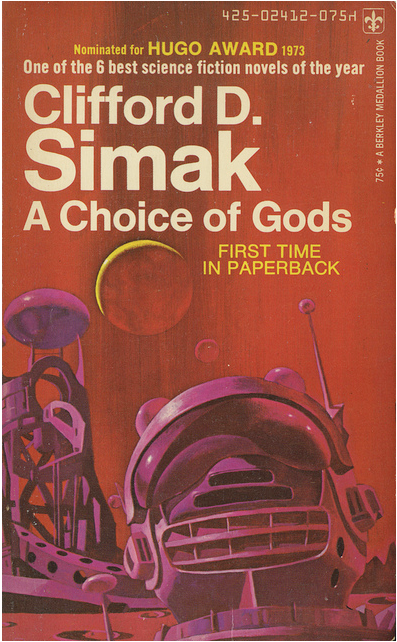
Book Review: A Choice of Gods, Clifford D. Simak (1971)

(Paul Lehr’s cover for the 1973 edition)

3.25/5 (Average)

Nominated for the 1972 Hugo Award for Best Novel

Clifford D. Simak’s A Choice of Gods (1971) is a flawed but intriguing novel.  Simak’s renowned for his original anti-technology pastoral visions.  His science fiction (replete with unusual aliens) is more likely to intersect our future world in the environs of the rural farm, the depopulated/gutted earth covered with forests or an isolated Native American tribe than an urban dystopia, trans-galactic spaceship, or distant planet.  The more famous examples are his Hugo winning Way Station (1963), deserving of at least some of the effuse praise it receives, and City (1952), rightly considered a classic.

Simak’s favorite themes are on show in A Choice of Gods including what happens to robots, whom Simak portrays as almost human but with a programmed need to Continue reading

Adventures in Science Fiction Cover Art: Models, Dolls, Mannequins

(David Davies’ cover for the 1968 edition of The Syndic (1953), C. M. Kornbluth)

Occasionally I dabble in the incredibly esoteric and artistically painful.  Apparently in the 60s and the early 70s — heralded by the artist David Davies — there was momentary interest in sci-fi covers constructed from manipulated photographs of store window mannequins, dolls, wire contraptions vaguely suggesting spaceships, toy spacemen, wooden artist mannequins dressed in clothes/wigs, and copyright violating models of the Star Trek: The Original Series Enterprise NCC-1701.

Unfortunately, most of the covers I’ve discovered are uncredited — they might all be the work of David Davies.  Internet Speculative Fiction Database has seventeen of his covers listed but I suspect that he made many many more — I’ve gone ahead and credited a few Continue reading

Book Review: Beyond Apollo, Barry N. Malzberg (1972)

(Roger Hane’s cover for the 1972 edition)

5/5 (Masterpiece — but please consider the caveats below before procuring a copy)

(This review is a product of lengthy dialogues with my girlfriend, a graduate student in English, who devoured the work with great relish and enthusiasm.  Her remarkable eye peeled away levels I didn’t even know existed and heightened my appreciation for this underread classic.   I owe large portions of this review to her.)

Barry N. Malzberg’s Beyond Apollo (1972), the third of his novels I’ve read (Conversations, In the Enclosure, Guernica Night), is generally considered his best work (he won the inaugural John Campbell Award for best Novel).  In a genre infrequently blessed with literary experimentation — of course, there are a few exceptions, Ballard’s The Atrocity Exhibition (1970), Joanna Russ’ The Female Man (1975), Russ’ And Chaos Died (1970), and John Brunner’s Stand on Zanzibar (1968) among others — I’m always more predisposed to works which are structurally/stylistically inventive and thought-provoking.  Barry N. Malzberg’s Beyond Apollo more than fulfills  Continue reading

Updates: Recent Science Fiction Acquisitions No. XXXIV (Brunner + Tucker + Brackett + et al.)

A mixture of a few clearance section novels from Austin bookstores (Chandler and Siodmak) and three recent purchases from a nice used bookstore (for science fiction) in my current town…  I can’t wait to read another Leigh Brackett novel (one of the most renowned pulp sci-fi writers of the 50s) — I’ve only read her novels, The Big Jump (1955) and was pleasantly surprised.

One can never have too many Brunner novels (I have 21 at the moment and I’ve read a majority of them) — even average works from the early 80s….

And Wilson Tucker’s The Year of the Quiet Sun (1970) — yes, I generally dislike time travel, but I’ve yet to read one of his works so I might as well start with what is generally considered his best novel.

(*note: I include images of what I consider the best cover for the novel if it has multiple editions because I enjoy good examples of sci-fi art.  I own perhaps half of the exact editions shown.  A few readers have expressed confusion.)

1. The Long Tomorrow, Leigh Brackett (1955)

(Ed Emshwiller’s cover for Continue reading

Adventures in Science Fiction Cover Art: Crashed Spaceships

(Gaylord Welker’s cover for the December 1952 issue of Astounding Science Fiction)

Gaylord Welker’s cover for the December 1952 issue of Astounding Science Fiction appeared in my best sci-fi cover post a while back.  Although I rarely recycle images, whenever I see his masterful cover I’m impressed with the sheer desolation and desperation of the scene.  Inspired by the image I set off to find more covers depicting crashed spaceships (alien or human on Earth, the moon, distant planets….).

Hannes Bok’s cover for Campbell’s The Moon is Hell (1951), Hubert Roger’s cover for the February 1939 issue of Astounding, Earle Bergey’s cover for the November 1952 issue of Fantastic Story, and Walker Brook’s cover for the 1953 edition of Simak’s First He Died (variant title: Time and Again) are thematically similar but less successful.  The others include one of my personal favorites (not one of the best by a long shot) — Earle Bergey’s cover the June 1952 issue of Startling Stories — where a man and a woman rescue two green tentacled Continue reading

Book Review: Wyst: Alastor 1716, Jack Vance (1978)

(Eric Ladd’s cover for the 1978 edition)

4.25/5 (Good)

Wyst: Alastor 1716 (1978), the second book of the Alastor Trilogy I’ve read, is more involving, satirical, and thought-provoking than Marune: Alastor 933 (1975).  Each book takes place in the same star cluster so there’s no need to read them in order.  As with every Vance book I’ve had the pleasure to read, the world is vibrant, detailed, and believable.  And also with every Vance book I’ve had the pleasure to read, an unoriginal political intrigue-driven plot is grafted with varying degrees of success onto the world.

A Description of Wyst

The Alastor trilogy takes place in the Alastor cluster, a dense collection of stars ruled by the Connatic (who makes a brief appearance in this novel) from his palace on Numenes. Wyst, Alastor 1716, is comprised of the urban center Uncibal in Arrabus where the egalist utopian society resides, large rural regions with small Continue reading