Which books/covers/authors intrigue you? Which have you read? Disliked? Enjoyed?
1. Tales of Science and Sorcery, Clark Ashton Smith (1964)

Bob Haberfield’s cover for the 1976 edition
From the back cover: “A universe of remote and paralyzing fright–jungles of poisonous and iridescent blossoms on the moons of Saturn, evil and grotesque temples in forgotten elder worlds and dark-morasses of spotted death-fungi in spectral countries beyond the earth’s rim. Who else has seen such gorgeous, luxuriant and feverishly distorted visions and lived to tell the tale?” — H. P. Lovecraft
Contents: “Master of the Asteroid” (1931), “The Seed from the Sepulcher” (1933), “The Root of Ampoi” (1949). “The Immortals of Mercury” (1932), “Murder in the Fourth Dimension” (1930), “Seedling of Mars” (variant title: “The Planet Entity”) (with E. M. Johnston) (1931), “The Maker of Gargoyles” (1932), “The Great God Awto” (1940), “Mother of Tads” (1938), “The Tomb-Spawn” (1934), “Schizoid Creator” (1953), “Symposium of the Gorgon” (1958), “The Theft of the Thirty-Nine Girdles” (1958), “Morthylla” (!953)
Initial Thoughts: I was impressed enough with Smith’s “Master of the Asteroid” (1932) to track down more of his short fiction. If anyone knows which stories in the collection are more of the SF bent, let me know!
2. Patternmaster, Octavia E. Butler (1976)

John Jude Palencar’s cover for the 1995 edition
From the back cover: “A brilliant unique in speculative fiction, multiple Hugo and Nebula winner Octavia Butler is the creator of extraordinary novels that combine the cultural vision of Alice Walker and Terry McMillian with the cosmic scope of Ursula K. Le Guin and Doris Lessing. Powerful, thought-provoking, and filled with white-knuckle suspense, this is one of her classic novels….
The combined mind-force of telepathic race, Patternist thoughts can destroy, heal, rule. For the strongest mind commands the entire Pattern and all within it. Now the son of the Patternmaster craves this ultimate power. He has murdered or enslaved every threat to his ambition–except one, in the wild, mutant-infested hills, a young apprentice must be hunted down and destroyed because he is the tyrant’s equal… and the Patternmaster’s other son.”
Initial Thoughts: I recently read and wrote briefly about Butler’s Mind of My Mind (1977) and enjoyed it enough to track down more of the series.
3. Fury, Henry Kuttner and C. L. Moore (1947)
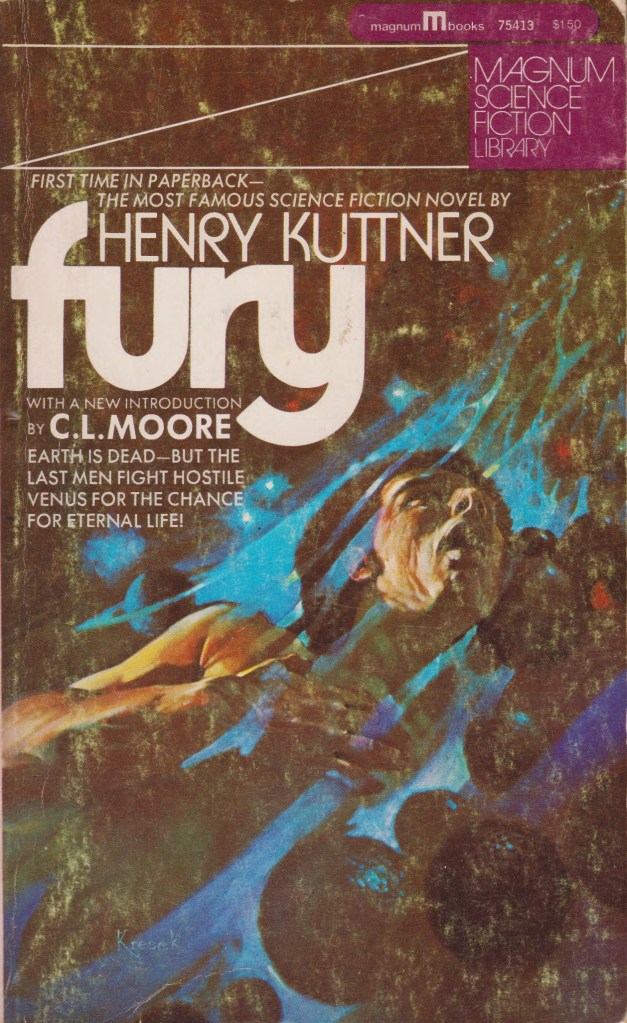
Larry Kresek’s cover for the 1972 edition
From the back cover: “THE IMMORTALS lived a thousand years or more, blessed by the poisonous magic that had destroyed earth. They ruled the keeps of Venus, those last cities of the race of man that were huddled beneath the shield of planetary ocean, avoiding the harsh realities of surface life. The immortals seemed content to watch the race drift toward inevitable death–until one of their own was born in hatred and bred in violence–a violence that made him explode in a rebellion that would take the race back to the stars.”
Initial Thoughts: Quoting my most recent review: “I can’t escape the post-apocalyptic wasteland. Like a voyeuristic shadow, I follow the denizens of the charred surface as they plod their slow movements toward the end. I observe how they push away the looming violent redness that blots out the sky, and, when everything else seems lost, they turn interior. A final movement that lays bare tattered dreams and ephemeral memories…” I am aware that Kuttner and Moore’s vision might be lest ruminative than some of the recent stuff I’ve been exploring.
4. Healer, F. Paul Wilson (1976)
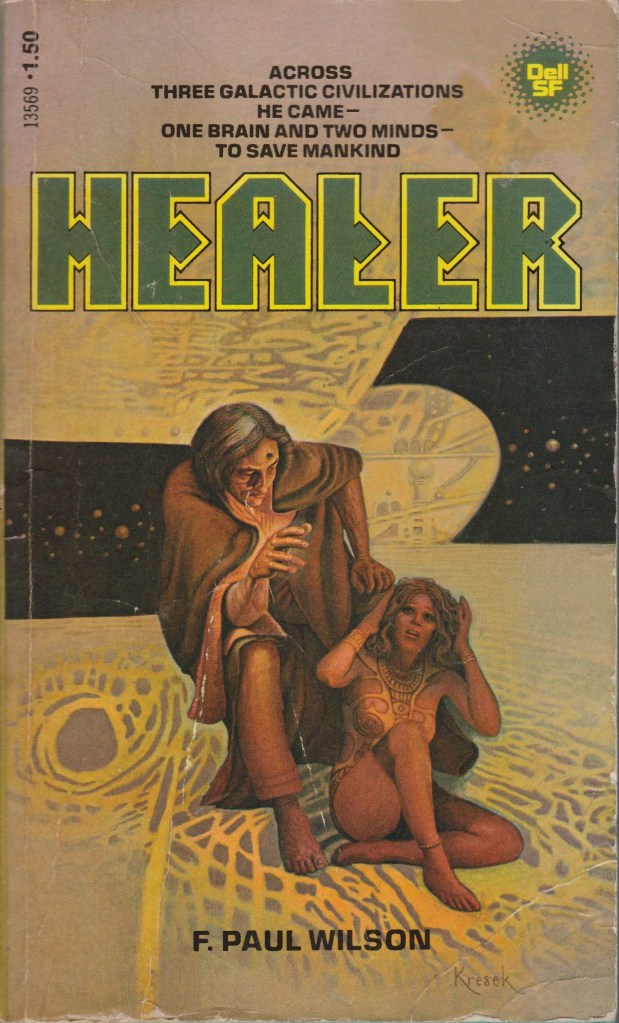
Larry Kresek’s cover for the 1977 edition
From the back cover: “THE FEDERATION OF MAN IS BEING DRIVEN INSANE! A plague of psionic terrorism threatens humanity, Impossible holes open in midair, vomiting alien berserkers. An epidemic madness called the horrors is leaving millions mindless, gibbering, cringing.
Once again the Healer emerges.
A cosmically unique symbiote of man and an alien being–immortal, telepathic scarred, and somehow human. He is the only galactic consciousness powerful enough to grapple with the alien evil called Kali.
To mankind he is a savior… and a freak.
A gripping, poignant space saga to join the ranks of The Whole Man and Davy.”
Initial Thoughts: Not an author I’ve read. I am aware of the basics of his work, and its Libertarian bent, from SF Encyclopedia but little else! Healer is the first novel in his LaNague Federation sequence. Also, what a weird comparison to Edgar Pangborn’s Davy (1964) in the back cover blurb. Davy is hardly a space opera and certainly doesn’t feature telepathy…
For book reviews consult the INDEX
For cover art posts consult the INDEX
For TV and film reviews consult the INDEX
 Science Fiction and Other Suspect Ruminations
I have that edition of Fury!
What an odd pitch for Healer. It’s about a man who becomes very long lived, who gets to experience a thousand years of history as a result. F. Paul Wilson was a libertarian when he wrote it (may still be) but rather oddly for one of his ilk, didn’t think libertarianism would catch on. There’s a planet of libertarians in his LaNague Federation, the very planet founder LaNague came from, but it’s seen as a planet of weirdos, not a model to emulate.
I enjoyed Healer a lot in 1977 but found it a bit thin in 2014.
Yeah, I mention his Libertarian views in the post but other than that I know little about that sequence. I’m guessing you also wouldn’t compare it to Davy! haha.
It’s almost exactly unlike Davy.
I read Healer (and a few other of the Wilson books) back in the 1980s. One weird thing about the structure of Healer – our hero encounters a telepathic computer (if I recall correctly) in the first section of the story, and leaves it be, causing this reader to have some expectations when (centuries later) a telepathic plague is besetting humanity, but it turns out there’s no connection at all.
Wilson writes supernatural thrillers these days (or did until recently), right?
He’s still alive: https://www.isfdb.org/cgi-bin/ea.cgi?235
I don’t know anything about his recent output — but yeah, it does seem like he moved away from SF to horror and the like. According to isfdb.org, he published a novel earlier this year. https://www.isfdb.org/cgi-bin/pl.cgi?963611
I’ve never read any of his supernatural horror, but I see it a lot at the library and on book racks, so I suspect a desire to eat regularly was involved in his move away from straight-SF.
Alas… reminds me of Joan Vinge moving into larger intellectual property markets, Chelsea Quin Yarbro, and my favorite of the bunch, Kate Wilhelm. All made later career genre shifts.
I read “Wild Seed” in the series very many years ago. It wasn’t bad as I remember, although I also recall that the prose style is flat. The theme of African superhumans seeding themselves through generations of their race, is interesting though.
Yup, I read and wrote about Mind of My Mind recently which charts the original creation of the Pattern and the death of Doro (who appears in Wild Seed). Wild Seed is the first in the series according to internal chronology.
Yes, it is, I just read about it on Wikipedia.
The only F. Paul Wilson I can recall reading was “The Keep” back in the day. It was a while ago.
Thanks for stopping by! Yeah, he’s an unknown to me.
Read any solid pre-1985 SF recently?
Damn, and I had just reviewed some Smith myself. I’m always staggered by how much he wrote. Think the only one in that collection I’ve read is “Mother of Toads,” which is very much not SF.
I have Parable of the Sower and Parable of the Talents on my shelf. I need to get to those…
I will get to Fury (for review) eventually, but actually I have the prequel story “Clash by Night” that I hope to review first quite soon.
Only Wilson stories I’ve read are “Lipidleggin’” (definitely libertarian-themed SF, although more philosophically than from a paranoid right-wing survivalist type POV) and “Soft,” which is a pretty effective horror yarn and… arguably SF?
I thoroughly enjoyed Smith’s rather straightforward SF story “Master of the Asteroid” that I reviewed very recently. https://sciencefictionruminations.com/2023/08/19/short-story-review-kate-wilhelms-planet-story-1975-and-clark-ashton-smiths-master-of-the-asteroid-1932/
I can’t say his non-SF stuff interests me that much — but we shall see.
I am also interested in exploring Wilson’s early short fiction. Apparently “Lipidleggin’ (1978) is in this same LaNague Federation sequence. Almost tempted to read that one first…
Huh. Lipidleggin’ is clearly set in the US in the not too distant future. Healer is set far enough in the future colonies have had time to collapse into barbarism. Enemy of the State says Earth lost control of the colonies two centuries before and it’s at least 36 years prior to Healer. So, the connection isn’t that close…
I’m going off isfdb.org. Sounds like the sequence covers the longue durée.
https://www.isfdb.org/cgi-bin/pe.cgi?1641
Review of “Clash by Night” (and other Kuttner/Moore collabs) posted! https://sciencefictionruminations.com/2024/03/29/book-review-clash-by-night-and-other-stories-henry-kuttner-and-c-l-moore-1980/
I woud like to read Fury, having read Clash by Night, which was good.
Clark Ashton Smith’s Zothique stories are Dying Earth stories avant la lettre, though more fantasy than sf. Evocatively conjured though. I’ve read a bunch over the years but don’t remember specific tales. More tropes. Desert wastes and long lost cities.
I recently snagged a collection that contains “Clash of Night” as I didn’t have a copy. I’ll probably read that one first.
“Clash by Night” is a Lawrence O’Donnell story by Moore and reads as such. FURY (1947) is primarily the work of Kuttner (per the material in HK: A MEMORIAL SYMPOSIUM, which I think I cited here some time ago). It is very different: tightly plotted and noirish, and preoccupied with a couple of themes: the non-psionic superman (Campbell had a thing for them too), and the conflict between progress and stasis that loomed large in ’50s SF. It’s well worth reading, and interesting to consider the through line from it to THE STARS MY DESTINATION.
John Boston: “It’s well worth reading, and interesting to consider the through line from it to THE STARS MY DESTINATION.”
Interesting that you write that. The golden age of science fiction is twelve or thereabouts, as we all know, and, besides PKD, three American SF novels I read as a kid of that age in late 1960s-era London particularly impressed me and made me a science fiction reader, and they were Bester’s THE STARS MY DESTINATION, the Kuttners’ FURY, and Budrys’s ROGUE MOON.
I’ve re-read the other two besides FURY over the years and they more or less stand up. I’ve been cautious about re-reading FURY and taking away from my boyhood memories of it, because I suspect in retrospect I’ll find it was merely a quite good SF adventure novel of its time.
Still, as John says, FURY is good and propulsively plotted, to the extent that IMHO it’s definitely better than much Asimov and Heinlein that’s gotten greater readership over the years. It was also the occasion for maybe the classic cover from Campell’s ASF golden era, this Rogers effort for the May 1947 ASTOUNDING —
I read Patternmaster not too long ago. I’m trying to catch up on the Butler books I haven’t read. It was an interesting start to her exploration of power dynamics and hierarchical behavior, but I thought she did that better in later books.
Dawn is still my favorite; I felt like it hit on every level — not to mention that it has great aliens and alien tech, which I always enjoy.
Did you see my recent comments about Mind of My Mind which is in the same Patternist sequence?
I’ve also covered — in a short review — Dawn. I must confess, I clash with her minimalist prose style. Kindred is my favorite of the three I’ve read so far.
Kindred is incredibly powerful, a real gut-punch of a story. Where most science fiction ages badly, I feel like Butler’s prescience and insight in human behavior makes her stories feel more and more relevant as time goes on.
I did read your comments on Mind of My Mind…it’s next up on my shelf of her books to read. I’m reading the series in publication order, for whatever reason — I know she jumps around chronologically. I’m curious to see where she goes with it.
My historian brain refuses to see things as dated — instead, they could only have been written when they were written. And what is in them is why I’m reading them — to learn about the specific views of the era.
I’m unsure of why I decided to read them in the order I did. Most likely as I didn’t have a copy of Patternmaster at the time so I picked up Mind of My Mind.
I returned to her work due to Garry Canavan’s masterpiece of a monograph Octavia E. Butler (2016) — highly recommended. https://www.amazon.com/Octavia-Butler-Masters-Science-Fiction/dp/0252082168
I do love reading older books as a window into that time period, although sometimes the sexism and racism (or, as likely, race erasure) are a bit much…but how much of that is the, I don’t know, baseline? of societal beliefs at that time and how much is the author’s specific beliefs, it can be hard to tell.
Absolutely. All normal challenges when confronting primary sources! 🙂
Re CAS. I have an identical copy lying around somewhere. CAS was primarily a fantasy author, although his stories often had sf trappings. I think he wrote around a story a month (over a ten year period) to pay his elderly parents’ medical expenses, stopping after they died. So I guess around a hundred stories in all?
Re F. Paul Wilson. The Keep was made into a movie. Not that I ever saw it, as it went straight to video, but there are enough corollaries with the book and the film for me to safely assume one was based on the other. It had a pretty high-end cast – Ian McKellen, Gabriel Byrne and Scott Glenn to name a few.
I just love the picture evinced by a probably valuable copy of a book “lying about somewhere”.As in my little flat..apartment..books are just THERE…like the air we breathe…
Haha. That said, these books are hardly expensive… I rarely spend more than $5 each.
Hah! I bought it in Waterstones for around two quid, I think (it wasn’t unusual to buy a book firsthand and to then discover it was around ten years old) plus my books are mixed in with a lot of other stuff. From where I’m sitting I can see a silicone gun, a bicycle lock, a scanner etc, various jamjars of screws, nails etc, and that’s just one shelf.
I read THE KEEP when I was a teenager and enjoyed it, but I haven’t paid much attention to Wilson. I thought he was always a horror writer and didn’t know he started out in sci-fi. I just looked at his Wikipedia page – how does anyone write that much and hold down a day job as a doctor?
I love the works of Clark Ashton Smith, but I rate his SF work lower than I do his horror / fantasy stories see in such locations as Atlantis, Hyperborea, Averoigne and Zothique. Nevertheless his SF work is interesting, and it’s surprising that much of it was published by Hugo Gernsback, given that it’s the antithesis of the technology-focused, “progress” obsessed worldview of Gernsback. I’d rate his best SF story as “The City of the Singing Flame”.
The SF material is scattered through Smith’s collections but is probably most strongly represented in his posthumous Arkham House collection “Other Worlds”. Like all of Smith’s AH collections it was reprinted (in 2 volumes) in the mid 1970s by the UK’s Panther Books; having access to British paperbacks in that period was great for Arkham House fans, as they reprinted a lot of AH titles! I believe this material is also scattered though the 5 volume Nightshade Press collection of CAS short stories from a decade or so back.
Yeah, you echo the general sentiment that I’ve read — his best work isn’t SF. The historian in me knows that I might not be reading his best but I’ll leave analysis of those non-SF works up to others. You gotta make some decisions about what to analyze! I included my review of his wonderful “Master of the Asteroid” (1932) in my series on subversive accounts of space travel. https://sciencefictionruminations.com/2023/08/19/short-story-review-kate-wilhelms-planet-story-1975-and-clark-ashton-smiths-master-of-the-asteroid-1932/
But who knows, maybe I’ll get so curious that I’ll just review that entire collection!
I thought Healer, F. Paul Wilson was fascinating when I read it (in the 80s?), enough that I read it several times, though not lately. I think what really hooked me was not so much the telepathy, but the ~symbiotic relation that develops, and the moves from place to place in the protagonist’s long life, trying not to be noticed too much.
Sounds intriguing. So telepathy is treated in a far more adept manner than others of its ilk? I can’t say telepathy is one of my favorite SF topics… with a few exceptions. I’m in the Silverberg’s Dying Inside and Butler’s Mind of My Mind camp — as in telepathy would be another form of oppression and depression and sadness.
In this case, it’s more like one human, one non-human, and it’s mostly? accidental. It’s not comfortable for them but they kind of learn to symbiote along after a while.