Note: My read but “waiting to be reviewed pile” is growing. Short rumination/tangents/impressions are a way to get through the stack before my memory and will fades. My website partially serves as a record of what I have read and a memory palace for future projects. Stay tuned for more detailed and analytical reviews.
You’ll soon understand why I haven’t posted regularly. There’s a substantial article (mostly complete) with original (and laborious) research on the horizon. Stay tuned!
1. Kim Stanley Robinson’s Icehenge (1984)
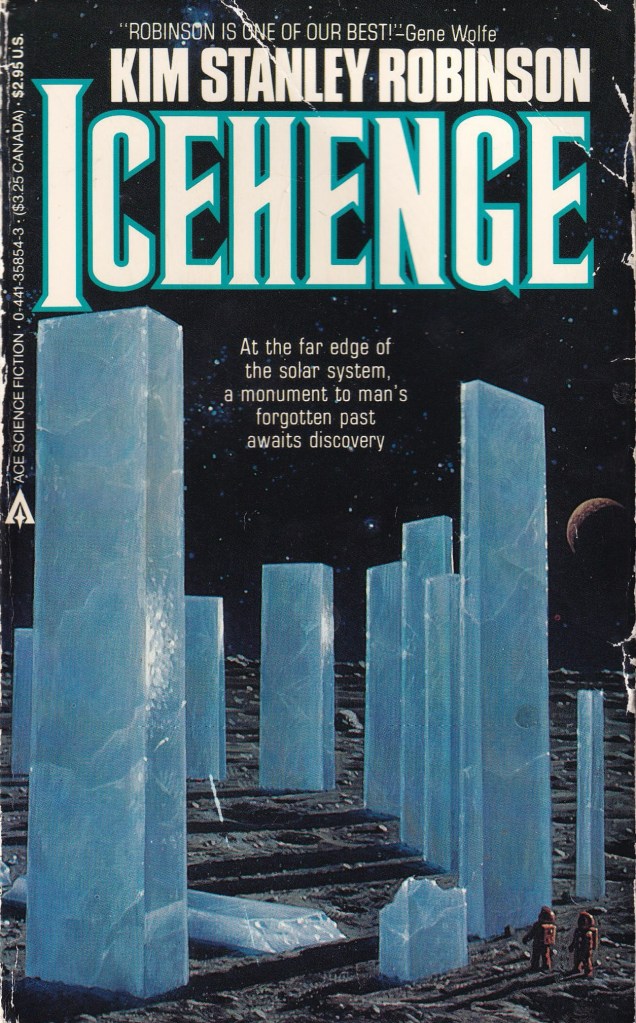
Mark Weber’s cover for the 1st edition
4.5/5 (Very Good)
Kim Stanley Robinson’s Icehenge (1984), a fix-up from two previously published stories “To Leave a Mark” (1982) and “On the North Pole of Pluto” (1980), tells three interconnected tales that all connect to a mysterious monolith left on Pluto (the titular Icehenge).
In part I (2248 A.D.), hydroponics specialist Emma Weil, stationed on a mining ship in the asteroid belt, finds herself caught up in a radical act of defiance to coincide with a revolt on Mars–the creation of a spaceship for a voyage outside the solar system. She must confront the pull of home and the multitude of ways the power of the state informs and manipulates her life. In part II (2547 A.D.), historian and archaeologist Hjalmar Nederland discovers evidence of the revolt on Mars long covered up by authorities, the diary of Emma Weil, and the monolith on Pluto — a testament to the act of defiance? In so doing, he too, must reckon with Mars’ bureaucratic dictatorship and its amorphous ability to claim narratives of resistance as its own. In part III (2610 A.D.), Edmond Doya, a descendant of Nederland, spins his own conspiracy theory casting all that went before into question. As the threads intersect and split and cross, a voyage sets off, again, for Pluto and its icy pillars—a testament to our desire to find meaning in a disenchanted world.
In many ways I preferred Icehenge to Red Mars (1992), Green Mars (1993), and Blue Mars (1996). In Robinson’s best-known epic trilogy, the reader follows the main movers and shakers in humanity’s conquest of our solar system. By design Icehenge instead follows the action after the action: men and women attempting to figure out their own place in a world characterizes by lifespans that stretch hundreds and hundreds of years. And its this brilliant interconnection between self-conception and the operations of history that Robinson succeeds and casts his spell. The story is well-told, polished, and filled with fascinating details (technological and sociological).
However, the central drive of the Icehenge centers on the ways we navigate the islands in our lives created by the vicissitudes of memory and time and the meaning we attempt to create from the space between. Despite the solar-system spanning milieu of the plot, it’s more about the distance both physical and metaphorical. The ways we cut each other off. The ways we try to figure out how to reconnect. The ways we grasp on to something alone in the dark.
Unfortunately, I waited too long to write a full-fledged review. Hopefully you get a sense of why I highly recommend giving it a read.
2. Peter Vansittart’s The Game and the Ground (1956)
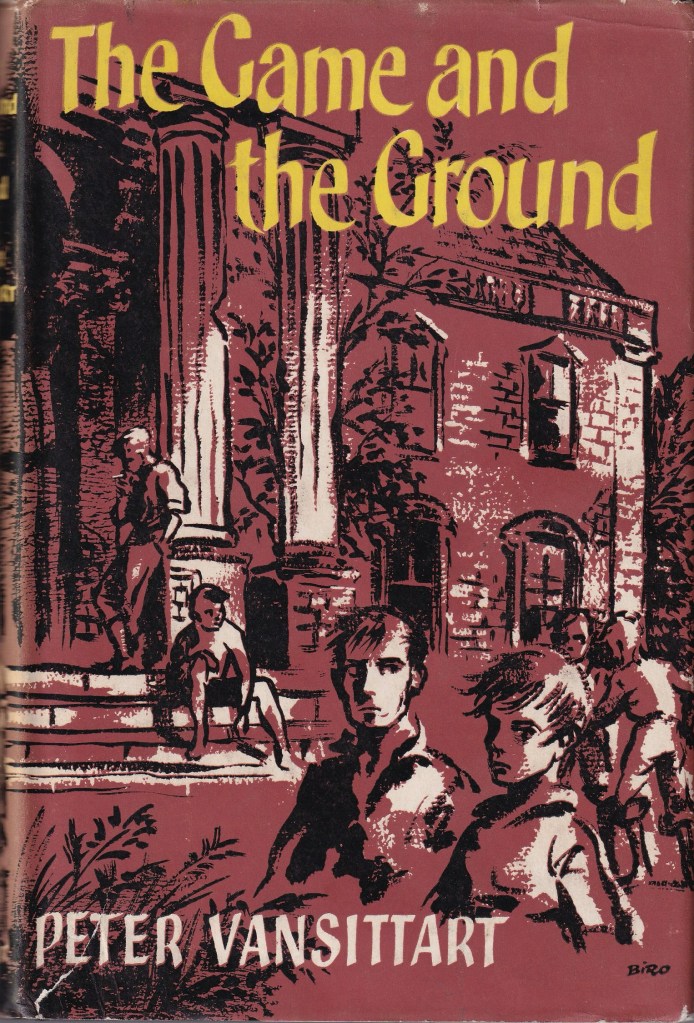
Val Biro’s cover for the 1st edition
3.25/5 (Above Average)
First, the preliminary and inevitable genre question: is Peter Vansittart’s The Game and the Ground (1956) at all “speculative”? SF Encyclopedia claims the following: “set in an indeterminate venue which may be Near Future, or an Alternate History version of a Britain haunted by gangs of feral children after a great Future War — again focuses on the rise to power of another Hitler figure.”
I disagree on all generic counts. I think there is enough to claim that it is not an “indeterminate venue” at all. It’s somewhere in Germany where there were concentration camps during WWII. This is definitely not a “Near Future” or an Alternate History of Britain (the latter is utterly befuddling) venue. First there are general references to the Nazi rise to power (56), rampant anti-Jewish sentiment, Western and Eastern fronts, the Berlin Airlift (1948-1949) (130, 146) happening in the “capital” (130), growing Cold War tensions (130), the release of Party (Nazi) war criminals (130), and propagandistic delusions of “The Thousand Years’ Empire” (i.e. the Tausendjähriges Reich) (150), etc. Yes, the names provided of various generals and Field Marshals are not actual Nazis (I checked). Yes, the specific historical details are kept deliberately distant and imprecise. However, there are enough details to position the novel as transpiring, albeit in a somewhat surreal and obfuscated manner, in the aftermath of WWII in an area in which both Soviets and the West attempted to assert control. There is no suggestion of any technology or elements that would imply the aftermath of a future WWIII.
Somewhere in the wreckage of the post-Nazi world, two brothers (Eric and Mike) return to Kasalten, their ancestral home. During the war the regime used Kasalten served as a concentration camp. The destroyed remnants of a gas chamber, rail lines, and blockhouses liter the grounds of the decayed and war-damaged mansion. With various other adult survivors (most with pasts they seek to escape), they attempt to create a “school” to rehabilitate the traumatized gangs of children that prowl the surrounding countryside. While not an institution in the traditional sense, Mike and Eric, and their staff, attempt to slowly encourage self-reliance and voluntary participation a democratic government. Everything starts to unravel when the third brother, an unabashed supporter of the regime, returns. Nicky, in his garish uniform with stories of glorious wartime activity, slowly takes over the workings of Kasalten. The children begin to worship him. Eric attempts to re-assert control. Mike, the narrator, also feels the inexorable pull his brother exerts. A final confrontation looms.
Vansittart suggests it’s all to easy to slip back into the fascist rituals and patterns of control. It’s all to easy to fall victim to a rewritten history, the communal delusion of a conflict with the “Barbarian” other… The surreal venue, a mansion sitting near the ruins of mass genocide, the implied details placing the location and era, all generates a disturbing alterity to the proceedings. This surreal alterity is where the novel succeeds. Elements reminded me of Lars von Trier’s cinematic marvel Europa (1991). Where does Vansittart lose the thread? The actual narrative is unnecessarily bewildering. The various feral gangs of children are interchangeable: they plot, they fight, they worship Nicky, they move from place to place, they do lots and lots and lots and lots of things, etc. There’s too much needless motion that muddies the effectively wrought post-war devastation.
Yes, I bought the book because of John Clute’s descriptors in SF Encyclopedia. Despite the lack of speculative content, Vansittart’s The Game and the Ground (1956) is a simultaneously fascinating, disturbing, and mystifying reading experience that I can only partially recommend.
For book reviews consult the INDEX
For cover art posts consult the INDEX
For TV and film reviews consult the INDEX
 Science Fiction and Other Suspect Ruminations
Pingback: A speculative fiction advent calendar of quotes: Dec. 22, 2025 – Fantastes
I looked Vansittart up because the name jogged my very vague memory of seeing some of his books at the local library in London when I was a kid. (Though I never read any.)
An interesting guy with an interesting background, who, living from 1920 to 2008, who seemingly knew every 20th century UK literary figure of note and published fifty novels —
https://www.telegraph.co.uk/news/obituaries/3174546/Peter-Vansittart.html
https://www.theguardian.com/books/2008/oct/10/2
https://en.wikipedia.org/wiki/Peter_Vansittart
Your assessment of The Game and the Ground’s setting is very much in line with the following from Vansittart’s Guardian obituary: “His well-received final novel, Secret Protocols (2006) …(is set) … in Estonia, just before that war, when Peter had visited the country. Its central character, Erich, is taken to Germany when Soviet forces invade …
Vansittart’s first novel is more overtly SF apparently. Although, it’s not supposed to be good… He did receive an OBE for his services to literature!
I found The Game and the Ground (1956) intriguing. I remain unconvinced though of its merits.
I’d never even heard of this KSR novel so the review is much appreciated, sounds a bit more interesting to me than his usual output to be honest. I do appreciate his prominence and his sort of literaty activism bit to be honest with his later output I find his prose workmanlike and his plots repetitive; this one sounds a little more idiosyncratic.
Icehenge‘s prose is just as workmanlike (but no more than that) as present-day KSR, as I recall from reading it when it came out. That’s about all I can remember from my reading of the book when it came out.
If you want early, more idiosyncratic KSR, you might try The Memory of Whiteness, which (a) reads a bit like he was trying out a Jack Vance (!) in the context of a human-settled solar system (like his later 2312) and (b) has all these grandiose ideas about music as a large part of the plot (in a way I found deeply implausible as a one-time professional musician).
https://en.wikipedia.org/wiki/The_Memory_of_Whiteness
His prose, at least in Icehenge, does not bother me. And is often quite adept at weaving the scene and emptiness of the world. However, my father also read the book and thought the prose was workmanlike. However, as I mentioned, I preferred this to the Mars Trilogy because of the sense that the triumph has already happened: Mars has already been colonized, the monolith already discovered, and Emma Weil (who is more at the center of things) is neither part of the main expedition to the stars or the attempted Revolution on Mars (well, read it and find out it). It’s more the way we spin narratives about the “triumph” — both personal and political. The ways we hide and find meaning in those narratives.
Yeah that does sound more interesting than his standard “and this is how we hard science our way out of THIS problem” approach to plot/theme. I do find “The Memory of Whiteness” intriguing for similar reasons (I also share Mark’s curiosity about the musical angle). Too bad about the title of that one. Out of context one could be forgiven for thinking its some kind of neo-nazi treatise like “The Turner Diaries” or something haha.
Yeah, not a fan of that Hal Clement-style science fiction, i.e. we have a problem let’s spend the entire novel fixing it. Not for me.
“To Leave a Mark” thrilled me when I first read it in F&SF. I thought the full Icehenge was quite good, but I didn’t like it as much as the novelette.
I thought early KSR stories were sometimes very well written, but by the time of the Mars trilogy the prose was much more clipped, more workmanlike. I sense he has so much he wants to say that he doesn’t take as much care saying it. Perhaps that’s unfair!
Hello Rich,
In comparison to other writers, his prose did not bother me. I even thought there were some powerful moments. I thought the fix-up novel’s ending really tied together the strands and emphasized the subversive elements of the story — and made it more trenchant for the modern era (i.e. conspiracy theories, etc.).
I’m intrigued by the combination of Kim Stanley Robinson and Peter Vansittart – what drew you to these two authors together? 🤔
Nothing in particular. There were two books that struggled/waited to long to write longer reviews so I grouped them together.
I might have to read Icehenge then. I didn’t know about it, and thought it was that weird stone-age story he wrote about cave men ice age. Which I have no interested in reading.
Yeah, definitely no cavemen. I also was put off by the title for a long time.