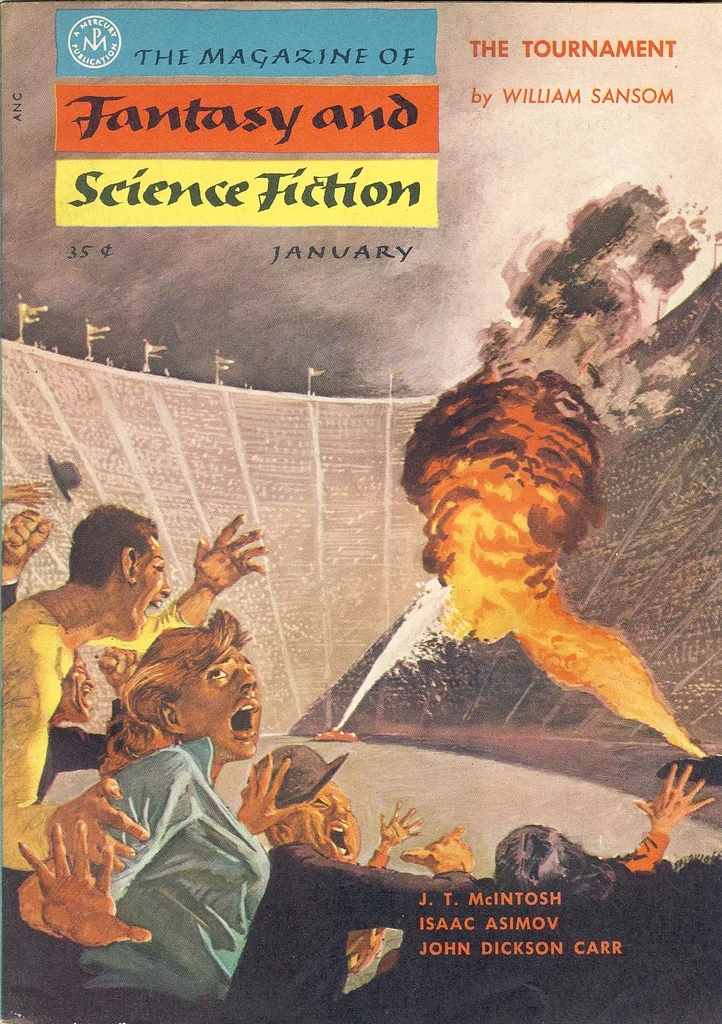
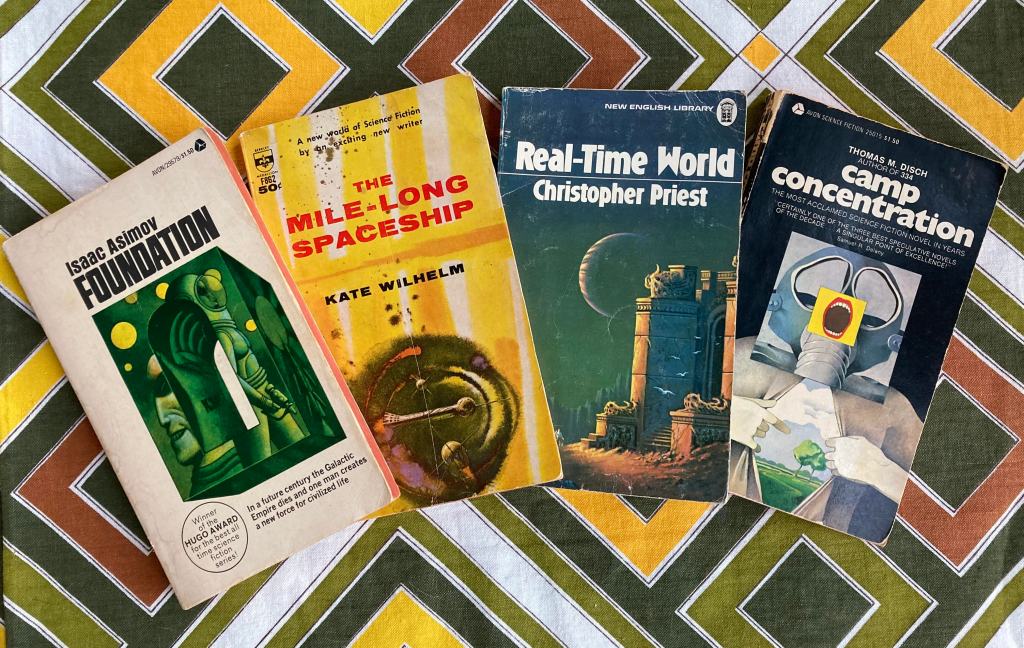
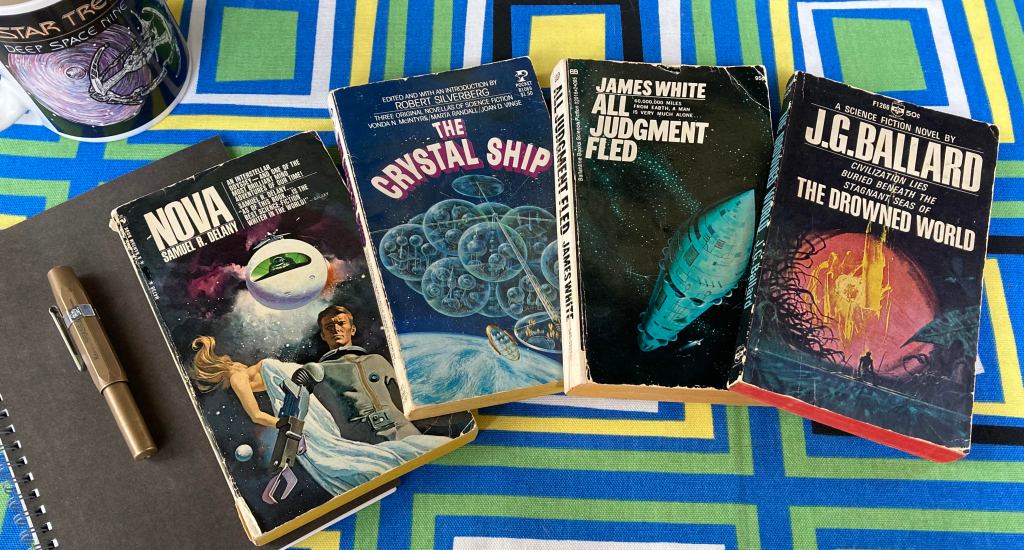
Updates: Recent Science Fiction Purchases No. CCCXXXIV (Robert Silverberg, Best SF of 1979, C. L. Moore, George Hay)

Spring semester in the books! It’s now time to read (and go on vacation).

Which books/covers/authors in the post intrigue you? Which have you read? Disliked? Enjoyed?

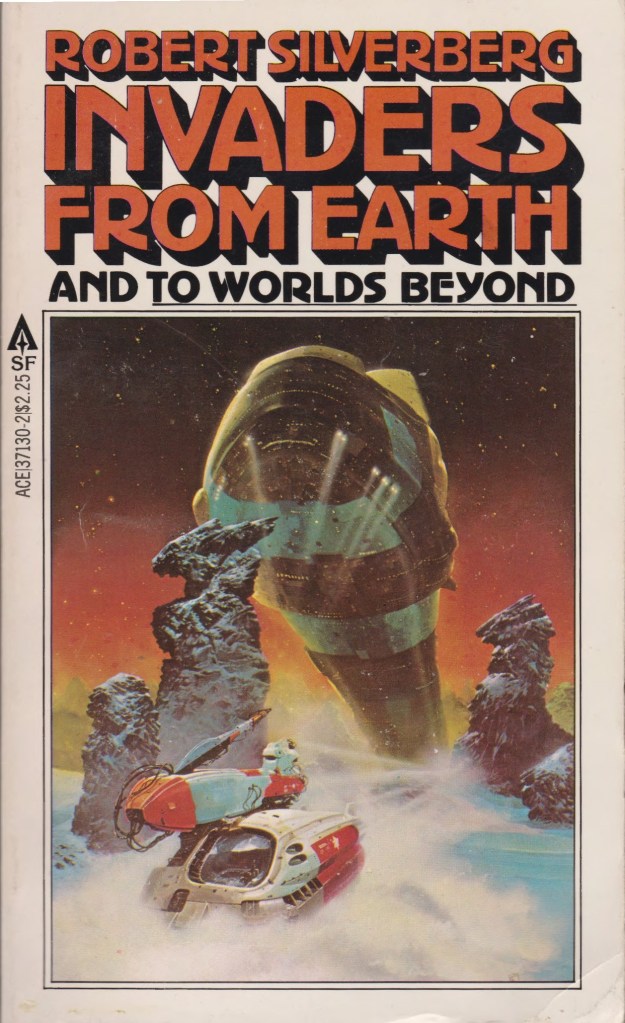
1. Invaders from Earth and To Worlds Beyond, Robert Silverberg (1980)

From the back cover: “The Ganymedians had a rich, peace culture, peaceful culture extending back hundreds of thousands of years in human time. But the soil of their Jovian moon held uncountable riches in the form of the nuclear fuels Earth so desperately needed. It was a pattern that had been repeated many times in humanity’s bloody history; in Asia, in Africa, in the American West–but the nations of mankind were not ready to make the same mistake again. So when the Corporation decided it wanted those fissionables whether the Ganymedians wanted to give them up or not, they knew they had a job of selling of their hands, to swing the weight of public opinion behind them. And that was a job for Ted Kennedy, ad-man supreme. Kennedy’s record showed he could sell the public on just about anything. Even genocide.”

Continue reading

Short Book Reviews: Clifford D. Simak’s They Walked Like Men (1962) and Jacques Sternberg’s Sexualis ’95 (1965, trans. 1967)

Note: My read but “waiting to be reviewed pile” is growing. Short rumination/tangents are a way to get through the stack before my memory and will fades. My website partially serves as a record of what I have read and a memory apparatus for future projects. Stay tuned for more detailed and analytical reviews.


1. They Walked Like Men, Clifford D. Simak (1962)

3/5 (Average)

In a confrontation with maleficent alien land prospectors in Clifford D. Simak’s They Walked Like Men (1962), the main character ruminates that “it was almost if [we] were acting out an old morality play, with the basic sins of mankind enlarged a millionfold to prove a point by exaggeration” (113). Simak’s moment of meta-commentary on his own narrative and tonal choices gives shape to odd conjuration of juvenile comedy and apocalyptic extrapolation of capitalism unleased.

Continue reading

What pre-1985 science fiction are you reading? + Update No. XII

What pre-1985 science fiction are you reading or planning to read this month?

Here’s April’s installment of this column.

First, a bit about Isaac Asimov’s Foundation (1951) from M. Keith Booker’s Monsters, Mushroom Clouds, and the Cold War: American Science Fiction and the Roots of Postmodernism, 1946-1964 (2001), my current history of science fiction read:

Continue reading

Short Story Reviews: Clifford D. Simak’s “Masquerade” (1941) and “Tools” (1942)

Today I’ve selected two early Clifford D. Simak “apprentice” stories–“Masquerade” (1941) and “Tools” (1942)–deeply critical of the American business ethic.1 Collectively they posit a future in which colonization goes hand-in-hand with the exploitation of resources, workers, and threatens the alien intelligences they encounter.2

Welcome to a future of capitalistic vastation!


3/5 (Average)

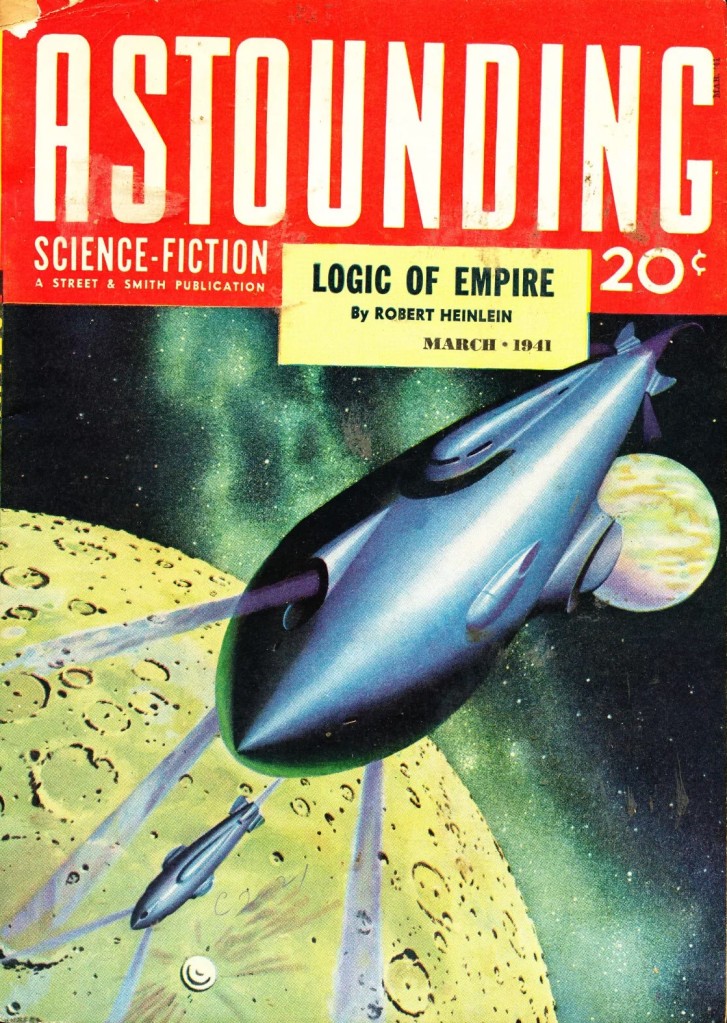
“Masquerade” first appeared in Astounding, ed. John W. Campbell, Jr. (March 1941). You can read it online here.

In the surprisingly bleak “Masquerade” (1941), metamorphic aliens on Mercury’s radiation-blasted surface parrot human actions. Beneath their clownish behavior is a plot, a plot to takedown an Earth corporation. The story begins with a disquieting sequence in the bleak expanse outside a sunlight harvesting power station on the surface of Mercury: “the Roman candles, snatching their shapes from Creepy’s mind, had assumed the form of Terrestrial hillbillies and were cavorting the measures of a square dance” (57). The Candles, “kicking up the dust, shuffling and hopping and flapping their arms” (58), are the mysterious natives of Mercury. In classic Simak fashion, there’s a method to their apparent comic madness.3

Continue reading

Updates: Recent Science Fiction Purchases No. CCCXXXIII (Keith Laumer, Vernor Vinge, Mack Reynolds, Daphne du Maurier)

Which books/covers/authors in the post intrigue you? Which have you read? Disliked? Enjoyed?

1. It’s A Mad, Mad, Mad Galaxy, Keith Laumer (1968)

Back cover: “This frenetic collection of science fiction stories–often disturbing, always entertaining–comes from outstanding and unpredictable SF author Keith Laumer.

Tingle your imagination: In ‘The Planet Wreckers,’ Jack Waverly goes to bed an ordinary mortal and wakes up a movie star. But the trouble is, his life is the price.

Tired of being a 97-pound weakling? “The Body Builders” has the answer for you: Just buy yourself the Body Beautiful.

Exorcise your hostility! A Certain Powers plans to obliterate “the greatest menace in the world today”–coast-to-coast television, better known as ‘The Big Show.'” [I think the last description is not for a story in the collection. Laumer always had a story title “The Big Show” that appeared in 1968. Maybe they were planning on including it in this collection but substitute something else at the last minute?]

Continue reading

Generation Ship Short Story Review: Fred Saberhagen’s “Birthdays” (1976)

This is the 19th post in my series of vintage generation ship short fiction reviews. I am not entirely sure Fred Saberhagen’s vision exactly fits the definition of a generation ship but it’s so fascinating that I had to share it with you all!

As a reminder for anyone stopping by, all of the stories I’ll review in the series are available online via the link below in the review. And, if you want to work through the reviews from the series from the beginning, here’s my first post from 2019 on Chad Oliver’s “The Wind Blows Free” (1957).

You are welcome to read and discuss along with me as I explore humanity’s visions of generational voyage. And thanks go out to all who have joined already. I also have compiled an extensive index of generation ship SF if you wish to track down my earlier reviews on the topic and any that you might want to read on your own.

Previously: Barrington J. Bayley’s “Exit from City 5” (1971).

Next Up: Poul Anderson’s “The Troublemakers” (1953)

4.25/5 (Very Good)

Continue reading

Short Story Reviews: Robert Bloch’s “Daybroke” (1958) and “The Head” (1976)

After watching the first episode of the new Fallout (2024) adaptation a few nights ago (I like it!), I impulsively decided to push aside all my unfinished reviews and write about two more nuclear gloom tales. I selected two by Robert Bloch (1917-1994), best known as the author of Psycho (1959), whose SF output I’ve only recently started to explore. Both stories are slick satires that use the nuclear scenario to poke holes in the stories we weave about American exceptionalism and progress.

Let’s get to the nightmares!


3.25/5 (Above Average)

“Daybroke” first appeared in the only issue of Star, ed. Frederik Pohl (1958). You can read it online here.

Robert Bloch’s “Daybroke” attempts to convey an encyclopedic glimpse of post-apocalyptic destruction in order to satirize an America that allowed the usage of a nuclear weapon. Despite its appealing structure, the story lacks the prose necessary to sear and burn–the last sentence, well, that you’ll remember.

Continue reading

What pre-1985 science fiction are you reading? + Update No. XI

What pre-1985 science fiction are you reading or planning to read this month. Here’s March’s installment of this column.

Before we get to books and birthdays and writing plans…

Continue reading

Short Story Review: Vladimir Colin’s “The Contact” (1966, trans. 1970)

Today I’m joined again by Rachel S. Cordasco, the creator of the indispensable website and resource Speculative Fiction in Translation, for the second installment of our series exploring non-English language SF worlds. Last time we covered Kōbō Abe’s allegory of Marxist transformation, “The Flood” (1950, trans. 1989).

This time we journey east of the Iron Curtain to 1960s Romania with Vladimir Colin’s “The Contact.” It first appeared in his collection of short stories Viitorul al doilea (1966). We read it in Other Worlds, Other Seas: Science-Fiction Stories from Socialist Countries, ed. Darko Suvin (1970). The story was translated into English by the author. I cannot find a copy online. Reach out if you want to read it!

Make sure to check out Rachel’s website Speculative Fiction in Translation. Not only does she review the global phenomena of speculative fiction but gathers lists of translated fiction by language. Also check out her reference monograph Out of This World: Speculative Fiction in Translation from the Cold War to the New Millennium (2021).

Now let’s get to our reviews!

Continue reading