Updates: Recent Science Fiction Acquisitions N. XIII

A few fellow History grad students and I (and two or three from various departments — Gender Studies, English) have cobbled together a science fiction reading group list for this fall and spring: mainly social sci-fi by female authors along with a few random gems by Ballard (The Drowned World), Silverberg (The World Inside), and Delany (Nova).  I wasn’t going to buy any sci-fi books this semester.  I promise.  That is before we formed our reading group!  So, I had to pick up the few works on our list that I didn’t already own.

What a haul!

1. The Drowned World (1962), J. G. Ballard

Continue reading

Adventures in Science Fiction Cover Art: A Selection of Elevated Cities Part I

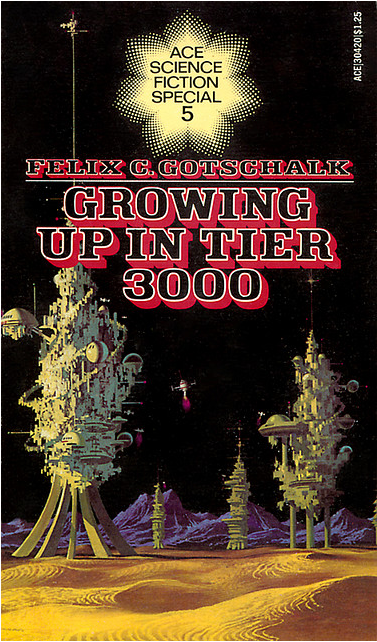
(uncredited cover for the 1975 edition of Growing Up in Tier 3000 (1975), Felix C. Gotschalk)

“After a seven days’ march through woodland, the traveler directed towards Baucis cannot see the city and yet he has arrived.  The slender stilts that rise from the grown at a great distance from one another and are lost above the clouds that support the city […] There are three hypotheses about the inhabitants of Baucis: that they hate the earth; that they respect it to much they avoid all contact; that they love it as it was before they existed and with spyglasses and telescopes aimed downward they never tire of examining it, leaf by leaf, stone by stone, ant by ant, contemplating with fascination their own absence” — Italo Calvino (Invisible Cities, 1972, pg. 77)

I’ve always been fascinated by imaginary and historical cities: the utopian (Tommaso Campanella’s 1602 work The City of the Sun), the allegorical (Calvino’s Invisible Cities), the multi-layered (Rome), the planned (16th century Palmanova), the decaying (Jeff VanderMeer’s Ambergris), the multi-tiered (Tolkein’s Minas Tirith)…   Continue reading

Book Review: Missing Man, Katherine MacLean (1975)

5/5 (Near Masterpiece)

Nominated for the 1976 Nebula Award for Best Novel

Katherine MacLean’s underrated and seldom read novel Missing Man (1975) was expanded from her 1971 Nebula Award winning novella by the same name.  I’ve not read the original version so I’m unsure about how much was added, subtracted, or completely re-conceptualized.

The novel version is a finely wrought vision of a future post-disaster Balkanized New York City comprised of innumerable communes, often at war with each other, inhabited by a small number of slightly telepathic people who are able to detect the emotions of others.  Archetype individuals unknowingly project emotions when they are in danger which could at any moment plunge society into intercommune Continue reading

Adventures in Science Fiction Cover Art: Hoot von Zitzewitz’s Fantastic Flights of Fancy

(Hoot von Zitzewitz’s cover for the 1967 edition of The Winged Man (1966), A. E. van Vogt and E. Mayne Hull)

In the 1960s the sci-fi covers of the major publishers Dell, Berkley Medallion, Signet, Avon, Ace (etc) ran the gamut from Richard Powers’ avant-garde landscapes and conglomerate faces to the fantastic collages of a relatively unknown artist by the name of Hoot von Zitzewitz (Hubertus Octavio von Zitzewitz).

I’ve cobbled together a few bits of a biography (if any one knows some more concrete facts let me know).  He was a fine arts teacher at Hofstra University and passed away around 2002.  Hoot worke Continue reading

Adventures in Science Fiction Cover Art: The Best of Alex Schomburg’s 60s Novel Covers

(Alex Schomburg’s cover for the 1965 edition of The Well of the Worlds (1953), Henry Kuttner)

Alex Schomburg (1905-1998) produced only a handful of novel covers in the 60s (his classic 50s covers can be found here).  But what a beautiful handful!  It’s a shame because they evoke genuine excitement and wonder — especially Kuttner’s The Well of the Worlds (above) and one of my favorites, Moore and Kuttner’s Earth’s Last Citadel (below).  They are dynamic, vivid, and occasionally Continue reading

Book Review: Assignment Nor’ Dyren, Sydney Van Scyoc (1973)

3.25/5 (Average)

Sydney Van Scyoc’s Assignment Nor’ Dyren (1973), inspired by Ursula Le Guin’s masterpiece The Left Hand of Darkness (1969), is a problematic yet generally enjoyable work.  I found that Van Scyoc is unable to maintain the sense of wonder she conjures so vividly in the first third.  Likewise, her prose tends to plod due to the descriptive restrictions she forces on herself (for example, describing each alien the main character encounters by their species).  Perhaps it’s unfair to compare  Assignment Nor’ Dyren to Ursula Le Guin’s masterpiece — considered among the best science fiction works ever written — but the overwhelming impression Continue reading

Adventures in Science Fiction Cover Art: A Selection of Vincent Di Fate’s early 70s Covers

(Cover for the 1972 edition of Plunder (1972), Ron Goulart)

The covers of Vincent Di Fate (1945-) often evoke a Terry Gilliam-esque romp — for example, Ron Goulart’s Plunder — a lone facade and a house dot a purple and green plain, mountains emerge in the distance, planets pepper the sky, a head floats ominously, a bizarre reptilian creature in a boatie rides an antique bicycle.  I desperately want to know if it’s a scene from the book.  If so, I’m tracking down a copy!

Vincent Di Fate’s work graced a few of the great works of the genre Continue reading

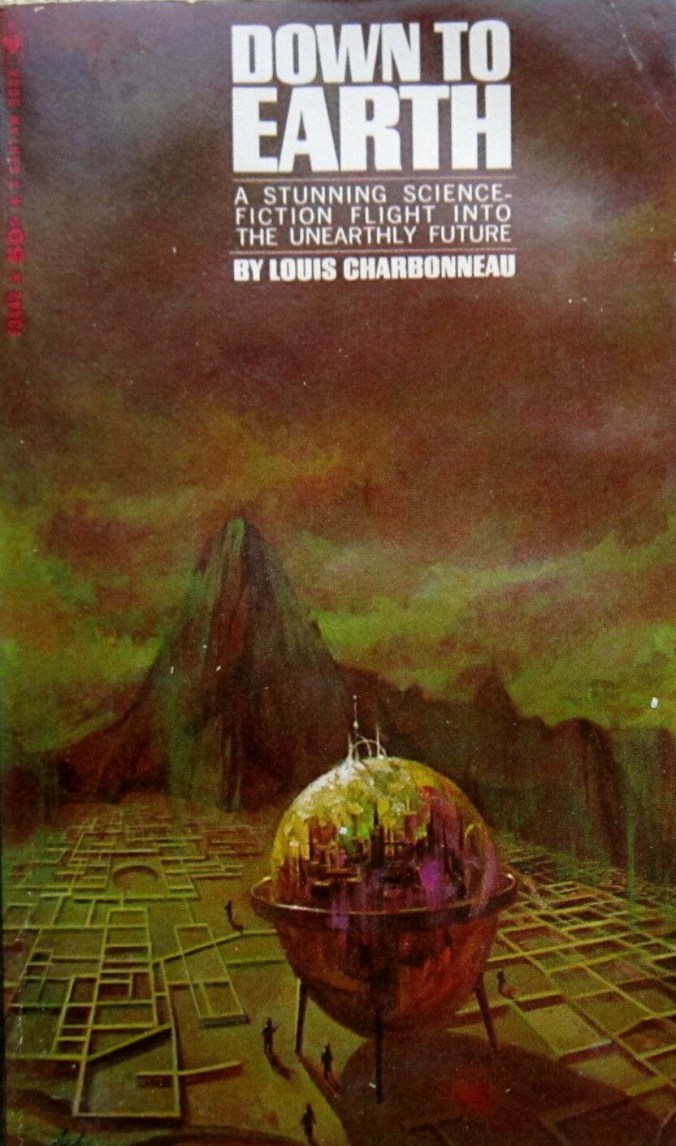
Book Review: Down to Earth (variant title: Antic Earth), Louis Charbonneau (1967)

down to earth louis charbonneau

2/5 (Bad)

The seductive combination of a beautiful cover by Paul Lehr, a seldom read author, a fascinating premise (well, at least from the back cover) appeared at first glance a glorious chance for the pen to wax delightfully on the glories everyone else missed out on.

As much as the esotericist delights in searching through back catalogues of dusty books the lack of extant information/reviews on the work entails risk.  If I had known the entire plot revolves around a vengeful/vindictive/insane man inflicting tortures (the PG-13 sort) on an unsuspecting family hanging out in space — à la a watered down version of Michael Haneke’s Funny Games (1997) without its postmodern deconstruction of our desire Continue reading