Happy holidays. I hope you’ve been able to squeeze in a bit of science fiction reading.
Which books/covers/authors intrigue you? Which have you read? Disliked? Enjoyed?
1. Those Who Watch, Robert Silverberg (1967)
Gene Szafran’s cover for the 1971 edition
From the back cover: “CRASH LANDING FROM THE STARS.
Only three humans would ever know that the blinding flash in the sky on that night in 1982 was an exploding flying saucer. Only they would learn the truth about THOSE WHO WATCH–about the alien beings who came into this world in a crash landing from the stars. THOSE WHO WATCH is the strange, seductive novel of three accidental colonists from outer space whose chance encounter with Earth triggers interplanetary conflict. It is also the most unusual love story ever written.”
What pre-1985 science fiction are you reading this week?
I’ve settled on a monthly schedule for this column. Check out the previous installment!
If you’re new and curious about my rationale for the perimeters of my site, check out this recent interview and podcast. And follow me on Mastodon if you don’t already as I no longer post on my Twitter account.
And, most importantly, let me know what pre-1985 SF you’ve been reading!
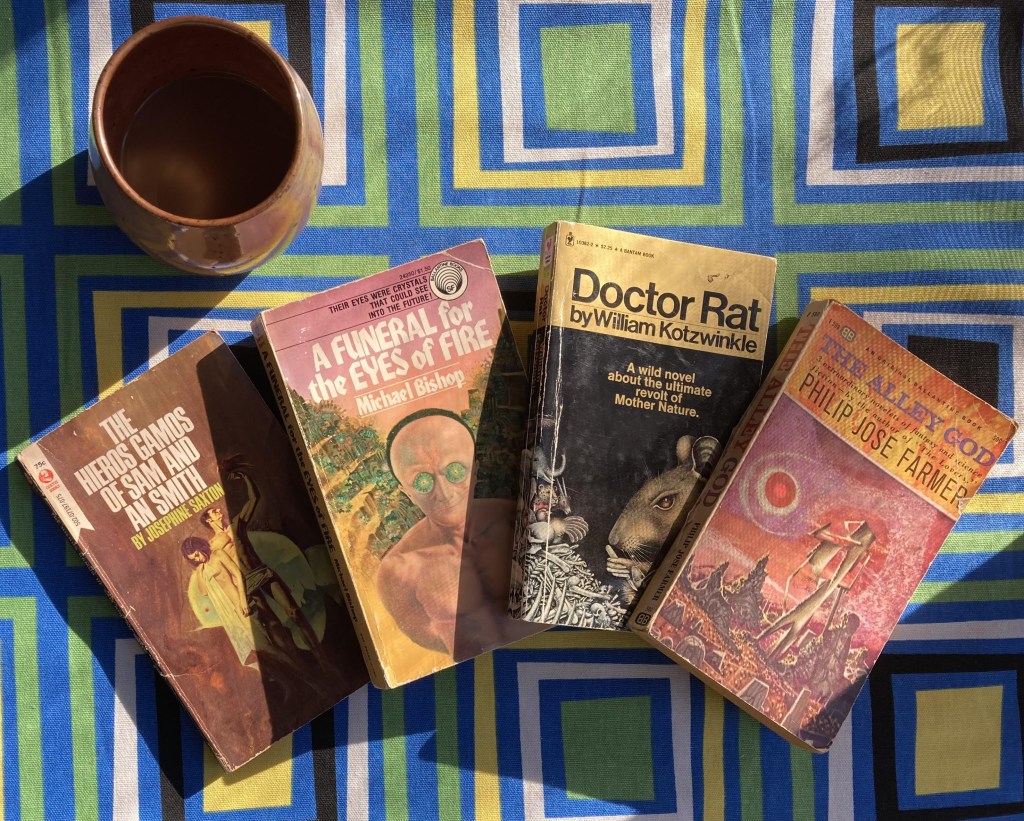
The Photograph (with links to reviews and brief thoughts)
Judith Merril’s collection contains one of the feminist visions of the 50s — “Daughters of Earth” (1952). Reworking a standard pulp plot of alien contact, Merril recasts the encounter through multiple generations of women in one family. She adeptly inverts the Old Testament trope of tracing generations through fathers. Simultaneously, the story itself is a metatextual collection of rewritten family documents containing the lessons necessary for future daughters in the family. Brilliant and heady stuff.
Barry N. Malzberg’s The Men Inside(1973) remains one of his strangest works. A perverse (and Freudian) metafictional (and literary) retelling of Otto Klement and Jerome Bixby’s Fantastic Voyage replete with filmic flashbacks… For Malzberg fans only — if you’ve missed this one, track it down.
And now for something completely different: Murray Leinster’s S.O.S From Three Worlds (1967). I am unsure why I enjoy Leinster’s Med Service so much. Sometimes positivist stories about spacemen devoted to selfless service solving medical crises–and reigning in rampant unchecked capitalism–with their friendly tormals (think furry mobile petri dishes) bring a bit of warmth to my bitter heart.
I sneakily consumed Joe Haldeman’s masterpiece The Forever War (1975) while working my first job as an oil change cashier. In-between angry customers and running domestic incidents, I relished every moment of Haldeman’s defiant Vietnam War satire. As I’ve only reviewed Mindbridge (1976) on the site (I’ve read a bunch more), I’ve been meaning to return his work — maybe a resolution for 2024.
Today I’ve reviewed the 30th and 31st story in my series on the science fictional media landscape of the future. In Edmond Hamilton’s “Requiem” (1962), the newsmen and women of the far future descend en masse to witness Earth’s death. And in John Anthony West’s snarky satire “George” (1961), the titular character’s body slowly atrophies while ensconced in the living room watching TV.
Lloyd Birmingham’s cover for Amazing Stories, ed. Cele Goldsmith (April 1962)
3.5/5 (Good)
Edmond Hamilton’s “Requiem” first appeared in Amazing Stories, ed. Cele Goldsmith (April 1962). You can read it online here.
In 2020, I read Hamilton’s brilliant “What’s It Like Out There?” (1952) which obliterated my ignorant view of his fiction. I asked some of my readers for other ruminative Hamilton works (i.e. not the pulp cosmos-exploding adventures he’s best known for) and “Friend of the Site” Brian Collins mentioned “Requiem.” And onto the queue, it went as it fit this series. Thank you!
Sarban, the pen name of British diplomat and author John William Wall (1910-1989), spins a hypnotic horror in which a soldier, escaping from a Nazi prison camp, awakes in a dystopia a hundred years after Hitler’s victory in WWII [1].
Drawing on a rich English tradition of pastoral novels, The Sound of His Horn (1952) [2], despite its brief length, weaves a disquieting vision of the mechanisms of power and control [3] It’s unusual. It’s terrifying. It’s possessed by a gorgeous turn of phrase. And, in its most ruminative moments, an incisive exploration of the nature of desensitization and the fear that underpins all actions.
What pre-1985 science fiction are you reading this week?
It’s been over a month since the previous installment. Sorry! While I’d like to keep a schedule, I find myself pathologically unable to do so. As with so much on my site, I’ll post continue to post these updates when I feel the inclination.
As these posts seem to bring in new readers, if you’re curious about my rationale for the perimeters of my site, check out this recent interview and podcast. And follow me on Mastodon if you don’t already as I no longer post on my Twitter account.
Let me know what pre-1985 SF you’ve been reading!
The Photograph (with links to reviews and brief thoughts)
Chan Davis (1926-2022) was a fascinating figure. He was a communist activist, fanzine editor, mathematician, and political prisoner. He was fired from the University of Michigan in 1954 and imprisoned for six months in 1960 on charges of contempt of Congress leveled by HUAC. The Hugo Book Club recently posted a fantastic interview, from which I derived the bibliographic blurb above, with Steve Batterson, the author of The Prosecution of Professor Chandler Davis: McCarthyism, Communism, and the Myth of Academic Freedom(2023) that I plan on purchasing soon.
Today I have selected three of Chan Davis’ thirteen published SF short stories. The connecting theme? 1940s speculations on nuclear war in the immediate post-Hiroshima world. All three appeared in Astounding Science Fiction under the tutelage of John W. Campbell, Jr.
William Timmins’ cover for Astounding Science Fiction, ed. John W. Campbell, Jr. (May 1946)
3/5 (Average)
“The Nightmare” first appeared in Astounding Science Fiction, ed. John W. Campbell, Jr. (May 1946). You can read it online here.
A few months before the atomic bomb attack on Hiroshima (August 6th, 1945), a group of scientists at the University of Chicago published The Franck Report (June 11th, 1945). James Franck and his colleagues argued that “within ten years other countries may have nuclear bombs, each of which, weighing less than a ton, could destroy an urban area of more than ten square miles.” They point out the great disadvantage of the United States with its “agglomeration of population and industry in comparatively few metropolitan districts” in comparison to countries with a population and “industry […] scattered over large areas.” In the months after Hiroshima, Chan Davis published his first SF story “The Nightmare” with The Franck Report warning firmly in mind [1].
Which books/covers/authors intrigue you? Which have you read? Disliked? Enjoyed?
1. Tales of Science and Sorcery, Clark Ashton Smith (1964)
Bob Haberfield’s cover for the 1976 edition
From the back cover: “A universe of remote and paralyzing fright–jungles of poisonous and iridescent blossoms on the moons of Saturn, evil and grotesque temples in forgotten elder worlds and dark-morasses of spotted death-fungi in spectral countries beyond the earth’s rim. Who else has seen such gorgeous, luxuriant and feverishly distorted visions and lived to tell the tale?” — H. P. Lovecraft
I can’t escape the post-apocalyptic wasteland. Like a voyeuristic shadow, I follow the denizens of the charred surface as they plod their slow movements toward the end. I observe how they push away the looming violent redness that blots out the sky, and, when everything else seems lost, they turn interior. A final movement that lays bare tattered dreams and ephemeral memories…
Ed Emshwiller’s cover for Galaxy Science Fiction, ed. H. L. Gold (November 1954)
5/5 (Masterpiece)
Edgar Pangborn’s “The Music Master of Babylon” first appeared in Galaxy Science Fiction, ed. H. L. Gold (November 1954). You can read it online here.
Fresh of Edgar Pangborn’s masterpiece Davy (1964), I decided to cover some of his short fiction on the site. He’s shaping up to be my author of the year. “The Music Master of Babylon” (1954), which I suggest should be included as part of his Tales of a Darkening World sequence due to multiple references to events and people present in the world of Davy, contains many of the embryonic concerns that crop up in the later novel. Pangborn is the master of interweaving narrative and personal memory and the ways art–in this instance music–lays bare the topography of self.





 Science Fiction and Other Suspect Ruminations