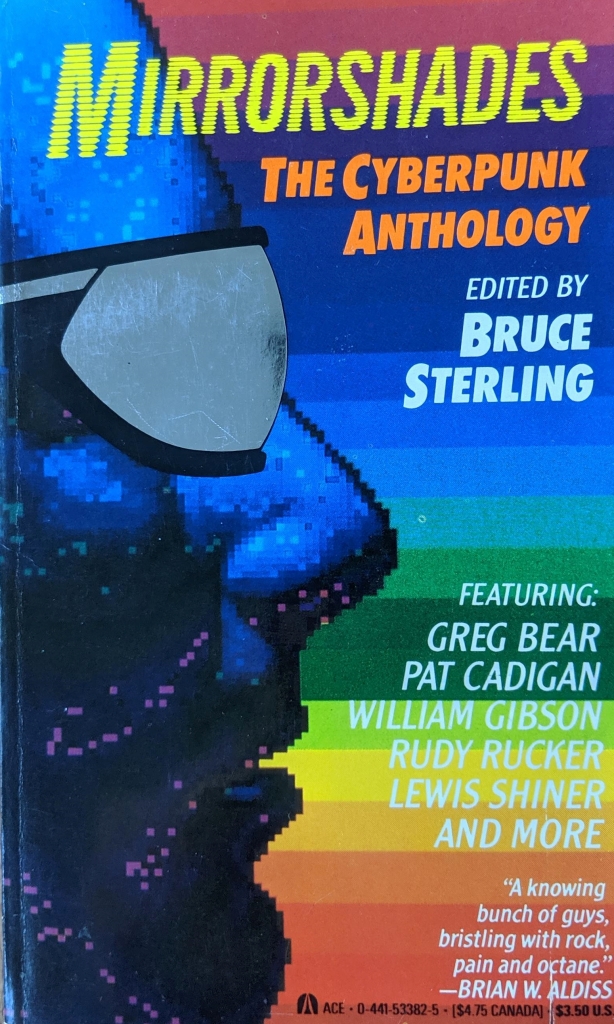
Which books/covers/authors intrigue you? Which have you read? Disliked? Enjoyed?
1. The Escape Orbit (variant title: Open Prison), James White (1964)
Jack Gaughan’s cover for the 1965 edition
From the back cover: “STRANDED ON A PLANET OF MONSTERS. When the survivors of the his starship were taken prisoner by the insec-creatures against whom Earth had fought a bitter war for nearly a century, Sector Marshal Warren expected to be impounded in a prison camp like those the Earthmen maintained. But the “Bugs” had a simpler method of dealing with prisoners–they dumped them on an uninhabited planet, without weapons or tools, and left them to fend for themselves against the planet’s environment and strange monsters. A “Bug” spaceship orbited above, guarding them.
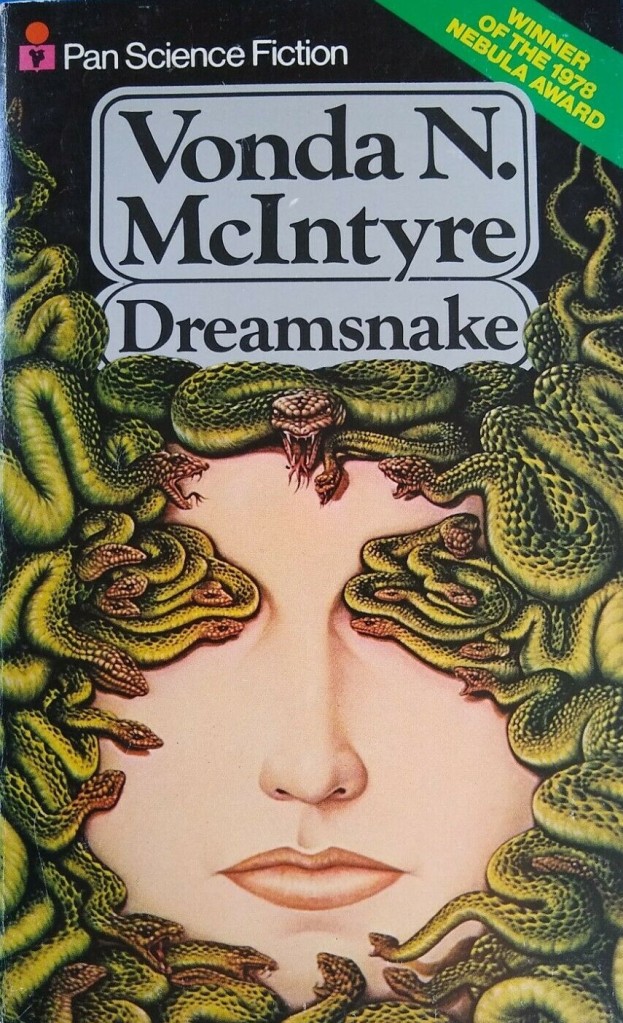
Won the 1979 Hugo, Locus, and Nebula Award for Best Novel.
I’ve now tackled the only pre-1990 Hugo Award-winning novel I had yet to read. And I was not disappointed. Fresh off Vonda N. McIntyre’s ingenious generation ship short story “The Mountains of Sunset, The Mountains of Dawn” (1974) with its winged-alien voyagers, I savored Dreamsnake‘s original blend of feminist science fiction and post-apocalyptic quest tale.
In the past few months, I’ve put together an informal series on the first three published short fictions by female authors who are completely new to me or whose most famous SF novels fall mostly outside the post-WWII to mid-1980s focus of my reading adventures. So far I’ve featured Carol Emshwiller (1921-2019), Nancy Kress (1948-), Melisa Michaels (1946-2019), and Lee Killough (1942-). To be clear, I do not expect transformative or brilliant things from first stories. Rather, it’s a way to get a sense of subject matter and concerns that first motivated authors to put pen to paper.
Today I’ve selected an author I’ve never read–Eleanor Arnason (1942-). According to SF Encyclopedia, most of her best-known science fiction appeared from the mid-1980s onward with To the Resurrection Station (1986) (which I own), A Woman of the Iron People (1991), Changing Women (1992), and the Hwarhath sequence (1993-2012). Unfortunately, I did not encounter her work in my late teens and early 20s when I read science fiction more widely.
I’d rank Eleanor Arnason’s first three published short fictions as the most auspicious start of the those I’ve covered so far. Her stories–often self-consciously in dialogue with pulp worlds and plots–demonstrate a fascination with ritualized landscapes and behaviors and feature female narrators attempting to find their place in strange new worlds.
Let me know which Arnason fictions–perhaps from much later in her career–resonate with you.
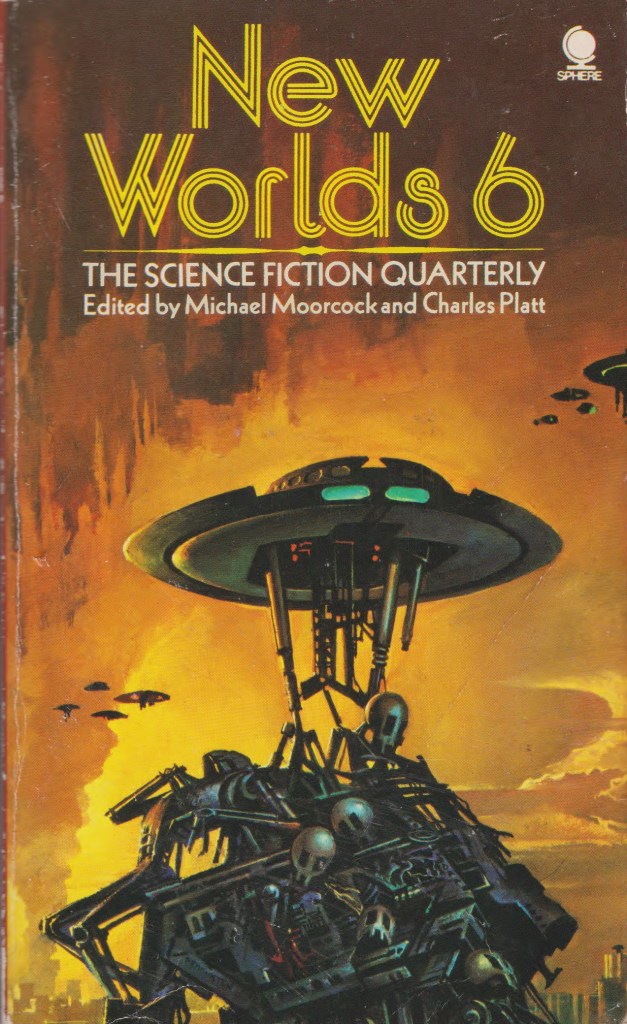
Bruce Pennington’s cover for New Worlds 6, ed. Michael Moorcock and Charles Platt (1973)
4/5 (Good)
“A Clear Day in the Motor City” first appeared in New Worlds 6, ed. Michael Moorcock and Charles Platt (1973). This does not seem to be available online. If you find it, let me know.
Like a cryptic quilt, a strange ritualized landscape drapes across the polluted industrial expanse of Detroit and Windsor. On clear air holidays, when “the Seven Sisters” were visible from the roof of a nearby office building, CEOs adorn “wreaths of plastic oak leaves” and release pigeons to “whoever’s responsible for the weather, to bear our thanks to him, her, it or them” (187).
Which books/covers/authors intrigue you? Which have you read? Disliked? Enjoyed?
1. The Darfsteller and Other Stories, Walter M. Miller, Jr. (1982)
Peter Jones’ cover for the 1st edition
From the back cover: “Walter M. Miller, Jr., wrote A CANTICLE FOR LEIBOWITZ, and changed the nature of science fiction, forever. Now, collected together for the first time are some of his most gripping masterpieces, including the Hugo Award-winning ‘The Darfsteller’ and ‘Crucifixius Etiam.'”
Today I’ve reviewed the eleventh story in my series on the science fictional media landscape of the future! Ann Warren Griffith spins a nightmarish dystopia where advertisements are illegal to block out.
Ed Emswhiller’s cover for the 1960 edition of The Best from Fantasy and Science Fiction, Third Series, ed. Anthony Boucher and J. Francis McComas (1954)
4/5 (Good)
Ann Warren Griffith’s “Captive Audience” (1953) first appeared in The Magazine of Fantasy and Science Fiction, ed. Anthony Boucher and J. Francis McComas (August 1953). You can read it online here.
In the 1950s, Americans depicted Communism as denying inherent human freedoms of choice and enslaving the mind. Over the course of the decade, the terror of Communist brainwashing collided with fears of the detrimental effects of consumer culture and advertising. Perhaps the evil Communist was so successful due to a new softness within the American family (Dunne, 123). Anne Warren Griffith’s “Captive Audience” imagines a dystopic future in which the American mind is turned into malleable putty by an entropic (and sonic) inundation of advertisements. According to the story’s relentless logic, the last bastions of independent thought will cease to exist in a capitalist world where the right of every product to receive “its share of the consumer dollar” is the only right that matters (57).
Which books/covers/authors intrigue you? Which have you read? Disliked? Enjoyed?
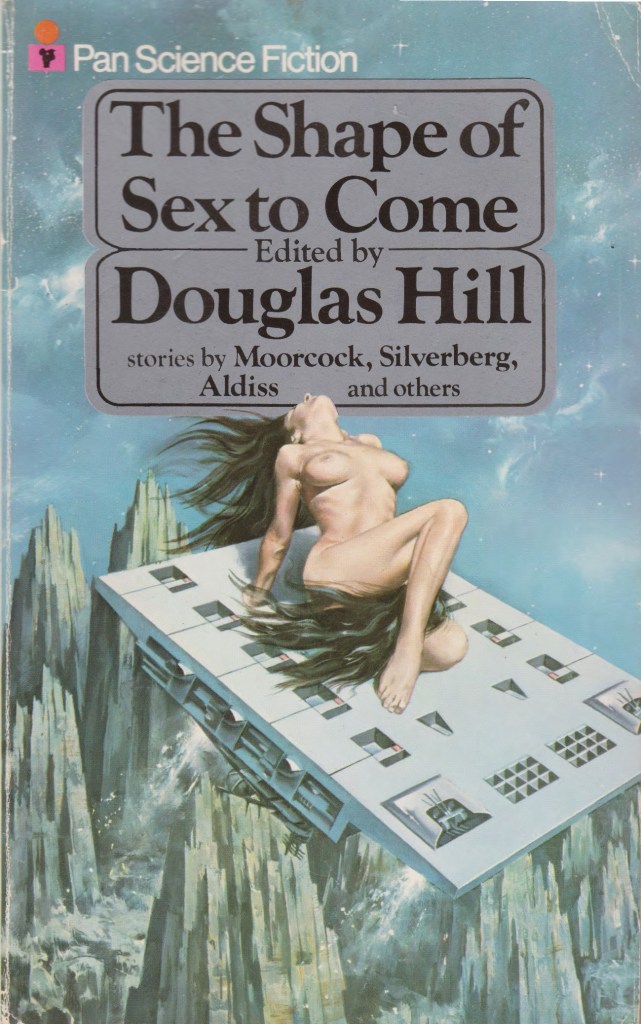
1. The Shape of Sex to Come, ed. Douglas Hill (1978)
Uncredited cover for the 1st edition
From the back cover: “Eight stories from SF names as highly-respected as Aldiss, Moorcock and Silverberg explore the strange and bizarre possibilities for sexuality in the furthest reaches of tomorrow.”
Contents: Robert Silverberg’s “In the Group” (1973), Thomas M. Disch’s “Planet of the Rapes” (1977), A. K. Jorgensson’s “Coming-of-Age Day” (1965), Anne McCaffrey’s “The Thorns of Barevi” (1970), Brian W. Aldiss’ “A One-Man Expedition Through Life” (1974), Brian W. Aldiss’ “The Taste of Shrapnel” (1974), Brian W. Aldiss’ “Forty Million Miles from the Nearest Blonde” (1974), Hilary Bailey’s “Sisters” (1976), John Sladek’s “Machine Screw” (1975), and Michael Moorcock’s “Pale Roses” (1974).
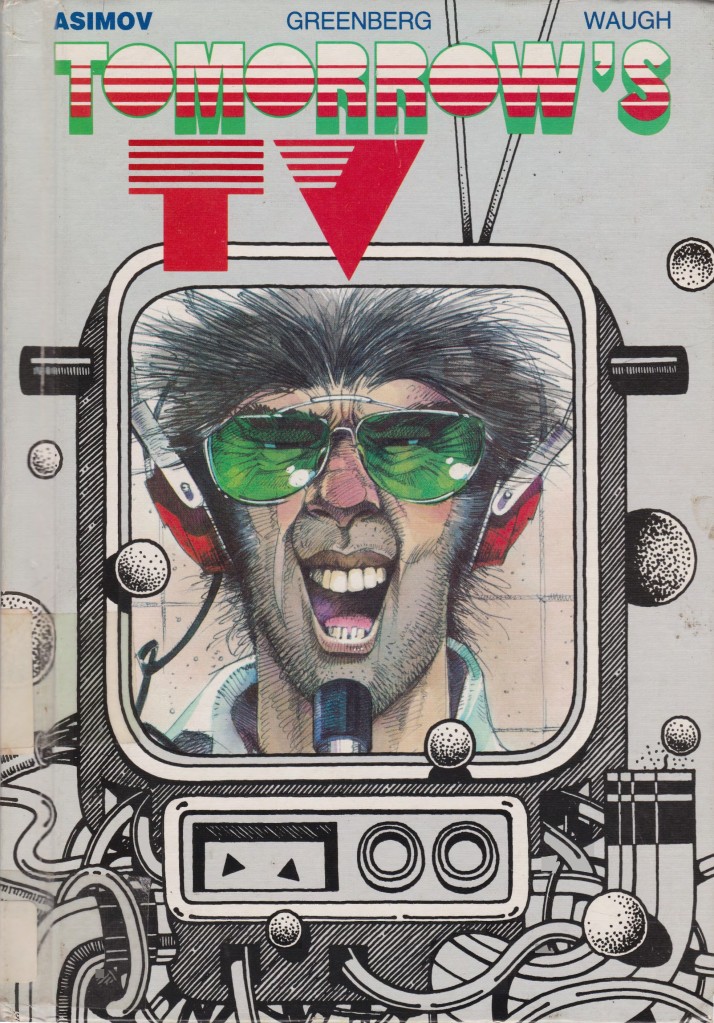
The seventh, eighth, ninth, and tenth stories in my series on the science fictional media landscape of the future appear in the anthology Tomorrow’s TV, ed. Isaac Asimov, Martin Harry Greenberg, and Charles Waugh (1982).
Tomorrow’s TV (1982) gathers together five short stories published between 1951 and 1979 on future speculations and disturbing manifestations of the tube of the future. The extensive number of TV-related science fiction from these decades (especially the 50s and early 60s) should not come as a surprise. According to Gary R. Edgerton’s magisterial monograph The Columbia History of American Television (2007), no “technology before TV every integrated faster into American life” (xi). Isaac Asimov speculates on the nature of education and the role of the “teacher” if every kid goes to school on their TV. Ray Bradbury imagines a frosty world where everyone turns inward towards the hypnotic glow of their TV sets. Robert Bloch explores the intersection of programming as escape and its collision with the real world. Ray Nelson narrates a hyperviolent expose of the alien entities behind subliminal messaging. And Jack Haldeman II imagines what will happen when the human mind reaches a moment of information overload.
Bob Venosa’s interior art illustrating Nancy Kress’ “And Whether Pigs Have Wings” (1979) in Omni (January 1979)
Back in December 2019, I read An Alien Light (1987), my first science fiction work by Nancy Kress (1948-). I was so impressed with the novel, a “bleak and powerful rumination on violence” within a “new alien architecture,” that I placed it on my Best Reads of 2019 list. Like my recent rumination on Melisa Michaels’ first three published short stories, I thought I’d do the same with Kress. I relentlessly seek to map another feature in the fascinating territory of 50s-70s SF.
Let me know which Kress fictions–perhaps from much later in her career–resonate with you.
Rick Sternbach’s cover for Galaxy, ed. James Baen (December 1976)
3.5/5 (Good)
“The Earth Dwellers” first appeared in Galaxy Science Fiction, ed. James Baen (December 1976). You can read it online here.
The fifth and sixth story in my series on the science fictional media landscape of the future. Fritz Leiber imagines a sinister conjuration of the Girl behind the advertisement and a robot who wanders a post-nuclear landscape selling soda to the charred victims.
Previously: Brian W. Aldiss’ “Panel Game” (December 1955).
Next Up: Tomorrow’s TV (1982). Stories by Isaac Asimov, Jack C. Haldeman II, Ray Bradbury, Robert Bloch, and Ray Nelson.
Tony Roberts’ cover for the 1975 edition of The Secret Songs (1968)
4.5/5 (Very Good)
Fritz Leiber’s “The Girl with the Hungry Eyes” (1949) first appeared in The Girl with the Hungry Eyes, and Other Stories (1949). I read it in his collection The Secret Songs (1968). You can read it online here.
“The Girl with the Hungry Eyes” explores the post-WWII economic boom as television and rapidly growing suburbs expanded the reach and power of advertising. Cold War rhetoric promoted consumerism as a key component of the American Way of Life (source).
A tale of erotic obsession and terror, “The Girl with the Hungry Eyes” imagines a fantastical conjuration of the archetypal advertising Girl selling every conceivable product. Her face appears on billboards across the urban expanse. Her torso or limb holds the object to be marveled at. And her eyes, “the hungriest eyes in the world” (131), tear into the soul and take something away with their gaze. Fritz Leiber’s terrified narrator, the “poor damned photographer” (129)who unleashed her on the world and fell for her spell, confesses “there are vampires and vampires, and not all of them suck blood” (128).