Short Story Reviews: Harlan Ellison’s “Psycho at Mid-Point” (1956) and “The Discarded” (variant title: “The Abnormals”) (1959)

The following review is the 20th installment of my series searching for “SF short stories that are critical in some capacity of space agencies, astronauts, and the culture which produced them.” Some stories I’ll review in this series might not fit. Many are far from the best. And that is okay. I relish the act of literary archaeology.

I turn now to an author, Harlan Ellison (1934-2018), whom I’ve only marginally explored considering his prodigious output. I am completely ignorant of his 50s visions. I’d previously read and reviewed his collection Approaching Oblivion (1974) and a handful of other stories including “A Boy and His Dog” (1969). The first story in this post–“Psycho at Mid-Point” (1956)–exemplifies the theme at its most brutal and nihilistic. As a bonus, I’ve paired it with one of Ellison’s better known 50s tales of mutants and prison ships–“The Discarded” (variant title: “The Abnormals”) (1959). If you know of any other Ellison stories that might fit the theme, let me know.

As always, feel free to join the conversation and read along with me on the search for the depressed astronaut.

Previously: Alfred Coppel’s “The Hunters” (1952, “The Dreamer” (1952), and “Double Standard” (1952).

Up Next: George R. R. Martin’s “The Second Kind of Loneliness” (1972) and Tom Godwin’s “The Nothing Equation” (1957)

3.25/5 (Above Average)

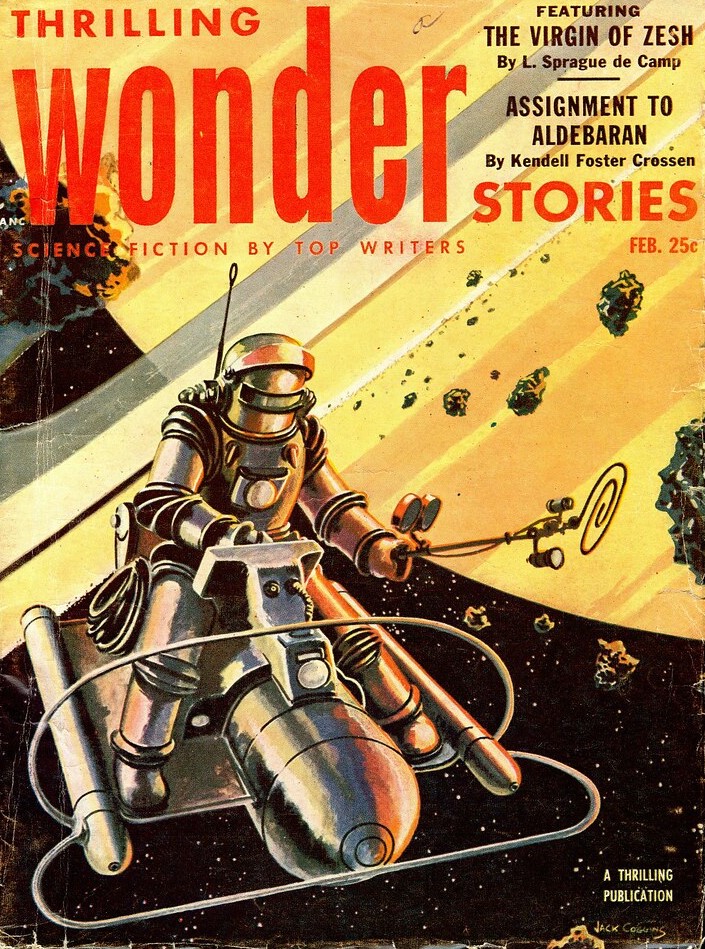
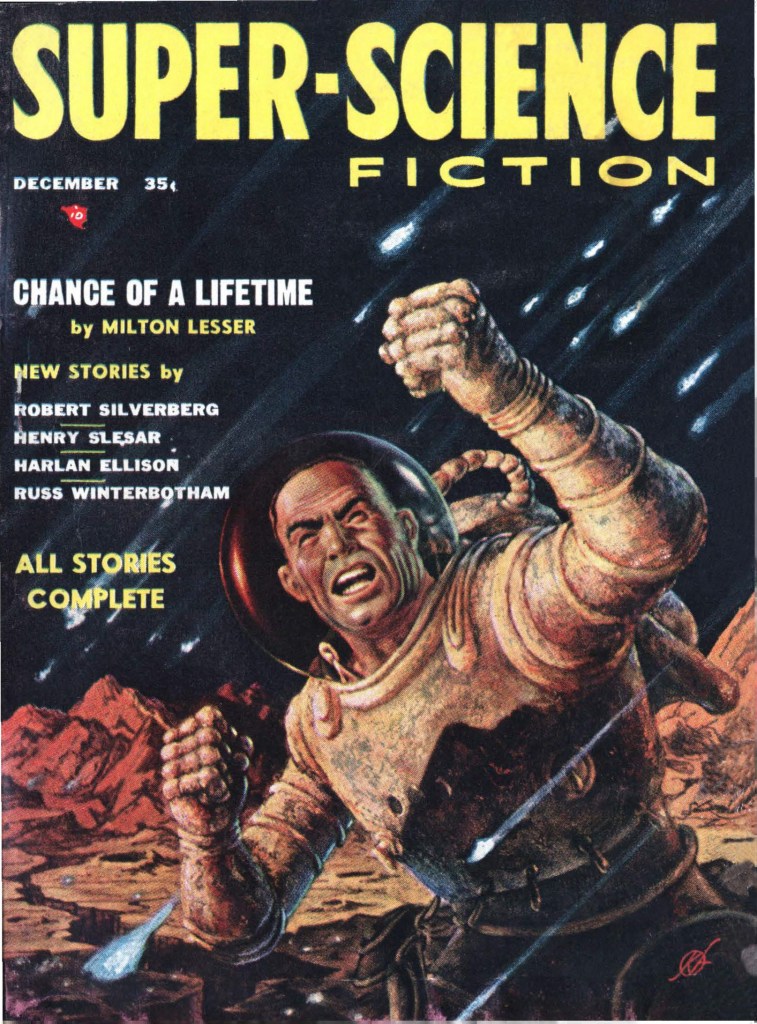
Harlan Ellison’s “Psycho at Mid-Point” first appeared in Super-Science Fiction, ed. W. W. Scott (December 1956). You can read it online here. It was not collected or anthologized.

Mike Ashley in Transformations: The Story of the Science Fiction Magazines from 1950 to 1970 (2005) does not have kind words for the three-year run of the magazine Super-Science Fiction (1956-1959). He describes the editor W. W. Scott as utterly out of his depth with a misguided reliance on “instant impact” without substance or cohesion or knowledge of the field. That said, Scott accidentally published a few solid short stories before the magazine’s demise in the market collapse in the late 50s even if the overall issues tended to be poor (168-169) and pandered to whatever craze filled the air (187). I’d classify Harlan Ellison’s “Psycho at Mid-Point” as a solid early work that fits the theme of this series perfectly!

“After fifteen months, Wallace went mad” (54).

Continue reading

Short Story Reviews: Betsy Curtis’ “Divine Right” (1950), “The Old Ones” (1950), and “The Protector” (1951)

In the past year or so I’ve put together an informal series on the first three published short fictions by female authors who are new(ish) to me and/or whose most famous SF novels fall mostly outside the post-WWII to mid-1980s focus of my reading adventures. So far I’ve featured Josephine Saxton (1935-), Carol Emshwiller (1921-2019), Wilmar H. Shiras (1908-1990), Nancy Kress (1948-), Melisa Michaels (1946-2019), Lee Killough (1942-), and Eleanor Arnason (1942-).

I do not expect transformative or brilliant things from first stories. This is particularly relevant to keep in mind for today’s post. Rather, it’s a way to get a sense of subject matter and concerns that first motivated authors to put pen to paper and to further map the territories that fascinate me.

Today I’ve selected the first three professional science fiction stories published by Betsy Curtis (1917-2002). She is “best” known for her Hugo-nominated short story “The Steiger Effect” that appeared in Analog Science Fiction, ed. John W. Campbell, Jr. (October 1968). It lost to Harlan Ellison’s “The Beast That Shouted Love at the Heart of the World” (1968). Her short biographical blurb by Eric Leif Davin in Partners In Wonder: Women and the Birth of Science Fiction 1926-1965 (2006) indicates that she received an M.A. in English (1941) from Oberlin College, in 1966 another M.A. in Education from Allegheny College, and was active in the Society for Creative Anachronism (375). Her work is not discussed in much detail by Davin. She published 13 stories in professional magazines and two in fanzines between 1950-1973. For a bit more about her fannish activities, check out the following forum posts.

Have you read any of her work? If so, what were your thoughts?


2.75/5 (Below Average)

Betsy Curtis’ “Divine Right” first appeared in The Magazine of Fantasy and Science Fiction, ed. Anthony Boucher and J. Francis McComas (Summer 1950). You can read it online here.

Sometime in the future a family of telepathic monarchs rule. Until the death of King Almar the Eighth, Curtis suggests the monarchy was more on the benevolent side of things–collecting a small tithe and encouraging the indoctrination of children to its glories through song and rhyme. But everything changes with the controversial ascension of King Glann. Unlike his predecessors, he squeezes the people dry for new palatial constructions. The story’s protagonist, the young Tod Winster bubbles with the capitalistic credo: “But Dad [..] When you’ve worked hard and earned something, shouldn’t it be yours to keep?” (98). He wants a bicycle. And in a confusing sequence of events his life savings are handed over as a tithe to King Glann in a ceremony to inaugurate the completion of the Winter Palace… but something is amiss. The king doesn’t seem to be a telepath at all. And Tod’s confused actions create the spark of rebellion!

Continue reading

Short Story Reviews: Alfred Coppel’s “The Dreamer” (1952), “Double Standard” (1952), “The Hunters” (1952), and “Death is Never Final” (1952)

The following review is the 17th, 18th, and 19th installment of my series searching for “SF short stories that are critical in some capacity of space agencies, astronauts, and the culture which produced them.” Some stories I’ll review in this series might not fit. Many are far from the best. And that is okay. I relish the act of literary archaeology.

Reinvigorated by the positive response to my last post in my series, I turn now to an author, Alfred Coppel (1921-2004), whom I’ve only infrequently explored. Track down his post-apocalyptic masterpiece, of the “realistic” variety, Dark December (1960) if you haven’t already. As I was in the Coppel reading mood, I included an extra tale on a different theme.

As always, feel free to join the conversation and read along with me on the search for the depressed astronaut.

Previously: John D. MacDonald’s “The Flaw” (1949)

Up Next: Harlan Ellison’s “Psycho at Mid-Point” (1956)

3.5/5 (Good)

Alfred Coppel’s “The Hunters” first appeared in Fantastic Story Magazine, ed. Samuel Mines (Fall 1952). You can read it online here.

“The Hunters” imagines a world after humanity has voyaged to the stars. Or rather, after humanity figured out that they were not suitable for the stars–a simulacrum of the human was required instead. Felti hides from the hunters–Grancor and Corday–on a “twisted, tortured world that had not died with dignity” (107). An archaeologist by trade who studied the culture that started the exploration of the cosmos, Felti felt the pull of this shattered place despite its “acrid tang of radiation” (107). But he was on the run! The “Psychoanalyzer” required Felti’s reconditioning (107).

Continue reading

Book Review: Hothouse (variant title: The Long Afternoon of Earth), Brian W. Aldiss (1962)

4.5/5 (Very Good)

Brian W. Aldiss’ Hugo-winning Hothouse (1962) imagines an oppressive, violent, and alien Earth transformed by “the long age of the vegetable” (187). The surviving humans live–“more by instinct than intelligence” (54)– in a continent-encompassing banyan tree in constant fear of killer flora and fauna. Aldiss succeeds in constructing a profoundly unsettling worldscape encyclopedic in its details with unusual rituals of survival. There’s the existential sense throughout that the humans, detached from any memory of their past, who attempt to survive are but frantic movements of an apocalyptic paroxysm. Inventive, relentless, hallucinogenic.

Continue reading

Short Fiction Review: John D. MacDonald’s “Flaw” (1949)

The following review is the 16th installment of my series searching for “SF short stories that are critical in some capacity of space agencies, astronauts, and the culture which produced them.” Some stories I’ll review in this series might not fit. And that is okay. I relish the act of literary archaeology.

I decided to return to this all-but-defunct series after I was inspired by a conversation in the comment section of my recent review of John D. MacDonald’s “Spectator Sport” (1950). A friend of the site listed a fascinating range of MacDonald’s short stories and multiple appeared to fit my series on subversive accounts of astronauts and space travel. MacDonald’s “Flaw” (1949) charts the end of the dream of the conquest of space.

As always, feel free to join the conversation and read along with me on the search for the depressed astronaut.

Previously: Walter M. Miller, Jr.’s “The Hoofer” (1955)

Up Next: Alfred Coppel’s “The Hunters” (1952), “The Dreamer” (1952), and “Double Standard” (1952)

3.75/5 (Good)

John D. MacDonald’s “The Flaw” first appeared in the January 1949 issue of Startling Stories, ed. Sam Merwin, Jr. You can read it online here.

The Dream Sold to the Legions

Carol Adlar, a government clerk at a rocket station in Arizona, falls in love with both the young astronaut Johnny Pritchard and his dream. Johnny believes the moment that humanity can travel to the stars will be the opportunity to create a new “world with no wars, no disease, no starvation” (84). The scars of the ruined Earth offer lessons to create a better future where the sinful will be able to transcend their timeless tendencies. Carol recounts, after Johnny’s tragic death, that “within a week I had caught his fervor, his sense of dedication” (84). They share the dream. They imagine that they will become “one of the first couples to become colonists for the new world” (84). And against her better judgement, she gives her “heart to a man who soars up at the top of a comet plume” (84).

Continue reading

Generation Ship Short Story Review: Fred Saberhagen’s “The Long Way Home” (1961)

This is the 15th post in my series of vintage generation ship short fiction reviews. Today I have an unusual take on the subgenre–a young scavenger couple encounter a mysterious blip on their radar!

As a reminder for anyone stopping by, all of the stories I’ll review in the series are available online via the link below in the review.

You are welcome to read and discuss along with me as I explore humanity’s visions of generational voyage. And thanks go out to all who have joined already. I also have compiled an extensive index of generation ship SF if you wish to track down my earlier reviews on the topic and any that you might want to read on your own.

Previously: Don Wilcox’s “The Voyage That Lasted 600 Years” (1940).

Next Up: Julian May’s “Star of Wonder” (1953).


3/5 (Average)

Fred Saberhagen’s “The Long Way Home” first appeared in the June 1961 issue of Galaxy Magazine, ed. H. L. Gold. You can read it online here.

Among the Asteroids out Near Pluto

Marty and Laura–recently married and very much in love–form the crew of the Clementine, a robotic mining, ore refining, and hauling vessel. They spend their isolated existence identifying prospective asteroids out near Pluto. Laura, on her very first space voyage, remains his liaison in the control room when Marty scoots off in his space bike to investigate a blip on the radar. If it’s a wrecked hull of “a ship dead for decade, or a century, or a thousand years” if theirs by right of salvage if they could tow it into a port (181). The robotic librarian indicates that no such vessel has ever existed! Marty’s investigation reveals that the thirty-mile long hull is part of a two-thousand-year-old larger vessel that has suffered a possibly cataclysmic disaster.

Continue reading

Future Media Short Story Review: Frederik Pohl’s “The Wizards of Pung’s Corners” (1958)

Today I’ve reviewed the twentieth story in my series on the science fictional media landscape of the future. Frederik Pohl satirizes a post-apocalyptic world where advertising gets right to work after the bomb!

Previously: C. M. Kornbluth’s “The Advent on Channel Twelve” (1958) and Alice Eleanor Jones’ “The Happy Clown” (December 1955).

Up Next: Ray Bradbury’s “Almost the End of the World” (December 26, 1957).


3/5 (Average)

Frederik Pohl’s “The Wizards of Pung’s Corners” first appeared in Galaxy Magazine, ed. H. L. Gold (October 1958). You can read it online here.

The year 1957 flashed subliminal messaging directly into the popular imagination. Vance Packard published The Hidden Persuaders (1957), that quickly became a best seller, and articles including “The Growing Power of Admen” in the Atlantic [1]. In addition, research findings were released and publicized demonstrations occurred over the course of the year appeared to substantiate Packard’s primary claims. In September 1957 James Vicary, a pioneer in subliminal advertising, conducted his infamous “breakthrough media event” to gathered reporters [2]–he intermixed a nature documentary with the subliminal message “Drink Coca-Cola” 169 times! –that built on his earlier studies [3].

Continue reading

Future Media Short Story Reviews: C. M. Kornbluth’s “The Advent on Channel Twelve” (1958) and Alice Eleanor Jones’ “The Happy Clown” (1955)

Today I’ve reviewed the eighteenth and nineteenth stories in my series on the science fictional media landscape of the future. Alice Eleanor Jones and C. M. Kornbluth conjure a media-saturated world and cartoon characters that generate cultish adoration. Both authors respond to the rapid growth of television in the United States over the 1950s and multimedia conglomerates like Disney.

Previously: John Brunner’s “Fair” (March 1956) under the pseudonym Keith Woodcott.

Up Next: Frederik Pohl’s “The Wizards of Pung’s Corners” (October 1958).


4.5/5 (Very Good)

C. M. Kornbluth’s “The Advent on Channel Twelve” first appeared in Star Science Fiction Stories No. 4, ed. Frederik Pohl (1958). You can read it online here if you have an Internet Archive account. Nominated for the 1959 Hugo for Best Short Story. Lost to Robert Bloch’s “That Hell-Bound Train” (1958).

In the short intro to the story in The Best of C. M. Kornbluth (1976), Frederik Pohl explains that Kornbluth’s two young sons (and their father) never missed an episode of the The Mikey Mouse Club (1955-1958). The iconic Disney TV show generated a “national mania” with kids everywhere singing the Mouseketeer song and wearing mouse-ear hats. In 1955, the wider Disney craze would see the creation of their first theme park–Disneyland. Expanding on earlier ruminations on media and the masses in The Space Merchants (1953), “The Advent on Channel Twelve” imagines the dystopic elevation of cartoon character to an altogether new pedestal in the American consciousness.

Continue reading

Book Review: Heroes & Villains, Angela Carter (1969)

4.5/5 (Very Good)

English author Angela Carter (1940-1992) spun postmodern fabulations of decadent futures and decaying urban expanses replete with incisive deconstruction of genre conventions [1]. Her dark, Freudian, and erotic masterpiece The Infernal Desire Machines of Doctor Hoffman (1972) ranks amongst my favorite SF 70s visions. From a young age Carter read John Wyndham and, like so many others in the 60s, felt the relentless pull of Michael Moorcock’s New Worlds magazine and the larger New Wave movement: “this lode, this seam of intensely imaginative and exciting fiction” [2]. And, as with her contemporary Emma Tennant, the work of J. G. Ballard–and/or his ability to fill the air with his entropic sadness–spurred her to write post-apocalyptic SF [3]. Heroes & Villains (1969) is the product of her inspiration and “her first tale to engage in a recognizably sf displacement of reality” [4].

Continue reading