Future Media Short Story Review: Walter F. Moudy’s “The Survivor” (1965)

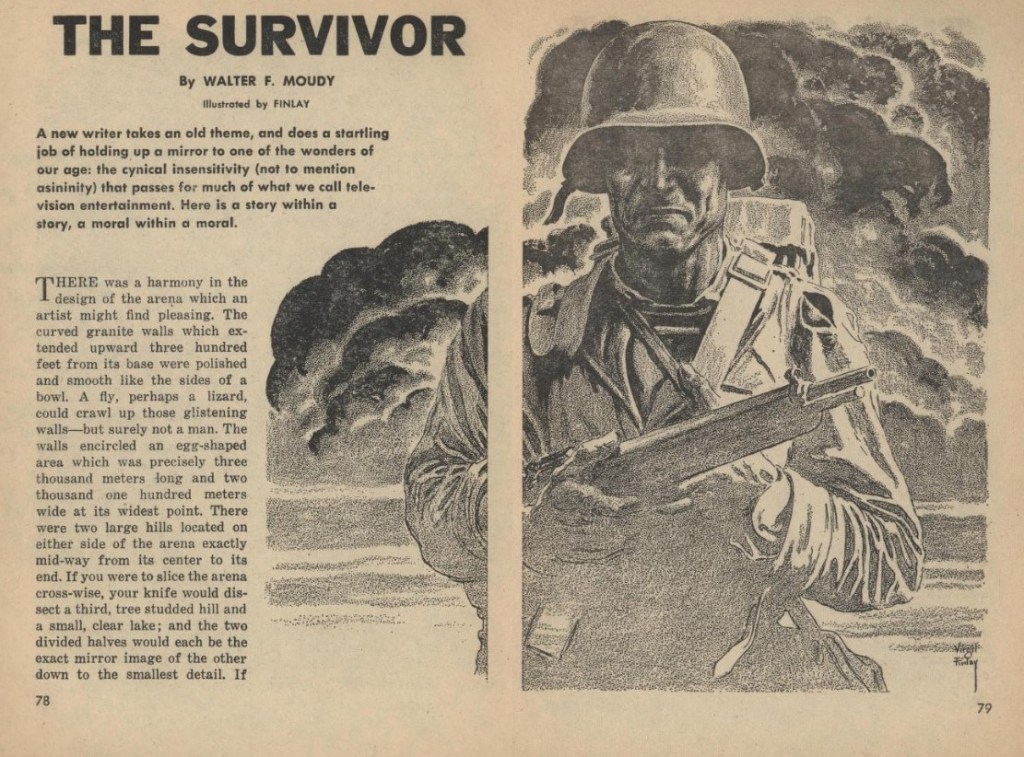
Today I’ve reviewed the fourteenth story in my series on the science fictional media landscape of the future. Walter F. Moudy relays the coverage of the 2050 Olympic War Games between the United States and Russia with harrowing effect.

Previously: Barry N. Malzberg’s “The Idea” (1971) (as K. M. O’Donnell).

Up Next: Theodore Sturgeon’s “And Now the News…” (December 1956).
3.5/5 (Good)

Walter F. Moudy’s “The Survivor” first appeared in the May 1965 issue of Amazing Stories, ed. Cele Lalli (Goldsmith). You can read it online here.

Recently James Harris highlighted the truncated writing career of Walter F. Moudy (1929-1973) with a focus on No Man on Earth (1964), his only science fiction novel. Inspired by his comments on “The Survivor” (1965) and relentlessly intrigued by authors who have fallen from contemporary memory, I placed the slick future televised Cold War conflict tale at the top of my media landscapes of the future review list. For those expecting a masterful Henry Kuttner tale, stay tuned! In the meantime, let’s plunge into Moudy’s coverage of the 2050 Olympic War Games between the US and Russia.

Continue reading
Book Review: Mockingbird, Walter Tevis (1980)

4.5/5 (Very Good)

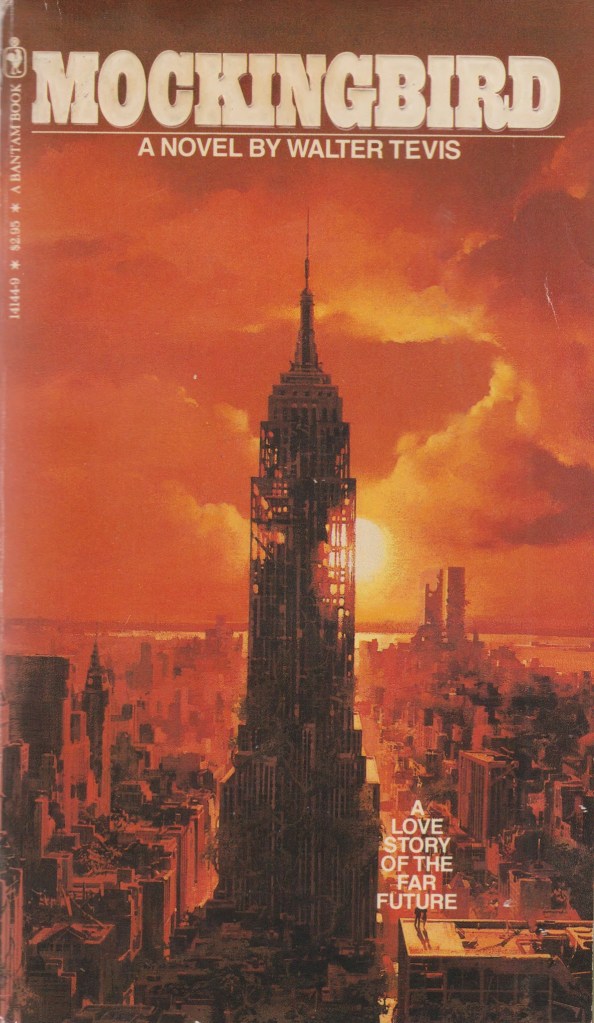
William Tevis’ Mockingbird (1980) is a paean to the power of reading. Possessed by an encyclopedic adoration for silent films and books of all genres, Tevis creates a rich textual substate in which his characters pin together the true nature of their world. For more on the situation in Tevis’ life that prompted him to write Mockingbird–his experiences teaching and his own attempts to defeat alcoholism–and his relationship to science fiction, check out James Sallis’ review in The Magazine of Science Fiction and Fantasy.

The World

In a rapidly depopulating world, the last humans live a medicated life. Successful indoctrination programs of privacy and individuality with catch phrases like “Don’t ask-relax” (24) and “Alone is best” (26), have deprived the masses from the desire to learn or interact with each other. Paul and Mary Lou might be the “last generation of children, ever” (32). Tevis lays out the reasons for depopulation as follows: “1. Fears of overpopulation 2. The perfection of sterilization techniques 3. The disappearance of the family 4. The widespread concern with “inner” experiences 5. A loss of interest in children 6. A widespread desire to avoid responsibilities” (145).

Continue reading

Book Review: Moon-Flash, Patricia A. McKillip (1984)

3.5/5 (Good)

As Patricia A. McKillip (1948-2022) recently passed away (obituary), I decided to pick up one of her few science fiction novels. And I’m glad I did! Channeling (and reworking) the conceptual breakthrough-style premise of Clarke’s Against the Fall of Night (serialized 1948) and countless generation ship novels, Moon-Flash (1984) is an achingly beautiful coming-of-age story of a young woman who sets out to map the geography of her restrictive world.

Continue reading

Book Review: The Grain Kings, Keith Roberts (1976)

4/5 (collated rating: Good)

Keith Roberts (1935-2000) was an influential, if underread and underappreciated, English author (and cover artist) best known for his alternate history fix-up novel Pavane (1968) and powerful short fictions evocative of the English countryside. He won four BSFA awards in various categories (novel, short story, and artist) yet did not achieve the same critical success in the United States. According to his obituary, his difficult personality, like his common male main characters unable to form steady professional or personal relationships, and propensity to refuse to deal with major publishers impacted his popularity.

Continue reading

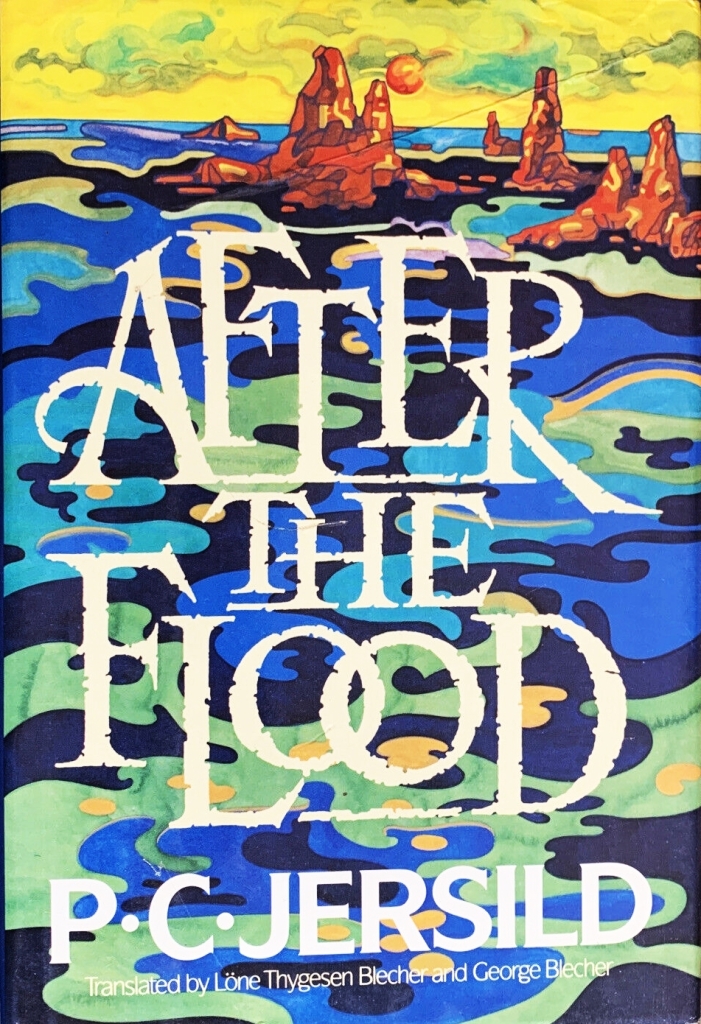
Book Review: After the Flood, P. C. Jersild (1982, trans. 1986)

4.75/5 (Near Masterpiece)

P. C. Jersild’s After the Flood (1982, trans. 1986), a relentlessly bleak and incisive analysis of humanity’s death drive after a nuclear event, hits harder than Cormac McCarthy’s The Road (2006). Possessed by a deceptively powerful prose, Jersild maps out the apocalyptic bodyscapes of this new and dying world with merciless strokes.

P.C. Jersild (1935-), a Swedish physician and author, wrote a handful of novels that can be classified as science fiction. According to SF Encyclopedia, he’s “a central figure in modern Swedish literature, both a favorite among critics and, with some of his novels, a major bestseller.” Until recently, as is typical for many mainstream authors, Jersild tried to distance himself from SF despite writing a range of works that are set in the future. Of these works, unfortunately only three have been translated into English–The Animal Doctor (1973, trans. 1975), A Living Soul (1980, trans. 1988), and After the Flood (1982, trans. 1986).

Continue reading

Updates: Recent Science Fiction Purchases No. CCXCVII (Poul Anderson, Kingsley Amis, Eleanor Arnason, Roger Elwood anthology of SF plays)

Which books/covers/authors intrigue you? Which have you read? Disliked? Enjoyed?

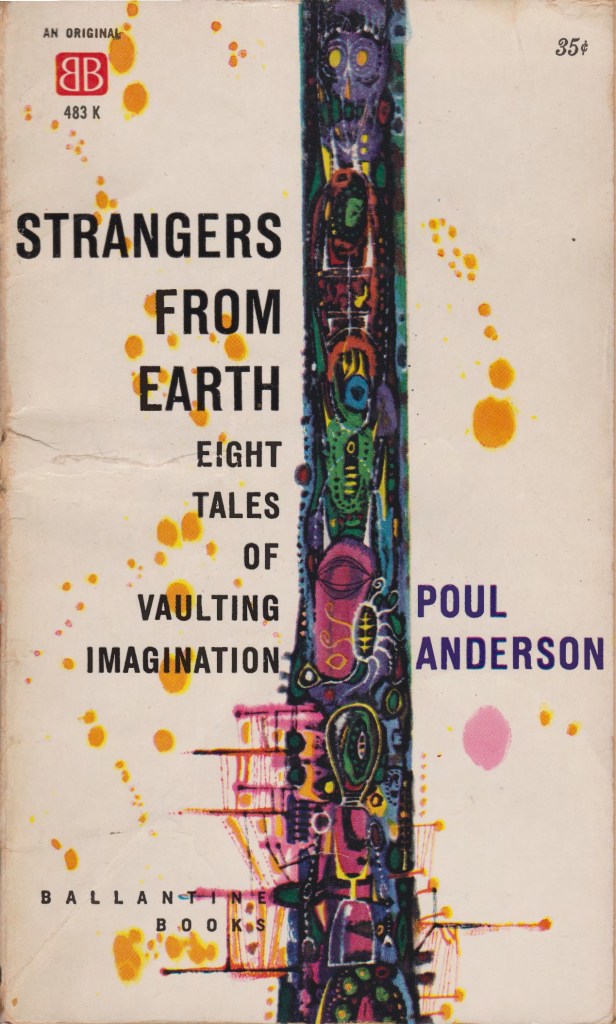
1. Strangers from Earth, Poul Anderson (1961)

From the back cover: “A SENTIENT ROBOT

THE COLONISTS WHO LEFT A PERFECT WORLD

A MADDENING HUNT FOR A MARTIAN

A MAN-MADE ANIMAL

A GALACTIC SWINDLER

These are some of the ingredients Poul Anderson chooses to mix and blend into this first-class collection of stories: and his ability is as wide as the range of his interests.”

Contents: “Earthman, Beware!” (1951), “Quixote and the Windmill” (1950), “Gypsy” (1950), “For the Duration” (1957), “Duel on Syrtis” (1951), “The Star Beast” (1950), “The Disintegrating Sky” (1953), “Among Thieves” (1957)

Continue reading

Future Media Short Story Review: Barry N. Malzberg’s “The Idea” (1971) (as K. M. O’Donnell)

Today I’ve reviewed the thirteenth story in my series on the science fictional media landscape of the future. Here, I finally return to the nightmarish embrace of Barry N. Malzberg.

Previously: Pat Cadigan’s “Rock On” (1984).

Up Next: Walter F. Moudy’s “The Survivor” (May 1965).

3.5/5 (Good)

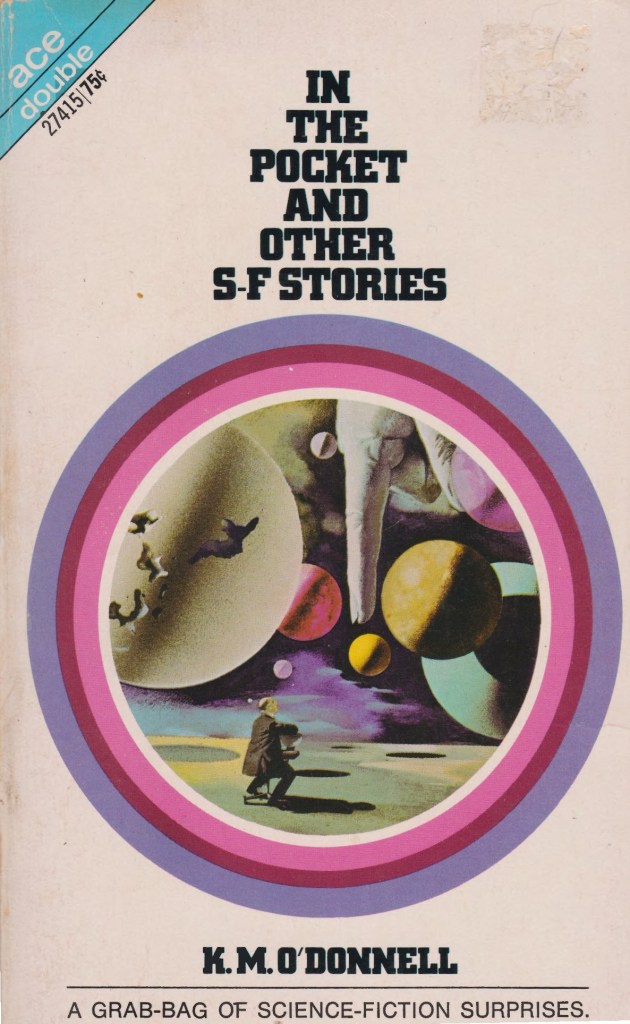
Barry N. Malzberg’s “The Idea” first appeared in In the Pocket and Other S-F Stories (1971) (as K. M. O’Donnell). I cannot find the story online. Please contact me if you do not own a copy and want a PDF of the story. I recommend you procure the fantastic anthology TV: 2000, ed. Isaac Asimov, Martin H. Greenberg, Charles G. Waugh (1982) which “The Idea” also appears in. I’ll be returning to this volume in coming weeks for this series.

Reading a Barry N. Malzberg story is like returning to a familiar embrace–an embrace of the blackest satire conveyed via terrifying existential traps. Ever since I read his masterpiece Beyond Apollo (1972), a metafictional destruction of America’s obsession with space exploration, Malzberg joined the pantheon of my favorite authors.

Continue reading

Short Fiction Reviews: Algis Budrys’ “Forever Stenn” (variant title: “The Ridge Around the World”) (1957), Basil Wells’ “Sole Survivor” (1957), Helen McCloy’s “The Unexpected” (1957), and John D. Odom’s “The Word is Law” (1957)

Preliminary note: I never can pinpoint exactly why I read what I read when I read it as I am a creature of impulse and whim. While browsing lesser known authors, I came across Helen McCloy (1904-1994). She’s best known for her post-apocalyptic novel The Last Day (1959) (as Helen Clarkson)—which you read online as paper copies are incredibly scarce and expensive–and wrote a handful of speculative short stories of which three appear to be science fiction. Mysteries and non-genre fiction made up the majority of her output.

The Last Day led me to McCloy’s “The Unexpected” (1957) and that in turn lead me to the December 1957 issue of Satellite Science Fiction, ed. Cylvia Kleinman. As I recently read the short novel in the issue, Jack Vance’s solid The Languages of Pao (1957), I decided that I might as well read the rest of the stories in the magazine. And I hadn’t read a Budrys short in a bit… And I’d never heard of Basil Wells (1912-2003) or John D. Odom (unknown dates).

Continue reading

Short Book Reviews: Michael G. Coney’s Monitor Found in Orbit (1974) and Ron Goulart’s After Things Fell Apart (1970)

Note: My read but “waiting to be reviewed pile” is growing. Short rumination/tangents are a way to get through the stack before my memory and will fades. Stay tuned for more detailed and analytical reviews.


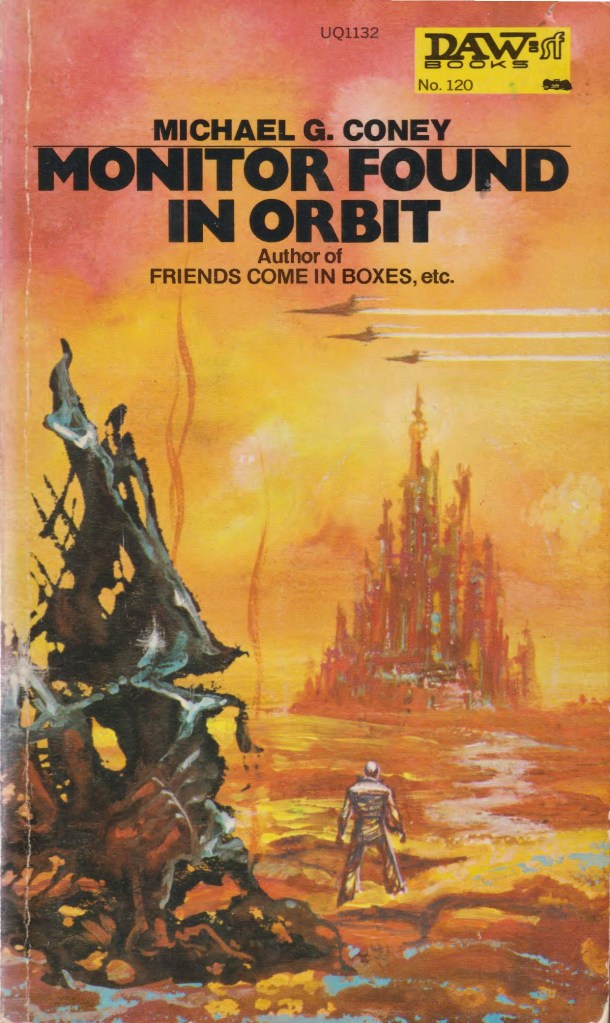
1. Monitor Found in Orbit, Michael G. Coney (1974)

3/5 (collated rating: Average)

I’ve long enjoyed Michael G. Coney’s science fiction–check out Friends Come in Boxes (1973), Hello Summer, Goodbye (variant title: Rax) (1975), “Those Good Old Days of Liquid Fuel” (1977), and my recent rumination on “The Mind Prison” (1971) (which appears in this collection) for my Generation Ship Short Story Review series. Unfortunately, the majority of the stories in Monitor Found in Orbit (1974), his only published short story collection, are middling at best. I waited far too long to review this one! Despite the presences of some solid to good stories, I can only provide brief summaries at this point without a reread.

Continue reading