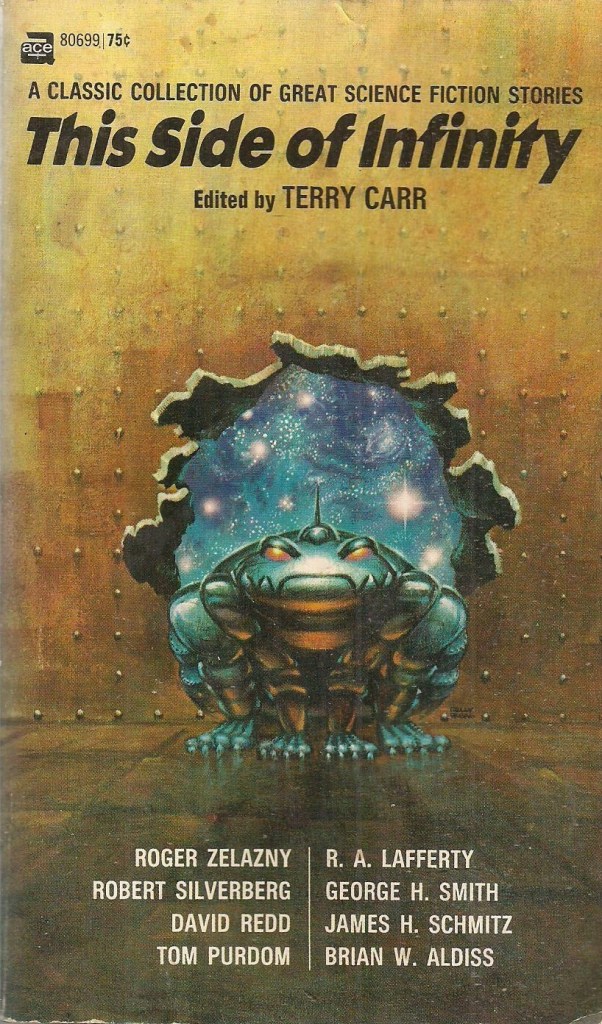
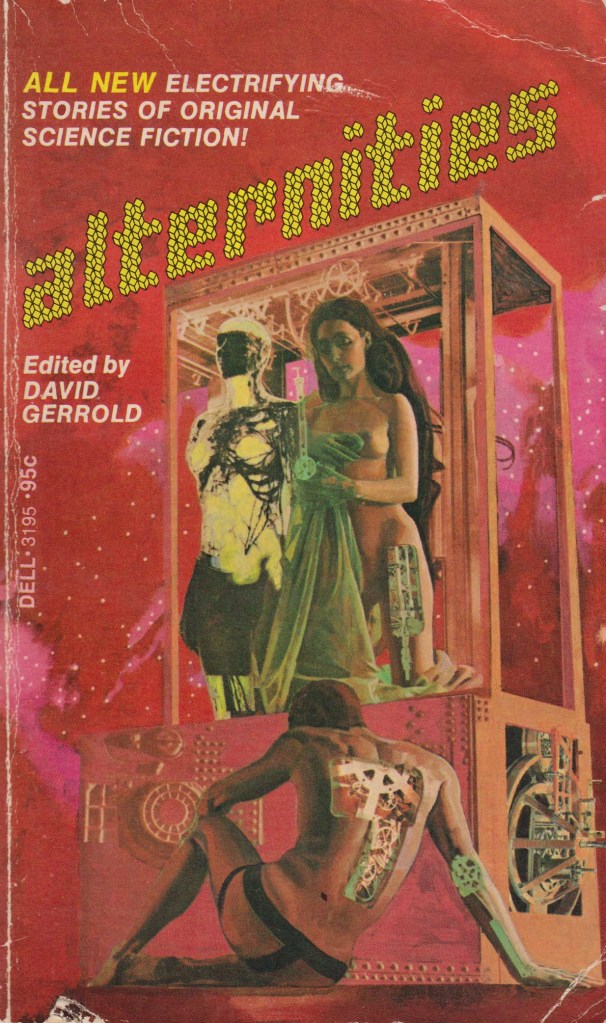
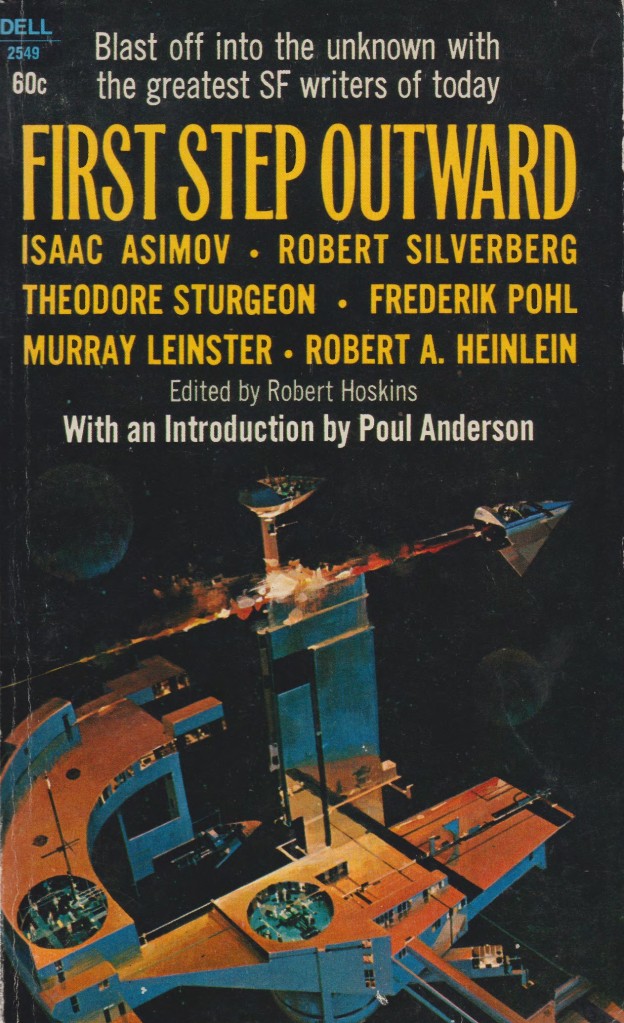
Book Review: This Side of Infinity, ed. Terry Carr (1972) (Zelazny, Silverberg, Aldiss, Lafferty, et al.)

3.25/5 (Collated rating: Vaguely Good)

Soldiers in mech armor plagued by existential crisis. Asexual insectoid aliens pretending to be human. Children wielding pet apes as weapons. This Side of Infinity, ed. Terry Carr (1972) gathers eight kaleidoscopic visions from stalwarts (Roger Zelazny and Robert Silverberg) to lesser known authors (David Redd and George H. Smith). As a collated whole, this is a solid collection without a defining standout masterpiece but worth acquiring for the sheer variety and hallucinatory power of it all.

Continue reading

Short Story Reviews: Carol Emshwiller’s “Baby” (1958), “Idol’s Eye” (1958), and “Pelt” (1958)

I’ve hit gold! Robotic nurses with adult “children.” A blind girl possessed by second sight. And a dog who cannot understand freedom. Here’s the fourth post in my series exploring Carol Emshwiller’s science fiction and fantasy–published between 1955-1979 in genre magazines–in chronological order. And if you missed earlier installments, check out Part III, and III.

In this installment, I have the first that I can confidently declare a 1950s masterpiece–“Pelt” (1958). If you want to participate in my explorations, links to the stories can be found below.

As always, feel free to join the conversation!

Her next three stories are covered in Part V.


“Baby” in The Magazine of Fantasy and Science Fiction (February 1958), ed. Anthony Boucher. 4/5 (Good). You can read it online here.

Raised by a robotic nurse, Baby, “six feet tall, lean, [with] the look of a hungry hunting animal,” encounters a slowly decaying world unable to provide his needs (115). Baby’s simulacra parent, and to a lesser degree Rob the repair robot, parrot the language, actions, and intentions of humans. He detects an emptiness to the space behind their words and increasing inability to explain the mechanical breakdowns that are never fixed. Saying “please” no longer works (116) but rather makes him angry. Nurse, with her “soft mother-arms” and “specially built place at her breast,” continues to follow her programming and treat Baby as if he were a child (118).

Continue reading

Book Review: Twilight Country, Knut Faldbakken (1974, trans. Joan Tate, 1993)

4.75/5 (Near Masterpiece)

In 1968, the moody Canadian psychedelic pop group The Poppy Family released “Of Cities and Escapes,” a haunting song of urban emptiness. The song’s narrator intones: “I live in a one-room apartment, with windows on one side / I stare through the glass ‘cross the water, to where the big, ugly city lies.” In the second verse, later sampled by Deltron 3030 on “Madness” (2000), the narrator cannot escape the death spiral: “I’m caught in the grip of the city, madness and smog.” Twilight City (1974, trans. Joan Tate, 1993), by Norwegian novelist Knut Faldbakken (1941-), delves into a similar dystopian urban gloom. The refugees of a decaying city dust off the entangling membranes of lost paths and the weight of melancholy souls and attempt to chart a new beginning in the city dump.

Brief Plot Summary/Analysis

In an unnamed country, the metropolis of Sweetwater–“an eruption of urban geography” (2) possessed by an “ever-growing urban sprawl” (23)–suffers under the effects of global warming, industrialization, and malignant societal decay.

Continue reading

Book Review: Alternities, ed. David Gerrold and Stephen Goldin (1974) (Malzberg, McIntyre, Bunch, Bear, Sallis, et al.)

2.5/5 (collated rating: Bad)

David Gerrold and his associate editor Stephen Goldin collect a bizarre range of SF oddities including an epistolary nightmare from Vonda N. McIntyre’s pen and a one-sentence “sign” by Duane Ackerman. Gerrold argues that he wants “science fiction to be fun again” without “literary inbreeding and incestuous navel-studying” (8). With a more than pungent hint of hypocrisy, he spouts “I’m tired of the kind of bullshitting that creates false images in the readers’ minds” (8). Alternities (1974) reads like the cast off stories from a New Wave (i.e. deliberately literary) Judith Merril or Harlan Ellison anthology with heavy dose of erotic comedy and shock value. A few–including E. Michael Blake’s “The Legend of Lonnie and the Seven-Ten Split,” Vonda N. McIntyre’s “Recourse, Inc.,” and Edward Bryant’s “Cowboys, Indians”–rise above the dross.

To be clear, I enjoy devouring anthologies like Alternities. The stories are originals and few are anthologized elsewhere. I adore reading authors I wouldn’t otherwise encounter (Robert Wissner, E. Michael Blake, et al.). Gerrold’s nonsense of an introduction aside, the anthology with its deliberate attempts at the “literary” (Greg Bear’s “Webster” and James Sallis’ “The First Few Kinds of Truth”) and “edgy” (Steven Utley’s “Womb, with a View”) firmly fit in the passing mid-70s foam of the New Wave movement.

Continue reading

Book Review: First Step Outward, ed. Robert Hoskins (1969) (Asimov, Silverberg, Sturgeon, Heinlein, et al.)

3.25/5 (collated rating: Vaguely Good)

Published a few months before the Apollo 11 mission to the moon, Robert Hoskins’ anthology First Step Outward (1969) charts an imagined future history of humanity’s exploration of the galaxy. The stories, gathered from some of the big names of the day (Robert Heinlein, Robert Silverberg, Theodore Sturgeon, Isaac Asimov, Poul Anderson, etc.), are grouped as if part of the same future with headings such as “To the Planets” and “To the Stars.” As with most anthologies, this contains a range of gems (such as Sturgeon’s “The Man Who Lost the Sea”) and duds (Ross Rocklynne’s “Jaywalker”).

I’ve previously reviewed five of the thirteen stories in their own posts–linked for easy consultation.

Brief Plot Summary/Analysis

“Cold War” (1949), Kris Neville, 3/5 (Average): Previously reviewed in its own post here.

“Third Stage” (1963), Poul Anderson, 3.5/5 (Good): Previously reviewed in its own post here.

“Gentlemen, Be Seated!” (1948), Robert A. Heinlein, 2.75/5 (Vaguely Average): My first return to Robert A. Heinlein in around a decade is exactly like I thought it would be–thoroughly disappointing. Yes, yes, yes, I know this is far from what he was capable of. The number of reprints this misfire of a story receives mystifies (it appeared in the regularly reprinted The Green Hills of Earth and The Past Through Tomorrow).

Continue reading

Short Story Reviews: Carol Emshwiller’s “The Coming” (1957), “You’ll Feel Better…” (1957), and “Two-Step for Six Legs” (1957)

Here is another post in my series exploring Carol Emshwiller’s science fiction and fantasy–published between 1955-1979 in genre magazines–in chronological order. And if you missed earlier installments, check out Part I and II.

I found Emshwiller’s next three science fiction stories, including the first in her new long-term home The Magazine of Fantasy and Science Fiction, polished fables utilizing standard genre tropes (alien mating rituals, a mysterious stranger, etc.) to highlight humanity’s encounter with itself in idiosyncratic and grim ways.

However, this batch presents a bit of a lull in overall quality. These are probably only recommended for Emshwiller completists like myself or fans of off-kilter 50s parables. The next post will contain one of her best known works of the 50s–“Pelt” (1958). I look forward to Part IV.

For those curious why I am conducting this series, check out my review of the intense power that is “Animal” (1968) (the best story of hers I’ve read so far).

As always, feel free to join the conversation!

Her next three stories are covered in Part IV.


“The Coming” in The Magazine of Fantasy and Science Fiction (May 1957), ed. Anthony Boucher. 3.5/5 (Good). You can read it online here.

A mysterious stranger, “stick thin, and he walked as as scarecrow might walk” (102), comes into town like someone in a trance, his “lips parted, eyes half closed, head thrown back” (102). On cue, a young girl named Nina with her homework spread before her, slips into the same trance-like state. Her mom threatens “if you don’t keep your mind on your work you’ll be set back again this year” (103). But something about the stranger, the unknown, and the other world in which he seems to inhabit free from all care or obligation beckons.

Continue reading

Short Story Review: Poul Anderson’s “Third Stage” (1962)

The following review is the 14th installment of my series searching for “SF short stories that are critical in some capacity of space agencies, astronauts, and the culture which produced them.” Some stories I’ll review in this series might not fit. And that is okay. I relish the act of literary archaeology.

As always, feel free to join the conversation.

Previously: Anthony Boucher’s “Star Bride” (1951)

Up Next: Walter M. Miller, Jr.’s “The Hoofer” (1955)

3.5/5 (Good)

Poul Anderson’s “Third Stage” first appeared in the February 1962 issue of Amazing Stories, ed. Cele Goldsmith. You can read it online here.

At first glance Poul Anderson’s “Third Stage” (1962) reads as an archetypal disaster-in-space tale of intrepid spacemen making courageous decisions under great duress. Around that central core, Anderson delves into far more sinister reaches–the media’s role in televising and manipulating grief. Anderson’s astronauts maintain their heroism despite the machinations of nefarious media men in pursuit of ratings.

Continue reading

Short Story Review: Anthony Boucher’s “Star Bride” (1951)

The following review is the 13th installment of my series searching for “SF short stories that are critical in some capacity of space agencies, astronauts, and the culture which produced them.” Some stories I’ll review in this series might not fit. And that is okay. I relish the act of literary archaeology.

As always, feel free to join the conversation.

Previously: J. G. Ballard’s “The Cage of Sand” (1962)

Up Next: Poul Anderson’s “Third Stage” (1962)

2/5 (Bad)

“Star Bride” (1951) first appeared in the December 1951 issue of Thrilling Wonder Stories, ed. Samuel Mines. You can read it online here.

Anthony Boucher’s short “Star Bride” is a tepid condemnation of colonialism written in the immediate post-WWII stages of decolonization (the Philippines gained its independence from the United States in 1946 and India from the British Empire in 1947). While a deeply problematic and forgettable story, a handful of Boucher’s themes and observations are worth teasing out due to later SF formulations I’ll be exploring in this series.

Continue reading

Short Book Reviews: John Wyndham’s The Chrysalids (variant title: Re-Birth) (1955), John A. Williams’ Captain Blackman (1972), and Gina Berriault’s The Descent (1960)

Note: My read but “waiting to be reviewed pile” is growing. Short rumination/tangents are a way to get through the stack before my memory and will fades. Stay tuned for more detailed and analytical reviews.


1. The Chrysalids (variant title: Re-Birth), John Wyndham (1955)

3/5 (Average)

John Wyndham’s The Chrysalids (1955), my first exposure to his science fiction, transpires in a standard post-apocalyptic cozy catastrophe scenario with a deeply emotional core. The narrative follows David’s childhood in the backwater territories of Labrador, Canada hundreds of years after a nuclear war. The Church, inspired by Nicholson’s Repentances—which along with the Bible are only surviving books–imposes a draconian theology that “only God produces perfection” (51). Mutations, a visual sign of diabolical influence, must be destroyed. David, the son of the local strongman and preacher, discovers a young girl with a terrifying secret–she has six toes. David starts to accumulate secrets including his own mysterious telepathic abilities and recurrent dreams of a city in a world without cities. He shares them with his sympathetic Uncle Axel, who attempts to protect him from the forces narrowing in.

There are some nice touches throughout. Uncle Axel recounts his travels and knowledge of the world as a seaman and the effects is that of a medieval map, filled with pseudo-legendary beings, historical fragments, and “real” flora and fauna that, at first glance, seems too fantastic to exist (54-57).

Continue reading