Short Story Review: Edmond Hamilton’s “What’s It Like Out There?” (1952)

This is the second post in a loose series on SF short stories that are critical in some capacity of space agencies, astronauts, and the culture which produced them.

Thank you “Friend of the Site” Jennifer Jodell for alerting me to the existence of this gem, our discussion, and for providing a summary  of  Damon Knight’s 1962 introduction.

Previously: Walter M. Miller, Jr.’s “Death of a Spaceman” (variant title: “Memento Homo”) (1954).

Up Next: William Tenn’s “Down Among the Dead Men”  (1954)

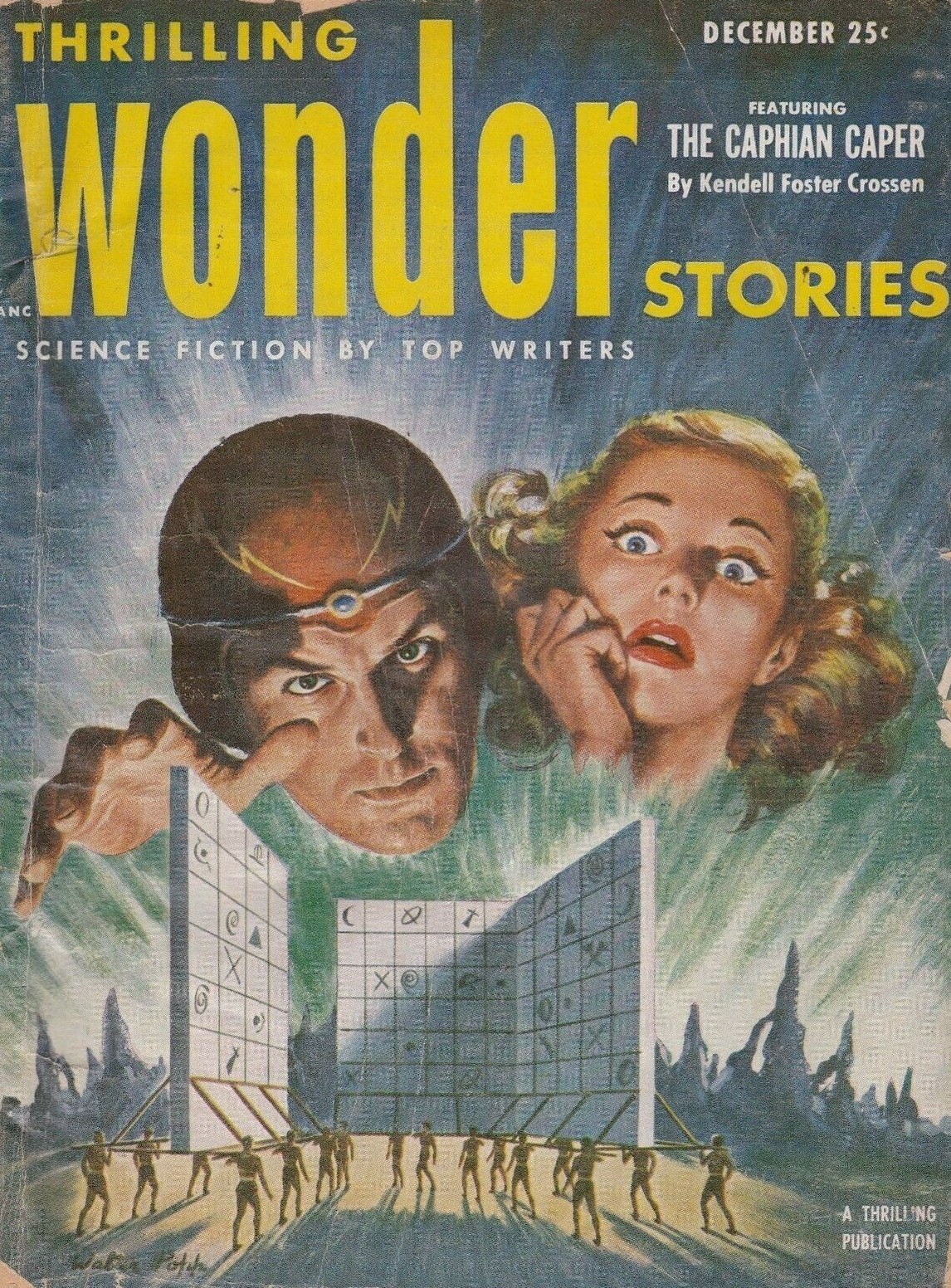
Walter Popp’s cover for the December 1952 issue

5/5 (Masterpiece)

In the December 1952 issue of Thrilling Wonder Stories, Samuel Hines (the editor) presents “What’s It Like Out There?” as the culmination of Edmond Hamilton’s Phoenix-like evolution from a “primitive period” of writing extravagant pulps to Continue reading

Book Review: Albion! Albion! (variant title: Singleton’s Law), Dick Morland (aka Reginald Hill) (1974)

KRUDDART’s cover for the 1986 edition

3.25/5 (Vaguely Good)

Reginald Hill (1936-2012), best known for his crime and mystery novels, wrote two science fiction works under the name Dick Morland. Albion! Albion! (1974) charts the rise of fascism in the UK. The twist to the standard formula? The four main football clubs (Athletic, Wanderers, United and City) depose the government.  The football games are long disbanded. Instead, each team’s supporter groups, managers, insignia, and chants become vehicles of fascist ideology. 

As England devolves into tribalism and turns away from its European neighbors, the Continue reading

Short Story Review: Mari Wolf’s “The Statue” (1953)

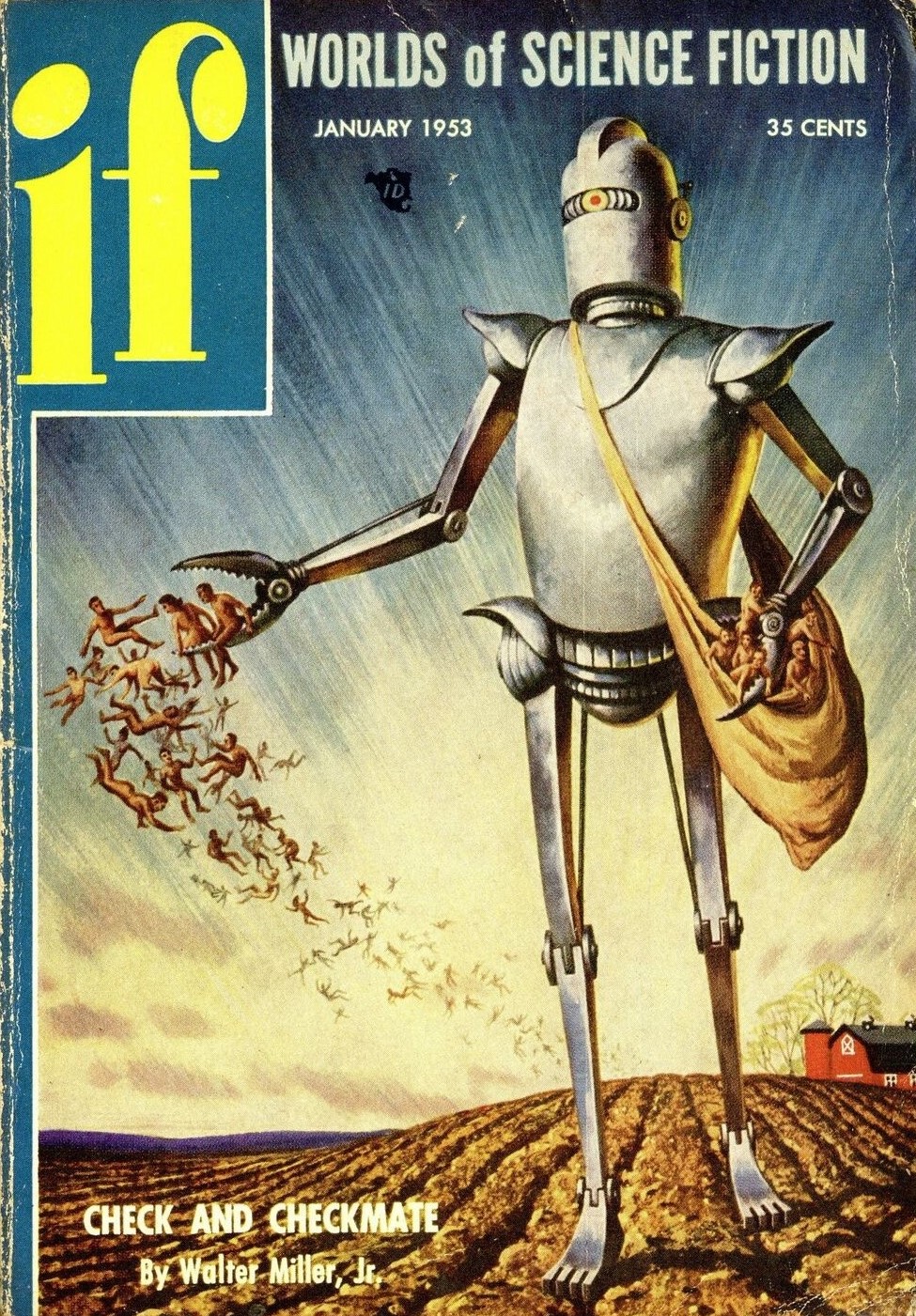
Anton Kurka’s cover for the January 1953 issue

I thought Mari Wolf’s “The Statue” (1953), a rumination on mortality, might find a home in my series on SF stories that are critical in some capacity of space agencies, astronauts, and the culture which produced them. However, due to its overall positivism–despite the blue-collar grit and focus on death–it didn’t fit. I would like to thank “Friend of the Site” Mark Louis Baumgart (see comments) for pointing me towards a new author!


Mari Wolf (1927-), best known for her contributions to fandom including the Fandora’s Box column (1951-1956) in Imagination, published seven short stories between 1952 and 1954, six of which appeared in If. Unfortunately, after her divorce in 1955 from fellow SF author Rog Phillips (1909-1966), she stopped publishing SF. Here is a brief bibliographic blurb on her life, career, and SF endeavors. Ted White Continue reading

Short Story Review: Walter M. Miller, Jr.’s “Death of a Spaceman” (variant title: “Memento Homo”) (1954)

This is the first post in a loose series on SF short stories I’ll be reviewing that are critical in some capacity of space agencies, astronauts, and the culture which produced them.

If you know any stories that might fall into this category published before 1980, let me know in the comments! I have compiled an extensive list (from Barry N. Malzberg to John Sladek) but my encyclopedic tendencies are mere delusions of completeness…

Up next: Edmond Hamilton’s “What’s It Like Out There?” (1952).


Amazing Stories, March 1954

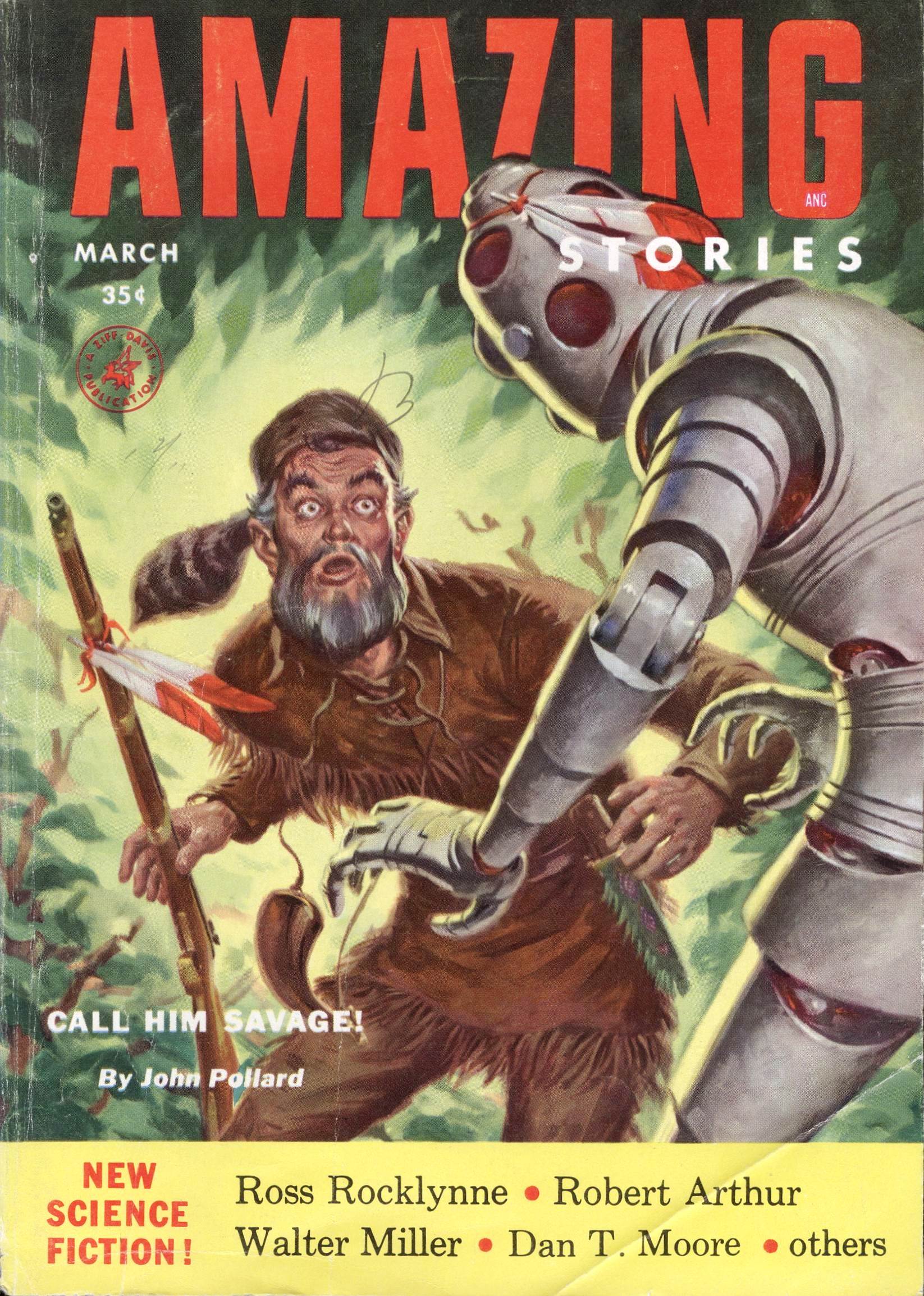
Clarence Doore’s cover for the March 1954 issue

5/5 (Masterpiece)

Walter M. Miller, Jr. (1923-1996), best known for his Hugo-winning fix-up novel A Canticle for Leibowitz (1959), wrote a fascinating range of short fictions between 1951-1957. I’ve previously reviewed a handful in The View From the Stars (1965). However, “Death of a Spaceman” (1954), a complex exploration of death and the delusions we tell ourselves and ones we love, might be the best of his I’ve Continue reading

Book Review: S.O.S. From Three Worlds, Murray Leinster (1967)

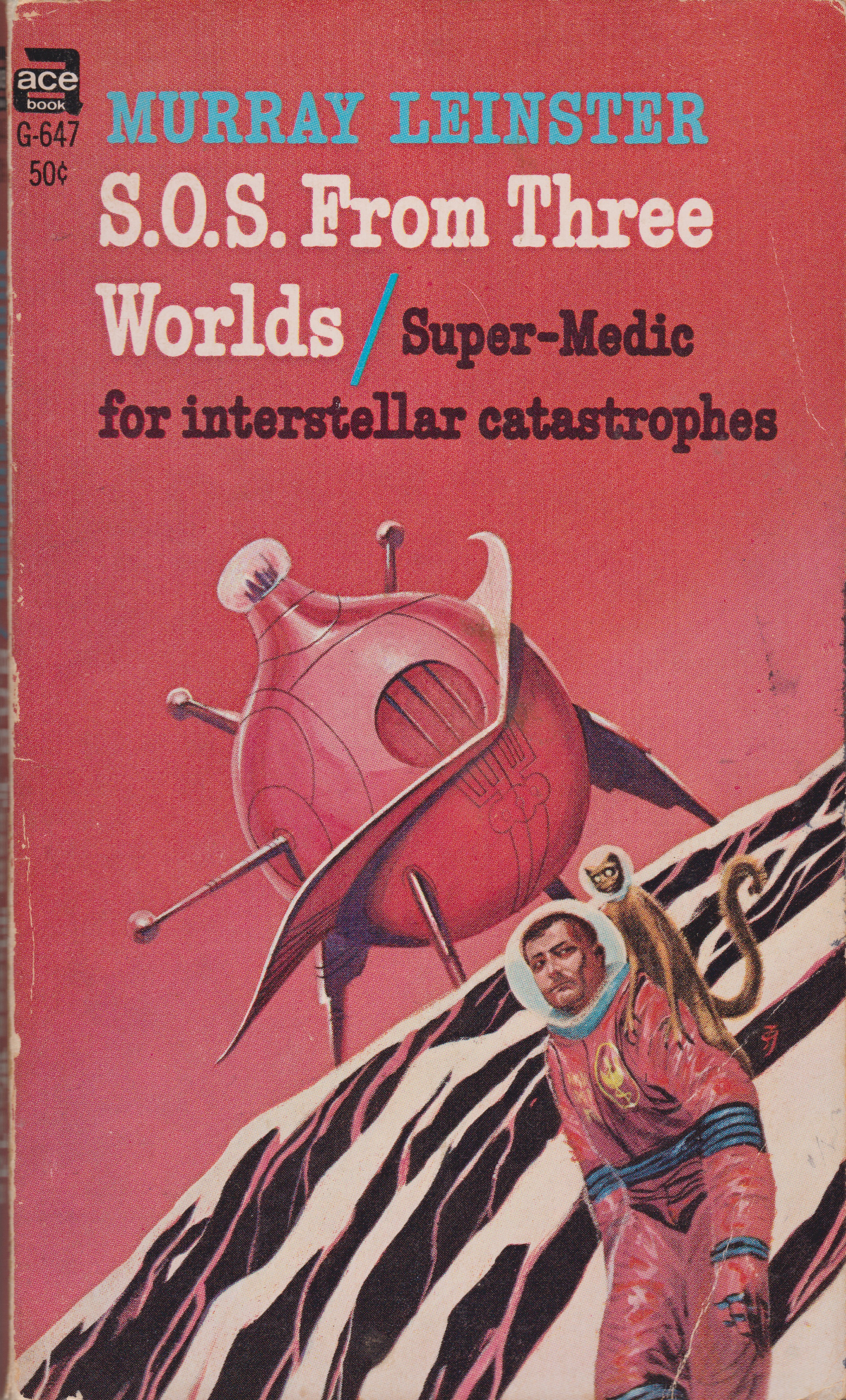
Jack Gaughan’s cover for the 1st edition

4/5 (collated rating: Good)

In times of stress, positivist stories about spacemen devoted to selfless service solving medical crises with their friendly tormals (think furry mobile petri dishes) bring a bit of warmth to my bitter heart. While a medical mystery to be solved with logic and resolve forms the core of each story, Murray Leinster hints at the future history of this decentralized spacescape–a product of chaotic often business-driven expansion.  As limited contact exists between distant colonies, The Interstellar Continue reading

Short Story Reviews: Phyllis MacLennan’s “A Contract in Karasthan” (1963), “Thus Love Betrays Us” (1972), and “A Day in the Apotheosis of the Welfare State” (1975)

Between 1963 and 1980, American SFF author Phyllis MacLennan (1920-1912) published one novel and seven short stories (bibliography and obituary). She served as a translator and linguist in Military Intelligence during WWII.  As I can find little about her work online, I decided to review three of her SFF short fictions. Perhaps they’ll inspire me to pick up her sole novel Turned Loose on Idra (1970), which I bought in 2014.


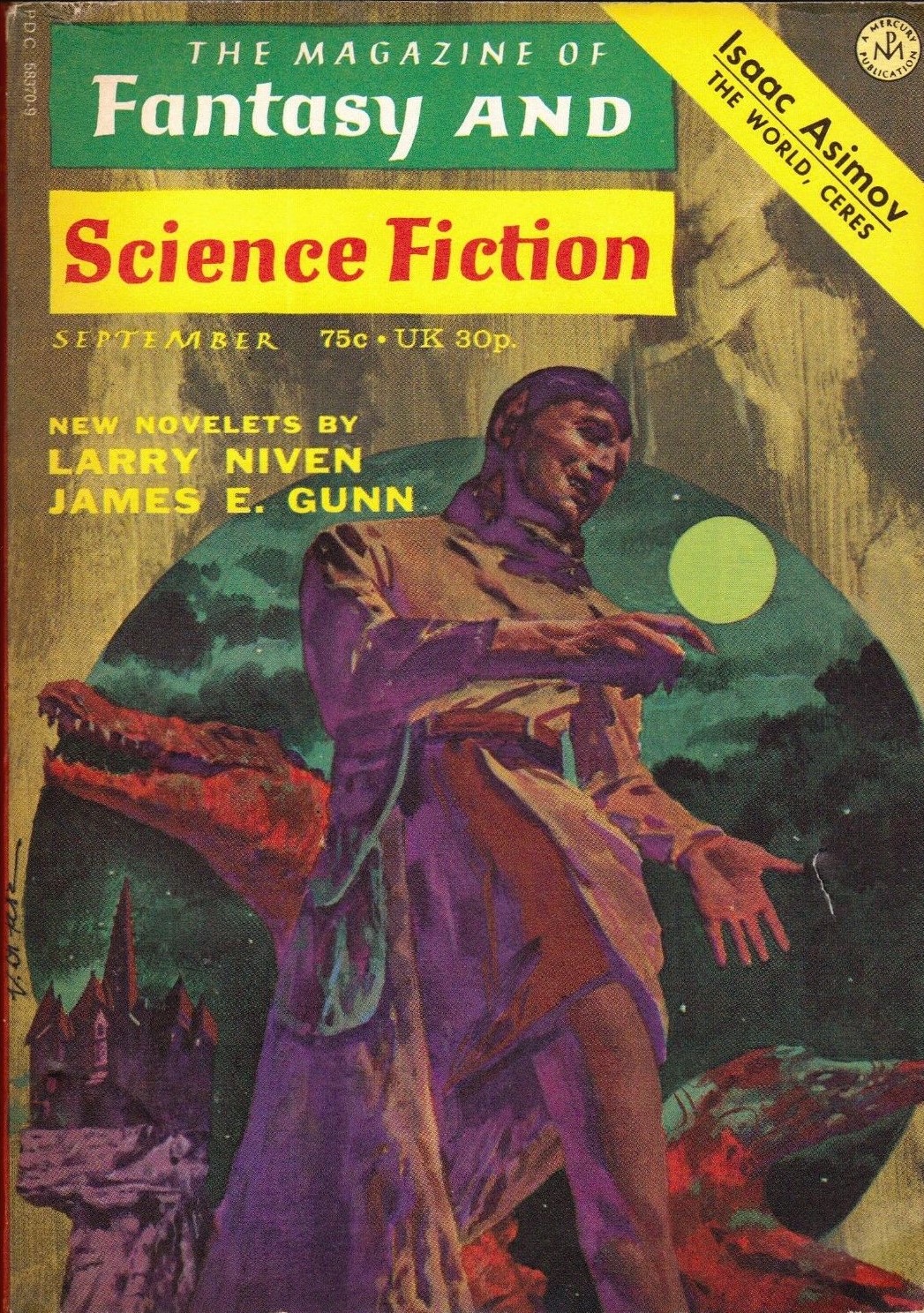
Vincent Di Fate’s cover for The Magazine of Fantasy and Science Fiction, September 1972

“Thus Love Betrays Us” (1972), 4.5/5 (Very Good): First appeared in the September 1972 issue of The Magazine of Fantasy and Science Fiction, ed. Edward L. Ferman. Read the story here.

Deirdre, a night-less and oppressive world filled with thick mists and layers of moss, had only just been Continue reading

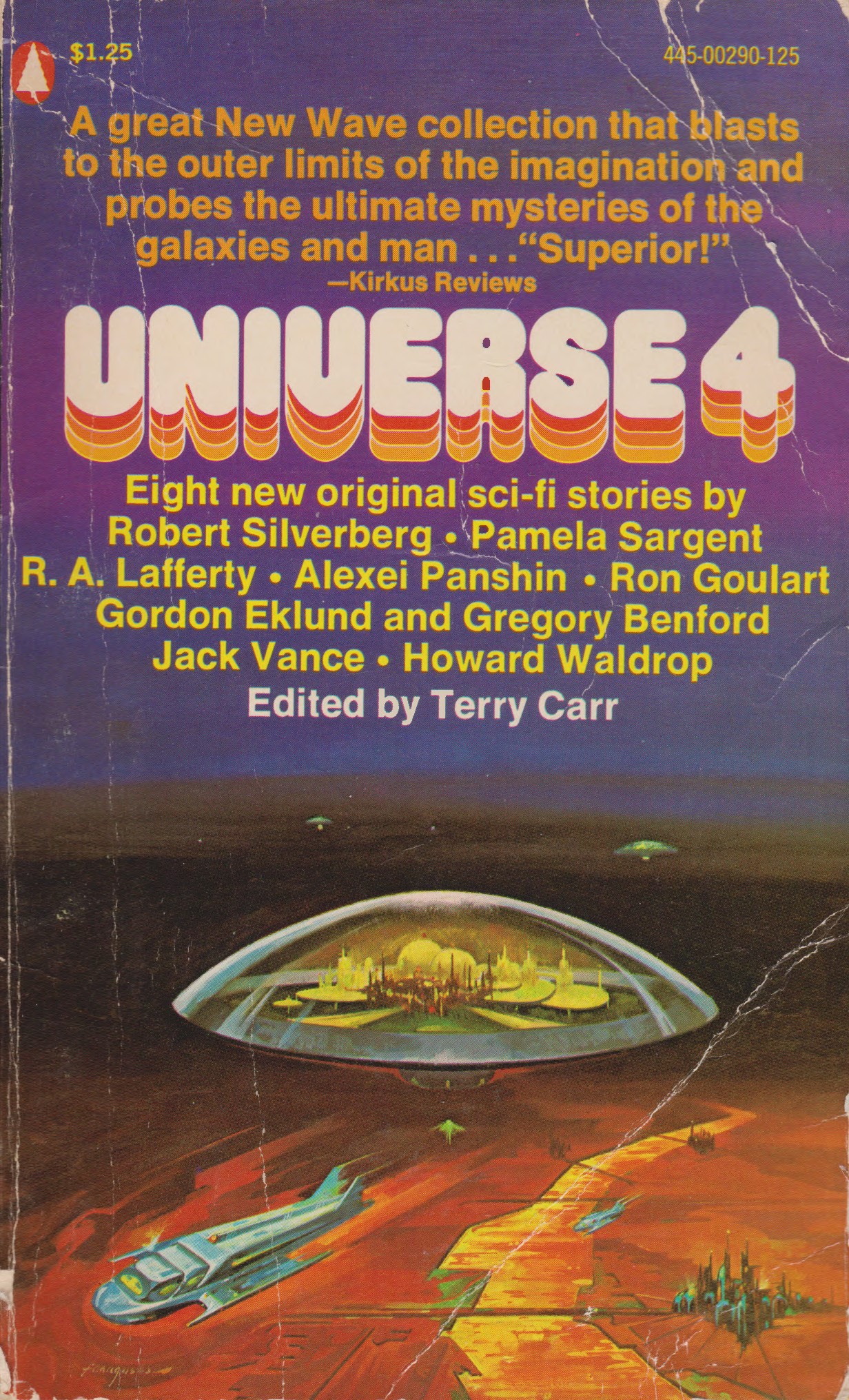
Book Review: Universe 4, ed. Terry Carr (1974) (Robert Silverberg, Pamela Sargent, Jack Vance, R. A. Lafferty, Alexei Panshin, Ron Goulart, et al.)

Jack Faragasso’s cover for the 1975 edition

3.25/5 (collated rating: Vaguely Good)

Terry Carr’s original anthology Universe 4 (1974) contains a cross-section of early 70s science fiction–from oblique New Wave allegories to “hard SF” first contact stories with unusual aliens.

Despite clocking in last in the installments I’ve read so far– behind Universe 2 (1972), Universe 1 (1971), and Universe 10 (1980)—the best stories, R. A. Lafferty’s rumination on memory and nostalgia, Pamela Sargent’s bleak account of urban Continue reading

Book Review: The Wind From Nowhere, J. G. Ballard (1962)

Richard Powers’ cover for the 1st edition

3/5 (Average)

In J. G. Ballard’s The Wind From Nowhere (1962), cosmic radiation creates an immense natural disaster. Ever-increasing winds threaten to tear buildings out by their foundations and force the survivors into subterranean caverns. With the winds comes dust, a manifestation of erasure, that lacerates skin and engulfs all.

John Carnell serialized Ballard’s first novel in New Worlds in 1961 (issues 110 and 111). Continue reading

Book Review: Quake, Rudolph Wurlitzer (1972)

Sandy Kossin’s cover for the 1974 edition

3.75/5 (Good)

Rudolph Wurlitzer’s Quake (1972) parades the traumatized victims of a near-future earthquake through a lust-filled black comedy. Wurlitzer deftly re-purposes the language of erotica for distinctly un-pornographic ends: the aimlessness of life transmutes into a priapic shuffle towards nothing.

Brief Summary

In the near future an earthquake destroys Los Angeles. A nameless transient (N), a recent transplant to the city’s “rituals and corruptions” (3), wakes to a scene of carnage. N stumbles from his cheap cabin, with a bed sheet tied around his waist, towards the hotel pool. Stretched out on the diving board, he observes hotel cabins collapse disgorging the sad dramas playing out within. A woman joins him on the diving board and attempts to converse. He refuses to give his name: “we’re overloaded as it is” (11).

Continue reading