Guest Post: Cyborgs and Intergalactic Freight Transport: “No Woman Born” (1944), C.L. Moore and “Lady in the Tower” (1959), Anne McCaffrey

The scholarly and widely published Kate Macdonald (twitter), a Professor of English Literature and currently a Visiting Fellow at the University of Reading, provides the fifth guest post in my SF Short Stories by Women Writers pre-1969 series (original announcement and list of earlier posts). I recommend browsing her eponymous blog—she recently interviewed the SF author Elizabeth Moon on her collaborations with Anne MacCaffrey and reviews literature and SF (including Iraq + 100. Stories from a Century After the Invasion (2013), ed. Hassan Blasim and the famous post-apocalyptical novel The Long Tomorrow (1955) by Leigh Brackett).

Her post focuses on two of the best known SF women authors from the pre-1969 era: C.L. Moore and Anne McCaffrey.

Cyborgs! Intergalactic Freight Spaceships!

Find copies!

_________________________________________________________________
screen-shot-2016-12-18-at-1-58-13-pm

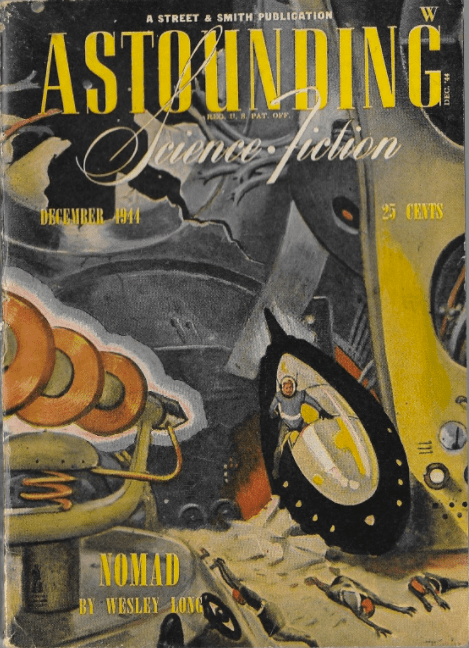
(“No Woman Born” first appeared in Astounding Science Fiction, December 1944, cover: William Timmins)

Review of “No Woman Born” (1944) by C.L. Moore and “Lady in the Tower” (1959) by Anne McCaffrey

By Kate Macdonald

I teach sf to university students, and knew from the critical literature about gender in sf that sometime in the 1940s a writer called C. L. Moore published a landmark story about the first female cyborg. I tracked down a copy of ‘No Continue reading

Guest Post: Three SF Short Stories Pre-1969 by Women Authors: “Vintage Season” (1946), C.L. Moore and Henry Kuttner, “The Snowball Effect” (1952), Katherine Maclean, “The Painter of Dead Women” (1910), Edna Underwood

The erudite and prolific Jesse provides the fourth guest post in my SF Short Stories by Women Writers pre-1969 series (original announcement and list of earlier posts). I recommend investigating the archives over at his blog Speculiction, which covers both vintage and new SF ranging from Aliya Whiteley’s The Beauty (2014) to John Brunner’s The Jagged Orbit (1969).

His post focuses on three stories from different authors including one of the best known from the pre-1969 era: the writing pair of C.L. Moore and Henry Kuttner, Katherine MacLean, and Edna Underwood. As no discussion of women in pre-1969 SF would be complete without C.L. Moore, and it is often impossible to discern which stories she wrote individually and which she wrote with her husband Henry Kuttner, I gave the go ahead for Jesse to review one of their best known co-written short stories.

I hope you’ll track them down!

_________________________________________________________________

galaxy_195209

(Katherine Maclean’s “The Snowball Effect” first appeared in the September 1952 issue of Galaxy, cover: Jack Coggins)

Review of “Vintage Season” (1945) by C.L. Moore and Henry Kuttner, “The Snowball Effect” (1952) by Katherine MacLean, and “The Painter of Dead Women” (1910) by Edna Underwood

By Jesse

Gender in science fiction is surely one of the top three subjects in online genre discussion these days.  The objectification of women, the roles of women in story, the lack of award recognition for female writers, the negative Continue reading

Guest Post: Three SF Short Stories by Soviet Women Authors Pre-1969: “The Useless Planet” (1967), Olga Larionova, “The Astronaut” (1960), Valentina Zhuravlyova, “Life Space” (1969), Marietta Chudakova

The third guest post in my series SF Short Stories by Women Writers pre-1969 (original announcement and list of earlier posts) comes via Kaggsy (you can follow her on twitter), the proprietor extraordinaire of Kaggsy’s Bookish Ramblings. A connoisseur of Russian literature (among other things) and a long-time commentator on the site, I got wind of her interest in Soviet SF reading her review of Kirill Bulychev’s collection Half a Life (1975, trans. 1977) and her acquisition posts of various Foreign Languages Publishing House, Moscow editions — Alexei Tolstoi’s Aelita (1923) and Destination: Amaltheia (1963), ed. Richard Dixon (image below).

Her post focuses on stories by three Soviet Women SF authors — Olga Larionova, Marietta Chudakova, and Valentina Zhuravlyova.  One story is from the cutoff date of 1969.

Enjoy!

_________________________________________________________________

dstntnmltha81963

(Valentina Zhuravlyova’s “The Astronaut” can be found in Destination: Amaltheia, ed. Richard Dixon (1963), Cover: Nikolai Grishin)

Review of “The Useless Planet” (1967) by Olga Larionova, “The Astronaut” (1960) by Valentina Zhuravlyova, and “Life Space” 1969) by Marietta Chudakova

By Kaggsy

When I was approached by Joachim with a view to writing about three favourite short stories written by women writers pre-1969, I confess I did think twice. Although I’ve dipped in and out of sci fi over the years, specifically short stories and specifically written by women isn’t a demographic that necessarily fits Continue reading

Book Review: The Metallic Muse, Lloyd Biggle, Jr. (1972)

thmtllcmsb1972

(Ed Nuckolls’ cover for the 1972 edition)

3.5/5 (collated rating: Good)

Over the years I’ve collected quite a few of Lloyd Biggle, Jr.’s SF novels and collections but have not read any of his work since late 2011 when I reviewed The Light That Never Was (1972). Mike’s mostly positive review of his short stories in The Metallic Muse (1972) reminded me of my lack of knowledge of Biggle, Jr.’s strange brand of relatively breezy but earnest SF.  And due to an unnatural aggregation of cosmic particles, our ratings align with unnerving precision.

Many of the stories in The Metallic Muse center around the transformative power of music and art: for example, a song calls space orphans back home in “Orphan of the Void”; an artist dares to create non-commercial music in “The Tunesmith”; TV keeps the masses in line in “Well of the Deep Wish”; and a robotic violin teacher deprives a professor of his students in “Spare the Rod.”  Lloyd Biggle, Jr.’s ebullient style of telling sometimes trivializes and simplifies the heady themes, but his inventiveness Continue reading

Guest Post: Two Speculative Fictions from the 1890s: “The Yellow Wallpaper” (1892), Charlotte Perkins Gilman, “The Little Room”(1895), Madeline Yale Wynne

The second guest post in my series SF Short Stories by Women Writers pre-1969 (original announcement and list of earlier posts) comes via MPorcius (follow him on twitter) who runs MPorcius Fiction Log. This wonderful site is predominately focused on vintage SF.  I must confess, he has wider-ranging SF interests (and tolerance!) than myself and frequently reviews “classic” authors I’ve delegated, for good or bad, to the refuse pile — A. E. Van Vogt and his ilk for example.  This is a good thing, because if you want a more illustrative cross section of the genre (from the New Wave to pulp to sword and fantasy) then check him out!

His post focuses on two short stories by 19th century speculative fiction women writers.

_________________________________________________________________

moremacabre-schoenherr

(“The Yellow Wallpaper” appeared in More Macabre (1961), ed. Donald A. Wollheim, cover: John Schoenherr)

Review of “The Yellow Wallpaper” (1892) by Charlotte Perkins Gilman and “The Little Room” by Madeline Yale Wynne (1895).

By MPorcius

First, thanks to Joachim for hosting this series of guest posts and for inviting me to participate, and, more broadly, for doing so much to promote speculative fiction that is a little off the beaten path and perhaps receives less attention Continue reading

Book Review: Real-Time World, Christopher Priest (1974)

real-time-world

(Bruce Pennington’s cover for the 1976 edition)

3.75/5 (collated rating: Good)

Christopher Priest’s An Infinite Summer (1979) clocks in as my second highest rated single-author collection, behind Michael Bishop’s Catacomb Years (1979), so far in the life of my site.  I find Priest’s fiction intense and hypnotic.

As Real-Time World (1974) contains a range of Priest’s earliest published short stories, one cannot escape the feel that he is still trying to find his way as an author.  Similar indecision characterized his first novel Indoctrinaire (1970). The best stories in the collection revolve around the themes—the complex nature of perception and reality, psychologically unsettled environments and characters, voyeurism and performance—that his later Continue reading

Guest Post: Three Short Stories by French Women SF Writers Pre-1969: “The Devil’s Goddaughter” (1960), Suzanne Malaval, “Moon-Fishers” (1959), Nathalie Henneberg, “The Chain of Love” (1955), Catherine Cliff

The first guest post in my series SF Short Stories by Women Writers pre-1969 (original announcement) comes via Rachel S. Cordasco (follow her on twitter) who runs the spectacular, and much needed, resource Speculative Fiction in Translation and who blogs on literature more generally at Bookishly Witty.  She also writes for tor.com and Book Riot.

Check out her list of reviews organized by country! Israel, Iraq, France, Italy, Korea, etc.

Her post focuses on three stories by French women writers: “The Devil’s Goddaughter” (1960) by Suzanne Malaval, “Moon-Fishers” (1959) by Nathalie Henneberg, and “The Chain of Love” (1955) by Catherine Cliff.

_________________________________________________________________

13fsfstr1965

(Louis S. Glanzman’s cover for the 1965 edition of 13 French Science-Fiction Stories (1965), ed. and trans., Damon Knight)

Three Stories from 13 French Science-Fiction Stories, edited and translated by Damon Knight (Bantam Books, 1965, 165 pages).

by Rachel S. Cordasco

Don’t be put off by the purple prose on the front and back covers; 13 French Science-Fiction Stories is a fantastic resource for anyone looking to read more widely in the Continue reading

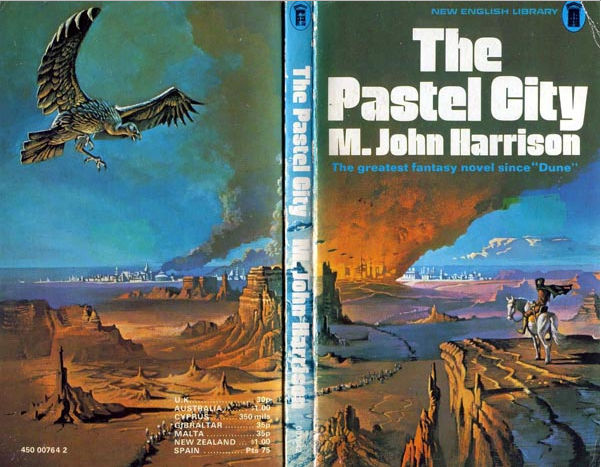
Book Review: The Pastel City, M. John Harrison (1971)

screen-shot-2016-11-04-at-10-30-36-am

(Bruce Pennington’s cover for the 1971 edition)

4.25/5 (Very Good)

One of the previous owners of my copy of M. John Harrison’s The Pastel City (1971) must have harbored a pernicious grudge against corroded landscapes and nebulous morals.  So much in fact that they propped up the first volume of the Viriconium sequence against a tree and used it for BB gun target practice. I am still trying to identify the cause of the book’s other wounds… [pictorial evidence below].

As one can expect from Harrison, decadence and decay seeps from the quires of The Pastel City as characters try to create meaning, or grasp hold of half-formed Continue reading

Book Review: Universe 10, ed. Terry Carr (1980) (Lafferty + Bishop + Tiptree, Jr., Waldrop, et al.)

screen-shot-2016-10-30-at-10-36-06-am

(Uncredited cover for the 1982 edition)

3.5/5 (collated rating: Good)

Fresh off Terry Carr’s novel Cirque (1977), I decided to return to his original Universe series of anthologies.  I’ve previously reviewed Universe (1971) and Universe 2 (1972).  As with the majority of SF anthologies, Universe 10 (1980) is sprinkled with both good and bad.  I selected it from the veritable sea of anthologies on my shelves due to the presence of authors I wish to explore further and those who are foreign to me: Michael Bishop and James Tiptree, Jr. in the former category; Lee Killough, Howard Waldrop, Carter Scholz, and F. M. Busby in the latter.

Michael Bishop’s “Saving Face”, James Tiptree, Jr.’s “A Source of Innocent Merriment,” and Carter Continue reading