Book Review: The Human Angle, William Tenn (1956)

(Richard Powers’ cover for the 1964 edition)

3.75/5 (collated rating: Good)

I’ve been in a 50s SF short story craze of late, devouring collections by Robert Silverberg (Godling, Go Home!), Walter M. Miller, Jr. (The View From the Stars), Fritz Leiber (A Pail of Air), Lester Del Rey (Mortals and Monsters), and a few Robert Sheckley volumes a few months before. Fresh off of William Tenn’s solid novel Of Men and Monsters (1968) I went into The Human Angle (1956) (containing three novelettes and five short stories predominately from the 50s) with high expectations.  Despite the handful of duds — “The Human Angle” (1948), “Project Hush” (1954) and “The Discovery of Morniel Mathaway” (1955) —  that tend to creep into most collections of shorts, the majority were characterized by sardonic brilliance.

Although not as biting as his august contemporaries Robert Sheckley and C. M. Kornbluth, Tenn’s visions are delightfully humorous and ironic.  It’s worth getting your Continue reading

Book Review: The Bridge, D. Keith Mano (1973)

(Uncredited — but looks like Jerome Podwil’s work — cover for the 1974 edition)

3.25/5 (Good)

The Bridge (1973) is D. Keith Mano’s only “full-fledged” SF work (Clute on SF encyclopedia).  Mano’s profoundly unsettling dystopic New York circa 2035 is characterized by an unusual mix of radical environmentalism gone amok and Christianity misinterpreted beyond recognition.  In our current day of overwhelming evidence of Global warming and other types of environmental devastation caused by mankind, Mano’s near future will come off as unnecessarily alarmist.

Clearly Mano means his work to be a satire of the most draconian rhetorical flourishes of the environmentalist Continue reading

Book Review: The View from the Stars, Walter M. Miller, Jr. (1965)

(Richard Powers’ cover for the 1965 edition)

3.75/5 (Collated rating: Good)

Almost all SF fans have read Walter M. Miller, Jr.’s masterpiece A Canticle for Leibowitz (1959) but few indulge in his shorter works.  By 1957 Miller had virtually quit publishing new SF (A Canticle is comprised of novellas published between 1955-1957).  His only work published later was Saint Leibowitz and the Wild Horse Woman (1997) completed by Terry Bisson and released posthumously.

The View From the Stars (1965) — containing five short stories, two novelettes, and one novella — is a cross section of his most productive decade.  Although I found that none of the works included should be considered masterpieces, “I, Dreamer” (1953), “Dumb Waiter” (1952),  “Big Joe and the Nth Generation” (1952), and “The Big Hunger” (1952) were wonderful.  All the others are readable Continue reading

Book Review: A Pail of Air, Fritz Leiber (1964)

(Richard Powers’ cover for the 1964 edition)

4/5 (Collated rating: Good)

My only previous exposure to Fritz Leiber was his enjoyable and highly experimental Hugo-winning novel The Big Time (1958) — an unusual story (evoking a one-act play) whose characters are soldiers recruited from all eras of history relaxing in between missions during a vast temporal war.  The same sort of invention and incisive wit abounds in the collection A Pail of Air (1964).  Against a post-apocalyptical backdrop that runs throughout most of the stories, Leiber’s stories are chimeric (and satirical) parables on a vast spectrum of themes — the mechanization of the future, gender relations, endless war, media saturation…  The stories shift between whimsical delight and gut-wrenching despair.

This collection of eleven stories from the early 50s to the early 60s is highly recommended for all SF fans — especially the title story  “A Pail of Air” (1951),  “The Foxholes of Mars” (1952), Continue reading

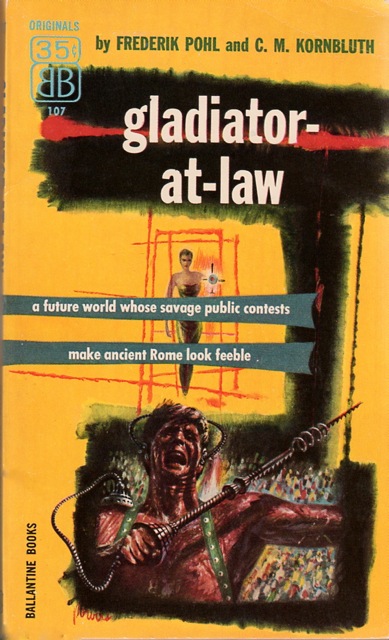
Book Review: Gladiator-At-Law, Frederik Pohl and C. M. Kornbluth (magazine publication 1954)

(Richard Powers’ cover for the 1955 edition)

3.25/5 (Good)

In honor of Frederik Pohl, who recently passed away, I decided to pick up one of his works from the dark maw that is my extensive and overwhelming to read pile.  The last Pohl novel I attempted was a complete disappointment — Slave Ship (1956) — but his collaborations with one of my favorite 50s short story authors, C. M. Kornbluth (who died in 1958 at 34), are often highly readable.   Perhaps the most famous writing duo in SF history, Kornbluth and Pohl produced five novels together including the SF classic The Space Merchants (1953) and multiple short story collections.  The dystopian satire Gladiator-At-Law (1954), although far from the heights of The Space Merchants, is a fine example of their fruitful collaboration.

The world they create is downright fantastic: A future where youth gangs rule the tough streets of Belle Rave (known as Belly Rave), fantastically brutal arena spectacles where old people clubbing each other draw large crowds, lavish bubble houses that supply virtually all needs and are given only Continue reading

Book Review: Of Men and Monsters, William Tenn (1968)

MNNDMN1968

(Stephen Miller’s cover for the 1968 edition)

4/5 (Good)

There’s a small pile of novels on my shelf that wait ever so patiently to be reviewed months and months after I’ve read them — J.G. Ballard’s The Drowned World (1962), Robert Silverberg’s The Masks of Time (1968) and Dying Inside (1972), David R. Bunch’s Moderan (1972) (among others), and, until now, William Tenn’s Of Men and Monsters (1968).  Perhaps I was put off by the three mysterious pages filled with small chicken scratch composed by some earlier reader– “224 PKNY, 248 MINCED, 219 M in OKST” — that hinted at some arcane undercurrents or masonic messages that had alluded me.  Perhaps it was my confusion over Tenn’s Heinlein-esque female character, who, in a work of satire, could indicate something so much more progressive than Continue reading

Book Review: Armed Camps, Kit Reed (1969)

Screen shot 2013-08-29 at 9.24.15 AM(Bob Haberfield’s cover for the 1969 edition)

4.5/5 (Very Good)

“[…] and the men were on the way to the bar, they were talking about the performance, they had to compare it to every other performance, they had to link them all and form them into something continuous, something to keep away the dark” (19).

Kit Reed’s first SF novel Armed Camps (1969) is all about characters constructing narratives and conjuring visions in order to keep the aphotic tides of societal disintegration at bay.  The two paralleled narratives — a woman (Anne) running from her past and a man (Danny March) slowly recounting what led to his own downfall — are two different ways of fighting off what is bound to come.  An oppressive melancholy that never lifts soaks the passages, presaging the motions of the characters as if they are trapped in some Thucydidean manifestation of the cyclicality Continue reading

Book Review: The Deep, John Crowley (1975)

(Richard Powers’ cover for the 1976 edition)

4.5/5 (Very Good)

The Deep (1975) was John Crowley’s first published novel and his first of three SF works from the 70s (The Deep, Beasts, Engine Summer).  He is best known for Engine Summer (1979) and his complex/literary fantasy — Little, Big (1981) and the Ægypt sequence (1987-2007).  In the two novels of his I’ve read (the other is Beasts), Crowley’s prose is characterized by an almost icy detachment, an adept construction of unusual images, and dialogue that says only what is needed.

The Deep deploys, in minimalistic fashion, the standard tropes of the fantasy genre mixed with distinctly SF elements: namely, an android visitor whose blood “was alive — it flowed  Continue reading

Book Review: Darkover Landfall, Marion Zimmer Bradley (1972)

(Jack Gaughan’s cover for the 1972 edition)

3/5 (Average)

Marion Zimmer Bradley (1930-1999), most famous for her Arthurian fantasy novel Mists of Avalon (1983) from late in her career, published countless SF works starting in the late 1940s.  Her first novel The Planet Savers (1958) introduced readers to the massive and complex Darkover sequence of works — by far her most famous and iconic contribution to SF.

Darkover Landfall (1972) is a somewhat routine adventure (with a good dose of social commentary) which, according to internal chronology, is the beginning of the vast Darkover series.  Although I cannot speak for the rest of the sequence as this is the first of Bradley’s novels I’ve read, I found Darkover Landfall a problematic and Continue reading