Book Review: Beasts, John Crowley (1976)

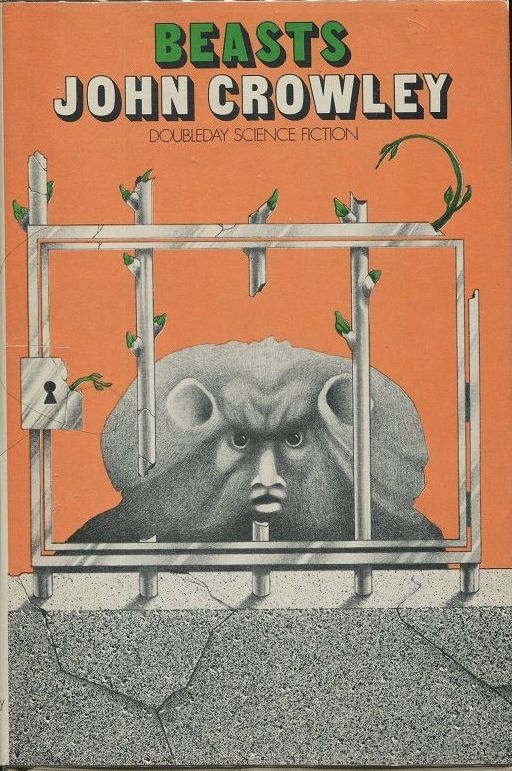
s-l1600-2.jpg

(John Cayea’s cover for the 1976 edition)

4.5/5 (Very Good)

“‘They want to kill us all, you know.  They’re trying […].  The government.  Men.  You.’  Still his eyes searched hers. ‘We’re no use to them.  Worse than useless.  Poachers.  Thieves.  Polygamists.  We won’t be sterilized.  There’s no good in us.  We’re their creation, and they’re phasing us out.  When they can catch us'” (33).

While reading John Crowley’s Beasts (1976) I was reminded of the life of Stephan Bibrowski (1891-1932) à la Lionel the Lion-faced Man.  Stephan was afflicted with hypertrichosis (most likely) which caused his entire body to be covered with hair.  His mother was so horrified at his appearance  — which she believed was caused because she saw her husband mauled by a lion while she was pregnant Continue reading
Book Review: The Burning, James E. Gunn (1972)

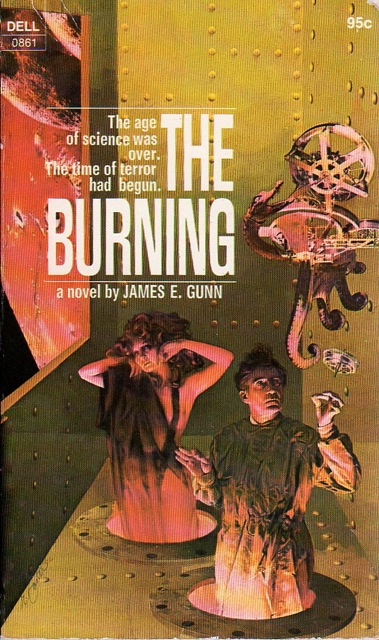
TBRNNG1972

(Robert Foster’s evocative cover for the 1972 edition)

3.25/5 (collated rating: Above Average)

James E. Gunn’s The Burning (1972) is a fix-up novel containing three previously published but linked novelettes: ‘Witches Must Burn’ (1956), ‘Trial By Fire’ (1969), and ‘Witch Hunt’ (1969).  The first two are contiguous while the third section is more loosely related.  I will rate each separately as I did with the superior The Immortals (1962).

As someone who has lived in areas of the United States plagued by virulent strains of anti-intellectualism, massive higher education funding cuts (especially in the liberal arts), and an increasing emphasis on “practical” fields of study, James E. Gunn’s The Burning (1972) is a profoundly unsettling read.  Of course Gunn’s dystopic future is much more one of doom and gloom: The universities lie in smoldering ruins, the professors (“eggheads”) Continue reading

Book Review: The Immortals, James E. Gunn (1962)

THMMRTLSNS1962(Mitchell Hooks’ cover for the 1962 edition)

4.25/5 (collated rating: Good)

James E. Gunn’s The Immortals (1962) is less about the lives and mental state of the eponymous humans “blessed” with immortality (a fascinating topic in itself) and more about the ramifications of their existence on the rest of society not “blessed” with such genetic structures.  Their presence exacerbates the problems of an already dystopically tinged world where medical care is increasingly the domain of the ultra wealthy.  With the knowledge that a random genetic mutation has created a bloodline whose members are immortal, society is all too eager to root them out and (literally) bleed them dry.  Living longer — achieved by whatever means — becomes the single-minded desire of all.  Most of humanity is oblivious to the festering (and carcinogenic) Continue reading

Book Review: The Status Civilization, Robert Sheckley (1960)

THSTTSCVLZ1960

(Richard Powers (?) cover for the 1960 edition)

4/5 (Good)

Robert Sheckley deftly manipulates — in a mere (but dense) 127 pages — a plot straight from the pulps involving prison planets and gladiatorial fights against terrifying robots into a scathing and artfully constructed work of satire.  Similar skills were apparent in his masterful collection Store of Infinity (1960) where traditional sci-fi situations such as colonization of alien worlds, robot rebellions, post-apocalyptical wastelands, and time-travel (among other tropes) are imbued with witty wordplay and biting social Continue reading

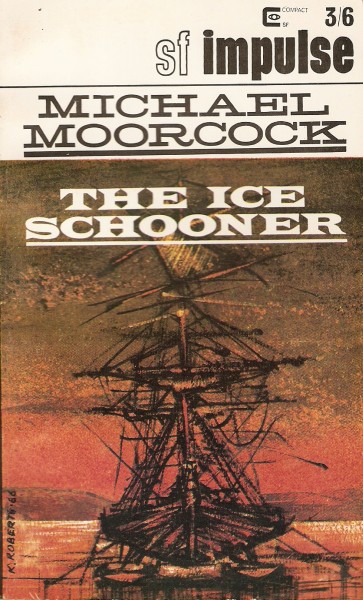
Book Review: The Ice Schooner, Michael Moorcock (1969)

IMPULSENOV1966

(Keith Robert’s cover for the 1966 edition)

3.25/5 (Average)

The Ice Schooner (1969) is the second of Michael Moorcock’s novels I’ve read — the first was the equally unremarkable adventure The Warlord of the Air (1971).  The Ice Schooner, an homage to seafaring  works of Joseph Conrad, functions as a standalone novel without the trappings of Moorcock’s multi-verse mythology.  Despite the lack of explicit connection between this novel’s hero and the “eternal champion” character archetype that features in so many of his works, one could argue that Konrad Arflane displays many of the same Continue reading

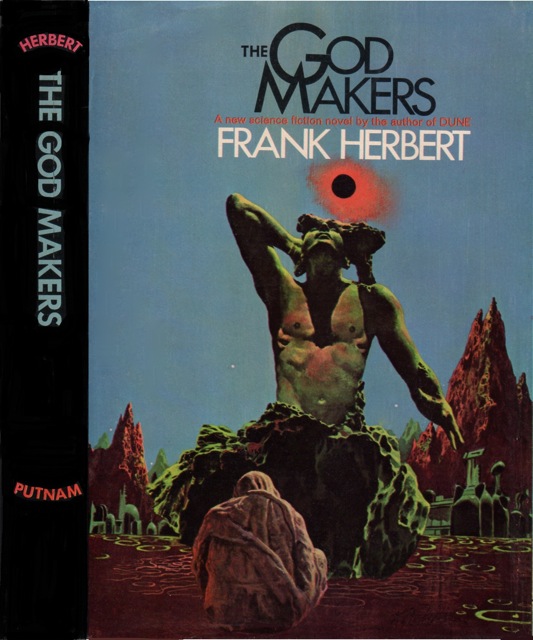
Book Review: The God Makers (variant title: The Godmakers), Frank Herbert (1972)

the god makers

(Vincent Di Fate’s cover for the 1972 edition)

3.25/5 (Average)

As of late I’ve been returning to the extensive catalogue of Frank Herbert’s non-Dune novels on my shelf — The Eyes of Heisenberg (1966) was an engaging read with adept world building which created an intriguing/harrowing dystopic future.  The God Makers (1972) lacks not only Herbert’s trademark dense prose (for example, constantly shifting perspective over the course of a conversation) but also features one of his more poorly conceived future worlds.  This might be due to the fact that the novel was cobbled together from four short stories Continue reading

Book Review: The Mile-Long Spaceship (variant title: Andover and the Android), Kate Wilhelm (1963)

(Richard Powers’ cover for the 1963 edition)

3/5 (collated rating: Average)

Kate Wilhelm, famous for her Hugo-winning masterwork Where Late the Sweet Birds Sang (1976), started her writing career with more modest works.  The Mile-Long Spaceship (1963) collects some of her earliest short stories from the late 50s and a few written for the collection in the early 60s — Clone, her first novel, co-written with Theodore L. Thomas would come out in 1965.  However, her best sci-fi was published in the late 60s to the mid-70s.  Before then her work tended to be straight-forward with an occasional interesting idea or poignant scene but generally unremarkable….

Three stories are worth reading in this collection: an early work of feminist science  Continue reading

Book Review: Pebble in the Sky, Isaac Asimov (1950)

Screen shot 2012-12-24 at 9.50.07 AM

(Uncredited (Powers?) cover for the 1957 edition)

3.5/5 (Good)

Pebble in the Sky (1950), Isaac Asimov’s first published novel, is a revision of the earlier short story ‘Grow Old With Me’ published in the late 1940s.  The novel itself takes place in the vast Galactic Empire based at Trantor that features in so many of Asimov’s short stories and novels — most famously, Foundation.  Although I am generally unimpressed with Asimov’s science fiction, Pebble in the Sky contains intriguing world building and an elderly man as the main character which is rather rare in sci-fi (albeit, this does not prevent a silly romance between the other younger main characters from providing the novel’s emotional core). But, most appealing to me, Asimov moves away from the all too simplistic dichotomy of good vs. bad Continue reading

Book Review: Store of Infinity, Robert Sheckley (1960)

(Uncredited cover for the 1960 edition)

4.5/5 (collated rating: Very Good)

Robert Sheckley’s collection Store of Infinity (1960) contains eight remarkable short stories — three of which are near masterpieces.  Sheckley’s visions are satirical, mordant, and replete with vivid imagery conveyed in solid prose.  A few selections remind me of the lighthearted (yet thought-provoking in content) robot fairy tales by  Stanislaw Lem — for example, those collected in The Cyberiad (1965) — although Sheckley’s visions are less whimsical.

‘The Prize of Peril’ (1958), ‘Triplication’ (1959), ‘The Store of the Worlds’ (1959), and ‘If the Red Slayer’ (1959) are must reads for any Continue reading