Book Review: Three for Tomorrow, novellas by Robert Silverberg, Roger Zelazny, and James Blish, (1969)

(Uncredited cover for the 1970 edition)

3.5/5 (collated rating: Good)

Three for Tomorrow (1969) contains three novellas written specially for the volume on the following theme selected by Arthur C. Clarke: “with increasing technology goes increasing vulnerability: the more man conquers Nature, the more prone he becomes to artificial catastrophe” (foreword, 8).  In my continuing quest for Robert Silverberg’s work from his Glory Period (proclaimed by me) 1967-1976, I was delighted to come across one of his shorter works paired with two other great authors, James Blish and Roger Zelazny.  If you want to read Silverberg’s novella but not the others, it appeared in many of his later collections — Earth’s Other Shadow (1973) for example.

As with most collections, Three for Tomorrow is uneven.  Silverberg’s installment is the best due to its intriguing social analysis of a city suddenly whose inhabitants are suddenly missing Continue reading

Book Review: Revelations, Barry N. Malzberg (1972)

(Michael Presley’s cover for the 1977 edition)

5/5 (Masterpiece)

Revelations (1972) is the second in a thematically linked group of Malzberg’s novels — published in-between its siblings, The Falling Astronauts (1971) and Beyond Apollo (1972) (from now on BA).  Each deals with insane astronauts, and in Malzberg’s own words, “sexual dysfunction as representing the necessary loss of energy of the machine age,” and each contains a character desperately attempting to speak out.  But, as with most of Malzberg’s novels, it is unclear whether there is truth in these cries.

Revelations is less rigorously structured than BA, which was characterized by 67 short tellings/retellings/scenes/dream moments all from the perspective of a single insane character.  As with BA, our anti-hero is an unreliable narrator, but due to the variety of diaristic, epistolary, and interrogatory fragments that comprise  Continue reading

Book Review: Dr. Futurity, Philip K. Dick (1960)

(Ed Valigursky’s cover for the 1960 edition)

2.75/5 (Average)

Over the years I’ve found Philip K. Dick’s early novels hit or miss.  Along with The World Jones Made (1956), Dr. Futurity (1960) (expanded from the 1954 short story “Time Pawn”) is the least satisfying of his novels I’ve read so far.  My total PKD consumption is extensive — around 20 novels and at least 60 short stories.

Time travel is by far my least favorite major science fiction trope.  However, in many of Philip K. Dick’s novels and short stories time travel is transformed into something surreal and often, downright fascinating.  But unlike his later novels, the trope in Dr. Futurity is an endlessly laborious plot device.  Our hero doctor, Jim Parsons, is constantly whisked back and forth in time with hardly a moment of rest or discussion. Continue reading

Book Review: Seed of Light, Edmund Cooper (1959)

(Uncredited cover for the 1959 edition — I suspect it might be David Davies)

3.25/5 (Average)

Edmund Cooper’s Seed of Light (1959) is less of a traditional narrative of the voyage of a generation ship as are its fellow generation ship novels of the 40s/50s. The best examples are Brian Aldiss’ Non-Stop (1958) and Robert Heinlein’s Orphans of the Sky (1941).  Seed of Light is more like a piece of pseudo-history interlaced with fragments of narrative of varying effectiveness.  The work is best described as a thematically-linked series of novellas tracking the future development of man in broad strokes à la Brian Aldiss’ Galaxies Like Grains of Sand (1960).  Unfortunately, Cooper’s original splicing of the generation ship theme onto a Future History template (made popular but Olaf Stapleton and Isaac Asimov among others) is extremely uneven.  Some portions are involving while others are plagued by laborious epoch-spanning pseudo-historical lectures.

Because each part is a separate novella (the last two are more closely Continue reading

Book Review: Sargasso of Space, Andre Norton (1955)

(Ed Emshwiller’s cover for the 1964 edition)

4/5 (Good)

Andre Norton’s Sargasso of Space (1955), the first installment of her Solar Queen sequence of novels, delivers everything a 1950s juvenile science fiction adventure should.  Sargasso of Space is not only blessed with genuine tension, intriguing situations, heroic young adults, but also a multi-racial cast (an African-American apprentice engineer and two crew members of Asian descent).  This is my first of Andre Norton’s massive body of work I’ve read — Secret of the Lost Race, Star Born, Daybreak-2250 A. D., and Witch World are all on my shelf waiting to be devoured — and I will be looking to add more to my collection.  There’s something so appealing in the classic archetypal trope of the young hero–with the help of loyal friends–solving an intriguing (and dangerous) puzzle.

Brief Plot Summary

Our young/intrepid hero Dane Thornson is an apprentice Cargo-Master Continue reading

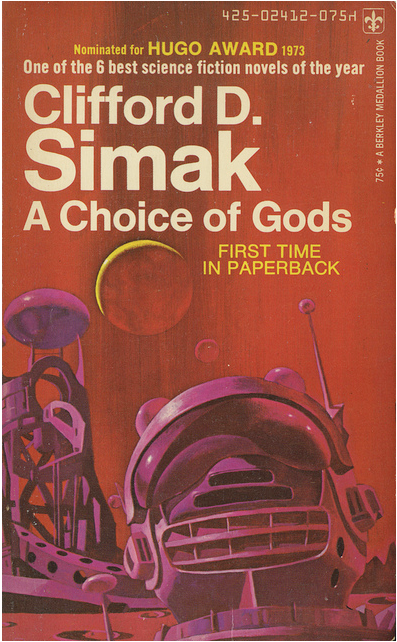
Book Review: A Choice of Gods, Clifford D. Simak (1971)

(Paul Lehr’s cover for the 1973 edition)

3.25/5 (Average)

Nominated for the 1972 Hugo Award for Best Novel

Clifford D. Simak’s A Choice of Gods (1971) is a flawed but intriguing novel.  Simak’s renowned for his original anti-technology pastoral visions.  His science fiction (replete with unusual aliens) is more likely to intersect our future world in the environs of the rural farm, the depopulated/gutted earth covered with forests or an isolated Native American tribe than an urban dystopia, trans-galactic spaceship, or distant planet.  The more famous examples are his Hugo winning Way Station (1963), deserving of at least some of the effuse praise it receives, and City (1952), rightly considered a classic.

Simak’s favorite themes are on show in A Choice of Gods including what happens to robots, whom Simak portrays as almost human but with a programmed need to Continue reading

Book Review: Beyond Apollo, Barry N. Malzberg (1972)

(Roger Hane’s cover for the 1972 edition)

5/5 (Masterpiece — but please consider the caveats below before procuring a copy)

(This review is a product of lengthy dialogues with my girlfriend, a graduate student in English, who devoured the work with great relish and enthusiasm.  Her remarkable eye peeled away levels I didn’t even know existed and heightened my appreciation for this underread classic.   I owe large portions of this review to her.)

Barry N. Malzberg’s Beyond Apollo (1972), the third of his novels I’ve read (Conversations, In the Enclosure, Guernica Night), is generally considered his best work (he won the inaugural John Campbell Award for best Novel).  In a genre infrequently blessed with literary experimentation — of course, there are a few exceptions, Ballard’s The Atrocity Exhibition (1970), Joanna Russ’ The Female Man (1975), Russ’ And Chaos Died (1970), and John Brunner’s Stand on Zanzibar (1968) among others — I’m always more predisposed to works which are structurally/stylistically inventive and thought-provoking.  Barry N. Malzberg’s Beyond Apollo more than fulfills  Continue reading

Book Review: Wyst: Alastor 1716, Jack Vance (1978)

(Eric Ladd’s cover for the 1978 edition)

4.25/5 (Good)

Wyst: Alastor 1716 (1978), the second book of the Alastor Trilogy I’ve read, is more involving, satirical, and thought-provoking than Marune: Alastor 933 (1975).  Each book takes place in the same star cluster so there’s no need to read them in order.  As with every Vance book I’ve had the pleasure to read, the world is vibrant, detailed, and believable.  And also with every Vance book I’ve had the pleasure to read, an unoriginal political intrigue-driven plot is grafted with varying degrees of success onto the world.

A Description of Wyst

The Alastor trilogy takes place in the Alastor cluster, a dense collection of stars ruled by the Connatic (who makes a brief appearance in this novel) from his palace on Numenes. Wyst, Alastor 1716, is comprised of the urban center Uncibal in Arrabus where the egalist utopian society resides, large rural regions with small Continue reading

Book Review: Space Skimmer, David Gerrold (1972)

(Dean Ellis’ cover for the 1972 edition)

3/5 (Average)

I’ve found that the science fiction trope reconstructing a fallen empire/meandering in the wreckage of an empire one of the most seductive of the genre.  The idea of a disconnected landscape filled with the ruins of empire — giant edifice ever more consumed by vegetation, technology unable to be used, spaceships empty in space — is so transfixing that I pick up every example published before 1980 that I find.  Unfortunately, works like David Gerrold’s Space Skimmer (1972) and John Brunner’s collection Interstellar Empire  (1976) are evidence that seductive trope or not, the delivery is often less than delectable.

I must confess that I picked up the novel because of the cover blurb: “The ultimate spaceship in the hands of a barbarian…”  And the intriguing Dean Ellis cover…  Little did I know the blurb should read “the ultimate spaceship in the hands of a barbarian who spouts endless streams of bad poetry, an annoying little prince, Continue reading