Book Review: The Watch Below, James White (1966)

(George Ziel’s cover for 1966 Ballantine edition)

4/5 (Good)

James White, famous for his Sector General series, spins a disturbing tale of two isolated and decaying societies — one alien, one human.  Without doubt the work demands a certain suspension of disbelief.  The isolated human society half of the premise comes off as highly artificial/improbably/impossible (and, well, bluntly put, hokey).  I found the alien half of the story line a more “realistic” situation but less emotionally involving as the human half.  White has difficultly meshing the trans-generational nature of both story lines — and the inevitable intersection at the end is predictable, anti-climactic, and dents the great appeal of the central portion of the work.

Lest this dissuade you, White’s dark vision is a transfixing take on the generation ship (literally) — how would a society descended from five individuals evolve for a hundred years trapped Continue reading
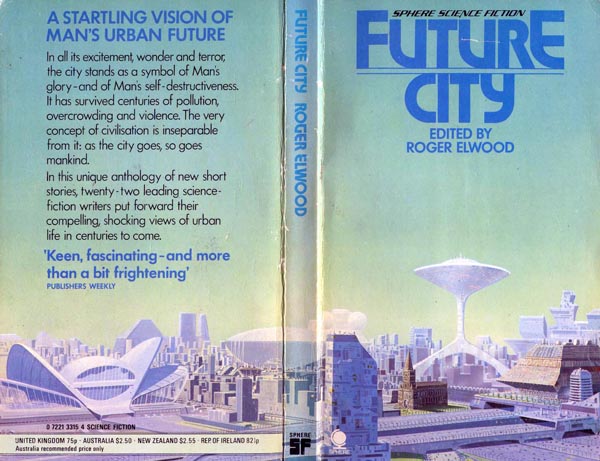
Book Review: Future City, ed. Roger Elwood (1973)

3.25/5 (Average)

According to Future City, the cities of the future are to be avoided at all costs.  There are no utopias here — only overpopulation, pollution, racial warfare, natural disasters, robot takeovers, and eventual reversion to primitivism!  But there’s a trajectory!  In fact, Roger Elwood, the editor of the volume, asked for new stories that fit along this arc.  Elwood claims that there are twenty-two leading science-fiction writers who contributed to the volume.  Unfortunately, three of these leading authors don’t submit stories: Tom Disch contributes a one page poem, Clifford D. Simak a brief introduction, and Frederick Pohl a short afterword.  Also, two of the twenty-two are monikers for Barry N. Malzberg.  Famous authors like Frank Herbert and Ellison contribute substandard short stories.  Many of the other leading figures are not “leading figures” in any sense of the word!

As with most collections there are gems AND complete blunders.  Robert Silverberg, R. A. Lafferty, Ben Bova (and others) all contribute thought-provoking stories making this collection Continue reading

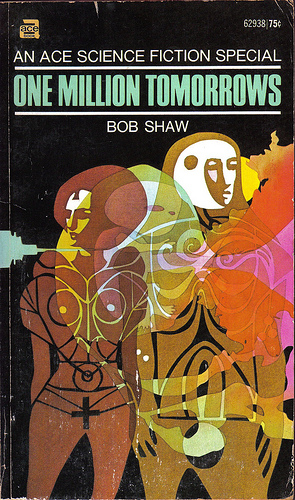
Book Review: One Million Tomorrows (variant title: 1 Million Tomorrows), Bob Shaw (1971)

(Diane and Leon Dillon’s cover for the 1971 edition of One Million Tomorrows (1971), Bob Shaw)

3/5 (Average)

One Million Tomorrows (1971) is the second of Bob Shaw’s science fiction novels I’ve read.  The first, Ground Zero Man (1971), suffered from an extreme case of grating melodrama which weakened the insightful central message — the ever evolving danger (and nature) of nuclear war.

One Million Tomorrows attempts, in a dubious manner, to tackle another standard trope — immortality.  That is, immortality with a catch, the sterilization and complete loss of sexual drive of all men who take the drug.  Women, on the other-hand, become ageless and maintain whatever level of sexual desire they had when they took the Continue reading

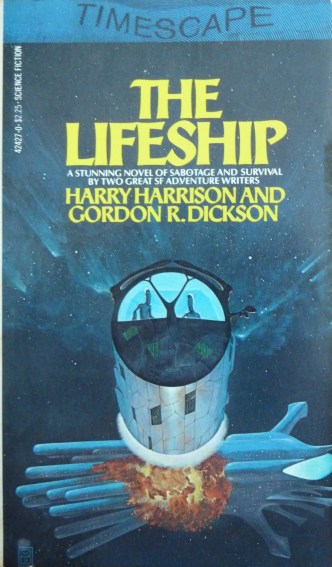
Book Review: The Lifeship, Harry Harrison and Gordon R. Dickson (1976)

3.5/5 (Good)

Harry Harrison and Gordon R. Dickson’s The Lifeship (1976) is two parts tense and exciting adventure in the expanse of space and one part half-hearted “key differences between individuals are overcome in the end” attempts at social commentary.  I found the first two-thirds of the work riveting.  Sadly, the final third devolves into a ramshackle and unpleasant mixture of save the world formulae and endless exposition at gunpoint about all the nefarious nooks and crannies of each and every plan, counter-plan, potential plan, half-realized plan, and unrealized plan soon to be fomented in the liminal realm of coalescing Continue reading

Book Review: Missing Man, Katherine MacLean (1975)

5/5 (Near Masterpiece)

Nominated for the 1976 Nebula Award for Best Novel

Katherine MacLean’s underrated and seldom read novel Missing Man (1975) was expanded from her 1971 Nebula Award winning novella by the same name.  I’ve not read the original version so I’m unsure about how much was added, subtracted, or completely re-conceptualized.

The novel version is a finely wrought vision of a future post-disaster Balkanized New York City comprised of innumerable communes, often at war with each other, inhabited by a small number of slightly telepathic people who are able to detect the emotions of others.  Archetype individuals unknowingly project emotions when they are in danger which could at any moment plunge society into intercommune Continue reading

Book Review: Assignment Nor’ Dyren, Sydney Van Scyoc (1973)

3.25/5 (Average)

Sydney Van Scyoc’s Assignment Nor’ Dyren (1973), inspired by Ursula Le Guin’s masterpiece The Left Hand of Darkness (1969), is a problematic yet generally enjoyable work.  I found that Van Scyoc is unable to maintain the sense of wonder she conjures so vividly in the first third.  Likewise, her prose tends to plod due to the descriptive restrictions she forces on herself (for example, describing each alien the main character encounters by their species).  Perhaps it’s unfair to compare  Assignment Nor’ Dyren to Ursula Le Guin’s masterpiece — considered among the best science fiction works ever written — but the overwhelming impression Continue reading

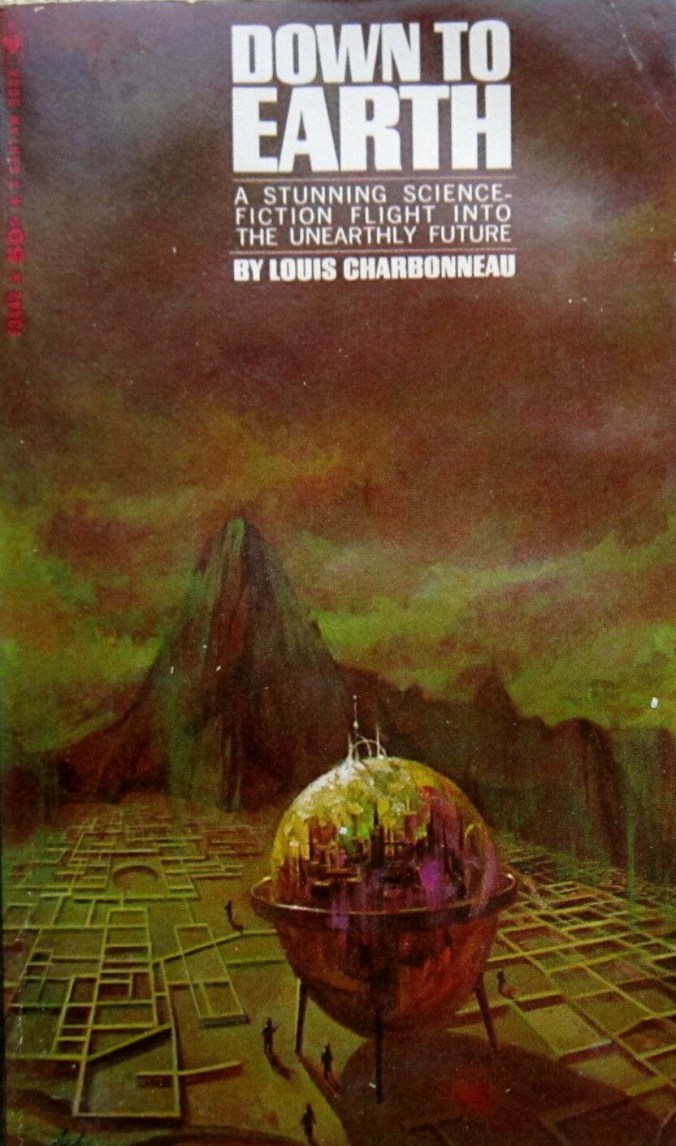
Book Review: Down to Earth (variant title: Antic Earth), Louis Charbonneau (1967)

down to earth louis charbonneau

2/5 (Bad)

The seductive combination of a beautiful cover by Paul Lehr, a seldom read author, a fascinating premise (well, at least from the back cover) appeared at first glance a glorious chance for the pen to wax delightfully on the glories everyone else missed out on.

As much as the esotericist delights in searching through back catalogues of dusty books the lack of extant information/reviews on the work entails risk.  If I had known the entire plot revolves around a vengeful/vindictive/insane man inflicting tortures (the PG-13 sort) on an unsuspecting family hanging out in space — à la a watered down version of Michael Haneke’s Funny Games (1997) without its postmodern deconstruction of our desire Continue reading

Book Review: The Light That Never Was, Lloyd Biggle, Jr. (1972)

3.25/5 (Average)

The Light That Never Was (1972) is an unusual take on space opera — there are no epic battles, voyages on spaceships, weird technology, or heroic figures.  Instead, the swirling eddies of interstellar change descend on a tourist planet replete with legions of rather atrocious, silly, and easily maleable “artists.”  The island of Zrilund on the plant of Donev is afflicted by a general artistic malaise — artists paint for the swarms of tourists which descend on the fountains and beaches of the island snatching Continue reading