Adventures in Science Fiction Cover Art: Nuclear Explosions + Mushroom Clouds, Part II

(Pattee’s cover for the November 1950 issue of Astounding Science Fiction)

In case you missed Part I.

Pattee’s cover for the Astounding Science Fiction November 1950 issue is visually stunning.  A transparent man (his arteries + brain showing) holds the atomic symbol aloft.  On the horizon a gigantic mushroom cloud is transposed with a spaceship.  Does man use atomic power for science and the good of mankind or evil and the destruction of mankind?  The message is made even more abundantly clear by the title of the piece of art — “Choice.”  Although this rhetoric might seem somewhat ham-fisted to modern post-Cold War readers, it produced some remarkable works of science fiction and science fiction art.  (If anyone knows the full name of the artist, I’d be grateful).

As with Part I, I’ve included some covers from the notorious hackwork spewing conveyor belt publisher Badger Books for giggles and Continue reading

Adventures in Science Fiction Cover Art: Visualizing Time

(Hubert Rogers’ cover for the January 1951 issue of Astounding Science Fiction)

In Hubert Rogers’ fascinating cover (titled ‘Achievement’) for the January 1951 issue of Astounding Science Fiction, mankind appears pulled upward, as if against their will, towards an undefined future goal.  Rogers’ cover encapsulates David Hume’s notion of historical time relentlessly moving towards improvement — improvement as something measurable and observable by the historian, and anyone who studies history.  Obviously, this historiographical framework has long been debunked (although it crops up in virtually all of my undergraduate students’ work in intro level courses) — it favors Western conceptions of progress, dismisses the achievements of non-European Continue reading

Adventures in Science Fiction Cover Art: The Statue of Liberty on Pre-1968 Magazine and Novel Covers

pota-statue-of-liberty-2.jpeg

(Still from the 1968 film Planet of the Apes, dir. Franklin J. Schaffner)

For more covers on the same theme see Part II

I suspect that virtually all science fiction fans and film cineastes recall the vivid sequence near the end of the 1968 film Planet of the Apes where the Statue of Liberty lies half-buried in the sands.  Franklin J. Schaffner’s film draws on a rich tradition in pulp science fiction cover art.  I’ve included six cover from 1941-1965, all before the film was released, that depict the Statue of Liberty submerged by apocalyptical floods and excavated by future spacemen.  I have a large catalogue of covers that show various landmarks destroyed by mechanical monsters, ogled at by aliens, and wrecked by a variety of world ending disasters.  The Hollywood penchant for destroying as many national landmarks as possible in movies is deeply rooted in existing visual traditions.

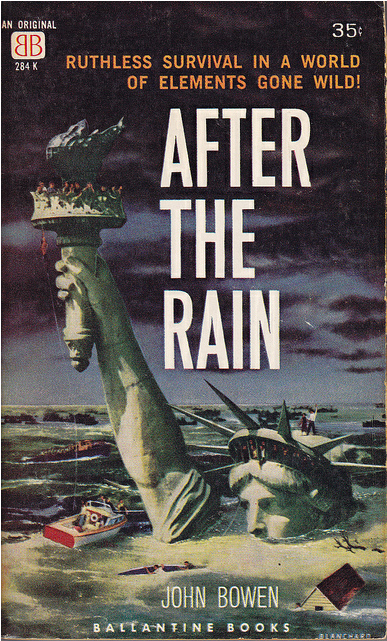
My favorite is by far Blanchard’s (does anyone know his full name) cover for the 1959 edition of John Bowen’s After The Rain (1958).  The dark skies, the stormy waters reaching up to her nose, the survivors of the flood perched near the flame, the boats and roofs of houses floating about, perfectly evoke the extent of the disaster — and, “elements gone wild!”

Enjoy!

(if I’ve missed any pre-1968 covers please let me know.  I know that there are multiple later covers but they might be purposefully referencing Planet of the Apes)

(Blanchard’s cover for the 1959 edition of After The Rain (1958), John Bowen) Continue reading

Adventures in Science Fiction Cover Art: Spacewomen of the Future (fixing spaceships + fighting aliens + charging across barren landscapes)

(Don Sibley’s cover for the November 1950 issue of Galaxy)

When we conjure the image of a 40s/50s science fiction pulp heroine we often imagine a character who has to be rescued by men from aliens, shrieks and clings to any man nearby, and is always in a state of undress.  I’ve included one cover, for the sake of comparison, that I find to be an exemplar of this type of sexist (and racist) depiction below (Alex Schomburg’s cover for the January 1954 issue of Future Science Fiction): white woman wrapped in only a towel stalked by an evil alien obviously painted with African-American facial characteristics (heavy on the sexual predation vibe) — the reader is supposed to buy into the racial stereotypes and thus be titillated by the fear she must feel.

I’ve selected a wide range of mostly pulp magazine covers depicting spacewomen of the future (I’ve loosely decided that this means women in space, in spacesuits) that tend to buck the trend Continue reading

Adventures in Science Fiction Cover Art: Inside the Skull (rats + women + sword fights + robotic circuits + space)

(Ebel’s cover for the 1953 issue of Space Science Fiction)

Previous art explorations which looked at disembodied brains and visualizations of the ultra-intelligent set the stage for this post.  Imagine skulls without brains: sometimes metaphorically, but often, literally hollow skull cavities that hold a vast array of mechanical devies and living captives.  Or, the reader is gifted a voyeuristic peek into the skulls of bodies masquerading as humans but in reality, a mesh of circuits or a metal sheen operates those beautiful limbs and terrifying weapons….

My favorite is by far the pulp goodness of Ebel’s cover (if anyone knows the full name of this artist please let me know) for the 1953 issue of Space Science Fiction.  The gorgeous heroine is held captive in gigantic stone heads with partially glass skulls — a robot that fails to conjure any menace stomps Continue reading

Adventures in Science Fiction Cover Art: Alien Friends

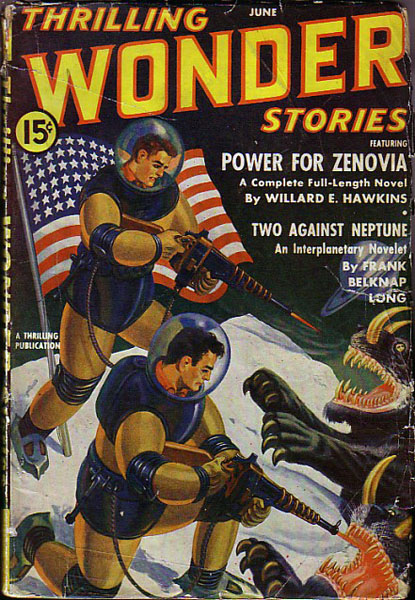
(H. W. Wesso’s June 1941 issue of Thrilling Wonder Stories)

In science fiction aliens are usually evil and generally end up dead — killed by our human heroes via pseudo-videogames (Ender’s Game), guns of endless variety, nuclear weapons detonated on their home worlds, horrific  diseases (Deep Space Nine), tossed into the vacuum of space, tossed into wormholes, etc etc.  They are rarely “humanized” — their families, societies, and history ignored by their human enemies — they are often depicted as “true” evil.  I’ve included the above cover, shooting aliens under the American flag (it is a wartime 40s issue so such overt jingoism is explainable), in order to highlight the attitude towards space fauna which we are all familiar with.

Sometimes “friendship” is feigned.  C. M. Kornbluth’s short story ‘Friend To Man’ (1951) (in this collection) is a disturbing example — the maternal feeling felt by the alien towards our antihero is just a ploy to lure him into her den where she implants him with eggs, which Continue reading

Adventures in Science Fiction Cover Art: Underwater Expeditions (futuristic submarines + underwater labs + sea monsters + cities), Part II

(Roger Stine’s cover for the 1979 edition of On The Run (variant title: Mankind on the Run) (1955), Gordon R. Dickson)

Part II of my Underwater Expeditions Series (Part I) is a veritable deluge of undersea wonders.  Unusual monsters/aliens proliferate the seascapes — snapping at our aquatic heroes.  A vast array of submersibles and submarines — including a mechanical whale equipped with a harpoon (Jack Coggins’ cover for the April 1957 issue of Galaxy Science Fiction) — trek across the oceanic expanses.  Cities, ruins, hidden scientific facilities are all to be discovered amongst the seaweed and deep water trenches…

There is something so mysterious about the ocean depths — almost as alienating and frightening as space.  Although due to our recent deep sea explorations increasingly less Continue reading

Adventures in Science Fiction Cover Art: Chess/Checkers (with people + planets)

(Ed Valigursky’s cover for the 1962 edition of Cosmic Checkmate (1962), Charles V. DeVet and Katherine MacLean)

Queue Ed Valigursky’s cover for the Cosmic Checkmate (1962): a chessboard arrayed against a background of stars, men stand on different colored squares, as much pawns of some distant player as the pieces nearby.  Spaceships flash across the vast expanse of space — remember, the game has galactic ramifications — with our characters arrayed, the game opens, and the battle (of wits and secret weapons) begins.  Although I have not (yet) read Charles V. DeVet and Katherine MacLean (whose later novel Missing Man (1975) I highly recommend) is explicitly about Chess, or more precisely, a similar alien game, and the ramifications are indeed, galactic in scope.  Other covers are more metaphoric Continue reading

Adventures in Science Fiction Cover Art: Models, Dolls, Mannequins

(David Davies’ cover for the 1968 edition of The Syndic (1953), C. M. Kornbluth)

Occasionally I dabble in the incredibly esoteric and artistically painful.  Apparently in the 60s and the early 70s — heralded by the artist David Davies — there was momentary interest in sci-fi covers constructed from manipulated photographs of store window mannequins, dolls, wire contraptions vaguely suggesting spaceships, toy spacemen, wooden artist mannequins dressed in clothes/wigs, and copyright violating models of the Star Trek: The Original Series Enterprise NCC-1701.

Unfortunately, most of the covers I’ve discovered are uncredited — they might all be the work of David Davies.  Internet Speculative Fiction Database has seventeen of his covers listed but I suspect that he made many many more — I’ve gone ahead and credited a few Continue reading