Adventures in Science Fiction Interior Art: Monday Maps and Diagrams (Science Fiction) 3/25/19: A French edition of Mark S. Geston’s Lords of the Starship (1967) and Out of the Mouth of the Dragon (1969)

Today’s installment of Monday Maps and Diagrams returns to the worlds of Mark S. Geston. In 1980 French publisher OPTA released the first two volumes of Geston’s The Wars series, Lords of the Starship (1967) and Out of the Mouth of the Dragon (1969), in a handsome volume with a striking interior map by Claude Fritsch. The series charts the slow climb out of a Dark Age, where the landscape is littered with unusual mutants and the relics of past technologically superior empires and peoples…. I find the map and cover try to evoke more “medieval” imagery than the actual novels (I mean, even in the first one, the technology exists to “construct” a spaceship).

Enjoy! And, as always, comments are welcome and appreciated!

My review of Lords of the Starship (1967).
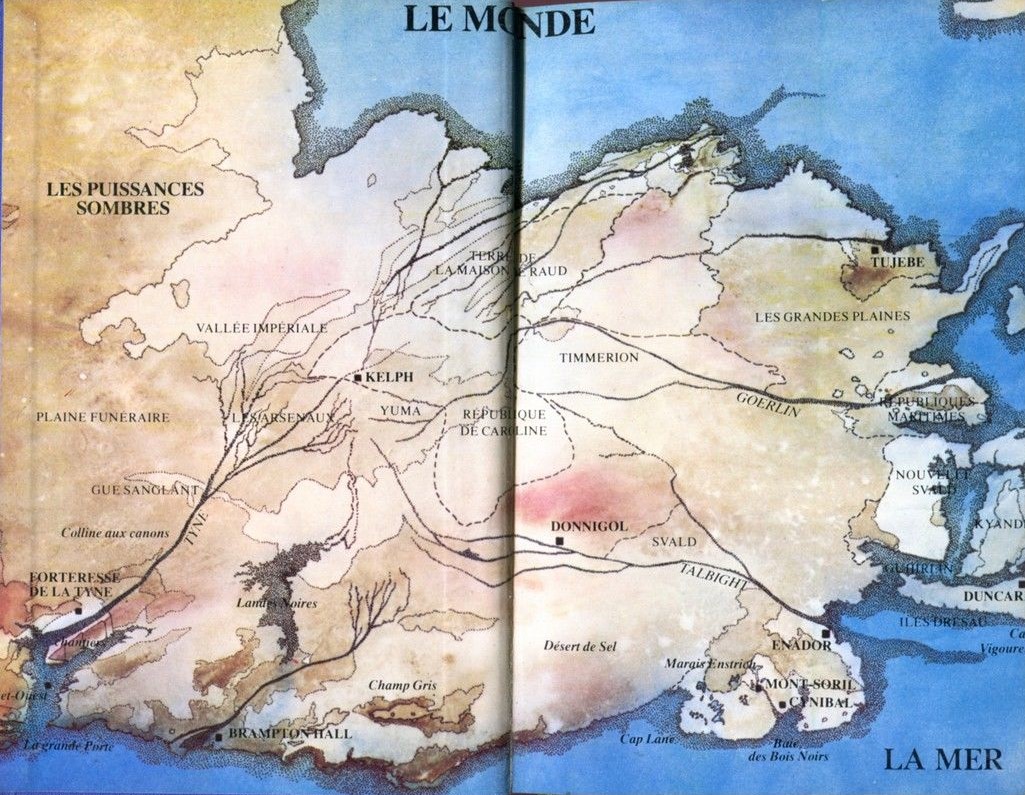
Citation: Claude Fritsch’s interior map (above) and cover art (below) for the 1st French OPTA edition of Les seigneurs du navire-étoile / Hors de la bouche du dragon (1980). Continue reading
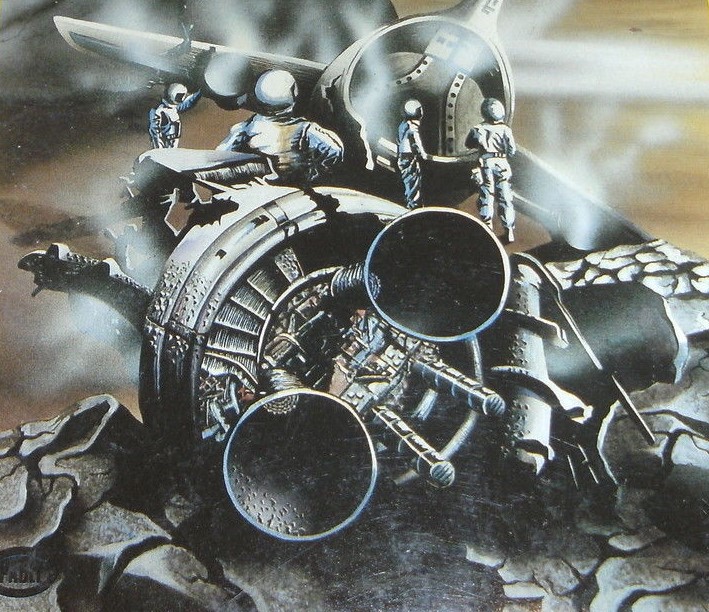
Adventures in Science Fiction Cover Art: Crashed Spaceships, Part III

(Detail from Alan Daniels’ cover for the 1980 German edition of Open Prison (1964), James White)

The crashed spaceship — a wrecked hulk spinning in the emptiness of space, shattered metal struts strewn across an alien landscape…. I find few SF scenarios more nostalgic than this one as a younger me was obsessed with books about the societies formed from the survivors of such cataclysms (Anne McCaffrey’s Acorna Universe sequence, of dubious quality now, was a cornerstone of my youth).

I have selected a range of fascinating covers which add to a series I made in 2012 (Part I) and 2013 (Part II). My favorite of the bunch is Tibor Csernus’ cover for the 1973 French edition of Clifford D. Simak’s Time and Again (1951) due to the verdant and wet landscape the spaceship finds itself in. My second favorite is Dean Ellis’ “descriptive” cover for the 1974 edition of Alan Dean Foster Icerigger (1974). It doesn’t try to be surreal but rather depicts a scene straight from novel. I usually prefer when the artist takes a more unusual approach but in this case Ellis narrows in on the wonder of the premise. Continue reading

Adventures in Science Fiction Interior Art: Monday Maps and Diagrams (Science Fiction) 2/18/19 — David Brin’s Sundiver (1980)

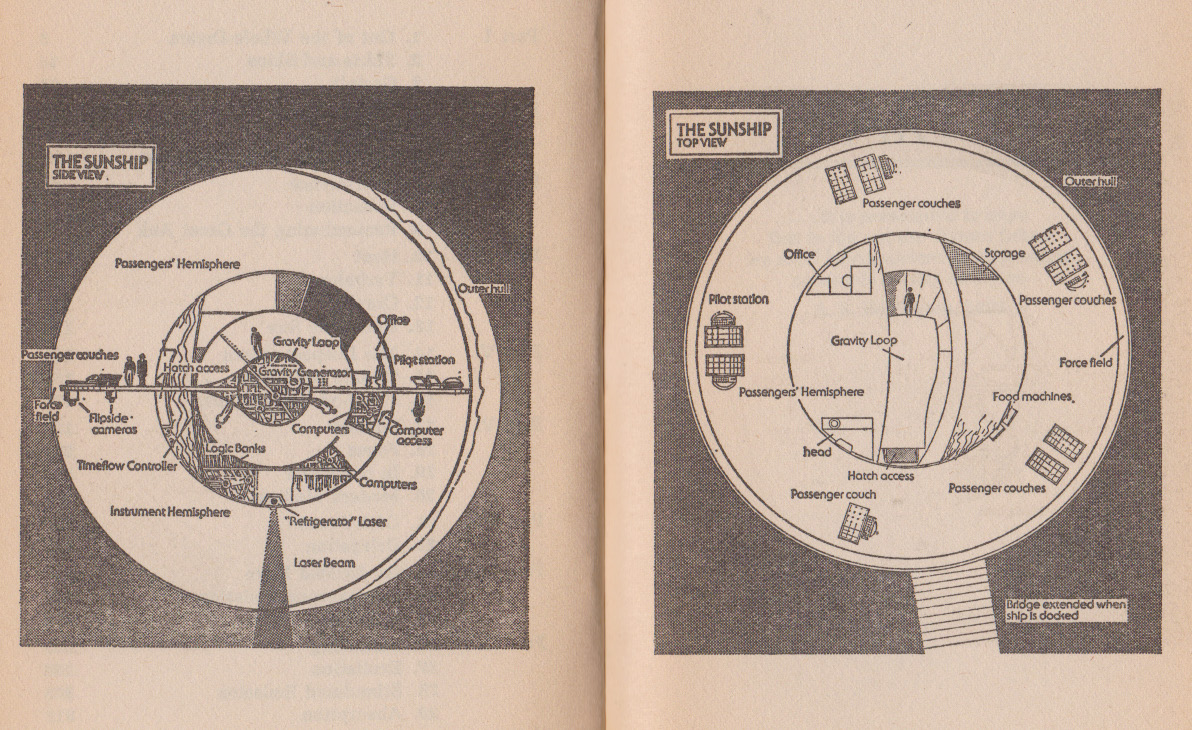
Today’s diagram comes from David Brin’s first novel in the Uplift sequence, Sundiver (1980). I remember virtually nothing from the novel (I must have been 15 when I read it), although, I was intrigued enough to read ALL the sequels. The years have sequestered them to the “I enjoyed them as a kid but probably wouldn’t enjoy them now” category. This series on maps and diagrams was a nostalgic journey…. leafing through the pages of tomes I had long forgotten.

The diagram in Sundiver is a vehicle to descend below the surface of the sun. As with so many diagrams and maps, I’m unsure if it is needed or adds to the reading experience. But like a gorgeous cover, the image draws you in…. and suggests grand adventures and fascinating worlds.

The artist is David Perry.

The Diagram (click to enlarge)

Citation: Hi-res scan of my personal copy of the diagram from the 1983 Bantam edition of David Brin’s Sundiver (1980) [click for larger image]. Continue reading

Adventures in Science Fiction Interior Art: Monday Maps and Diagrams (Science Fiction) 1/21/19 — Larry Niven’s The Integral Trees (1984)

Monday Maps and Diagrams 1/21/19

Larry Niven’s output often revolves around “hard” (and often scientifically impossible–*cough* Ringworld) SF premises. The Integral Trees (serialized 1983) is no different. The action in this Nebula and Hugo Award-nominated novel takes place within a “gas torus, a ring of air around a neutron star.” In my Larry Niven period (late teens) I’m convinced I read this one — and possibly its sequel The Smoke Ring (1987), but I remember little. Same thing goes for Ringworld, which, other than its basic premise, was incredibly bland….

As with last week’s installment, Shelly Shapiro created the interior diagram.

The Diagram (click to enlarge):

Continue reading

Adventures in Science Fiction Interior Art: Monday Maps and Diagrams (Science Fiction) 1/14/19 — Alan Dean Foster’s Voyage to the City of the Dead (1984)

Monday Maps and Diagrams 1/14/19

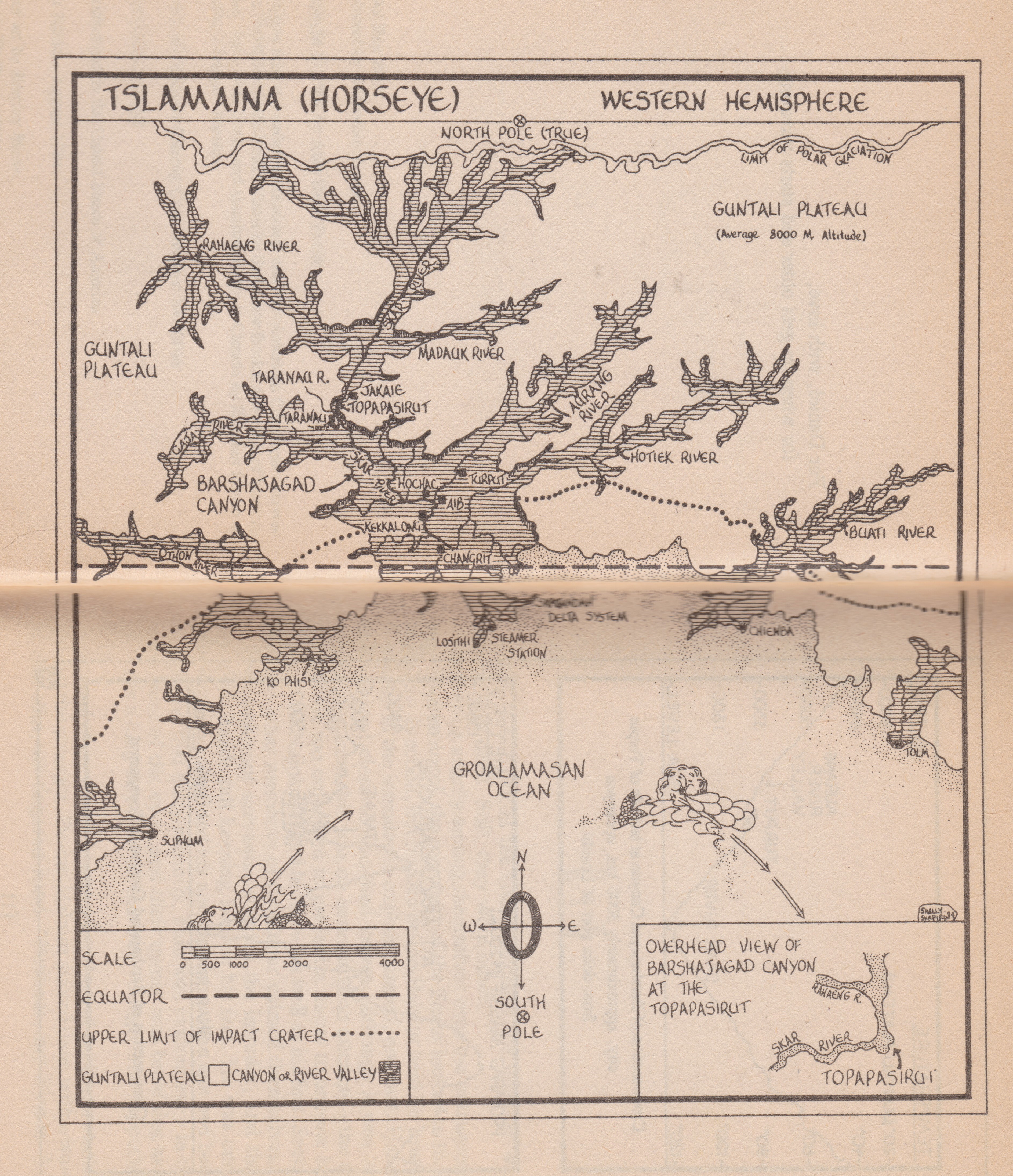
A tantalizing title—Voyage to the City of the Dead (1984)–made all the more mysterious by two wonderful maps by Shelly Shapiro. The first charts a lengthy winding river stretching from the north pole past the equator. The second, a cross section illustrating the elevation of the river’s vast canyon….

I’m almost compelled to pick up the book! Although I’ve had little luck with Alan Dean Foster’s SF in the past. Thoughts?

The Maps (click to enlarge):


Continue reading

Adventures in Science Fiction Cover Art: Yves Tanguy and Penguin SF Cover Art


(Yves Tanguy’s cover for the 1963 edition of Mission of Gravity (1954), Hal Clement)

On the birthday of French-American surrealist Yves Tanguy (1900-1955) (January 5th), I always take a minute to browse his art online. I faintly recalled seeing his art on various 1960s Penguin edition covers…. And lo and behold, J. G. Ballard’s  New Wave masterpiece The Drowned World (1962) and Hal Clement’s pioneering work of hard SF, Mission of Gravity (1954) were both graced with Tanguy’s canvases. Penguin regularly used the work of famous mainstream artists–for example, Max Ernst (I identified ten covers). China Miéville’s novella “The Last Days of New Paris” (2018) also uses a Tanguy/Lamba/Breton exquisite corpse collage (I’m focusing primarily on earlier covers in this post).   Continue reading

Adventures in Science Fiction Interior Art: The Power of a Good Introduction (Judith Merril’s 1968 New Wave Anthology England Swings SF)


(Ron Walotsky’s cover for the 1970 Ace edition)

I must confess, I generally skip the introductions to anthologies—even if they are written by my favorite authors who happen to be notable anthologists (Judith Merril, Robert Silverberg, Barry N. Malzberg, etc.). While paging through various collections hunting for stories, I encountered Judith  Merril’s micro-introduction to her famous New Wave anthology England Swings SF (1968). Here’s a list of the contents.

Although it is spread across three pages, it is only a few lines of text–a poetic beckoning, itself a condensed version of what the New Wave embodied. Merril’s intro as poem demonstrates literary invention, the blend of old (“scout ship”) and new (“heading out of sight into the multiplex mystery of inner/outer space”) images, and references to both high (“surrealism) and pop culture (“Beatles”). Continue reading

Adventures in Science Fiction Cover Art: The Dark Depths and Haunting Layers of Michel Jakubowski


(Fiction 114, May 1963)

Whenever it is Philippe Curval’s birthday I am pulled back into the fascinating world of French SF cover art–in particular the magazine Fiction, which, during its early years, had an utterly different aesthetic than anything found on American magazines. As I desperately want to read his novels (the vast majority remain untranslated), I can only enjoy the magazine covers he created in the 50s (Part I and Part I of my series on his photocollages).

This is all to say, I have chosen another lesser known artist for Fiction to showcase, Michel Jakubowski. This post which continues a loose series I’ve cobbled together on Adventures in French Science Fiction Cover Art (list below). I cannot find any information on him online. Perhaps he’s related to the more famous French SF author and editor Maxim Continue reading

Adventures in Science Fiction Interior Art: Monday Maps and Diagrams (Science Fiction) 12/24/18 — C. J. Cherryh’s Forty Thousand in Gehenna (1983)

Monday Maps and Diagrams 12/24/18

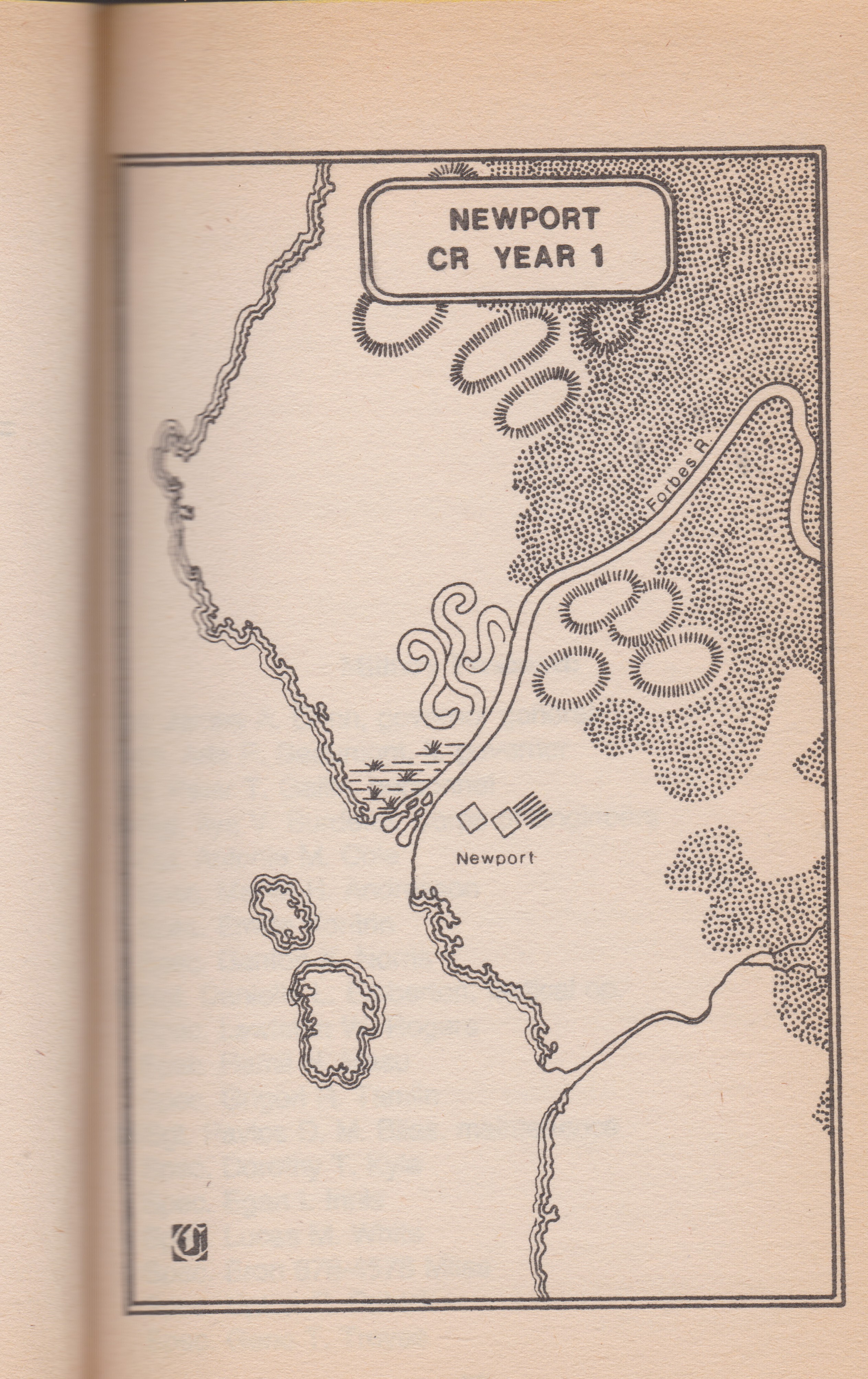
Sometimes a map tells a story…. Sometimes a series of maps reveal the evolution of a story. C. J. Cherryh’s sequence of six maps of the same location in Forty Thousand in Gehenna (1983) tracks the evolving relationship between settlers, azi clones, and native caliban lizard creatures.

A careful eye might be able to discern the general trajectory of the novel’s plot — if you haven’t read it yet, than perhaps (if you can tear your eyes off of MAPS) proceed no further….

Enjoy!

The Maps:

Continue reading