Book Review: Dark Dominion, David Duncan (1954)

Screen shot 2012-12-22 at 9.06.53 PM(Richard Powers’ cover for the 1954 edition)

2.5/5 (Bad)

David Duncan, most famous for writing the screenplay to George Pal’s film The Time Machine (1960), produced a handful of genre and non-genre novels in the 1950s.  Bluntly put, the Dark Dominion (1954) was one of the more disappointing novels I’ve read this year.  It is worthwhile for one thing alone, Richard Powers’ gorgeous cover.  Duncan’s novel is characterized by an incredibly painful strain of melodrama even for the 50s, downright preposterous science Continue reading

Updates: Recent Science Fiction Acquisitions No. XLVIII (Asimov + Brunner + Aldiss)

It’s been a while since I returned to one of the more well-known authors of the 50s — Isaac Asimov.  I’ve read many of his novels and short story collections (Foundation Trilogy, The Caves of Steel, The Naked Sun, The Robots of Dawn, Robots and Empire, The Currents of Space, The Gods Themselves, Nemesis, etc) and have never been too impressed.  However, with a run of recent bad 50s sci-fi works under my belt (review for David Duncan’s egregious Dark Dominion is upcoming) I feel the need to reappraise a few of the 50s greats. So, when I was perusing some gorgeous old paperbacks with well-preserved covers I purchased two Asimov novels for the first time since I was a young teenager.

And another Brunner to add to the 20+ works of his I already own….  Unfortunately the one edition I find was the one edition where the editor edited + modified Brunner’s words without his permission.

And some Aldiss short stories from the 50s….

A gorgeous collection of covers!

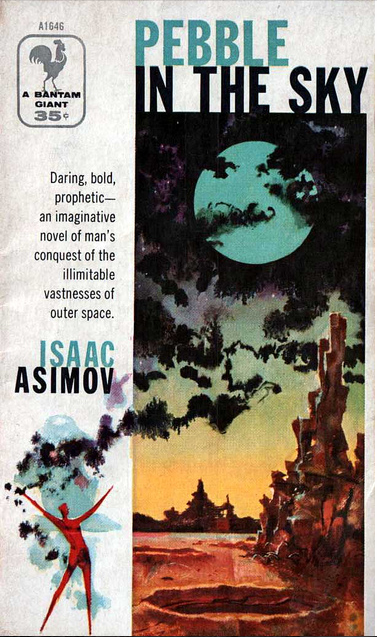
1. Pebble in the Sky, Isaac Asimov (1950) (MY REVIEW)

Screen shot 2012-12-24 at 9.50.07 AM

(Uncredited cover for the 1957 Continue reading

Book Review: Lords of the Starship, Mark S. Geston (1967)

(John Shoenherr’s cover for the 1967 edition)

3.75/5 (Good)

Mark S. Geston’s first novel Lords of the Starship (1967), written at the age of 21 while he was an undergraduate history student, revolves around a fascinating premise: The construction of a massive (fake) spaceship intended to lift a society out of a crippling malaise.  The narrative covers hundreds of years and seemingly innumerable characters.  The lack of distinct characters is the most frustrating aspect of the work.  However, the extremely dark tone and satirical underpinnings lift the novel above the endless morass of earlier pulp sci-fi.

For fans of 50s/60s space opera and more traditionalist 60s Continue reading

Updates: Recent Science Fiction Acquisitions No. XLVII (Merril + Sheckley + Stableford + Anderson)

Three short story collections and one novel from my Texan hunting grounds.  I enjoyed Merril’s short story collection Daughters of Earth (1968) so I quickly snatched up another…  I’ve been disappointed with Brian M. Stableford before but multiple fellow readers have claimed that The Halcyon Drift (1972) is worth reading.  We shall see…  And one can never have too many Sheckley and Anderson short stories…

1. Out of Bounds, Judith Merril (1960)

(John Schoenherr’s cover for the 1963 edition) Continue reading

Book Review: Needle in a Timestack, Robert Silverberg (1966)

(Richard Powers’ cover for the 1966 edition)

*Review for the 1966 edition.  The 1979 and 1985 editions were revised.*

collated rating: 3/5 (Average)

Needle in a Timestack (1966) is an uneven collection of ten short stories from the late 50s and early 60s by Robert Silverberg.  By the late 60s and early 70s Silverberg was producing his masterpieces.  However, earlier in his career he wrote mostly pulp novels and short stories.  A few in this collection tackle, in varying degrees of success, social science fiction themes: the media, war propaganda, colonialism, unusual criminal punishment, the suburban lifestyle etc.  Many of these Continue reading

Adventures in Science Fiction Cover Art: Pyramids (spaceships + future earthscapes + alien temples)

THPRMDSFRM1971

(Jack Faragasso’s cover for the 1971 edition of The Pyramids from Space (1970), Jack Bertin and Peter B. Germano)

This post is in a series on the interaction between television/film and science fiction cover art (The Statue of Liberty on Pre-1968 Magazine and Novel Covers and Cosmic Fetuses + Other Uterine Spaces).  In the former, the scene at the end of Planet of the Apes (1968) drew directly on pre-existing pulp science fiction art tropes.  In the later, Kubrick’s baby in a balloon scene in 2001: A Space Odyssey (1968) inspired many artists to reproduce the image of the cosmic fetus.  There isn’t a direct line of influence in this post between these covers and Stargate (1994) and its sequels.  I simply seek to illustrate that there has always been an obsession, verging into the sci-fi genre, with re-interpreting Continue reading

Book Review: What Entropy Means to Me, George Alec Effinger (1972)

(Stanislaw Hernandez’s cover for the 1973 edition)

5/5 (Masterpiece) (*caveats below*)

Nominated for the 1973 Nebula Award (lost to Asimov’s disappointing The Gods Themselves)

“She was Our Mother, so she cried.  She used to sit out there, under that micha tree, all day as we worked cursing in her fields.  She sat there during the freezing nights, and we pretended that we could see her through the windows in the house, by the light of the moons and the hard, fast stars.  She sat there before most of us were born; she sat there until she died.  And all the time she shed her tears.  She was Our Mother, so she cried” (11)

What Entropy Means to Me (1972) is one of the more satisfying products of the New Wave science fiction movement of the 60s and 70s that I’ve read.  I place it in the pantheon of Malzberg’s Revelations (1972), Samuel Delany’s Nova (1968), and Brunner’s Stand on Zanzibar (1968).  Effinger revels, and I mean gloriously revels, in metafictional Continue reading

Updates: Recent Science Fiction Acquisitions N. XLVI (Reed + Pratt + Brown + anthology)

Finally getting near the end of the pile of science fiction novels procured during my latest journey to Texas (a few were in clearance dollar bins) + gifts from 2theD.  I know very little about any of the authors (any info would be read with relish) — and I even bought a book from the early 1980s!  I know, shocker, but it has to do with drowned cities…. one of my favorite themes…. although it’ll never equal the uterine joys of Ballard’s magisterial The Drowned World (1962).

1. Under the City of Angels, Jerry Earl Brown (1981)

(Lou Feck’s cover for the 1981 edition) Continue reading

Adventures in Science Fiction Cover Art: Cosmic Fetuses + Other Uterine Spaces (+ levitating baby parts)

Screen shot 2012-10-24 at 9.22.09 AM

(Paul Lehr’s cover for the 1970 edition of The Eyes of Heisenberg (1966), Frank Herbert)

Stanley Kubrick’s iconic baby in a balloon image at the end of his film 2001: A Space Odyssey (1968) spawned a handful of intriguing cosmic fetus science fiction covers.  Even the famous artist Paul Lehr crafted perhaps the most artistically interesting version for Frank Herbert’s novel, The Eyes of Heisenberg.  Other artists, for example the uncredited creator of The Adam Experiment‘s cover, render incredibly hokey + spooky rip-offs.  Because I’ve found only a few on this particular theme I’ve included a variety of other baby related covers — hovering baby heads in space, mini-holograms of babies, adult men Continue reading