Adventures in Science Fiction Cover Art: The 1950s Surrealist Cityscapes of Richard Powers

Richard Powers (1921-1996) is one of my favorite science fiction cover artists.  Heavily influenced by the likes of Yves Tanguey and Picasso, his delightful vein of surrealism graced the covers of multiple classics of the genre (for example, Simak’s City, Clarke’s Earthlight and The City and the Stars, Norton’s Sky Gate, Vonnegut’s The Sirens of Titan, Sturgeon’s More Than Human).  His covers are unmistakable and extremely easy to identify.  I’ve decided to showcase a few of his surrealist cityscapes.
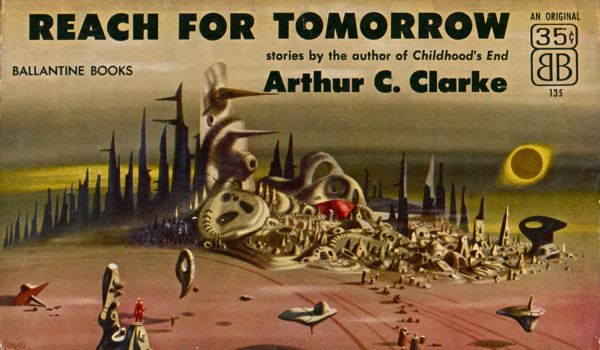
(cover for 1956 edition of Reach for Tomorrow (1956), Arthur C. Clarke)

The cover for Reach for Tomorrow achieves a wonderful Continue reading

Update: Recent Science Fiction Acquisitions N. VIII

My month of infrequent posts is over — I’ve returned to Austin after a month long sojourn across Colorado, New Mexico, France and Italy….  So, what do I do in my jet lagged state?  Head to the Half Price Books.  Not the best haul this time but a few potentially interesting reads.

1. Witch World (1963), Andre Norton

I’ve yet to read any of Andre Norton’s immense number of novels.  Not knowing exactly where to start I picked up what is generally considered among her best works — Witch World (1963).  It was nominated for the 1964 Hugo award for Best novel and often places in best Fantasy/Sci-fi lists.  And the cover is Continue reading

Book Review: Star Ways (variant title: The Peregrine), Poul Anderson (1956)

2.75/5 (Average)

Poul Anderson’s third novel contains a few glimmers of his later slick storytelling but lacks developed ideas and convincing characters.  This is not entirely Anderson’s fault, as he points out in the introduction to a later edition, because the original manuscript was heavily edited without his knowledge in order to achieve a specific page Continue reading

Book Review: To Live Again, Robert Silverberg (1969)

3/5 (Average)

To Live Again (1969) is a flawed work from a very fruitful period of Robert Silverberg’s career.  The ideas are original and well-conceived but a downright disgusting strain of misogyny and sexism permeates virtually every page.  Bluntly put, I cannot recall a single instance where a female character does anything without the shape, size, and clothed or unclothed state of her breasts Continue reading

Book Review: The Last Starship From Earth, John Boyd (1968)

2.5/5 (Bad)

John Boyd’s The Last Starship from Earth (1968) is a forgettable and predictable alternative history/science fiction novel incorrectly described by some reviewers as a lost classic.  The basic divergent point in history (which is only mentioned near the end) is the only redeeming feature of the work because the society he’s created becomes slightly more cohesive and realized.  However, Boyd’s reliance on time-travel Continue reading

Updates: Recent Science Fiction Acquisitions N. VII

Austin’s Half Price Books will be my downfall.  I’ve broken my promise not to buy any more science fiction books this summer…

1. The Big Jump (1955), Leigh Brackett (MY REVIEW)

I’ve yet to read a work by the famous female sci-fi writer and screenwriter (The Big Sleep, The Empire Strikes Back, Rio Bravo, El Dorado) Leigh Brackett.  I look forward to this “pulp” work with great Continue reading

Adventures in Science Fiction Cover Art: Gino D’Achille and small greenish men stealing large reddish women

While browsing through the spectacular collection of DAW sci-fi/fantasy covers between the 60s-80s on the Internet Speculative Fiction Database  I came across Ian Wallace’s The Lucifer Comet (1980).  I know nothing about the work itself (or the author) but something about the shoddy cover immediately rung a bell.  I had seen a similar small greenish man (but without wings) hoisting an unprotesting much heavier scantily clad reddish Continue reading

Book Review: A Billion Days of Earth, Doris Piserchia (1976)

4.25/5 (Very Good)

Doris Piserchia’s A Billion Days of Earth (1976) is a whimsical, disturbing, and stunningly inventive science fiction novel.  This is the second and by far the best of her novels I’ve read (A Billion Days of Earth surpasses Doomtime (1981) in virtually every regard).  Not only are the characters better drawn but the plot isn’t as easily derailed by repetitious actions.  That said, she isn’t always the best at plotting but her imaginative worldscapes and bizarre creatures more than compensate.   Continue reading