What pre-1985 science fiction are you reading this weekend?
Every Saturday for more than a year, I’ve asked this question on Twitter (and since February on Mastodon) with a photo of books I’ve read and reviewed on my website from my shelves. Due to the painful implosion of Twitter and the confused and frustrating “what platform do we go to next” panic, I’ve decided to move my weekly question and photo to my site. This community is always first and foremost in my mind. Thank you commenters and lurkers!
The career of Kris Neville (1925-1980) can be divided broadly into two parts. In his most productive period (1949-1957), Neville’s SF appeared in all the major magazines of the day, The Magazine of Fantasy and Science Fiction in particular. Afterwards, while he continued to publish short stories at a far reduced clip until his death, he wrote a handful of fix-up novels between 1964-1970. This trajectory neatly maps onto the restriction of magazine markets in the late 50s and the growing importance of the SF novel.
I’ve returned from my expedition abroad. It’s time to get back to writing about science fiction! But first, there are always new books that have accumulated at my doorstep…
Which books/covers/authors intrigue you? Which have you read? Disliked? Enjoyed?
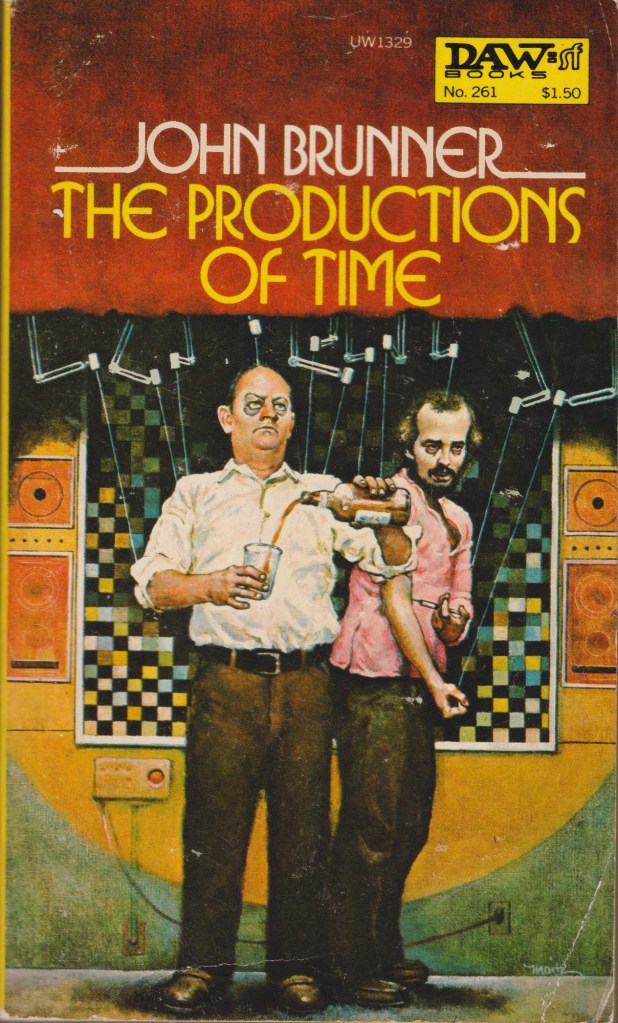
1. The Productions of Time, John Brunner (serialized 1966)
Don Maitz’s cover for the 1977 edition
From the back cover: “Murray Douglas had been a theatrical star until he’d hit the bottle once too often. But now he had broken the habit, and, handsome and fit, was ready for a comeback. The most challenging opening available was an avant-garde play where the actors themselves would make up the drama as they went along.
But out at an isolated country estate where the rehearsals were going on, Murray found himself trapped on a real-life day-and-night stage in which nothing was as it seemed, in which inexplicable devices monitored everything and eerie lures attracted each actor’s psychological weakness.
Who then was the real sponsor of this terrifying play–and to what alien audience was it to be presented?
By the Hugo-winning author of STAND ON ZANZIBAR, this is the first unabridged American edition of this John Brunner classic.”
Today I’ve paired two post-apocalyptic tales that attempt–with varying degrees of success–to chart the awesome transformation that nuclear war might bring. Ray Bradbury’s “The Highway” (1950) situates the realization that the end is neigh in an unusual location–the rural Mexican countryside. Leslie A. Croutch’s “The Day the Bomb Fell” (1950) charts the obliteration of the timeless rituals of life through the eyes of a young boy (and his cat).
John Richards’ cover for the 1955 edition of Ray Bradbury’s The Illustrated Man (1951)
3.75/5 (Good)
Ray Bradbury’s “The Highway” first appeared in Copy Magazine (Spring 1950) [as by Leonard Spalding]. It appeared as a section of The Illustrated Man (1951). You can read it online here.
Bradbury was one of my earliest exposures to science fiction. My dad selected cassette audiobooks of The Martian Chronicles (1951) and The Illustrated Man (1951) for family car trips. Other than a select few stories–“The Veldt” (1951) and “All Summer in a Day” (1954) come to mind, the specifics of those collections have faded from my memory. My various short story review series provide a wonderful opportunity to reorient myself with his fiction. See my earlier posts on “Almost the End of the World” (1957) and “The Pedestrian” (1951) for my media landscapes of the future series. And I have another lined up for my subversive accounts of space travel series.
Which books/covers/authors intrigue you? Which have you read? Disliked? Enjoyed?
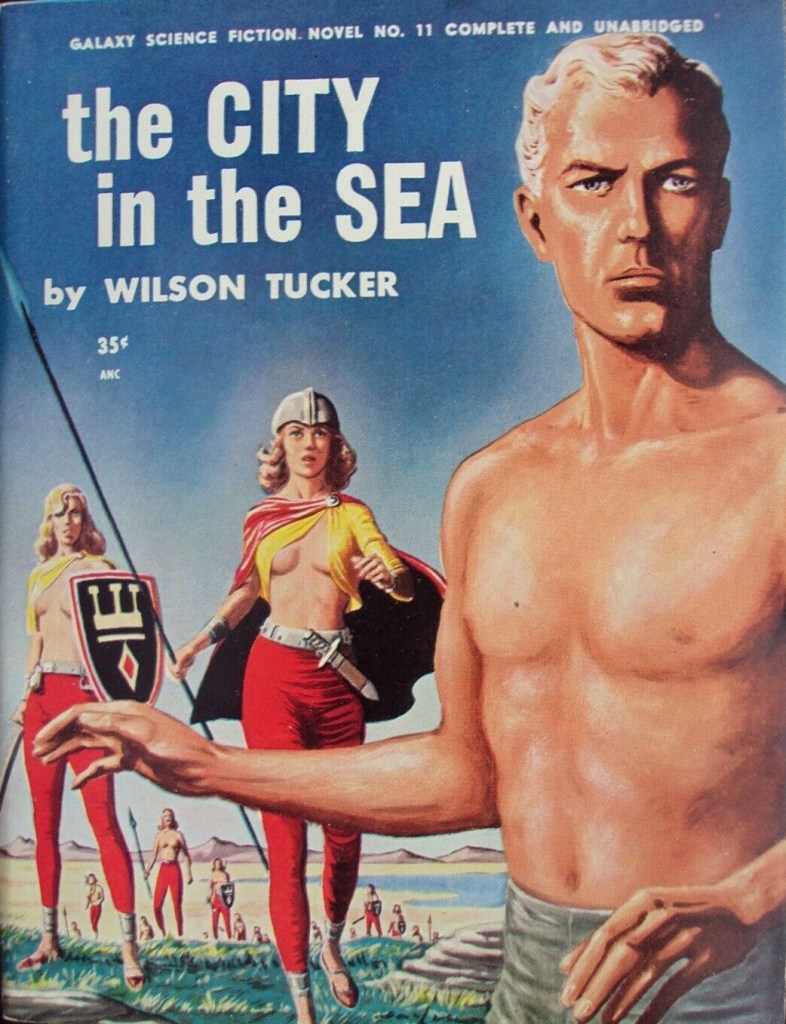
1. The City in the Sea, Wilson Tucker (1951)
Ed Emshwiller’s cover for the 1952 edition
From the inside flap: “Who knows whether the strange events of this story might not one day occur?
This is the story of an expedition—a strange and exciting expedition of one man and an army of women.
He had come into the land of the women suddenly—and without warning. Tall, bronzed, muscular, he stood out among their pale skins and meek spirits. And when they learned of the land from which he had come–the land they hadn’t even known existed—they had to follow him to it.
This is Part I of II in a series covering the short fiction of Russell Bates (1941-2018), one of a handful of Native American science fiction authors active in the 1970s [1]. I first came across his name while investigating all the authors featured in Craig Strete’s Native American fanzine Red Planet Earth (6 issues in 1974) [2]. I’ve managed to piece together the following information about his SF career.
Born in Lawton, Oklahoma (I’ve also seen Anadarko, OK implied as a birthplace), Bates was an enrolled member of the Kiowa tribe. After he finished high school, he entered the U.S. Air Force. While injured after an explosion at a missile assembly building, he was encouraged to take up a hobby. He began writing science fiction stories–including Star Trek fanfiction (discussed in more detail below) [4].
Interested in honing his craft, Bates attended the famous Clarion workshop in 1969, and his first story, “Legion” (1971), hit print two years later [4]. He published six science fiction short stories between 1971-1977. A seventh–“Search Cycle: Beginning and Ending 1. The Last Quest; 2. Fifth and Last Horseman”–was scheduled to appear in Harlan Ellison’s infamous Last Dangerous Visions, originally slated for 1973. It hasn’t been published elsewhere.
Bates decided to try his luck in Hollywood. He joined a Writer’s Guild program for minorities with the assistance of D. C. Fontana. Initially unsuccessful, his rejected Star Trek story attempt later appeared in The New Voyages 2(1978). He kept the American Indian crew member Walking Bear that later appeared in his only co-written Star Trek credit ST: The Animated Series’ “How Sharper Than a Serpent’s Tooth” (1974). It is for this episode that Bates is probably best known as it is the only episode of the two original Star Trek series that won an Emmy Award. Unfortunately, despite quite a few sales to the motion picture industry, few of his stories saw the screen after his early Star Trek credit [5].
Without further tangents, lets turn to his first three science fiction short stories–each a rumination on violence and trauma–to hit print.
Jim Steranko’s cover for Infinity Two, ed. Robert Hoskins (1971)
Today I’ve reviewed the twenty-sixth and twenty-seventh story in my series on the science fictional media landscape of the future. In Kate Wilhelm’s masterpiece of blue-collar drama “Ladies and Gentlemen, This Is Your Crisis” (1976), reality TV serves both as domestic irritant and therapy. Langdon Jones, in “The Empathy Machine” (1965), also speculates on the therapeutic aspects of “viewing” the crisis of another in a media-drenched future.
As always, if you know of other stories connected to this series that I haven’t reviewed, then let me know in the comments!
David Plourde’s cover art detail for the 1978 edition of Best Science Fiction Stories of the Year: Sixth Annual Collection, ed. Gardner Dozois (1977)
5/5 (Masterpiece)
Kate Wilhelm’s “Ladies and Gentlemen, This Is Your Crisis” first appeared in Orbit 18, ed. Damon Knight (1976). You can read it online here if you have an Internet Archive account. I read it in her collection Somerset Dreams and Other Fictions (1979).
Lottie comes home from the factory Friday afternoon with “frozen dinners, bread, sandwich meats, beer” to prepare for the weekend watching reality TV with her husband Butcher (121). As predicted, Butcher comes home mad, “mad at his boss because the warehouse didn’t close down early, mad at traffic, mad at everything” (123). He pulls up his recliner–they’ll sleep in front of the softly flickering screens–Lottie microwaves the dinners and brings her husband beer. The ritual commences.
Which books/covers/authors intrigue you? Which have you read? Disliked? Enjoyed?
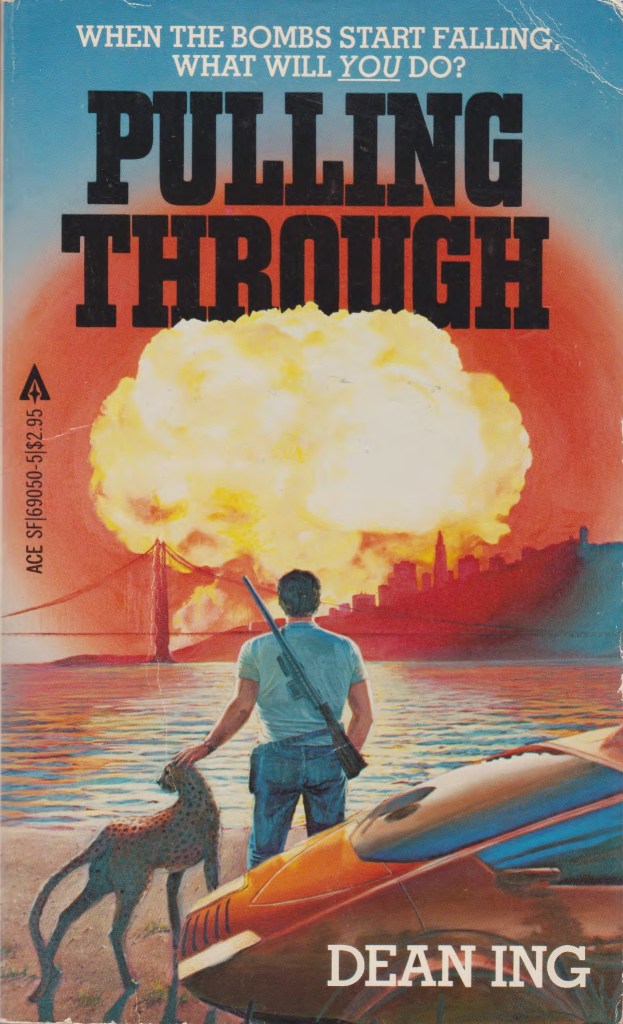
1. Pulling Through, Dean Ing (1983)
Uncredited cover for the 1st edition
From the back cover: “DOOMSDAY. ARE YOU READY?
HARE RACKHAM, bounty hunter, race-car driver. His best friend is a hunting cheetah. Harve has turned his California home into a survival shelter. He intends to pull through.
SHAR MCKAY, Harve’s little sister. Shar’s latest fad is nuclear survival. She intends for her husband and kids to all pull through.
ERNEST MCKAY, engineer. He has the knowledge and skills to save his family. With his help they’ll all pull through.
KATE GALLOW, runaway, forger, a tough street survival. She’s trouble–but when real troubles come down, Kate will always pull through.
Dean Ing has thought a lot about survival, and he wants as many of you as possible to pull through inevitable disaster of nuclear war. That’s why he’s written this more-than-a-novel. Dean Ing lays all the cards on the table in this one. The story tells why. The articles and blue-prints tell how. PULLING THROUGH won’t save your hide all by itself, but it sure will give you a head start on pulling through by yourself.”
Note: My read but “waiting to be reviewed pile” is growing. Short rumination/tangents are a way to get through the stack before my memory and will fades. My website partially serves as a record of what I have read and a memory apparatus for any larger project I might conduct in the future. I rather have a short review than none at all! Stay tuned for more detailed and analytical reviews.
1. The Princes of the Air, John M. Ford (1982)
Uncredited–looks like Jim Burns to me–cover for the 1991 edition
3.5/5 (Good)
John M. Ford (1957-2006) is one of those authors I’ve read a lot about but never sat down and read. As if often my strategy, I decided to explore around the edges a bit before reading his best-known novels Web of Angels (1980) and The Dragon Waiting (1983). I settled on his second novel The Princes of the Air (1982)….
The first layer of The Princes of the Air reads as a traditional space opera. Three young men from rough poverty-filled pasts–Orden Obeck, David Kondor/Koleman, and Theodor Thorn/Norne–aspire to serve the Queen of Humankind. On the dusty planet Riyah Zain, the three friends scam the unwary and while away their days in the Asterion Arcade playing military games in which they imagine how they will serve the queen—Obeck will be the Ambassador-Global, Kondor the Admiral of the Fleet, and Theodor Norn the best Pilot and writer of the book on piloting. Obeck, indentured to the state as he voluntarily went on the government dole, trains to be a diplomat. He brushes up against the classist views of the students, who look down on Obeck’s achievements as an indentured man. Soon his accomplishments mean that he, and his friends, can leave the planet. Eventually, they find themselves embroiled in the machinations of the state and the powers that bind everything together.





 Science Fiction and Other Suspect Ruminations