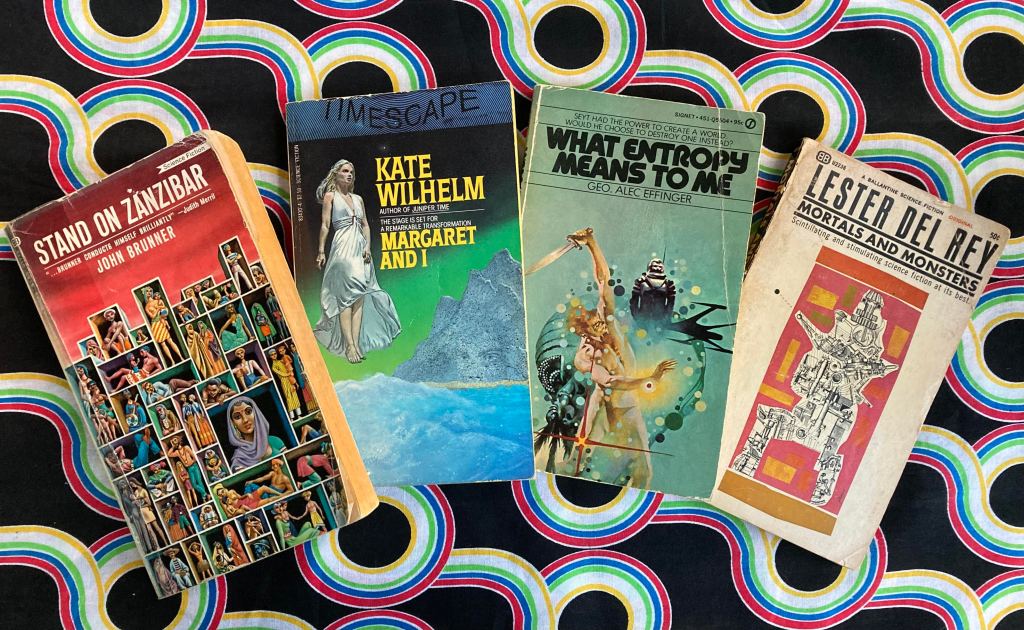
What pre-1985 science fiction are you reading this weekend?
After the success of the previous installment, I’ve decided to make this a bimonthly post (“column”) for my site (“fanzine”). As before, I’ve included a bit about the books in the photograph, birthdays from the last two weeks, and brief ruminations on what I’ve been reading and writing.
Which books/covers/authors intrigue you? Which have you read? Disliked? Enjoyed?
1. The Saliva Tree and Other Strange Growths, Brian W. Aldiss (1966)
Les Edwards’ cover for the 1979 edition
Contents: “The Saliva Tree” (1965), “Danger: Religion!” (1962), “The Source” (1965), “The Lonely Habit” (1962), “One Role with Relish” (1966), “Legends of Smith’s Burst” (1959), “Day of the Doomed King” (1965), “Paternal Care” (1966), “Girl and Robot with Flowers” (1965)
The following reviews are the 25th and 26th installments of my series searching for SF short stories that are critical in some capacity of space agencies, astronauts, and the culture which produced them. Some stories I’ll review in this series might not fit. Many are far from the best. And that is okay. I relish the act of literary archaeology.
I’ve paired two stories, one by Philip K. Dick (1928-1982) and another by prolific but forgotten Henry Slesar (1927-2007), that puncture the grandiose illusion of humanity’s progress.
Thank you Richard Fahey, “Friend of the Site,” for the PKD recommendation.
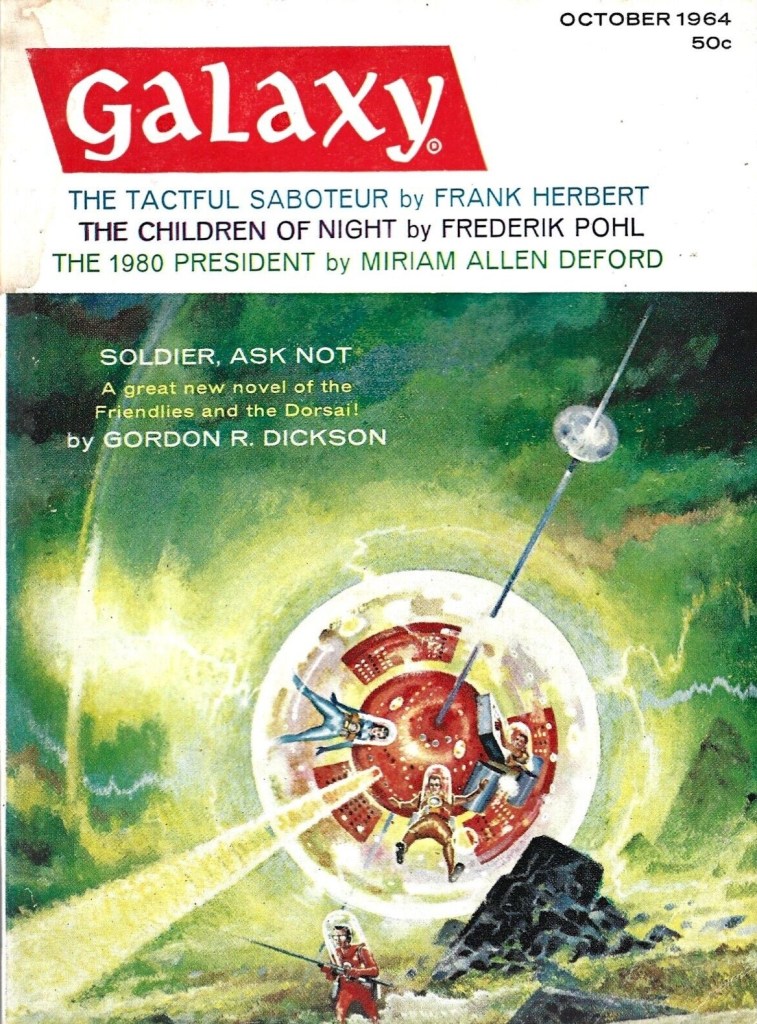
George Schelling’s cover for Galaxy, ed. Frederik Pohl (October 1964)
4/5 (Good)
Philip K. Dick’s “Precious Artifact” first appeared in Galaxy, ed. Frederik Pohl (October 1964). You can read it online here.
A vast array of scholarship charts the continuing allure Mars holds in the popular imagination [1]. David Seed writes that “since the late nineteenth century Mars has tantalized the literary imagination with the possibility that life might exist on that planet” [2]. The visions of Edgar Rice Burroughs, Leigh Brackett, Ray Bradbury, and countless others created a seductive and sometimes complex vista of longing and conquest. Brackett, for example, evocated a Mars that was “more complex and varied” than Burrough’s “imperial triumphalism” [3]. In Brackett’s “The Beast-Jewel of Mars” (1948) (scheduled for this series), Mars becomes the location for the revenge perpetrated by the colonized [4].
Today I’ve reviewed the 28th story in my series on the science fictional media landscape of the future. In Henry Kuttner’s masterpiece “Year Day” (1953), a couple attempts to rekindle their relationship in the midst of a sonic deluge of advertising that threatens to blot out their thoughts.
Richard Powers’ cover for the 1st paperback edition
5/5 (Masterpiece)
Henry Kuttner’s “Year Day” first appeared in his collection Ahead of Time (1953). Some of the other stories in the collection were co-written with his wife C. L. Moore. You can read the story online here.
What pre-1985 science fiction are you reading this weekend?
Every Saturday for more than a year, I’ve asked this question on Twitter (and since February on Mastodon) with a photo of books I’ve read and reviewed on my website from my shelves. Due to the painful implosion of Twitter and the confused and frustrating “what platform do we go to next” panic, I’ve decided to move my weekly question and photo to my site. This community is always first and foremost in my mind. Thank you commenters and lurkers!
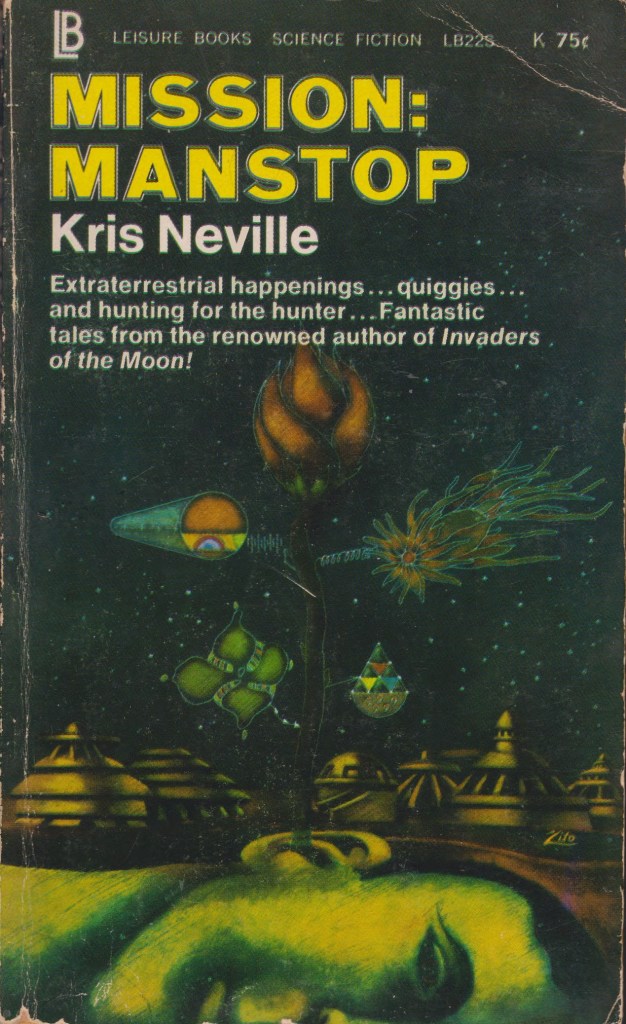
The career of Kris Neville (1925-1980) can be divided broadly into two parts. In his most productive period (1949-1957), Neville’s SF appeared in all the major magazines of the day, The Magazine of Fantasy and Science Fiction in particular. Afterwards, while he continued to publish short stories at a far reduced clip until his death, he wrote a handful of fix-up novels between 1964-1970. This trajectory neatly maps onto the restriction of magazine markets in the late 50s and the growing importance of the SF novel.
I’ve returned from my expedition abroad. It’s time to get back to writing about science fiction! But first, there are always new books that have accumulated at my doorstep…
Which books/covers/authors intrigue you? Which have you read? Disliked? Enjoyed?
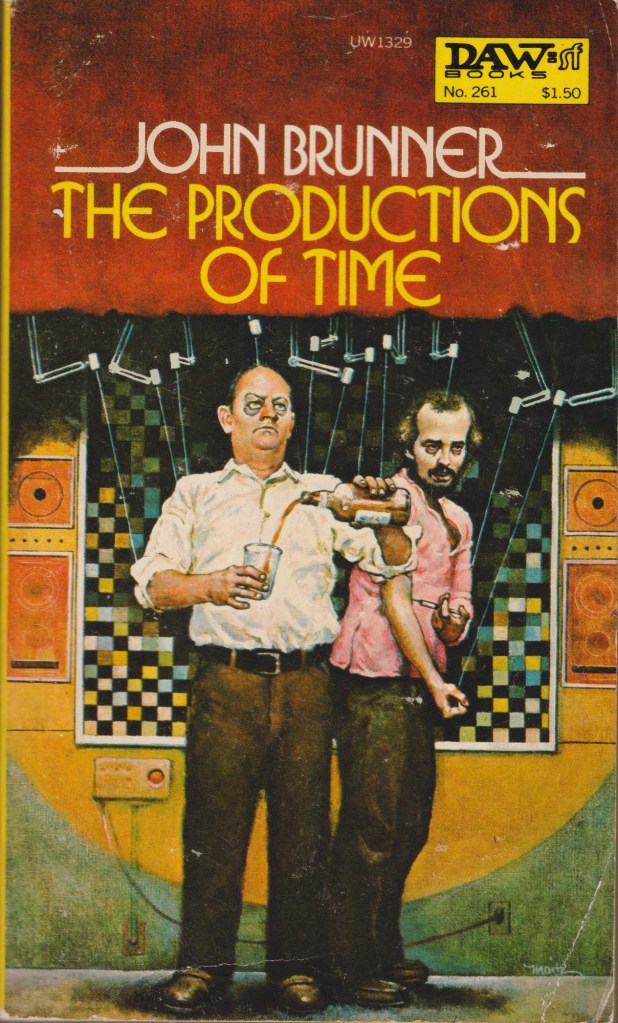
1. The Productions of Time, John Brunner (serialized 1966)
Don Maitz’s cover for the 1977 edition
From the back cover: “Murray Douglas had been a theatrical star until he’d hit the bottle once too often. But now he had broken the habit, and, handsome and fit, was ready for a comeback. The most challenging opening available was an avant-garde play where the actors themselves would make up the drama as they went along.
But out at an isolated country estate where the rehearsals were going on, Murray found himself trapped on a real-life day-and-night stage in which nothing was as it seemed, in which inexplicable devices monitored everything and eerie lures attracted each actor’s psychological weakness.
Who then was the real sponsor of this terrifying play–and to what alien audience was it to be presented?
By the Hugo-winning author of STAND ON ZANZIBAR, this is the first unabridged American edition of this John Brunner classic.”
Today I’ve paired two post-apocalyptic tales that attempt–with varying degrees of success–to chart the awesome transformation that nuclear war might bring. Ray Bradbury’s “The Highway” (1950) situates the realization that the end is neigh in an unusual location–the rural Mexican countryside. Leslie A. Croutch’s “The Day the Bomb Fell” (1950) charts the obliteration of the timeless rituals of life through the eyes of a young boy (and his cat).
John Richards’ cover for the 1955 edition of Ray Bradbury’s The Illustrated Man (1951)
3.75/5 (Good)
Ray Bradbury’s “The Highway” first appeared in Copy Magazine (Spring 1950) [as by Leonard Spalding]. It appeared as a section of The Illustrated Man (1951). You can read it online here.
Bradbury was one of my earliest exposures to science fiction. My dad selected cassette audiobooks of The Martian Chronicles (1951) and The Illustrated Man (1951) for family car trips. Other than a select few stories–“The Veldt” (1951) and “All Summer in a Day” (1954) come to mind, the specifics of those collections have faded from my memory. My various short story review series provide a wonderful opportunity to reorient myself with his fiction. See my earlier posts on “Almost the End of the World” (1957) and “The Pedestrian” (1951) for my media landscapes of the future series. And I have another lined up for my subversive accounts of space travel series.
Which books/covers/authors intrigue you? Which have you read? Disliked? Enjoyed?
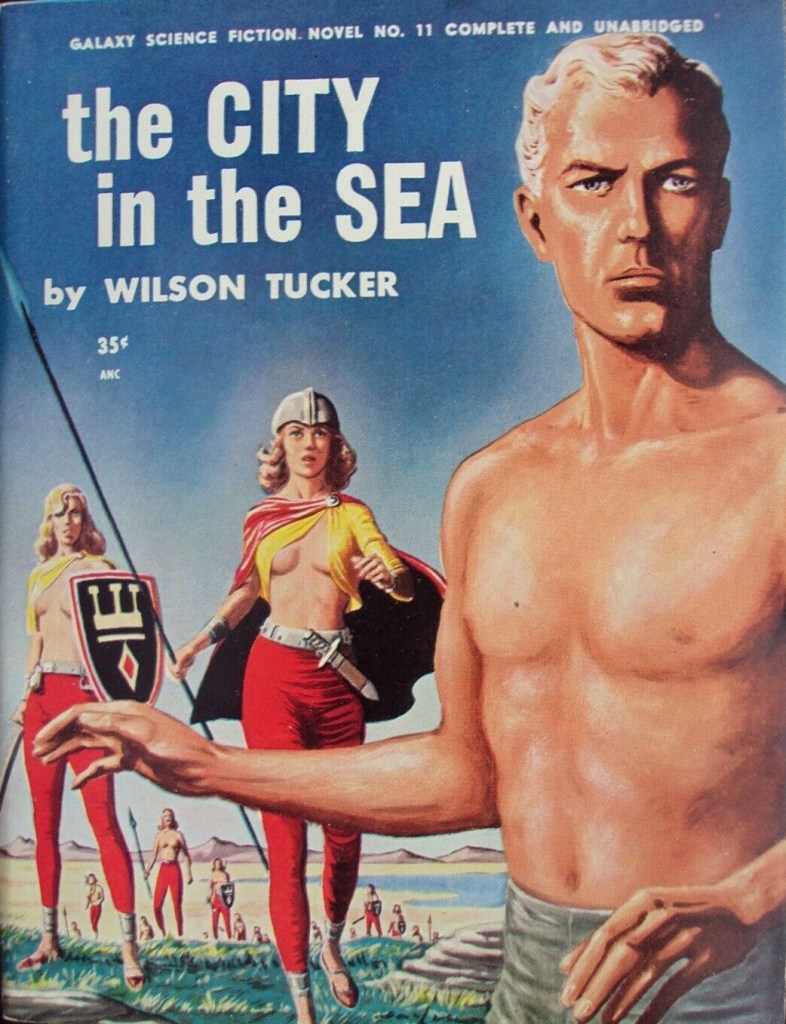
1. The City in the Sea, Wilson Tucker (1951)
Ed Emshwiller’s cover for the 1952 edition
From the inside flap: “Who knows whether the strange events of this story might not one day occur?
This is the story of an expedition—a strange and exciting expedition of one man and an army of women.
He had come into the land of the women suddenly—and without warning. Tall, bronzed, muscular, he stood out among their pale skins and meek spirits. And when they learned of the land from which he had come–the land they hadn’t even known existed—they had to follow him to it.