Updates: Recent Science Fiction Purchases No. CCC (James Blish, Norman Spinrad, R. M. Meluch, Kurt Vonnegut, Jr.)

My 300th purchase post!

Which books/covers/authors intrigue you? Which have you read? Disliked? Enjoyed?

Preliminary Note: As I’m currently on vacation, the images in this post are photographs of my volumes rather than my normal hi-res scans. I’ll replace them when I get home.

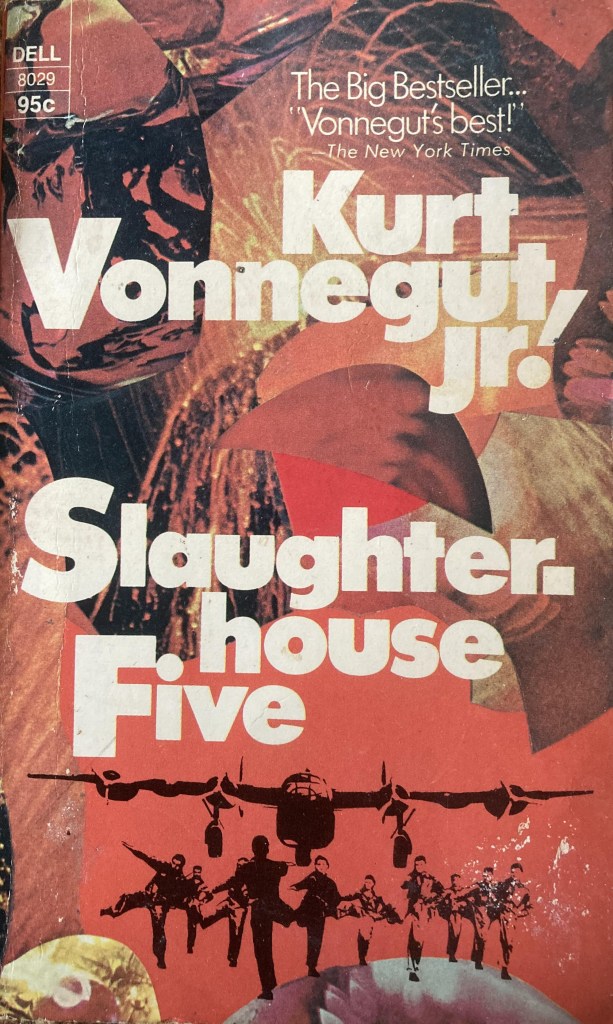
1. Slaughterhouse-Five or The Children’s Crusade: A Duty-Dance with Death, Kurt Vonnegut, Jr. (1969)

From the inside page: “TAKE A TRIP WITH BILLY PILGRIM

-To the cellar of a slaughterhouse in Dresden, a city about to be destroyed by the greatest man-made catastrophe of all time.

-To happy marriage and mating with the sweet and willing daughter of one of the finest citizens of Illium, New York.

-To a luxurious zoo on the planet Tralfamadore for the public exhibition of lovemaking with the famous Earthling blue-moviestar, Montana Wildhack.

All in an amazing novel that could only have been written by Kurt Vonnegut, Jr., a writer whose wildest flights take you straight to the hear and now.

Continue reading

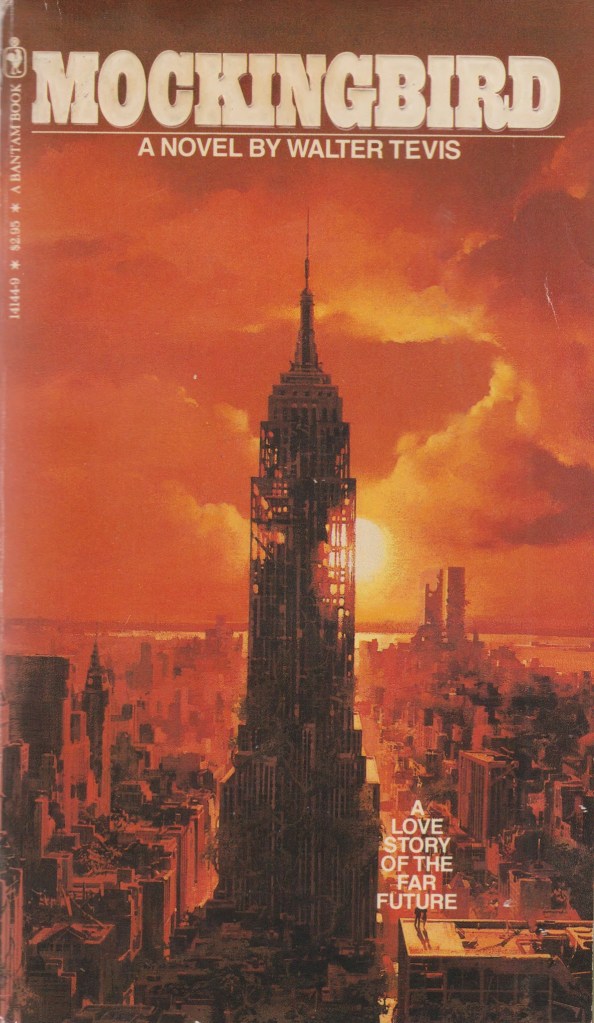
Book Review: Mockingbird, Walter Tevis (1980)

4.5/5 (Very Good)

William Tevis’ Mockingbird (1980) is a paean to the power of reading. Possessed by an encyclopedic adoration for silent films and books of all genres, Tevis creates a rich textual substate in which his characters pin together the true nature of their world. For more on the situation in Tevis’ life that prompted him to write Mockingbird–his experiences teaching and his own attempts to defeat alcoholism–and his relationship to science fiction, check out James Sallis’ review in The Magazine of Science Fiction and Fantasy.

The World

In a rapidly depopulating world, the last humans live a medicated life. Successful indoctrination programs of privacy and individuality with catch phrases like “Don’t ask-relax” (24) and “Alone is best” (26), have deprived the masses from the desire to learn or interact with each other. Paul and Mary Lou might be the “last generation of children, ever” (32). Tevis lays out the reasons for depopulation as follows: “1. Fears of overpopulation 2. The perfection of sterilization techniques 3. The disappearance of the family 4. The widespread concern with “inner” experiences 5. A loss of interest in children 6. A widespread desire to avoid responsibilities” (145).

Continue reading

Recent Science Fiction Purchases No. CCXCIX (Henry Kuttner, C. L. Moore, Jack Williamson, Jacob Transure, Star Anthology)

Which books/covers/authors intrigue you? Which have you read? Disliked? Enjoyed?

1. Ahead of Time, Henry Kuttner and C. L. Moore (1953)

From the inside page: “A brain in a box fights a criminal plot

A visitor from the future turns out to be peculiar even for his society

An eternal hillbilly family survives the centuries and gets into political trouble

A sick electronic calculator catches a psychosis from its operator

…these are some of the highly original and vividly written stories you will find in this selection of a master’s work.

Science fiction and fantasy grow constantly in popularity. Writing of this quality and imagination is the reason. Henry Kuttner demonstrates again in his book why more and more readers are becoming devotees of that intriguing fiction which is not content to stay in the world as we see it and know it, which takes us to the farthest reaches of space and time, to the farthest reaches of the human mind.”

Continue reading

Book Review: Moon-Flash, Patricia A. McKillip (1984)

3.5/5 (Good)

As Patricia A. McKillip (1948-2022) recently passed away (obituary), I decided to pick up one of her few science fiction novels. And I’m glad I did! Channeling (and reworking) the conceptual breakthrough-style premise of Clarke’s Against the Fall of Night (serialized 1948) and countless generation ship novels, Moon-Flash (1984) is an achingly beautiful coming-of-age story of a young woman who sets out to map the geography of her restrictive world.

Continue reading

Updates: Recent Science Fiction Purchases No. CCXCVIII (Harlan Ellison, Edward Bryant, Murray Constantine, Sayko Komatsu, and an automobile-themed anthology)

Which books/covers/authors intrigue you? Which have you read? Disliked? Enjoyed?

1. Car Sinister, ed. Robert Silverberg, Martin Harry Greenberg, and Joseph D. Olander (1979)

From the back cover: “MAN AND HIS MACHINE. The car is man’s most personalized machine; for teenagers it is a rite of passage and a statement of freedom; for adults it is a reflection of success, taste, and hopes; and for an entire culture it is a great and industrious mode of transportation–driving, perhaps, on the road of destruction. And the automobile–thrilling, honking, speeding, nerve-shattering–haunts us with the dark possibility that when our age of motoring innocence is over, we may no longer be the masters… CAR SINISTER–a splendid, imaginative vision of what lies down the road for all of us.”

Continue reading

Book Review: The Grain Kings, Keith Roberts (1976)

4/5 (collated rating: Good)

Keith Roberts (1935-2000) was an influential, if underread and underappreciated, English author (and cover artist) best known for his alternate history fix-up novel Pavane (1968) and powerful short fictions evocative of the English countryside. He won four BSFA awards in various categories (novel, short story, and artist) yet did not achieve the same critical success in the United States. According to his obituary, his difficult personality, like his common male main characters unable to form steady professional or personal relationships, and propensity to refuse to deal with major publishers impacted his popularity.

Continue reading

Book Review: After the Flood, P. C. Jersild (1982, trans. 1986)

4.75/5 (Near Masterpiece)

P. C. Jersild’s After the Flood (1982, trans. 1986), a relentlessly bleak and incisive analysis of humanity’s death drive after a nuclear event, hits harder than Cormac McCarthy’s The Road (2006). Possessed by a deceptively powerful prose, Jersild maps out the apocalyptic bodyscapes of this new and dying world with merciless strokes.

P.C. Jersild (1935-), a Swedish physician and author, wrote a handful of novels that can be classified as science fiction. According to SF Encyclopedia, he’s “a central figure in modern Swedish literature, both a favorite among critics and, with some of his novels, a major bestseller.” Until recently, as is typical for many mainstream authors, Jersild tried to distance himself from SF despite writing a range of works that are set in the future. Of these works, unfortunately only three have been translated into English–The Animal Doctor (1973, trans. 1975), A Living Soul (1980, trans. 1988), and After the Flood (1982, trans. 1986).

Continue reading

Updates: Recent Science Fiction Purchases No. CCXCVII (Poul Anderson, Kingsley Amis, Eleanor Arnason, Roger Elwood anthology of SF plays)

Which books/covers/authors intrigue you? Which have you read? Disliked? Enjoyed?

1. Strangers from Earth, Poul Anderson (1961)

From the back cover: “A SENTIENT ROBOT

THE COLONISTS WHO LEFT A PERFECT WORLD

A MADDENING HUNT FOR A MARTIAN

A MAN-MADE ANIMAL

A GALACTIC SWINDLER

These are some of the ingredients Poul Anderson chooses to mix and blend into this first-class collection of stories: and his ability is as wide as the range of his interests.”

Contents: “Earthman, Beware!” (1951), “Quixote and the Windmill” (1950), “Gypsy” (1950), “For the Duration” (1957), “Duel on Syrtis” (1951), “The Star Beast” (1950), “The Disintegrating Sky” (1953), “Among Thieves” (1957)

Continue reading

Future Media Short Story Review: Barry N. Malzberg’s “The Idea” (1971) (as K. M. O’Donnell)

Today I’ve reviewed the thirteenth story in my series on the science fictional media landscape of the future. Here, I finally return to the nightmarish embrace of Barry N. Malzberg.

Previously: Pat Cadigan’s “Rock On” (1984).

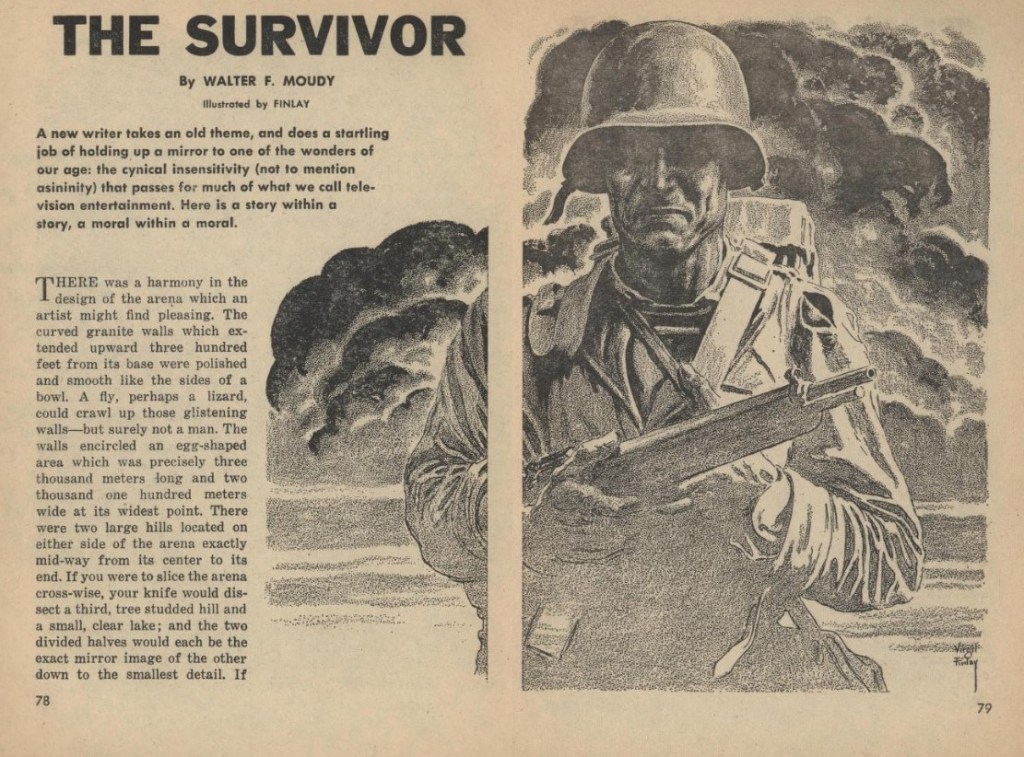
Up Next: Walter F. Moudy’s “The Survivor” (May 1965).

3.5/5 (Good)

Barry N. Malzberg’s “The Idea” first appeared in In the Pocket and Other S-F Stories (1971) (as K. M. O’Donnell). I cannot find the story online. Please contact me if you do not own a copy and want a PDF of the story. I recommend you procure the fantastic anthology TV: 2000, ed. Isaac Asimov, Martin H. Greenberg, Charles G. Waugh (1982) which “The Idea” also appears in. I’ll be returning to this volume in coming weeks for this series.

Reading a Barry N. Malzberg story is like returning to a familiar embrace–an embrace of the blackest satire conveyed via terrifying existential traps. Ever since I read his masterpiece Beyond Apollo (1972), a metafictional destruction of America’s obsession with space exploration, Malzberg joined the pantheon of my favorite authors.

Continue reading