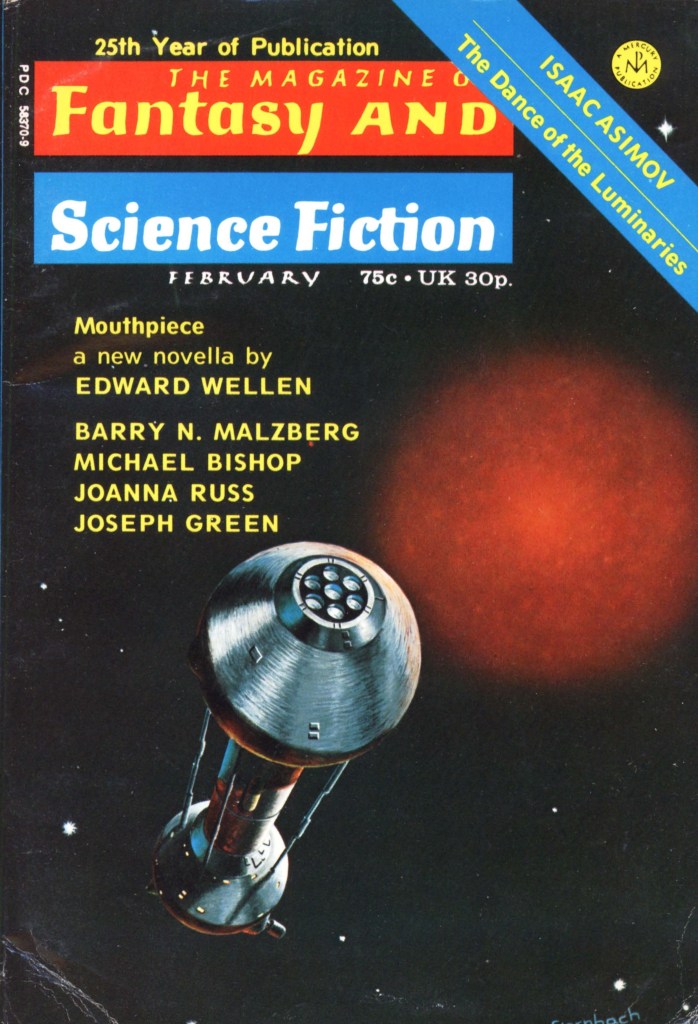
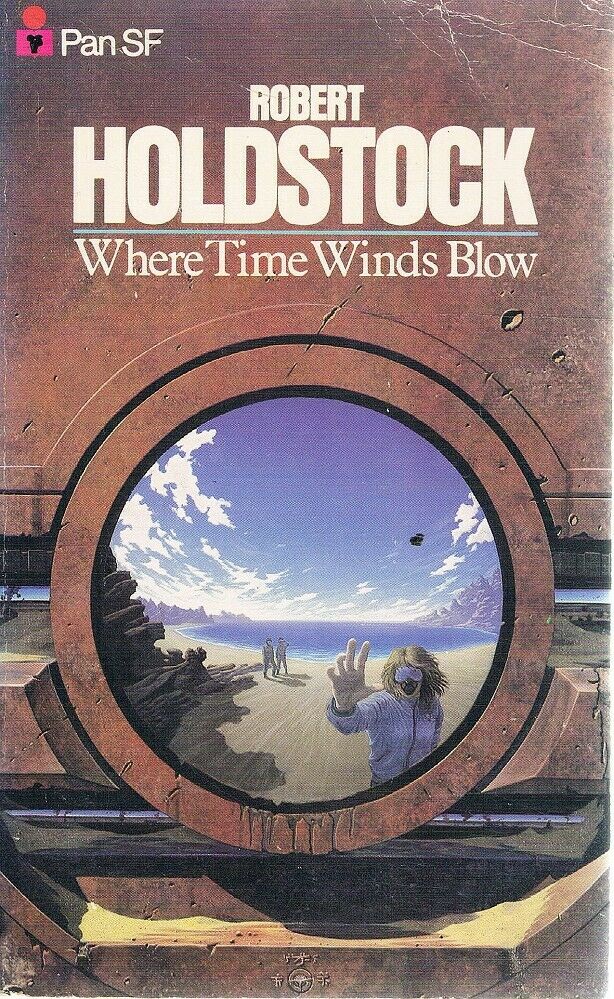
Roger Zelazny described To Die in Italbar (1973) as the one novel he would “kill off” if he could! Here’s a bit of context for his condemnatory statement. In early 1969, Zelazny quit his U.S. Social Security Administration job to become a full-time writer. Yes, he wrote Lord of Light (1967) and This Immortal (1966) among many others after work! He quickly wrote To Die in Italbar in May 1969 to complete a contract but the novel was rejected by the press. Years later Zelazny added new material and finally published the novel in 1973 (citation). Haste and filler characterize the final product. That said, if action-packed SF adventure with bizarre ideas is something you are looking for and you already enjoy Zelazny, pick this one up.
A. J. Bisley’s cover for the 1958 English translation
3.5/5 (collated rating: Good)
The French novelist Jean-Louis Curtis (1917-1995), best known for his Prix Goncourt-winning The Forests of the Night (1947), crafts a linked series of short stories in The Neon Halo (1956, trans. 1958) that chart the evolution of modern society between 1995-circa 2100. While the thematic influence of George Orwell’s 1984 (1949) and Aldous Huxley’s Brave New World (1932) permeates the pages (permanent warfare, reproductive technology, psychological and pharmaceutical conditioning, etc.), The Neon Halo contains genuine vibrancy and intriguing ruminations on persecution and martyrdom. Despite the frequent references to the French literary environment of Curtis’ day, The Neon Halo pulses with wit and levity despite the dour subject matter.
From the back cover: “THIS IS NO STORY OF SPACE SHIPS AND MARTIANS. THIS IS A STORY ABOUT OUR WORLD RIGHT NOW.
‘In 1942, three years before the general public had ever heard of nuclear fission. Lester del Rey wrote a brilliantly detailed novella of disaster in an atomics plant, which now appears, skillfully expanded to book length, as NERVES. A wholly admirable blend of prophetic thinking (in medicine as well as atomics), warm human values and powerful narrative suspense, this novel is strongly recommended…’ –N.Y. Herald Tribune.”
Which books/covers/authors intrigue you? Which have you read? Disliked? Enjoyed?
1. The Martian Chronicles, Ray Bradbury (1950)
Ian Miller’s cover for the 1979 edition
From the back cover: “A MAGNIFICANCTLY ILLUSTRATED EDITION OF THE MARTIAN CHRONICLES WHICH MASTERFULLY ENHANCES THE CLASSIC WONDER AND TERROR BY THE WORLD-RENOWNED AUTHOR OF THE ILLUSTRATED MAN RAY BRADBURY.
Note: My read but “waiting to be reviewed pile” is growing. Short rumination/tangents are a way to get through the stack before my memory and will fades. Stay tuned for more detailed and analytical reviews.
1. The Languages of Pao, Jack Vance (1958)
Ric Binkley’s cover for the 1958 1st edition
3.25/5 (Vaguely Good)
Since I started my site in 2011, I’ve soured a bit on Jack Vance’s brand of planetary adventure in richly realized and exotic worlds. I doubt I’d currently rate novels like Showboat World(1975) or The Blue World (1966) as highly as I did back then. One of more appealing elements of having a single project for so long is my ability to track my evolving views on genre. That said, I’d classify Wyst: Alastor 1716(1978) and The Languages of Pao (1958) amongst his most conceptually ambitious novels I’ve read so far and worth tracking down. For a full list consult my index. Note: I read but never reviewed Dying Earth (1950).
Enki Bilal’s art for the 1st edition of La Foire aux immortels (1980)
Collated Rating: 4/5 (Good)
Art: 5/5 (Masterpiece) + Story: 3/5 (Average)
Enki Bilal’s La Foire aux immortels (trans. The Carnival of Immortals) (1980) is the first volume in The Nikopol Trilogy. All three bande dessinée received a 2016 single-volume English translation by Titan Comics. Due to the limited chronological reach of my site, I’ve chosen to only review the 1st volume as the sequels, Le Femme Piège (trans. The Woman Trap) and Froid Equateur (trans. Equator Cold), were published in 2005.
Of the SF graphic novels I’ve read, The Carnival of Immortals proved by far the most successful. Bilal blends his terrifying depictions of decadence and decay with an oblique, if a bit clunky, story that hints at surrealism and otherworldliness. For what I’m comparing Bilal’s vision to, check out Howard V. Chaykin and Samuel R. Delany’s Empire (1978), Paul Gillon’s La survivante (1985), and Gene Day’s collection Future Day(1979).
Every morning for the last few years, I post on Twitter the birthdays (pre-1955) of artists, authors, and editors involved in some way with science fiction. In the last year, a singular compulsion has hit and I’ve started to include even more obscure figures like Gabriel Jan (1946-) and Daniel Drode (1932-1984). On May 31st, while perusing the indispensable list on The Internet Speculative Fiction Database, I came across an author unknown to me–Melisa Michaels (1946-2019) (bibliography). She’s best known for the five-volume Skyrider sequence (1985-1988) of space operas “depicting the growth into maturity of its eponymous female Starship-pilot protagonist” (SF Encyclopedia).
As I’m always willing to explore the work of authors new to me, I decided to review the first three of her six published SF short stories. Two of the three stories deal with my favorite SF topics–trauma and memory.
Karl Kofoed’s interior art illustrating Melisa Michaels’ “In the Country of Blind, No One Can See” in Isaac Asimov’s Science Fiction Magazine (January 1979)
“In the Country of the Blind, No One Can See” (1979), 3.5/5 (Good): First appeared in Isaac Asimov’s Marvels of Science Fiction (1979). It was reprinted in Isaac Asimov’s Science Fiction Magazine (January 1979). You can read it online here.
On a terraformed Mars, Allyson Hunter and her two clone sisters, Rebecca and Kim, are societal outcasts. They spent their lives trying to be “real people” yet were “reminded, every day in a dozen little ways, that they weren’t real people” (87). Clones retain their first usage as replacement body parts. Permitted to live only due to indications of telepathic potential (needed to guide spaceships), the sisters attempt to live meaningful lives and develop useful skills. The sisters charter two identical twins, Frank and Todd, to convey them across the Martian landscape. A horrific crash kills Kim and forces the survivors to work together and move past the deep resentment and hatred the brothers hold.
I’ve recently conducted a binge read of my ARC of Dangerous Visions and New Worlds: Radical Science Fiction, 1950-1985, ed. Andrew Nette and Iain McIntyre (2021). It is a must buy for any SF fan of the era interested in exploring the larger world behind the texts. Considering the focus of my website and most of my reading adventures over the last decade, I can unabashedly proclaim myself a fan of the New Wave SF movement–and this edited volume is the perfect compliment to my collection and interests.
The editors and PM Press have graciously provided me with the introduction to the volume. Perhaps it’ll convince you to purchase your own copy!
The “long sixties,” an era which began in the late 1950s and extended into the 1970s, has become shorthand for a period of trenchant social change, most explicitly demonstrated through a host of liberatory and resistance movements focused on class, racial, gender, sexual, and other inequalities. These were as much about cultural expression and social recognition as economic redistribution and formal politics. While the degree to which often youthful insurgents achieved their goals varied greatly, the global challenge they presented was a major shock to the status quo.
I recently finished David Dowling’s Fictions of Nuclear Disaster (1987) and thought I’d review a handful of the short stories discussed in the monograph. The first on my list is Theodore Sturgeon’s haunting “Memorial” which first appeared in the April 1946 issue of Astounding Science Fiction, ed. John W. Campbell, Jr. You can read it online here.
Ed Emshwiller’s cover for the 1st edition of Science Fiction Terror Tales, ed. Groff Conklin (1955)
“Memorial” (1946), Theodore Sturgeon, 4/5 (Good): Grenfell has a plan to create a war memorial to end all memorials—The Pit. It will writhe with lava. It will shine forth with a ghastly glow. Created by nuclear explosion a thousand times as powerful as the Hiroshima bomb (161). Like some grotesque manifestation of the Darvaza gas crater, it will be a “living reminder of the devastation mankind has prepared for itself” (161). And the message will be the most “useful thing in the history of the race—a never-ending sermon, a warning, an example of the dreadful” possibilities of nuclear war (161).