Which books/covers/authors intrigue you? Which have you read? Disliked? Enjoyed?
1. Subi: The Volcano, Burt Cole (1957)
Peter Rudland’s cover for the 1958 edition
From the inside flap: “This is a forceful war story with a different. There is the Far Eastern background, the convincing solders’ talk, the military politics, the sex, disablement, disease, death, violence, stoicism, sadism, and so on, which combine to stress once again war’s futility and stupidity and man’s inhumanity to man: but there are also deeper implications which make this novel so strikingly unusual.
Judson, a persistent deserter from an army camp, has made a rough shelter for his native girl in the nearby ramshackle, bombed city, when he hears of a guerrilla attack on the camp. He goes to the base of the volcano (where the mob has gathered) to persuade them that if they kill Americans they will only die of disease for want of medical treatment. For his pains he is set upon and torn to pieces.
MacGowan’s illustrations for Neil Shapiro’s “Starman of Faraway Station” in Vertex (July 1975)
Rodger B. MacGowan (1948-2025), best known for his wargame art and design, passed away yesterday.1 Most of the memorial posts I’ve seen on social media focus on his later career paths in the board-gaming world. Thus, I thought it would be worthwhile to narrow in on his contribution to science fiction art. After graduating UCLA, where he studied art, motion pictures, and graphic design, MacGowan found work at an advertising agency and an opportunity to create art for one of their accounts, the short-lived Vertex science fiction magazine.2
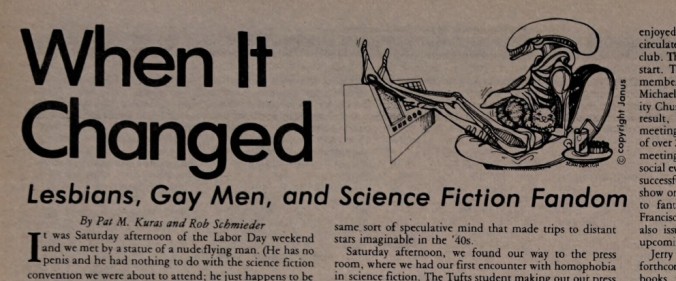
“We also encountered many gay people, feminists and progressives of every stripe. These people were at the convention because present day science fiction has much to offer them. Science fiction is the fiction of ideas, and the ideas coming from the minds of the new writers more and more concern progressive analyses of social issues.”
— Pat M. Kuras and Rob Schmieder (1980)
At the 38th World Science Fiction Convention (29th August–1st September, 1980) held in Boston, MA, organizers scheduled the first Worldcon panel with an openly LGBTQ topic: “The Closed Open Mind: Homophobia in Science Fiction Fantasy Stories” moderated by Jerry Jacks, one of the “early openly gay fans.”1 Around 200 fans attended to hear Elizabeth A. Lynn (SFF author), Samuel R. Delany (SFF author), Frank M. Robinson (SF author and activist), and Norman Spinrad (SFWA President and SF author) (“the token straight”) discuss issues of representation.
Pat M. Kuras and Rob Schmieder’s “When It Changed: Lesbians, Gay Men and Science Fiction Fandom” in the September 27th, 1980 issue of Gay Community News
Note: My read but “waiting to be reviewed pile” is growing. Short rumination/tangents/impressions are a way to get through the stack before my memory and will fades. My website partially serves as a record of what I have read and a memory apparatus for future projects. Stay tuned for more detailed and analytical reviews.
1. Margo Bennett’s The Long Way Back (1954)
Uncredited cover for the 1955 edition
3.25/5 (Above Average)
I’m always on the lookout for lesser-known SF works by female authors. And Margot Bennett’s The Long Way Back (1954) certainly fits the bill. Bennett (1912-1980), a Scottish-born screenwriter and author of primarily crime and thriller novels, lead a fascinating life before her writing career. During the Spanish Civil War, she volunteered for Spanish Medical Aid, and was shot in both legs. Afterwards, she continued to participate in various left-wing political causes such as the Campaign for Nuclear Disarmament.
The Long Way Back manifests, with satirical strokes, her critical stance on nuclear war and British colonialism. In a future collectivized Africa ruled by a calculating machine that grades the population, Grame, a “mechanical-repetitive worker” (7), dreams of a career in physics. Instead, the machine shuffles him off on an ill-fated expedition to the ruined remains of Britain post “Big Bang” (nuclear blast). On the way he falls in love with the leader of the expedition, Valya, who serves as a virginal Bride of the State (24). After their sea plane lands, they are beset by a bizarre range of mutations–ferocious dogs, micro-horses, etc. Eventually they discover a tribe of hairless white survivors holed up in primitive caves. Grame teaches the brightest arithmetic. Valya sets about measuring and applying pseudo-scientific theories to understand white society, religion, and conception of the world i.e. parroting all the pseudo-science and racist theories posed by British explorers of Africa. As they attempt to find a lost city, Hep, the third surviving member of the expedition, imagines the potential exploitation and colonization Africa might implement—“Yellow America” is on the rise and resources will be needed. History threatens to re-cycle through the horrors of the past in more ways than one.
What pre-1985 science fiction are you reading or planning to read this month? Here’s the December installment of this column.
Lost texts, and the act of reconstructing the fragments, fascinates. The questions pile up. Would the contents reveal a pattern in an author’s work? Intriguing personal details? A startling modus operandi? At the 11th World Science Fiction Convention (Philcon 2), Philadelphia (September 1953), Philip José Farmer gave a speech titled “SF and the Kinsey Report.” Considering Farmer’s recent publication of “The Lovers” (1952), this is not surprising. Alfred Kinsey, the famous sexologist and founder of the Kinsey Institute for Research in Sex, Gender, and Reproduction on Indiana University’s campus, published his controversial Sexual Behavior in the Human Male in 1948. Sexual Behavior in the Human Female appeared in 1953. Like many of Farmer’s earliest speeches, he did not keep copies.
Deeply intrigued by what the speech might have contained, Sanstone and I (on Bluesky) managed to piece together a few general responses from fanzines and magazine con reports.
The following reviews are the 31st and 32nd installments of my series searching for “SF short stories that are critical in some capacity of space agencies, astronauts, and the culture which produced them.” Some stories I’ll review in this series might not fit. And that is okay. I relish the act of literary archaeology.
Philip K. Dick’s “Explorers We” (1959) reframes the triumphant astronaut’s return home as the ultimate horror.
James Tiptree, Jr.’s “Painwise” (1972) imagines the hallucinogenic journey of a post-human explorer severed from the experience of physical pain.
A brief note before we dive into the greater morass of things: This series grew from my relentless fascination with the science fiction of Barry N. Malzberg (1939-2024), who passed away last month. Malzberg wrote countless incisive visions that reworked America’s cultic obsession with the ultra-masculine astronaut and his adoring crowds. As I am chronically unable to write a topical post in the moment, I direct you towards “Friend of the Site” Rich Horton’s obituary in Black Gate. If you are new to his fiction, I proffer my reviews of Revelations (1972), Beyond Apollo (1972), The Men Inside (1973), and The Gamesman (1975). The former two are relevant to this series.
Ed Emshwiller’s cover for The Magazine of Fantasy and Science Fiction, ed. Robert P. Mills (January 1959)
4.5/5 (Very Good)
Philip K. Dick’s “Explorers We” first appeared in The Magazine of Fantasy and Science Fiction, ed. Robert P. Mills (January 1959). You can read it online here.
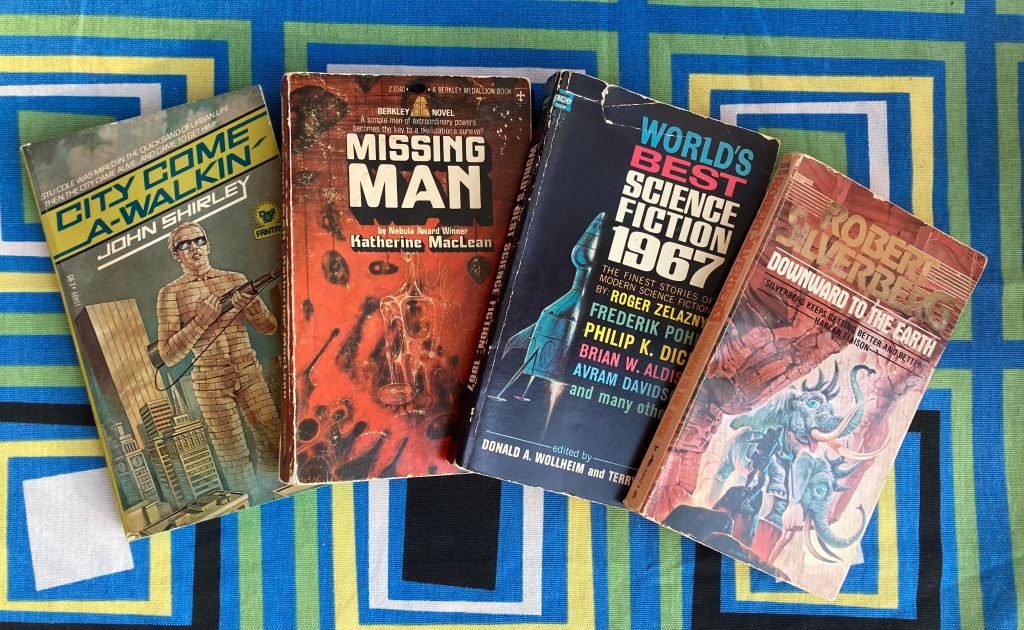
A selection of SF volumes acquired over winter break!
Which books/covers/authors intrigue you? Which have you read? Disliked? Enjoyed?
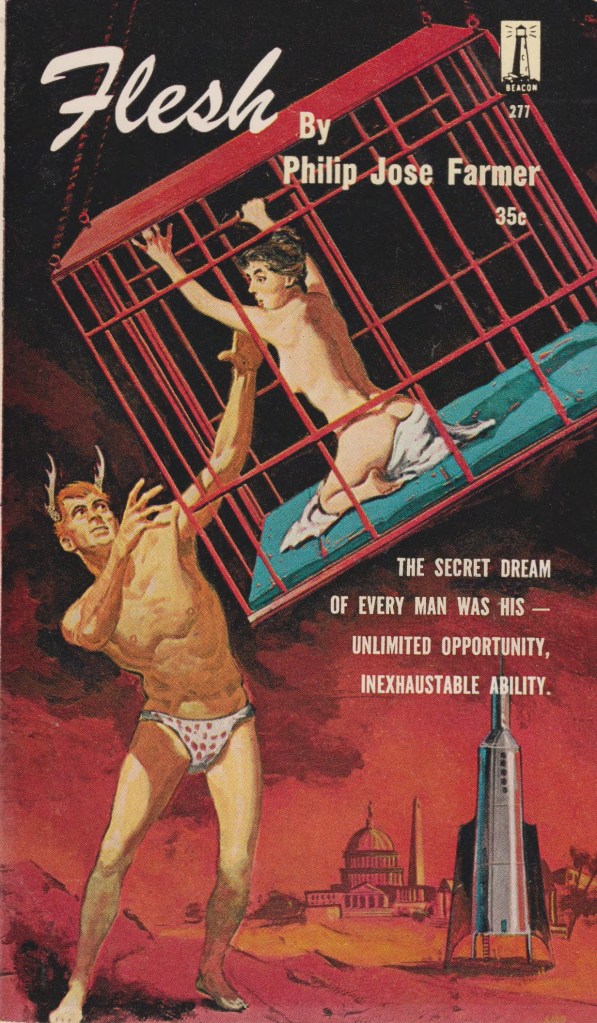
1. Flesh, Philip José Farmer (1960)
Gerald McConnell’s cover for the 1st edition
From the back cover: “Spaceman by DAY… MONSTER by night!
Peter Stagg was caught in the vilest trap ever devised–his own lust-driven body! For FLESH is the pulse-stirring story of a space explorer’s return from the strangest voyage man had ever made–to the strangest world the universe had ever seen–his own Earth!
Over the last few years, I have attempted to incorporate a smattering of the vast range of spectacular scholarship on science fiction into my reviews and highlight works with my Exploration Log series that speak to me.1 Today I have an interview with Jordan S. Carroll about his brand-new book, Speculative Whiteness: Science Fiction and the Alt-Right (2024). In the book, he examines the ways the alt-right uses classic science fiction imagery and authors to mainstream fascism and advocate for the overthrow of the state.
You can buy an inexpensive physical copy ($10) directly from the University of Minnesota Press website or an eBook version ($3.79) on Amazon.
Thank you so much for agreeing to this interview. First, can you introduce yourself and research interests?
Here’s to a happy reading in 2025! I hope you had a successful reading year. Whether you are a lurker, occasional visitor, a regular commenter, a follower on Bluesky or Mastodon, thank you for your continued support. It’s hard to express how important (and encouraging) the discussions that occur in the comments, social media, and via email are to me. This was the third year running of record-breaking numbers of viewers and views in the 13-year history of my site. What were your favorite vintage SF reads–published pre-1985–of 2024? Let me know in the comments.




 Science Fiction and Other Suspect Ruminations