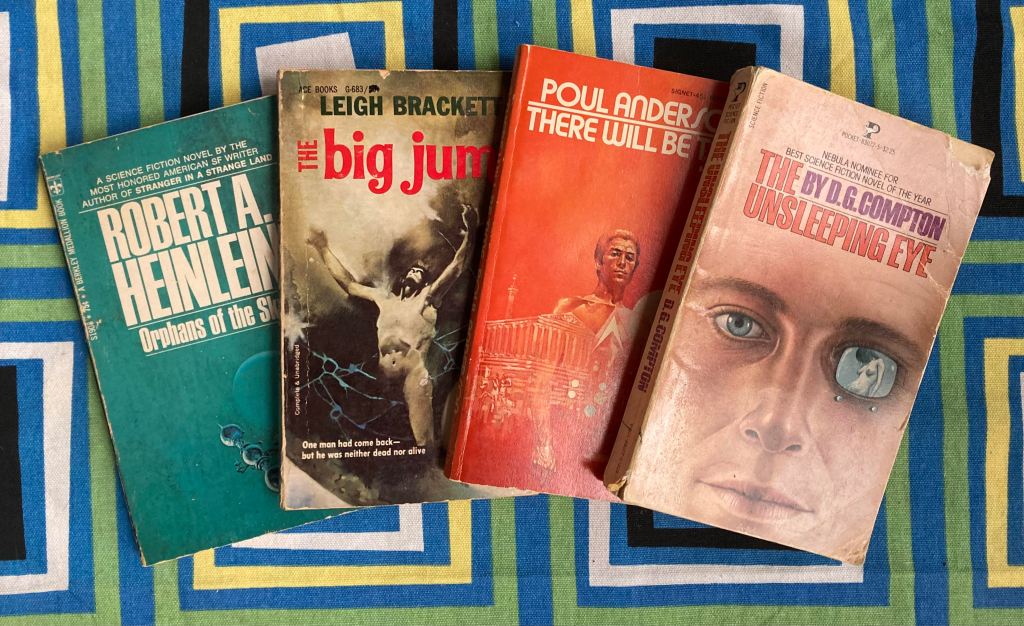
Which books/covers/authors in the post intrigue you? Which have you read? Disliked? Enjoyed?
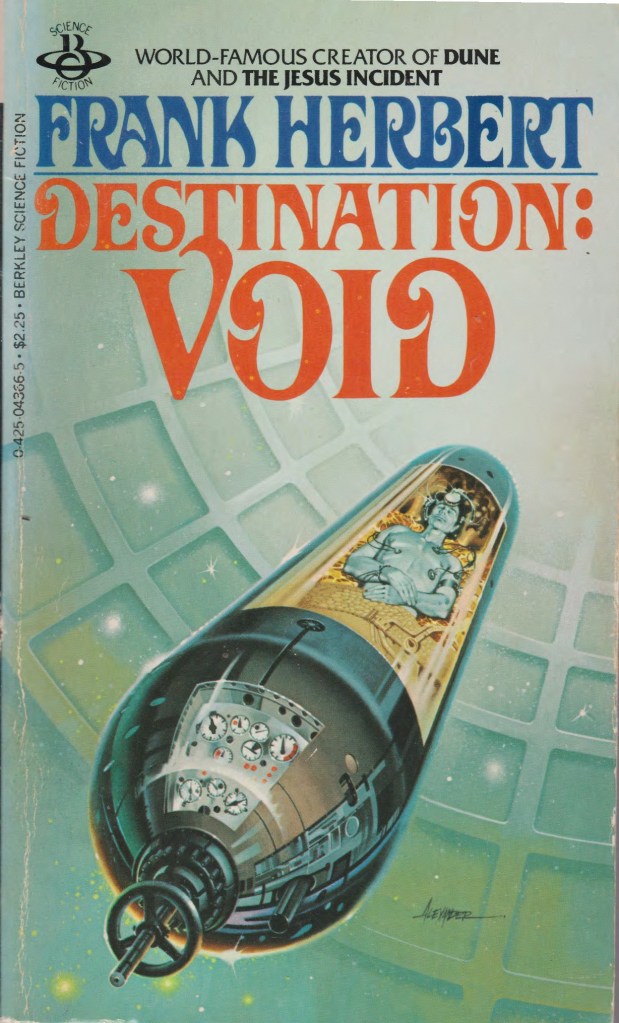
1. Frank Herbert’s Destination: Void (1966, rev. 1978)
Paul Alexander’s cover for the 1978 edition
From the back cover: “DESTINATION: VOID
THE COMPLETELY REVISED AUTHOR’S EDITION OF THE CLASSIC DEEP-SPACE ADVENTURE!
‘When the publishers announced that they were going to bring out a new edition of DESTINATION: VOID, they offered me the opportunity to make any changes I felt were necessary. Because of the tightly interwoven scientific premises behind this story and rapid development in the fields related to these premises, it would be extraordinary if discoveries across thirteen years did not dictate certain revisions.
Note: My read but “waiting to be reviewed pile” is growing. Short rumination/tangents/impressions are a way to get through the stack before my memory and will fades. My website partially serves as a record of what I have read and a memory apparatus for future projects. Stay tuned for more detailed and analytical reviews.
1. A Mask for the General, Lisa Goldstein (1987)
Mick McGinty’s cover for the 1st edition
3/5 (Average)
One of many attempts to dispel fascist gloom novels I’ve been drawn to recently, Lisa Goldstein’s A Mask for a General: A Novel (1987) imagines a deliberate retreat into the “primitive” as a way to resist. The story follows Mary, a young naive teenager desperate to strike out on her own, and her encounter with Lisa, a master mask maker. In this future, in the wreckage of the University of California, Berkeley campus (the parallel to the historical role of the university in the 60s is deliberate), various “Tribes” attempt to escape the grip of The General by wearing masks and taking on new personas detached from the present. Apparently after a series of disasters, Japan has far surpassed the United States as a technological power. Considering how the world viewed Japan in the 80s, this is not a ridiculous assumption. The General controls media and has dismantled every semblance of democratic government. Mary gets drawn into a larger, rather bizarre, attempt to influence The General that might tear down the state.
What pre-1985 science fiction are you reading or planning to read this month? Here’s the September installment of this column. I am a few days late with this post. We’ll pretend it appeared in October!
I’ve been reading the little scholarship on H. Beam Piper (1904-1964) in order to more adeptly understand his political views when I tackle his various union-related stories for my series. I was struck by the extreme poverty, impact of a memorable cover, and dependence on a responsive agent that he found himself mired in after he lost his railroad guard job and had to rely on writing. He kept himself alive by selling off his gun collection that he had accumulated over the years and eating pigeons his shot on his porch. While he doesn’t seem to have been the best with the little money that came his way, often blowing the majority of a paycheck from Campbell, Jr. on expensive suits, it’s shocking what he had to do to survive between story acceptances. Piper seems to have committed suicide in part due to his financial hardships.
Despite the fact that I can’t wholeheartedly recommend John F. Carr’s H. Beam Piper: A Biography (2008) or Typrewriter Killer (2015) as large sections take the form of haphazardly strung together journal entries with little larger historical analysis, I found Carr’s often unnervingly voyeuristic look into his life lay bare the financial realities of publishing SF, even in a moment when magazines paid well. Unfortunately, Carr leaves comments like Piper’s 1961 letter in which he states “John [Cambell, Jr.] is almost as big a fascist sonofabitch as I am — but he wants a couple of points hammered home a bit harder” un-analyzed.
And let me know what pre-1985 science fiction you’ve been reading!
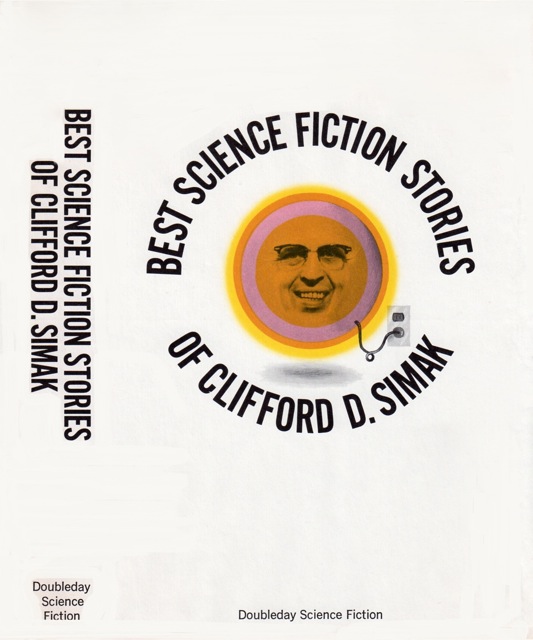
I can’t get off my Clifford D. Simak (1904-1988) kick–the author that’s defined, directly and indirectly, my 2024 reading and writing adventure. Rather than hunt for more stories on the theme of organized labor, I fished out a collection languishing in a dusty corner of my shelves instead. Best Science of Science Fiction Stories of Clifford D. Simak (1967), not to be mixed up with the later collection The Best of Clifford Simak (1975), contains seven short stories published between 1954-1963. Of the bunch, “Founding Father” (1957) ranks amongst the best of Simak I’ve read. Only one, “Lulu” (1957), should be avoided.
While I still recommend City (novelized 1952) for readers new to Simak, this collection contains a nice representative group of stories from those nine years.
Short Summaries/Analysis
“Founding Father” (1957), 4.75/5 (Very Good). First appeared in Galaxy Magazine, H. L. Gold (May 1957). You can read it online here.
For a large portion of the year, I’ve been collecting evidence on unions in post-WWII to very early 60s American science fiction.1 To be clear, I am not on the hunt for the best by these authors. This project is about stories that reference unions. I will read all the stories I can by American SF authors on the topic during this timeframe for this project in order to understand how authors responded to the historical moment in which they lived. Exciting!
A Bit of Historical Context
During the Great Depression, there was broad consensus among leftist thinkers that the labor movement would lead to radical change. The Second World War and the economic recovery shattered that consensus.2 The unions themselves underwent substantial transformation in this period. American corporate powers and their conservative congressional allies unleashed a “propaganda campaign” against the labor movement.3 This culminated in the contentious passage of the Taft-Hartley Act (1947), which weakened the ability of unions to strike. Over the course of the 1950s, automobile manufacturers and their unions pioneered a new relationship—adopted by other industries—in which companies agreed to grant wage increases, health care, and retirement plans in return for union support of long-term contracts. Increasingly, the political and social transformation of capitalism became secondary to preserving their organizations and maintaining a harmonious relationship with industry.4
Before World World II, anti-capitalist intellectuals imagined the labor movement as the American Proletariat which would, at any moment, transform the capitalist system. After WWII, they struggled to grapple with an economic system they had expected to collapse and the lack of interest in socialism within American unions.5 C. Wright Mills (1916-1962) argued labor had been co-opted by state power.6 Those that continued to support elements of the labor movement, such as Sidney Lens (1912-1986), struggled to rationalize labor’s part in the militarization of Cold War America.7 The one-time Trotskyist, Seymour Martin Lipset (1922-2006), argued that while the labor-movement fell short of representing the “class-based aims of a unified working class” it continued to play a roll in “prohibiting antidemocratic mass movements” by offering workers a role in a “mediating institution.”8 Most involved in the 60s New Left abandoned labor completely as a force for change and grouped unions as part of the liberal establishment, irrelevant in the construction of a new radicalism.9 As in, trade unions “focused on material gains, not fundamental social change.”10
Science fiction written in the post-WWII world likewise reflected outright criticism, deep ambivalence, and confusion over the role of the labor movement. Philip K. Dick’s “Stand-By” (1963) satirizes unions and the media in a post-scarcity world but tentatively suggests conflict between both might lead to the overthrow of a ruling computer and the eventual reemergence of democracy. Milton Lesser’s “Do It Yourself” (1957), one of only a handful unabashedly positive accounts on unions in the 50s, imagines a post-apocalyptic future in which the American individualist ethos reigns supreme. While banned and publicly ridiculed, a union secretly sends out agents to facilitate the rebuilding project. And in H. Beam Piper and John J. McGuire’s “Hunter Patrol” (1959), a ragtag group of disaffected, including a union man (an object of jest), attempt to recruit a soldier from earlier in time to overthrow a dictator. More than a few 50s authors, like Robert Silverberg (whom I’ll feature in a later post) and Clifford D. Simak, read and engaged with contemporary writers on the labor movement.11
Let’s get to the stories!
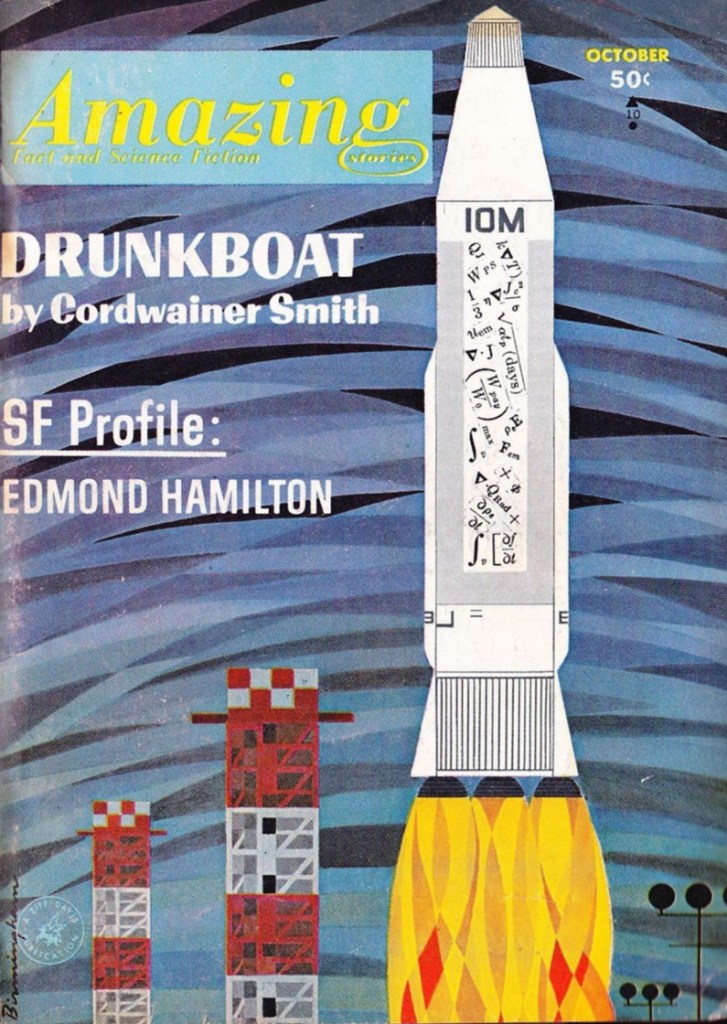
Lloyd Birmingham’s cover art for Amazing, ed. Cele Goldsmith (October 1963)
2.75/5 (Bad)
Philip K. Dick’s “Stand-By” first appeared in Amazing Stories, ed. Cele Goldsmith (October 1963). You can read it online here.
What pre-1985 science fiction are you reading or planning to read this month? Here’s the August installment of this column.
I often think back to how I got hooked on science fiction. As I have mentioned many times before, I primarily read fantasy–in particular every bloated Tolkein ripoff I could get my hands on–before I moved to science fiction in my late teens. Tad Williams’ fantasy trilogy Memory, Sorrow & Thorn (1988-1998) holds special significance. While looking for other fantasy titles by Williams at the local used book store, I stumbled across his equally bloated four-volume SF sequence Otherland (1996-2001). And so the slow shift began… I had read other science fiction but nothing hooked me quite like Otherland. It’s one of those works that I plan on never rereading—the spell would break.
Ted White (1938-) took over as editor of Amazing Science Fiction and Fantastic from Barry N. Malzberg in October, 1968. As the magazines were bi-monthly and Malzberg had already acquired stories for multiple later issues, White’s first issues appeared in 1969. He’d accepted the position on the condition that he phase out the reprints (not acquired by White) slowly over multiple years.1 Apparently while White was not a fan of the New Wave movement, he “was all for more daring fiction exploring adult themes and saw no reason why these stories could not co-exist alongside more traditional stories.”2 Thus, his two magazines attempted to appeal to a wide-range of readers.
By the early 1970s, White demonstrated growing interest in even “greater liberalization of science fiction, in line with what was happening to youth nationwide.” He saw SF as “a vehicle to push back on the barriers of the ‘establishment’, with no suppression of soft drugs, ‘healthy sex,’ or free expression.”3 His magazines included stories emphasizing future sex in all its forms” far more frequently than its competitors.4 As the pay rates of both magazines were low–White could only pay 1 cent a word vs. 3 cents for the bigger magazines of the day–he attempted to appeal to writers who did not mesh well with the “establishment.”5
White did not earn a living wage as the editor despite the magazines consuming much of his time. In order to cobble together a meager living he also served as art director (which included cutting and pasting each issue) and wrote stories to publish in his own magazines!6 White’s first professional stories appeared in 1962 after a decade of fan writing.
This post includes three of White’s own violent and bleak visions of future society that appeared in Amazing and Fantastic. While he might not have been a fan of the experimental tendencies of the movement, his obsession with violating taboos, scenes of urban decay, and general miasmic gloom are certainly on display.
I am increasingly fascinated by the more radical, bleak, and grimy stories within White’s magazines–both from his pen and others–and plan on exploring more. See my earlier reviews of Lisa Tuttle’s “Stone Circle” (1976) and Grania Davis’ “New-Way-Groovers Stew” (1976).
Let’s get to the stories!
Jeff Jones’ cover for Amazing Science Fiction, ed. Ted White (May 1971)
My article on organized labor in the 1940s and ’50s science fiction of Clifford D. Simak went live! I’d love to hear your thoughts. I’ve spent the last half year researching and reading religiously for this project–from topics such as Minnesota’s unique brand of radical politics to the work of contemporary intellectuals like C. Wright Mills (1916-1962) whom Simak most likely read.
Please check out the complete issue edited by Olav Rokne and Amanda Wakaruk over at Journey Planet. I have also embedded the PDF below.
The issue contains great work on the depiction of labor rights in a vast variety of other SF mediums. There are four articles that touch on vintage SF. The first two listed are by wonderful community members and official “Friends of the Site.”




 Science Fiction and Other Suspect Ruminations